Auchencar Standing Stone
A blade of red sandstone, five metres tall and thinner than a hand, standing where stone was born for Machrie Moor
Understand sacred places, explore living traditions, and learn how to engage respectfully with Pilgrim Map.
Access has not been verified. Check current local guidance before planning a visit.
Machrie, Scotland, United Kingdom
Read the sources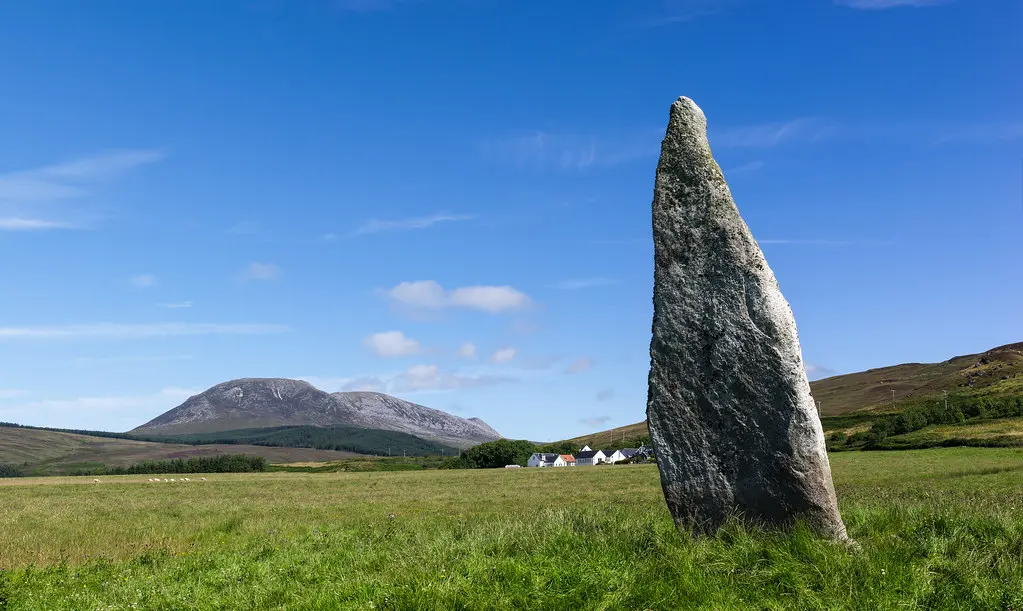
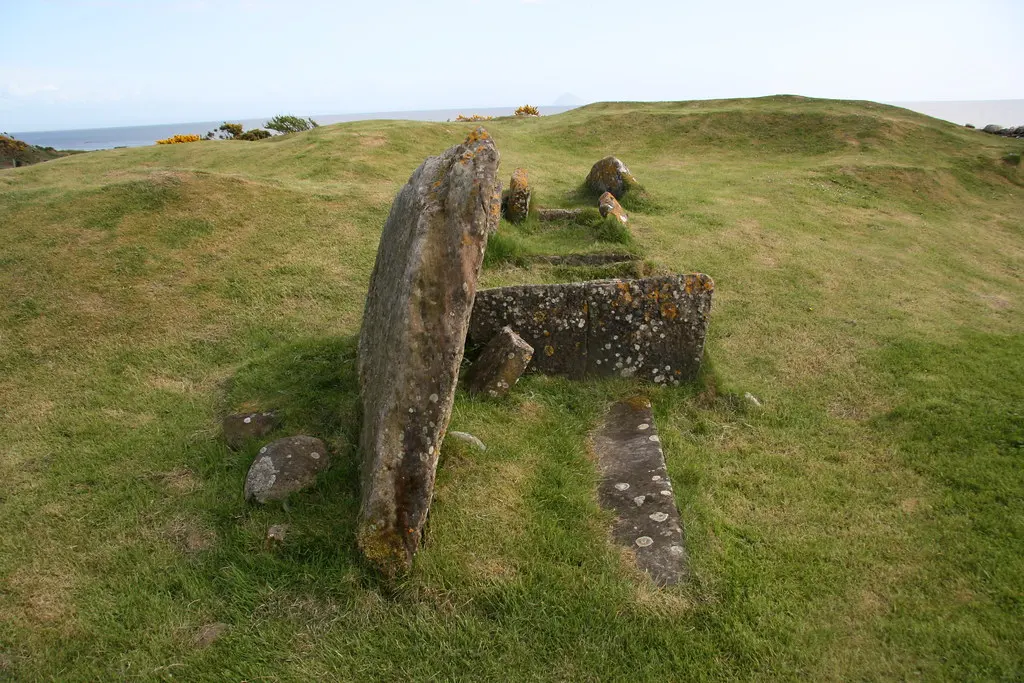
Image of Auchencar Standing Stone. Image source
Visit essentials
A quick read before you go
- Duration
- 1 hour including approach walk and contemplation
- Etiquette
- Seek permission from the farmer.
Overview
Auchencar Standing Stone impresses through almost impossible thinness. Rising five metres from a sheep field on Arran's west coast, this red-sandstone blade is scarcely thirty centimetres thick, tapering from a base nearly two metres wide to a knife-like point. Against Machrie Bay it appears carved as deliberately as it was erected. A fallen companion, now broken in two, was originally about eight metres long; the pair may have belonged to a circular setting, though only this stone remains intact.
Five thousand years of wind and rain have covered it in grey-green lichen without erasing the form. Aubrey Burl, a foremost authority on British stone circles, identified Auchencar as a possible quarry source for Machrie Moor's red-sandstone circles five kilometres south. If correct, this field produced material for one of Scotland's greatest prehistoric sacred landscapes, and the stone may have marked that origin or stood sentinel between quarry and ceremony.
Visible far offshore as a thin line against rounded hills, it may have announced sacred territory to arrivals by coracle or currach while linking farm and shore to Machrie Moor's circles and alignments.
Why this place is sacred
What is it about certain places that stops time? At Auchencar, it may be the sheer improbability of the stone. Standing beside it, you become aware of its proportions in a way that photographs cannot convey. The stone is taller than most rooms, wider than your outstretched arms at the base, yet thinner than your hand. Someone shaped this.
Someone chose this particular piece of red sandstone, worked it into this particular form, and raised it here, on this particular slope overlooking Machrie Bay, where the mountains of central Arran rise behind and the Atlantic stretches westward toward Ireland and beyond. There is no interpretation panel. No visitor centre explains the stone's significance. No gift shop sells miniature replicas.
You arrive at the field by walking up a farm track, crossing a stile, and entering a world where sheep graze around a monument older than the pyramids. The fallen companion stone lies nearby, broken but enormous, a reminder that time undoes even the most enduring materials. The standing stone persists as if by stubbornness, its thin edge turned to the prevailing winds like a sail set against five millennia of Atlantic weather.
Research suggests that around 2000 BC, the star Arcturus would have skimmed along the summit of Beinn Bharrain, visible due north from this spot. Whether or not the stone was intentionally aligned to mark this stellar event, standing here at night one inhabits the same sky that the stone's builders knew. The constellations have shifted, but the stone has not.
The stone likely served multiple purposes within the prehistoric sacred landscape of western Arran. Its prominent visibility from both land and sea suggests it functioned as a landmark and territorial marker. The possible astronomical alignment with Arcturus and Beinn Bharrain indicates it may have served as an observation point for stellar events. Its identification as a possible quarry source for Machrie Moor connects it to the ritual preparation and transportation of sacred materials.
The fallen companion and possible circular setting suggest ceremonial use beyond simple waymarking.
The stone was erected between approximately 3800 and 2500 BC by Neolithic or Early Bronze Age communities. At some unknown point, the companion stone fell and broke into two pieces. The site acquired the name 'Druid' in the 18th or 19th century, reflecting romantic antiquarian associations rather than historical fact. The stone was recorded by early antiquarians and eventually listed as a scheduled ancient monument by Historic Environment Scotland (Canmore ID 39210).
Aubrey Burl's identification of Auchencar as a quarry source for Machrie Moor brought new scholarly attention to the site. Today it stands in agricultural land near Auchencar Farm, visited by those who know to seek it out.
Experience and orientation
You reach the Auchencar Standing Stone by turning off the A841 coastal road between Machrie and Dougarie, on the west coast of Arran. A narrow lane leads uphill toward Auchencar Farm. Park near the beach at Machrie Bay if the lane is too narrow, and walk. Ask the farmer for permission to enter the field. Cross the stile, and there it is.
The stone appears first as a dark vertical line against the sky, its thinness making it almost disappear when seen edge-on. As you approach, the proportions become clear. This is not a squat boulder dragged into position. This is a shaped blade of red sandstone, worked to a taper that would not look out of place among the standing stones of Callanish in the Outer Hebrides, a thousand miles to the north. Stand at the base and look up.
The stone leans slightly, as if the wind of millennia has bent it. Touch the surface and feel lichen over sandstone, cool even in summer, rough under the fingertips. The texture is honest, the stone wearing its age without concealment. Walk around to the fallen companion. Here is the other half of whatever this setting once was, broken and recumbent, partially covered in turf.
Its eight-metre original length suggests that when both stones stood, the pair would have been remarkable even by the standards of a landscape crowded with prehistoric monuments. From the stone, look south. Five kilometres in that direction, the stone circles of Machrie Moor rise from the peat. If Burl was right that the red sandstone for those circles came from here, you are standing at the origin point, the quarry where the sacred was carved from the earth.
Look west over Machrie Bay, where the Atlantic meets the shore. Look north to the mountains. This is threshold landscape, where the domestic world of farming meets the wild space of mountain and ocean, and where a single stone has stood for five thousand years to mark the boundary.
The stone stands in a field near Auchencar Farm, accessible via a stile from the farm track. The standing stone is the upright blade visible from the track. The fallen companion lies approximately 4.5 metres to the southeast. Views extend west over Machrie Bay and north toward Beinn Bharrain.
Context and lineage
Between five and six thousand years ago, on a slope overlooking the western coast of Arran, people chose a piece of red sandstone and shaped it. They worked it into a form unlike the typical standing stones of the island, creating instead a tall, thin blade that rose to a sharp point.
They raised this blade in a field above Machrie Bay, where it could be seen from the sea and from the mountains, and where it would stand as a marker in a landscape already rich with sacred meaning. Five kilometres to the south, across the moorland, they were building stone circles from the same red sandstone.
Aubrey Burl, who spent a lifetime studying these circles, came to believe that the stone at Auchencar came from the same geological source, and that this field may have been the quarry from which the circles of Machrie Moor were born. Whether the standing stone marked the quarry, guarded it, or served some entirely different purpose in the ceremonial life of western Arran, no one can now say with certainty.
What is certain is that the stone has outlasted everything else. The companion stone fell and broke. Whatever setting the two formed has been lost. The people who raised them left no written record. But the blade of red sandstone still stands, thinner than a hand, taller than a house, five thousand years into its vigil over Machrie Bay.
The Auchencar Standing Stone exists within the wider prehistoric ritual landscape of western Arran, which includes the Machrie Moor stone circles (six circles with over 40 individual monuments), the Auchagallon stone circle, and numerous burial cairns and standing stones scattered along the coast. This landscape was in active ceremonial use from approximately 3500 to 1500 BC, a span of two thousand years.
Aubrey Burl
Traditions and practice
Unknown specifically. The possible astronomical alignment with Arcturus and Beinn Bharrain around 2000 BC suggests seasonal or stellar observation. The quarry connection to Machrie Moor implies the site may have been associated with the ritual preparation and transportation of sacred materials. The stone's visibility from the sea suggests it served as a landmark for maritime approaches.
Personal pilgrimage and contemplative visits. Walking between Auchencar and Machrie Moor, tracing the possible quarry route. Photography of the stone's distinctive silhouette. The stone appears in walking guides and megalithic site databases for those exploring Arran's prehistoric landscape.
Walk from Machrie Bay rather than driving to the farm, if conditions allow. The approach by foot connects you to the landscape in a way that driving cannot. Spend time with both the standing stone and its fallen companion. Walk around the standing stone to see how its form changes from blade-edge to broad face. If conditions and season permit, visit in the evening to see the stone silhouetted against the western sky over Machrie Bay.
Consider combining the visit with a walk to Machrie Moor, five kilometres to the south, to experience the full arc of the sacred landscape.
Neolithic/Bronze Age sacred landscape
HistoricalThe stone was erected as part of a sacred landscape that encompassed western Arran from approximately 3800 to 1500 BC. Its possible role as a quarry marker for Machrie Moor and its astronomical alignment with Arcturus suggest complex ceremonial and observational functions.
Astronomical observation, landmark and waymarking, possible ritual quarrying of sacred stone. Specific ceremonial practices are unknown.
Contemporary contemplative visiting
ActiveThe stone attracts visitors seeking unmediated encounter with prehistoric monuments, away from the more accessible and better-known Machrie Moor.
Walking pilgrimage, contemplation, photography. Some visitors walk the route between Auchencar and Machrie Moor, tracing the possible quarry path.
Perspectives and open questions
The Auchencar Standing Stone occupies a distinctive position in Arran's prehistoric landscape as both a monument in its own right and a possible origin point for the Machrie Moor sacred complex.
Scholarly perspective
Aubrey Burl's identification of Auchencar as a potential quarry source for the red sandstone circles at Machrie Moor remains the most significant scholarly contribution to understanding this site. The theory has not been conclusively proven through geological analysis but is widely cited. The stone's form, described as unusual for Arran and reminiscent of the thin, pointed standing stones of the Outer Hebrides at Callanish, has raised questions about inter-island cultural connections in the Neolithic.
The possible astronomical alignment with Arcturus and Beinn Bharrain, noted by researchers using astronomical software to reconstruct the sky of 2000 BC, adds a potential observational dimension. The stone is listed as Canmore ID 39210 and is a scheduled ancient monument.
Living and traditional perspectives
The name 'Druid' reflects 18th and 19th century romantic associations between standing stones and druids, a common pattern across the British Isles. The historical druids postdate the stone by at least two thousand years. Local tradition has associated the stone with the landscape of western Arran without attributing specific folklore or legends to it.
Alternative interpretations
Some visitors and writers interested in earth energies and sacred geography see the stone's prominent position between mountain and sea as indicating its placement on an energy line. The connection to Machrie Moor is sometimes interpreted as evidence that the quarrying and transportation of sacred stone was itself a ritual act, transforming raw material into sacred objects through journey.
Open questions
Whether the standing stone and fallen companion formed part of a circular setting has not been confirmed. The exact geological relationship between the Auchencar sandstone and the Machrie Moor circles requires further analysis. The nature of the possible Arcturus alignment and whether it was intentional remains unresolved. The cultural connections suggested by the stone's Callanish-like form are intriguing but unexplored. Why the companion stone fell, and when, is unknown.
Plan your visit
Access and arrival
The Isle of Arran offers accommodation in Brodick, Lamlash, Whiting Bay, and smaller villages. Self-catering cottages near Machrie provide the closest base. The island has hotels, B&Bs, a hostel, and campsites. Book ferry and accommodation well in advance during summer months.
Respectful visit
Sturdy footwear suitable for walking in fields, which can be muddy. Waterproof layers for Scottish weather.
Freely permitted. The stone photographs well from all angles, especially silhouetted against the western sky.
None should be left. The stone is a scheduled ancient monument in a working field.
The stone is a scheduled ancient monument; any disturbance is illegal. The field is private agricultural land. Access may be limited during lambing season.
The stone stands in a field with sheep. Close gates. Seek permission from the farmer at Auchencar Farm before entering. Avoid visiting during lambing season (typically March-May) unless given explicit permission.
Current practical details
Address
Auchangallon Jetty, Isle of Arran KA27 8DZ, UK
Hours
Hours, fees, and access can change — verify on the official source before you travel. Practical details last checked Jun 2026.
Location
Map loads as you approach this section.
Pilgrim reflections
A portrait of encounter, not a score
Pilgrims describe what they felt, how present they could become, and whether the place would shape a journey. There are no stars and no ranking of traditions.
No reviewed reflections yet
The first pilgrims can help describe the character of being here.
Share a reflection
Available after an account-backed “Been there.” Every reflection is reviewed before publication.
Nearby sacred places
Explore other sacred places in the region. Proximity does not establish access or travel time; check each place’s guidance.
References
Sources consulted for this page. Source categories describe the publication, not a guarantee that every claim is verified. Traditional accounts and outside interpretations may differ.
- 01Arran, Druid - Standing Stone (Prehistoric) - Canmore — Historic Environment Scotland / CanmoreSource contextNational Record of the Historic Environment with site details and grid reference
- 02Machrie Moor Standing Stones: History - Historic Environment Scotland — Historic Environment ScotlandofficialOfficial heritage body with information on the wider Machrie Moor sacred landscape connected to Auchencar
- 03Auchencar [Druid] Standing Stones - The Megalithic Portal — The Megalithic PortalacademicSpecialist megalithic database with coordinates, dimensions, astronomical alignment data, and visitor ratings
- 04Druid Auchencar - Isle of Albion — Isle of AlbionacademicSpecialist sacred sites database with detailed descriptions
- 05Standing stones, 170m north west of Druid Barn - Ancient Monuments UK — Ancient Monuments UKSource contextScheduled monument database entry
- 06Druid Auchencar - The Modern Antiquarian — The Modern AntiquarianacademicSpecialist antiquarian site with visitor accounts
- 07Machrie Moor Stone Circles - Wikipedia — Wikipedia contributorsencyclopediaComprehensive overview of the Machrie Moor complex with references to Auchencar as a quarry source
- 08Auchencar Druid Standing Stone, Arran - Britain Express — Britain ExpressguideVisitor-oriented guide with historical context and access information
- 09Druid Auchencar Standing Stone - Arran Online — Arran OnlineguideLocal tourist information with access details
- 10Standing Stones - Visit Arran — Visit ArranofficialOfficial Arran tourism information with dating and context
Share a photo
Help visitors recognize Auchencar Standing Stone. Every submission is reviewed before publication.