La Table des Marchands, Locmariaquer, France
A six-thousand-year-old passage grave whose capstone once crowned the world's tallest standing stone
Understand sacred places, explore living traditions, and learn how to engage respectfully with Pilgrim Map.
Access has not been verified. Check current local guidance before planning a visit.
Locmariaquer, Morbihan, France
Read the sources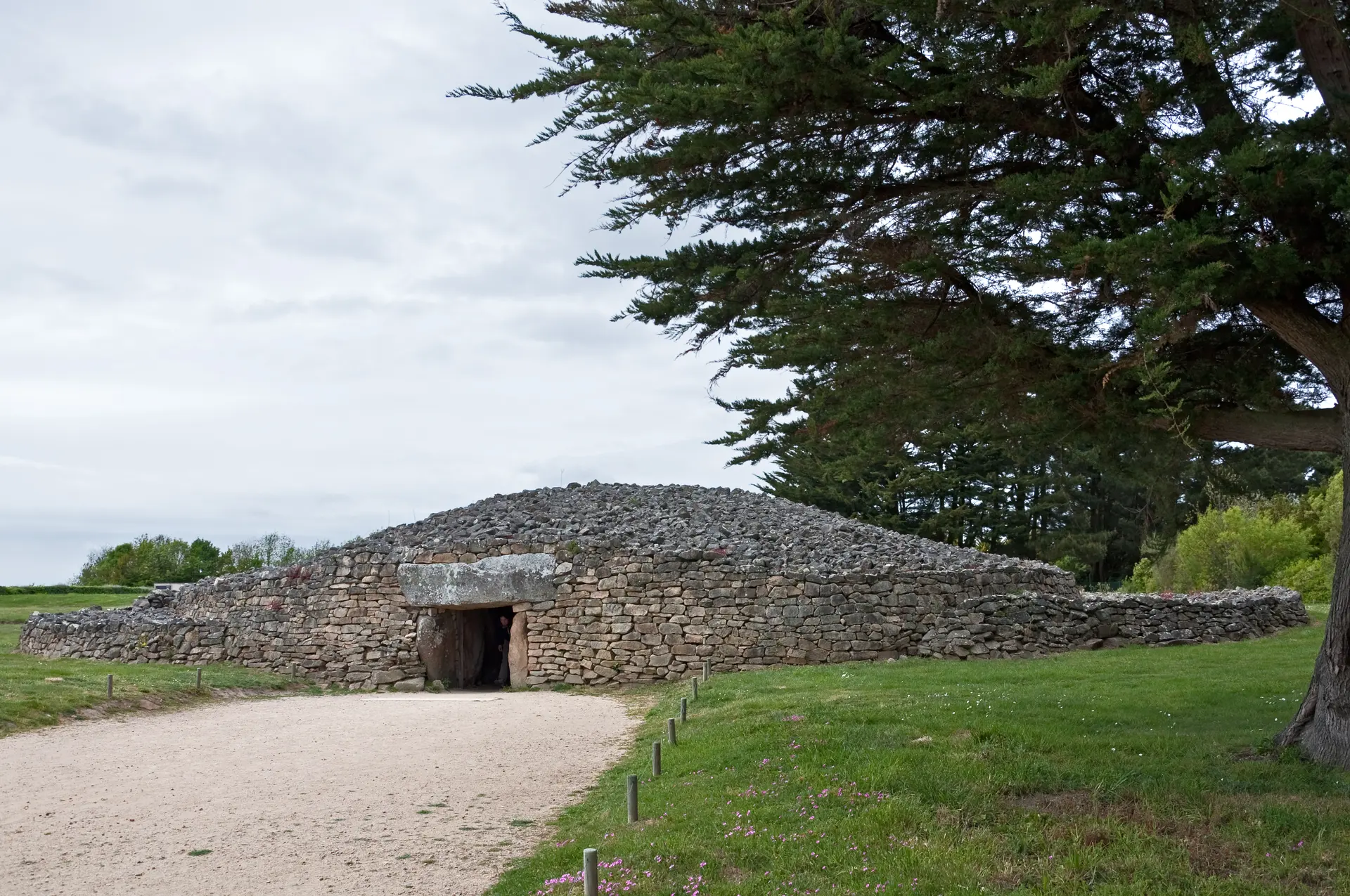
Image of La Table des Marchands, Locmariaquer, France. Image source · CC-BY-SA-3.0
Visit essentials
A quick read before you go
- Duration
- One to two hours for the full site, including La Table des Marchands, the Grand Menhir Brise,…
- Access
- Route de Kerlogonan, 56740 Locmariaquer, France.
Overview
La Table des Marchands' forty-tonne capstone bears carvings fifteen centuries older than the pyramids. When the Grand Menhir Brise—the largest standing stone prehistoric people ever erected—fell or was toppled around 4000 BCE, its fragments were deliberately redistributed: one roofed this chamber, another crossed to Gavrinis, with matching breaks and continuous carvings. This passage grave's corridor enters a chamber for the dead; its reconstructed earthen cairn restores a mound facing the Gulf of Morbihan.
Bodies and offerings expressed beliefs only partly recoverable. The capstone's axe and ox-drawn plough were meaningful signs of power, agriculture, life-sustaining technologies, and possible continuity or provision between living and dead. The Morbihan coast holds Earth's densest megalithic concentration; La Table des Marchands stands with the fallen Grand Menhir and Er Grah's long tumulus. Though now protected and interpreted as heritage, the stones remain testimony to what mattered to people who left no other belief record.
Why this place is sacred
Passage graves are not accidentally thin. They were constructed to create threshold space, the transition between ordinary ground and the chamber where the dead would rest. The corridor at La Table des Marchands narrows as it extends, limiting light, requiring visitors to move from brightness into increasing darkness before the chamber opens.
The orientation is intentional, though its exact significance is debated. Some passage graves align with winter solstice sunrise, when light penetrates the corridor for the first time in the year. Whether La Table des Marchands shares this alignment has been studied but not definitively established. What is clear is that the builders placed the entrance with purpose, embedding the monument within a larger understanding of landscape and sky.
The recycling of the Grand Menhir fragments adds another dimension. The menhir had stood for perhaps a century as the terminus of a nineteen-stone alignment, the largest single stone ever moved and erected by Neolithic peoples. When it fell, the community did not abandon it but incorporated its pieces into new monuments, extending its significance into new forms. The capstone of La Table des Marchands is part of that continuation.
The carvings on its underside were made when the stone stood upright; they now look down on whoever enters the chamber.
Visitors today follow the same path that mourners followed six thousand years ago. The darkness is the same darkness. The weight of stone overhead is the same weight. Whatever beliefs animated the original builders, the architecture they created continues to produce the effects they intended: the sense of crossing a threshold, of standing in a space set apart from ordinary life, of proximity to the dead.
Archaeological evidence indicates that La Table des Marchands served as a collective burial site for multiple individuals over an extended period. The passage design allowed for additional interments without disturbing earlier burials. The carved capstone and the elaborate cairn construction suggest that this was not merely practical disposal of remains but meaningful ritual: honoring the dead, maintaining relationship with ancestors, perhaps ensuring their ongoing role in community life.
The cairn that originally covered the monument eroded over millennia, eventually leaving only the massive capstone balanced on its uprights, resembling a table and giving rise to the name. Romans excavated the chamber in antiquity. The monument was classified as a historic site in the late nineteenth century. Between 1980 and 1993, major archaeological work culminated in the reconstruction of the cairn, restoring something of the monument's original appearance while preserving the accessibility that erosion had created.
Experience and orientation
The cairn rises from the grass, reconstructed to approximate its original form: an earthen mound covering the stone chamber within. The entrance is low, requiring attention as you step inside. Almost immediately, the quality of light changes. The corridor extends ahead, stone walls closing in, the sky now a memory rather than presence.
The chamber opens at the corridor's end. Here, the forty-tonne capstone reveals its carvings: the axe, the plough and oxen, symbols of power and sustenance placed above the dead. These carvings were made when the stone stood upright as part of the Grand Menhir. Now they face downward, witnessing whoever enters as they once witnessed the sky.
The scale of the engineering is difficult to absorb. This stone was moved without metal, without wheels, without written planning. Hundreds of people worked together over extended periods, motivated by beliefs strong enough to demand such effort. Standing beneath their work, you stand beneath that motivation as much as beneath the stone.
Visitors often describe a quality of presence in the chamber that differs from the exterior. The acoustics are strange, sound behaving differently within the enclosed space. Temperature remains cool regardless of season. The knowledge that human remains once occupied this space, that this was a place of death and ritual, adds dimension that purely aesthetic appreciation cannot capture.
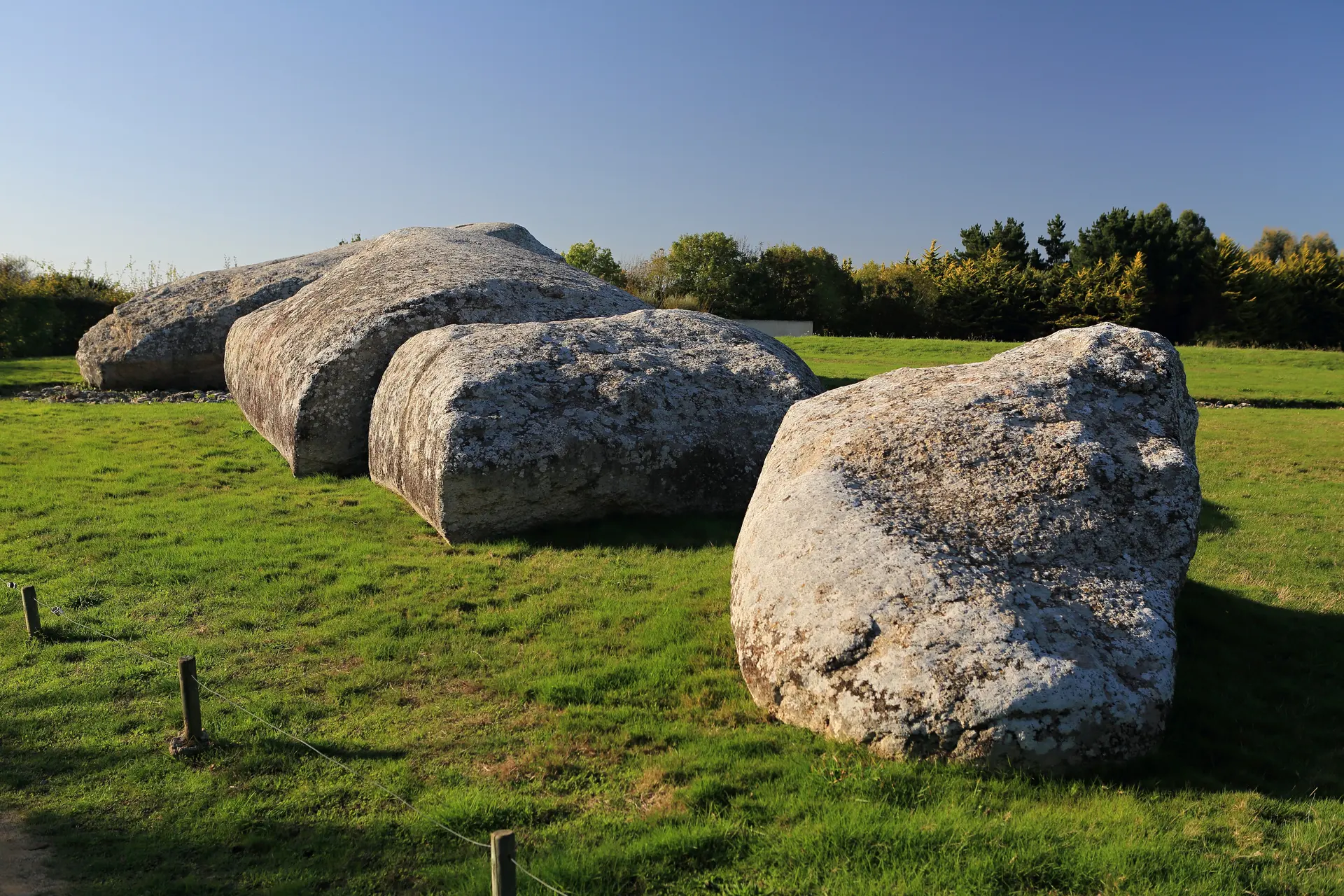
The relationship to the nearby Grand Menhir becomes visible from within. The broken fragments lie nearby, part of the same managed site. Seeing them, understanding that piece of one now shelters you, creates connection across time that maps do not convey.
Approach the site with awareness that you are entering a burial space. This was not abstract architecture but a place where community members placed their dead. Whatever you believe about what happens after death, entering here means entering a space designed to honor that transition.
Take time in the chamber before photographing. Let your eyes adjust to the darkness. Look up at the carvings that have looked down for six millennia. Consider what it meant to the builders that this stone had once stood as the largest menhir ever erected, and now it served a different purpose. The recycling was not waste management but ritual transformation.
After the chamber, visit the Grand Menhir fragments nearby. The connection between them becomes real when you have been under the capstone and then stand beside the pieces that remain.
Context and lineage
The capstone tells a story of transformation. Around 4700 BCE, Neolithic communities erected the Grand Menhir Brise as the terminal stone in an alignment of nineteen giants. For a century or more, it stood as the largest stone ever moved and erected by human hands. Then, around 4000 BCE, the alignment was toppled. Whether by earthquake, by deliberate ritual, or by structural failure remains unknown.
The breaking of the Grand Menhir did not end its significance. Fragments were transported to new locations and incorporated into new monuments. The capstone of La Table des Marchands carries half of a carved design; the other half is found on a stone at the tumulus of Gavrinis, accessible only by boat on a nearby island. The break lines match precisely.
The builders of these two monuments knew what they were doing: extending the sacred power of the broken menhir into new forms, connecting multiple sites through shared material.
The monument was used for burials for an unknown period, perhaps centuries. Eventually, interments ceased, though whether the site retained ritual significance afterward is not documented. The cairn eroded, leaving the capstone exposed. Romans excavated the chamber in antiquity, removing any contents that might have remained. Modern archaeological work in the 1980s and 1990s established the monument's relationship to the Grand Menhir and restored the cairn.
The site is now managed as heritage by the Centre des Monuments Nationaux, receiving visitors from around the world.
The Ancestors
spiritual
Those interred in the passage grave, whose identity is unknown but whose presence gave the monument its meaning. The design allowed for ongoing relationship between living and dead, with the passage enabling periodic access.
The Builders
historical
The Neolithic communities of the Morbihan region who constructed this monument without metal, writing, or wheels. Their engineering achievement and the beliefs that motivated it remain partly accessible through what they built.
Traditions and practice
The Neolithic communities who built La Table des Marchands practiced collective burial, placing multiple individuals in the chamber over time. Archaeological evidence suggests offerings accompanied the dead, though specifics are not recoverable from this site. The passage design allowed for periodic reopening and additional interments, indicating ongoing relationship between living community and deceased members.
The carved symbols on the capstone, the axe and plough, suggest beliefs connecting tools, power, and the afterlife. Whether the dead required these symbols, or whether the living made statements about status and sustenance, cannot be determined. What is clear is that burial was not disposal but ritual, embedded in beliefs about what happened to the dead and what the living owed them.
Visitors tour the site with interpretation materials provided by the Centre des Monuments Nationaux. Entering the passage grave is permitted and encouraged; the reconstructed cairn allows direct experience of the monument's interior. Educational programs explain the archaeological context and the relationship to nearby sites.
No formal spiritual practices are scheduled or encouraged. However, the nature of the space invites contemplation. Many visitors sit in silence within the chamber, allowing the weight of ancestry and the reality of mortality to become present.
Enter the passage grave slowly, allowing your eyes to adjust to decreasing light. Stop before entering the chamber and consider what it meant to bring a body through this corridor six thousand years ago. The threshold you cross was designed as threshold.
In the chamber, look up at the capstone. The carvings above you were made when this stone stood upright as part of the world's tallest menhir. Now it shelters the dead, transformed but not diminished. Consider what transformation of your own material might serve, what you hope will be done with what remains of you.
Before leaving, sit with the dead. They are long gone, their remains removed by Romans two millennia ago. But the space was made for them, and something of that intention persists. Your presence joins theirs, briefly, in the chamber built to hold them.
Neolithic Burial Practice
HistoricalLa Table des Marchands represents the burial practices of Neolithic farming communities in the Morbihan region. The passage grave design, the decorated capstone recycled from the Grand Menhir, and the cairn covering all indicate a community that invested extraordinary effort in honoring their dead. Collective burial over extended periods suggests ongoing relationship between living and ancestors.
Collective burial in the chamber. Passage design allowing for additional interments over time. Carved symbols of axe and plough suggesting beliefs about power, agriculture, and the afterlife. The specific rituals accompanying burial are not documented but were clearly elaborate given the monument's scale.
Perspectives and open questions
La Table des Marchands invites multiple interpretations without demanding resolution. Archaeological science, ancestral reverence, and contemporary contemplation each offer genuine access to what this monument means and what it continues to offer.
Scholarly perspective
Archaeological consensus places the monument's construction around 4000 BCE, making it contemporary with or slightly later than the breaking of the Grand Menhir alignment. The passage grave design is characteristic of the Morbihan megalithic tradition, with parallels throughout Atlantic Europe. The relationship between the decorated capstone and the fragment at Gavrinis has been confirmed through detailed analysis of the carvings and break patterns.
The site represents the mature phase of Morbihan megalithic culture, when communities invested enormous labor in monuments for their dead.
The exact meaning of the axe and plough carvings remains debated. Some scholars interpret them as status symbols marking the burials of important individuals. Others suggest agricultural symbolism connecting death to fertility cycles. The relationship between astronomical alignments and monument orientation has been proposed but not definitively established for this site.
Alternative interpretations
Earth-energy practitioners identify the Morbihan megalithic complex as a major power center, with La Table des Marchands functioning as a node in a network of sacred sites. The deliberate breaking and redistribution of the Grand Menhir is sometimes interpreted as ritual killing of a powerful standing stone, its energy redistributed through the fragments to new monuments.
From this perspective, the passage grave is not merely a tomb but an energy chamber, designed to concentrate and transmit forces that contemporary science does not measure.
Open questions
The exact meaning of the axe and plough carvings remains uncertain. Why the Grand Menhir was broken, whether deliberately or accidentally, is unknown. The relationship between astronomical alignments and the monument's orientation has not been definitively established. What specific beliefs motivated the enormous labor required for construction is not recoverable from the archaeological record. Much about the builders' worldview must remain inference rather than knowledge.
Plan your visit
Access and arrival
Route de Kerlogonan, 56740 Locmariaquer, France. Admission: approximately 7 euros for adults, free for visitors under 26 (EU). Train stations at Auray (17 km) and Vannes (30 km) connect to Paris; no public transport directly to the site. Driving is practical; parking is provided. The site is partially accessible for visitors with mobility limitations, though the passage grave itself requires walking and stooping.
Hotels and guesthouses in Locmariaquer village and throughout the Morbihan coast. The area is a popular tourist destination with options at all price points. The Gulf of Morbihan provides scenic setting beyond the megalithic sites.
Respectful visit
Comfortable walking shoes suitable for outdoor archaeological sites. No special dress code, but practical clothing is appropriate for the setting.
Permitted throughout the site for personal use. No flash in the passage grave, both for preservation and to avoid disturbing the experience for others. Professional equipment requires advance permits.
Not appropriate at this site. Do not leave objects of any kind. The monument is protected archaeological heritage, not an active sacred site accepting offerings.
Do not touch the carved capstone or other stones. Stay on designated paths. No pets except service animals. No food or drink within the monument. The site has admission hours and fees; check current schedules before visiting.
This is a protected archaeological site, not a temple for contemporary practice. Do not make offerings, leave objects, or perform ceremonies that might damage the monument or disturb other visitors. The experience the site offers is contemplative, not participatory in the ritual sense.
The passage can feel confining to those uncomfortable in enclosed spaces. If you have claustrophobia, consider viewing the exterior only. The chamber is genuinely dark and enclosed, designed to be so.
Current practical details
Address
Rte de Kerlogonan, 56740 Locmariaquer, France
Phone
Hours
Hours, fees, and access can change — verify on the official source before you travel. Practical details last checked Jun 2026.
Location
Map loads as you approach this section.
Pilgrim reflections
A portrait of encounter, not a score
Pilgrims describe what they felt, how present they could become, and whether the place would shape a journey. There are no stars and no ranking of traditions.
No reviewed reflections yet
The first pilgrims can help describe the character of being here.
Share a reflection
Available after an account-backed “Been there.” Every reflection is reviewed before publication.
Nearby sacred places
Explore other sacred places in the region. Proximity does not establish access or travel time; check each place’s guidance.

References
Sources consulted for this page. Source categories describe the publication, not a guarantee that every claim is verified. Traditional accounts and outside interpretations may differ.
- 01Site des Mégalithes de Locmariaquer - CMN — Centre des Monuments NationauxofficialOfficial site with visitor information
- 02Locmariaquer - World History Encyclopedia — World History EncyclopediaacademicArchaeological context and dating
- 03Site des Mégalithes de Locmariaquer - Brittany Tourism — Brittany TourismofficialRegional tourism information
- 04Locmariaquer megaliths - Wikipedia — Wikipedia contributorsencyclopediaOverview of the megalithic complex
- 05La Table des Marchands - The Megalithic Portal — Megalithic PortalofficialSpecialized megalithic site information
Share a photo
Help visitors recognize La Table des Marchands, Locmariaquer, France. Every submission is reviewed before publication.