Basilique Sainte-Anne d'Auray
Where a grandmother saint returned to claim her chapel, and pilgrims have sought her intercession ever since
Understand sacred places, explore living traditions, and learn how to engage respectfully with Pilgrim Map.
Access has not been verified. Check current local guidance before planning a visit.
Sainte-Anne-d'Auray, Morbihan, France
Read the sources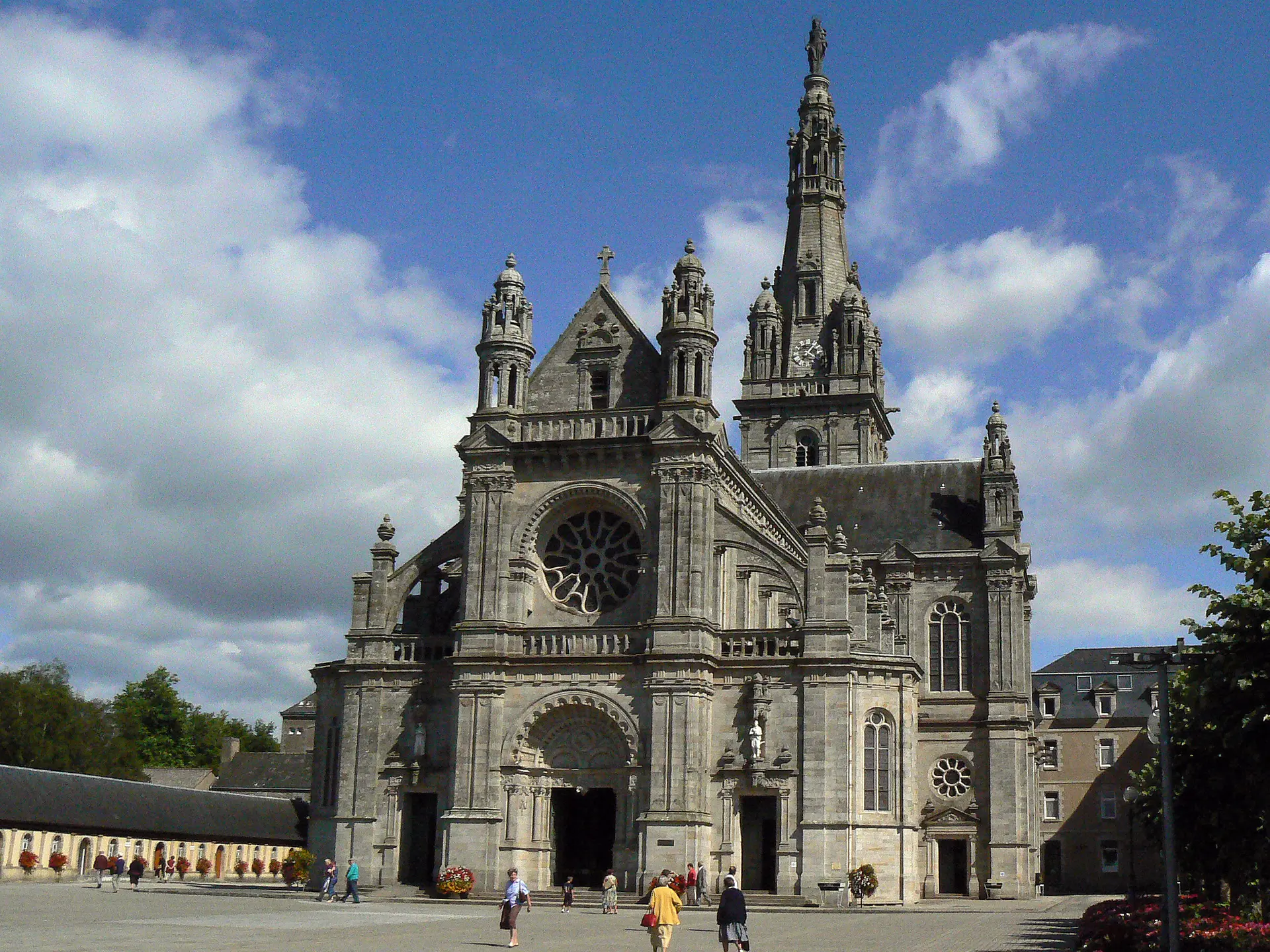
Image of Basilique Sainte-Anne d'Auray. Image source · CC-BY-SA-3.0
Visit essentials
A quick read before you go
- Duration
- One to two hours allows for exploration of the basilica, prayer at the statue, and walking the…
- Access
- Located in the commune of Sainte-Anne-d'Auray, Morbihan.
Overview
Sainte-Anne d'Auray channels the softer, patient love of a grandmother who has watched one generation grow. Saint Anne—mother of the Virgin Mary and grandmother of Jesus—appeared here in 1624 to the illiterate Breton farmer Yvon Nicolazic. She spoke his language rather than learned Latin and asked him to rebuild the chapel where she had once been honoured.
He found her ancient buried statue still recognizable in the ruins; miracles followed, the Church investigated, the French queen became patron, and pilgrims never stopped coming.
The present neo-Gothic basilica dates from the nineteenth century, but the site's sacred meaning predates it. Within the tradition, Saint Anne chose this ground, and the inexplicably old statue testified to continuous devotion. The grandmother of God returned to claim her chapel in Brittany, and Brittany remembers.
Why this place is sacred
The apparition of Saint Anne to Yvon Nicolazic in 1624 represents something rare: a grandmother's intervention in human affairs. Most Marian apparitions focus on Mary herself. But here, it was the generation before, the mother of the mother, who chose to appear. This shifts the quality of devotion. Those who come here seek not the intensity of the Virgin's grace but the patient, enduring love of an elder who has seen much.
The discovery of the ancient statue transformed apparition into archaeology. When Nicolazic dug at the site Anne had indicated and found a wooden statue still recognizable after centuries, the miraculous and the material converged. This was not simply vision but verification. Something had been here before, had been lost, and now was found.
The miracles that followed built upon this foundation. Hundreds of documented healings between 1633 and 1684 established the site as a place where intercession works. The sick came, prayed, and some walked away cured. Whether one attributes these healings to divine intervention, to faith itself as a healing force, or to the accumulated hope of centuries, the pattern is undeniable.
Papal and royal recognition added institutional weight. Pope Pius IX granted the statue the honor of crowning in 1868. Pope John Paul II visited in 1996, drawing 150,000 people to his sermon. A relic of John Paul II now rests in the basilica, adding another layer to the site's accumulation of sacred presence.
According to tradition, the first chapel to Saint Anne was erected in the seventh century at the village then called Keranna. The name itself means 'village of Anne' in Breton. This original chapel was destroyed by the end of the same century, and the devotion apparently lapsed for nine hundred years until the apparitions of 1624.
The purpose, from the beginning, was veneration of the grandmother of Jesus. Saint Anne holds particular significance for Bretons, for whom she is patron saint. The connection between Brittany and Anne predates clear documentation, suggesting deep roots in regional identity.
Sainte-Anne d'Auray has undergone continuous transformation while maintaining consistent purpose. The original modest seventh-century chapel gave way to larger structures as pilgrimage grew, culminating in the current neo-Gothic basilica, built between 1866 and 1872 by architect Deperthes to accommodate the hundreds of thousands who visit annually.
The Grand Pardon, held each July 26 on the Feast of Saint Anne, crystallizes centuries of devotion into a single annual peak. Twenty to thirty thousand pilgrims gather for religious services that blend solemnity with Breton cultural celebration. The integration of faith and regional identity remains as strong as when Anne spoke to Nicolazic in his own language.
Healing traditions
Intercession and family pilgrimage tradition
Sainte-Anne-d'Auray's story centers on Yvon Nicolazic's encounters with Saint Anne and the discovery of her statue in 1625. Pilgrims subsequently came seeking help through the mother of Mary, bringing illness and family concerns into prayer. The sanctuary's current history and spiritual guidance establish that living devotion; they do not provide a sufficiently detailed named healing case for this addition.
Ways to participate
Pray in the basilica for the person or family you have in mind, or follow the places associated with Nicolazic at a comfortable pace. Ask the sanctuary about a blessing or pastoral conversation. The pilgrimage can be a time to remember generations of care within a family, including those who are ill and those supporting them.
These accounts describe religious traditions and reported experiences. They do not promise a cure or replace medical care.
Experience and orientation
Entering the basilica, the first impression is often one of scale. The neo-Gothic architecture soars, drawing the eye upward in the manner of medieval cathedrals. But unlike cathedrals that can feel austere, Sainte-Anne d'Auray carries warmth. Perhaps it is the grandmother quality that pervades the devotion here, the sense of being welcomed rather than judged.
Many visitors describe a particular quality of peace. Not the silence of empty churches but the presence of centuries of prayers offered in hope. The accumulated weight of eight hundred thousand annual visitors, and the millions before them, creates an atmosphere that some find palpable.
The statue of Saint Anne becomes a focal point. Before it, pilgrims offer prayers for healing, for family, for the particular concerns that one brings to a grandmother. Candles multiply in the chapel, each one a prayer made visible.
The Grand Pardon intensifies all of this. On July 26, when tens of thousands gather, the experience becomes communal in ways rare in modern life. The religious procession blends with Breton cultural expression. The boundary between faith and heritage dissolves. Visitors report being swept into something larger than individual devotion, carried by a current of collective intention.
Even those who arrive as tourists rather than pilgrims often find themselves unexpectedly moved. The sight of genuine devotion, of people who have come in hope and faith, can touch even skeptical hearts. Something about encountering belief, particularly belief sustained across centuries, invites reflection.
Context and lineage
On July 25, 1624, Saint Anne appeared to Yvon Nicolazic, a farmer from the village of Keranna. She spoke to him in Breton, saying 'Me zo Anna mamm Mari'—'I am Anne, mother of Mary.' Over several visits, she asked him to rebuild the chapel where she had been honored centuries before. She indicated the location where proof would be found.
On March 7, 1625, Nicolazic dug at the spot Anne had shown him. Beneath the ruins of the ancient chapel, he discovered a wooden statue of Saint Anne. Though centuries old, it remained clearly recognizable. Word spread. Pilgrims came. Miracles began.
The Bishop of Vannes investigated and authorized the construction of a new chapel. By 1633, the flow of documented healings had established the site as a place of genuine power. Queen Anne of Austria, herself devoted to her namesake saint, obtained papal establishment of a confraternity in 1641. The pilgrimage was officially sanctioned and royally patronized.
The devotion to Saint Anne at this site represents continuous intention across fourteen centuries, though with a nine-hundred-year interruption. The seventh-century chapel, the 1624 apparitions, and the ongoing pilgrimage form a thread that connects early Christian Brittany through medieval loss to modern revival.
Sainte-Anne d'Auray now ranks as the third most-visited pilgrimage site in France, after Lourdes and Lisieux, with eight hundred thousand annual visitors.
Saint Anne
deity
Mother of the Virgin Mary, grandmother of Jesus. Patron saint of Brittany. Appeared to Yvon Nicolazic in 1624 in the only apparition of Saint Anne recognized by the Catholic Church.
Yvon Nicolazic
historical
The Breton farmer to whom Saint Anne appeared. An illiterate but devout man, he initially resisted sharing his visions, fearing ridicule. Anne's insistence and the discovery of the statue confirmed his experience.
Pope John Paul II
historical
Visited Sainte-Anne d'Auray in 1996, drawing 150,000 people. A relic of the pope now rests in the basilica, adding another layer to the site's sacred significance.
Traditions and practice
Catholic worship has continued at this site since the 1620s, following patterns established across centuries. Daily mass offers participation in the central Catholic ritual. Confession is regularly available, particularly during pilgrimage seasons. Veneration of the statue of Saint Anne, requests for intercession, and prayers for healing constitute the core devotional practices.
The documented miracles of the seventeenth century established a tradition of seeking healing through Saint Anne's intercession. While formal documentation of miracles is no longer maintained, personal testimonies of answered prayer continue.
The Grand Pardon de Sainte-Anne remains the annual peak of devotional activity. Held on July 26, the Feast of Saint Anne, the celebration draws twenty to thirty thousand pilgrims. Religious services include solemn masses and processions. Following the religious observance, Breton cultural celebration takes over, with traditional music, dancing, and festivity. The integration of faith and regional identity is central to the experience.
Throughout the year, pilgrims come individually and in groups. Many light candles as visible prayer. Some bring specific intentions, requests for healing or help with family concerns. The relic of Pope John Paul II, installed in 2014, has added a new focus for veneration.
Sancturay programs include retreats, organized pilgrimages, and educational offerings. The site functions not merely as a destination but as a center of ongoing religious life.
If you come seeking more than tourism, consider these approaches. Attend mass, even if Catholicism is not your tradition. The centuries of worship in this space create an atmosphere that participation deepens.
Light a candle before the statue of Saint Anne. Let the flame carry whatever intention you bring. The grandmother of Jesus is said to hear those who come to her.
If possible, time your visit for the Grand Pardon on July 26. The intensity of communal pilgrimage offers something individual visits cannot replicate. Be prepared for crowds, but understand that the crowds are the point—faith shared is faith amplified.
For quieter devotion, visit outside peak seasons. Winter mornings find the basilica nearly empty, the accumulated prayers of centuries available without distraction.
Roman Catholicism
ActiveSainte-Anne d'Auray is the only site in the world where an apparition of Saint Anne (grandmother of Jesus) has been recognized by the Catholic Church. The site is the third most-visited pilgrimage destination in France. For Bretons, the connection is deeper still: Anne is their patron saint, and her appearance here speaking Breton validates regional identity within universal faith.
Daily masses. Regular confession. Veneration of the statue of Saint Anne. Prayers for intercession and healing. Candle lighting. The Grand Pardon on July 26, combining solemn mass, procession, and traditional Breton celebration. Veneration of the relic of Pope John Paul II.
Perspectives and open questions
Sainte-Anne d'Auray holds different meanings for different visitors. For devout Catholics, this is a place of genuine miraculous presence. For students of Breton culture, it represents the fusion of faith and regional identity. For skeptics, it offers an encounter with sincere belief. The site accommodates all these perspectives without forcing reconciliation.
Scholarly perspective
Historians document the apparitions of 1624 and the subsequent development of the pilgrimage. The bishop's investigation, the discovery of the statue, and the rapid growth of the shrine are recorded in contemporary accounts. The neo-Gothic basilica is attributed to architect Deperthes, built between 1866 and 1872.
The extent of the documented miracles—hundreds between 1633 and 1684—represents one of the more substantial miracle claims in French Catholic history. Scholarly interpretation varies: some see genuine supernatural events, others see faith-healing effects, still others see documentation practices that differ from modern standards.
Living and traditional perspectives
Catholic teaching holds that Saint Anne truly appeared to Yvon Nicolazic and that the miracles that followed represent genuine divine intervention through her intercession. The discovery of the ancient statue is understood as providential confirmation. The site functions as a place where heaven and earth intersect, where prayers are heard by the grandmother of God.
For Bretons particularly, the site represents something beyond general Catholicism. Anne is their patron saint. That she chose to appear here, speaking Breton, validates regional identity within universal faith.
Alternative interpretations
Some interpreters see the devotion to Saint Anne as continuation of pre-Christian goddess worship. The grandmother archetype, the connection to earth and fertility, the feminine dimension of the divine—these elements suggest currents older than Christianity flowing into Christian forms.
The site's location in Brittany, with its deep Celtic heritage, adds resonance to these interpretations. Whether one sees this as syncretism, adaptation, or corruption depends on perspective.
Open questions
The origin and age of the discovered statue remain partly mysterious. Church tradition holds it dated to the original seventh-century chapel, but archaeological verification is lacking. The nine-hundred-year survival of recognizable wooden sculpture strains material explanation.
The nature of the apparitions themselves lies beyond historical verification. Nicolazic reported what he experienced; whether that experience was supernatural intervention, psychological phenomenon, or something else cannot be determined by historical methods. Faith fills the gap differently than skepticism does.
Plan your visit
Access and arrival
Located in the commune of Sainte-Anne-d'Auray, Morbihan. Well-signposted from major roads. The site is open daily with no admission fee. Accessible for visitors with mobility limitations.
Hotels and guesthouses in Sainte-Anne-d'Auray and nearby Auray. During the Grand Pardon, book far in advance. Vannes (15 km) offers additional options.
Respectful visit
Modest dress is expected for entry to the basilica. Shoulders and knees should be covered. This applies to all visitors regardless of religious affiliation.
Permitted in most areas of the site. During services, photography should be minimized and never intrusive. The statue of Saint Anne is frequently photographed, but be aware that you may be capturing others in prayer.
Candles are available for purchase and are the traditional form of offering. Donations to the sanctuary are welcome. No physical offerings are left at the statue.
None beyond the requirement for respectful behavior in an active place of worship.
This is an active site of Catholic worship. Behavior appropriate to a church is expected. Loud conversation, inappropriate dress, and disruptive behavior diminish the experience for genuine pilgrims.
The Grand Pardon is both religious ceremony and cultural festival. Respect the religious dimension even if you participate primarily in the cultural celebration. The two are not separate for those who come in faith.
Current practical details
Address
9 Rue de Vannes, 56400 Sainte-Anne-d'Auray, France
Phone
Hours
Hours, fees, and access can change — verify on the official source before you travel. Practical details last checked Jun 2026.
Location
Map loads as you approach this section.
Pilgrim reflections
A portrait of encounter, not a score
Pilgrims describe what they felt, how present they could become, and whether the place would shape a journey. There are no stars and no ranking of traditions.
No reviewed reflections yet
The first pilgrims can help describe the character of being here.
Share a reflection
Available after an account-backed “Been there.” Every reflection is reviewed before publication.
Nearby sacred places
Explore other sacred places in the region. Proximity does not establish access or travel time; check each place’s guidance.

References
Sources consulted for this page. Source categories describe the publication, not a guarantee that every claim is verified. Traditional accounts and outside interpretations may differ.
- 01Shrine of Sainte-Anne d'Auray — Sanctuary of Sainte-Anne d'AurayofficialOfficial sanctuary website
- 02Sainte-Anne-d'Auray - Villes Sanctuaires — Villes Sanctuaires en FrancespiritualFrench sanctuary cities network
- 03Sainte-Anne-d'Auray - Wikipedia — Wikipedia contributorsencyclopediaOverview with historical context
- 04Seeking Forgiveness at the Shrine of Saint-Anne - National Catholic Register — National Catholic RegisterspiritualCatholic perspective
- 05Sainte Anne d'Auray - Catholic Encyclopedia — New AdventencyclopediaHistorical documentation
- 06History — Sainte-Anne-d'Auray sanctuaryofficialSupports the attributed account or visitor practice in the healing section; not evidence of clinical efficacy.
- 07Spirituality — Sainte-Anne-d'Auray sanctuaryofficialSupports the attributed account or visitor practice in the healing section; not evidence of clinical efficacy.
Share a photo
Help visitors recognize Basilique Sainte-Anne d'Auray. Every submission is reviewed before publication.