Kaunos Tomb of the Kings
Cliff-carved tombs of a city founded by the grandson of Apollo, rising above the Dalyan River for 2,400 years
Understand sacred places, explore living traditions, and learn how to engage respectfully with Pilgrim Map.
Access has not been verified. Check current local guidance before planning a visit.
Muğla, Turkey
Read the sources
Visit essentials
A quick read before you go
- Duration
- Minimum 2 hours for the main tomb facade area; 3–4 hours for a thorough visit including the…
- Access
- The simplest and most atmospheric approach is a short boat crossing from Dalyan town's riverside…
Overview
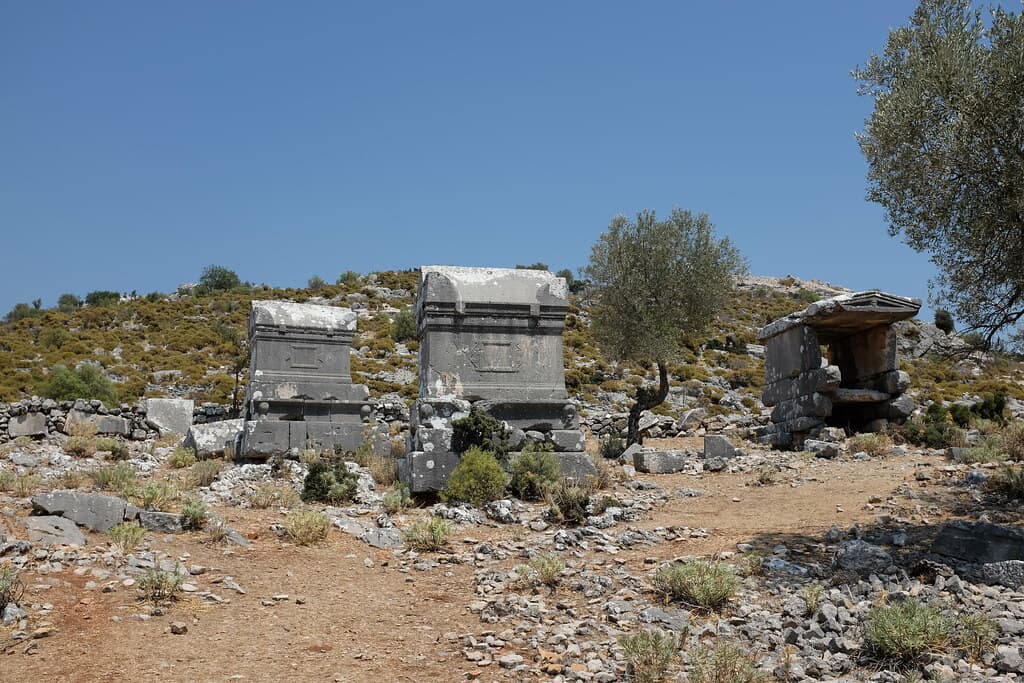
The popular name is misleading: these were not royal tombs. Kaunian civic officials, wealthy families, and perhaps priests of Basileus Kaunios commissioned the finest craftspeople of the mid-4th century BCE to cut their resting places into the river cliff. More than 150 tombs form seven groups, with the most celebrated visible for miles from the water. They are miniature temples of Ionic pilasters, triangular pediments, toothed-stone friezes, and palm-leaf acroterions.
Kaunos stood at the cultural edge between Lycia and Caria, two peoples with overlapping sacred traditions. Its chief deity, Basileus Kaunios, embodied a local divine-kingship theology that the ancient world slowly merged with Zeus; the city's mythology also placed it within Apollo's family. Burial here therefore meant entering a landscape already consecrated by divine lineage.
From a boat among reeds and water, the cliff tombs emerge as pale shapes, then architectural facades, then elaborate funerary declarations. Behind them stood the living city—acropolis, agora, Demeter's Sacred Rocks, and a theatre overlooking the river. Before them, the dead remained between water and sky, occupying the threshold the Kaunians understood for their ancestors.
Why this place is sacred
Threshold is the organizing principle of Kaunos. The city stood geographically between Lycia and Caria, spiritually between Apollo-derived divine lineage and indigenous Anatolian earth religion, and architecturally between the living city on the acropolis and the carved dead on the cliff. Kaunian religion did not separate these zones neatly — it honored them as a single sacred landscape.
The chief deity, Basileus Kaunios — 'King of Kaunos' — is attested from at least the 5th century BCE. The name implies divine kingship, a concept widespread across the ancient Near East. Over time this figure was syncretized with Apollo, linking the city to the broader Greek sacred world while retaining its Anatolian distinctiveness. Other cults operated alongside: Artemis, Demeter (whose sacred rocks survive in a precinct on the hillside), and the deities of the Letoon sanctuary nearby.
The mythology of the city's founding deepens this sense of divine overlay. Kaunos the man was said to be the son of Carian King Miletus and Kyane, and the grandson of Apollo. His story carries the weight of incest-adjacent tragedy: his sister Byblis fell in love with him, he fled, and she followed.
Whether this myth encodes something about the city's relationship to neighboring cultures, or simply reflects the universal human difficulty of forbidden bonds, its presence gives the site the quality of a place where human and divine stories intersect fatefully.
The sacred rocks of Demeter suggest a chthonic layer beneath the Apollo connection — earth religion, the fertility of the delta, the reed-grown river as sacred body. Kaunos was also a place of grain, fish, and water. Its dead were elevated into the cliff face, between the fertile valley floor and the open sky, occupying the transitional space that all funerary architecture reaches for but few achieve so literally.
Elite funerary monument and marker of civic status, expressing religious belief in the elevated dead as threshold beings between earth and sky.
The temple-style tomb facades date to the mid-4th century BCE and represent the peak of Kaunian/Carian funerary investment. After the Roman period, as Christianity spread and the old cults faded, active ritual use of the tombs ended. The site passed through Byzantine, Ottoman, and eventually modern Turkish stewardship. Today it functions as an archaeological heritage site and UNESCO tentative list candidate.
Experience and orientation
The boat crossing from Dalyan is not merely practical — it is the appropriate beginning. The Kaunians moved through this same river delta. Their dead faced the water. The approach by boat, through channels bordered by phragmites reed and watched by caretta caretta sea turtles in the estuary, works on the visitor before the ruins come into view. When the cliff finally appears, the tombs are already reading as something other than tourist monuments.
Landing on the far bank, the uphill path climbs through scrub to the main archaeological area. The 30-minute ascent is moderate; the site is large and partially unshaded, with the theatre, agora, bouleuterion, stoa, and acropolis walls all within range. Sturdy footwear is necessary. The Demeter Sacred Rocks precinct lies on a separate hillside and requires an additional short detour.
What the photographs do not convey is the scale of the tomb facades at close range. From the boat they read as decorative elements in the cliff; standing beneath them, you feel the height of the carved pediments and the precision of the Ionic columns cut from the same living rock as the mountain behind them. The largest tombs have modest interior chambers — small, low-ceilinged spaces where family remains were placed. There is little to see inside.
The funerary statement was always intended for the outside, for the living on the water below.
At dawn, when the light catches the pale stone and the river below still holds mist, the site produces one of the more arresting sensory encounters in southwestern Turkey. Dusk brings a second quality of light, when the cliffs turn amber and the tombs' shadows deepen. These are the moments the site gives willingly to those who time their visit accordingly.
Come by boat, not by road. The long drive around Lake Köyceğiz arrives at the ruins from behind, missing the river approach that defines the experience. The boat crossing from Dalyan's riverside takes a few minutes and a few lira. The ruins themselves require comfortable shoes and at least two hours; the full site with the acropolis and Demeter precinct rewards three to four.
Context and lineage
According to the mythology the city preserved about itself, Kaunos was founded by Kaunos the man — son of the Carian King Miletus and Kyane, grandson of Apollo. The founding story carries the quality of divine tragedy: Kaunos's sister Byblis fell in love with him, he fled across Asia Minor to escape her, and she pursued him until she dissolved into a spring of tears.
The city that bore his name was therefore a city already marked by the intersection of divine lineage and human grief.
Archaeologically, the city dates to at least the 9th century BCE, pre-dating the Greek colonization of the Aegean coast. Its location — on a bay of the ancient Calbis estuary, now the Dalyan delta — made it a significant maritime and trading center. In the classical period it minted its own coins and maintained political independence through careful navigation between Persian, Rhodian, and later Hellenistic powers.
The temple tombs were carved approximately in the mid-4th century BCE, during a period of Carian dynastic florescence.
The city continued through Hellenistic and Roman periods, eventually declining as the harbor silted up. The Dalyan delta that makes the site so visually distinctive today was in antiquity a navigable harbor; the silting that closed it is the same process that gradually ended Kaunos's commercial importance.
Kaunos represents the synthesis of indigenous Anatolian, Carian, and Lycian religious traditions, with later Greek and Roman overlays. The city's theological center — the local god Basileus Kaunios — was eventually merged with Apollo while retaining indigenous kingship elements. The Demeter cult suggests a parallel chthonic religious thread running alongside the Apollo connection.
Kaunos (mythological)
Eponymous founder; grandson of Apollo in the city's founding mythology
Byblis (mythological)
Sister of Kaunos; her pursuit and transformation into a spring anchors the city in a myth of transgression and metamorphosis
Hyssaldomos
Local Carian dynast; his family may be connected to the commissioning of the major temple tombs
Charles Fellows
Early 19th-century British scholar and traveler; among the first Europeans to document Kaunos systematically
Traditions and practice
The religious life of Kaunos was organized around several distinct cultic centers. The principal cult of Basileus Kaunios operated at a temple on the acropolis, with the formal worship apparatus of animal sacrifice, priestly offices, and festival calendars typical of Greek-influenced polis religion. Apollo and Artemis were honored in forms that overlapped with the local deity. The Demeter Sacred Rocks precinct hosted earth-oriented practices, likely connected to agricultural fertility and the delta's abundance.
The funerary practices that produced the rock tombs were elite rituals in themselves: the commissioning, carving, and consecration of a tomb facade was a civic and religious statement, not merely a practical arrangement for the dead.
No active religious ceremonies take place at Kaunos. The site operates as an open archaeological heritage site with Turkish state museum oversight. Scholarly excavation has been ongoing for decades. The UNESCO tentative list designation has increased international research attention.
Stand at the cliff base and look up at the tomb facades without immediately photographing them. Allow the scale — the height of the carved pediments, the precision of the Ionic details — to settle. Then move to the river bank and look back. The tombs were designed for this view, for the eyes of the living approaching from the water.
What you are seeing, from that position, is exactly what the Kaunians intended their elite dead to project across the delta for eternity.
If you arrive early, spend time at the theatre before the acropolis. The theatre faces the river and the reed beds; the view from the upper rows encompasses the relationship between city, cliff, and water that defined Kaunian sacred geography. Walk from the theatre to the tomb facades to the Demeter precinct if accessible — the circuit traces the different registers of Kaunian religious life: civic, funerary, and chthonic.
For those drawn to liminal thinking: this is a place explicitly about thresholds. The tombs are neither fully inside the rock nor fully exposed; neither city nor river; neither earth nor sky. The Kaunians built their theology of the afterlife into the geography itself. Moving slowly and attending to the physical transitions — from water to land, from open hillside to cliff face, from interior chamber to carved facade — tracks the logic of that theology through the body.
Carian / Kaunian Religion
HistoricalThe primary religious tradition of Kaunos, centered on the local god Basileus Kaunios, who was syncretized over time with Apollo. The city also maintained cults of Artemis, Demeter, and the Letoon deities. The cliff-face temple tombs represent the highest expression of Kaunian funerary theology.
Temple worship at the acropolis sanctuaries; funerary rituals and tomb commissioning as elite religious act; earth rites at the Demeter Sacred Rocks; cult of Basileus Kaunios with festival calendar and priestly offices
Archaeological / Heritage
ActiveKaunos is among the most studied Carian-Lycian border cities in Anatolia. On UNESCO's tentative list since 2012, it is recognized for its exceptional funerary architecture and the quality of its preserved urban remains. Ongoing excavation continues to refine understanding of the city's religious and civic history.
Active Turkish and international archaeological excavation; conservation of the tomb facades and civic structures; heritage tourism with Turkish state museum oversight
Perspectives and open questions
Kaunos invites multiple readings: a city of divine lineage and civic pride, a funerary monument expressing the Carian relationship between elevated dead and living community, and an archaeological landscape where three overlapping religious traditions — indigenous Kaunian, Greek-influenced, and Roman — left their distinct marks on the same hillside.
Scholarly perspective
Archaeological consensus places the major temple-style rock tombs in the mid-4th century BCE, contemporary with the high period of Carian dynastic patronage under the Hekatomnids. The tombs are not royal — they reflect civic elite investment in permanent funerary display. The local god Basileus Kaunios is attested in inscriptions and coins from the 5th century BCE; his gradual syncretism with Apollo is considered typical of the Hellenization of Anatolian religious identity.
Kaunos's position on the UNESCO tentative list reflects scholarly recognition of its outstanding value for Carian-Lycian funerary architecture.
Living and traditional perspectives
Kaunian tradition, as preserved in Greek sources, understood the city as part of Apollo's extended sacred geography. The founding mythology — Kaunos as Apollo's grandson — was not merely decorative; it placed the city within a divine lineage that entitled its dead to occupy the elevated threshold between mortal and immortal realms. The tomb facades as miniature temples carried this theology literally: the dead were housed in the form of gods' dwellings.
Alternative interpretations
The positioning of the tomb facades high on a cliff face overlooking a river, facing approximately east, has prompted informal speculation about solar orientation in the funerary program — a connection to Apollo's solar attributes. The pattern has not been formally measured or confirmed. The Demeter Sacred Rocks precinct, whose exact ritual function remains poorly documented, suggests a parallel cosmological concern with the underworld and chthonic fertility that may have balanced or complemented the sky-oriented cliff tombs.
Open questions
The identity of Basileus Kaunios as a theological figure remains genuinely uncertain. His name means 'King of Kaunos' — but king in what sense? Divine ruler of the city's sacred space? A deified ancestor? A local manifestation of a pan-Anatolian deity? No inscription has yet resolved this question definitively. Similarly, no tomb facade has been conclusively matched to a named individual.
The nature of the rituals at the Demeter Sacred Rocks and their relationship to the funerary practices of the cliff tombs is not understood.
Plan your visit
Access and arrival
The simplest and most atmospheric approach is a short boat crossing from Dalyan town's riverside (a few minutes, a few lira for a return trip). From the landing, a 30-minute uphill walk reaches the main ruins. Open daily: 08:30–19:30 (April–October), 08:30–17:30 (November–March). Entrance fee approximately 70 TL (as of 2024). An alternative road access circuits around Lake Köyceğiz — roughly 45 minutes from Dalyan by car — and arrives at the ruins from the landward side.
Mobile phone signal is unreliable at the ruins themselves; no emergency infrastructure on site. For updated access information, check with the Dalyan tourism offices or the Turkish Museums authority.
Dalyan town offers a range of small hotels, pensions, and guesthouses along the riverside, most within walking distance of the boat crossing point. Akyaka (25 km) provides additional accommodation options. No overnight facilities at the site itself.
Respectful visit
No religious dress requirements. Comfortable walking clothes and closed-toe shoes with grip are strongly recommended for the uneven paths.
Photography is permitted throughout the site. The tomb facades photograph best from the river approach — from a boat — and in early morning or late afternoon light. No restrictions on photography of the ruins.
Not applicable. The site is an archaeological heritage area, not a place of active worship.
Do not climb on or touch the tomb facades; the limestone carvings are irreplaceable and sensitive to physical contact. Sturdy footwear required for the uphill paths. No food or drink inside the enclosed site areas.
The site is largely unshaded. Summer midday temperatures on the exposed hillside and cliff-face path are severe; bring water. The uphill paths to the acropolis are rough and require attention. The Demeter Sacred Rocks precinct is a separate area; confirm its accessibility on arrival, as access conditions may vary.
Location
Map loads as you approach this section.
Pilgrim reflections
A portrait of encounter, not a score
Pilgrims describe what they felt, how present they could become, and whether the place would shape a journey. There are no stars and no ranking of traditions.
No reviewed reflections yet
The first pilgrims can help describe the character of being here.
Share a reflection
Available after an account-backed “Been there.” Every reflection is reviewed before publication.
Nearby sacred places
Explore other sacred places in the region. Proximity does not establish access or travel time; check each place’s guidance.


References
Sources consulted for this page. Source categories describe the publication, not a guarantee that every claim is verified. Traditional accounts and outside interpretations may differ.
- 01Tombs of Kaunos | Archaeology News Online Magazine — Archaeology Magazine OnlineacademicDetailed analysis of tomb typology and dating
- 02Ancient City of Kaunos - UNESCO World Heritage Centre — UNESCOofficialUNESCO tentative list entry with official description
- 03Kaunos | 7 reasons to visit this ancient city in Turkey — Peter Sommer TravelsguideExpert archaeological travel guide with scholarly context
- 04Muğla Kaunos Archaeological Site | Turkish Museums — Turkish MuseumsofficialOfficial Turkish state museum listing
- 05Kaunos - Livius — Livius.orgacademicScholarly ancient history resource
- 06Kaunos - Wikipedia — Wikipedia contributorsencyclopediaGood overview of city history and tombs
- 07Kaunos - History and Facts | History Hit — History HitguideGood historical overview
- 08Kaunos: An Ancient City of Ruins and Rock Cut Tombs — Historic MysteriesguideAccessible overview of site features
Share a photo
Help visitors recognize Kaunos Tomb of the Kings. Every submission is reviewed before publication.