Karakuş Tumulus
Eagle columns rising from a Commagenian royal burial mound — apotheosis made visible on the Adıyaman plain
Understand sacred places, explore living traditions, and learn how to engage respectfully with Pilgrim Map.
Access has not been verified. Check current local guidance before planning a visit.
Adıyaman, Turkey
Read the sources
Visit essentials
A quick read before you go
- Duration
- 20–45 minutes; combine with nearby Arsameia (15 km), Cendere Bridge (5 km), and Yeni Kale…
- Access
- Located 12 km from Kâhta on the D875 highway toward Mount Nemrut.
Overview
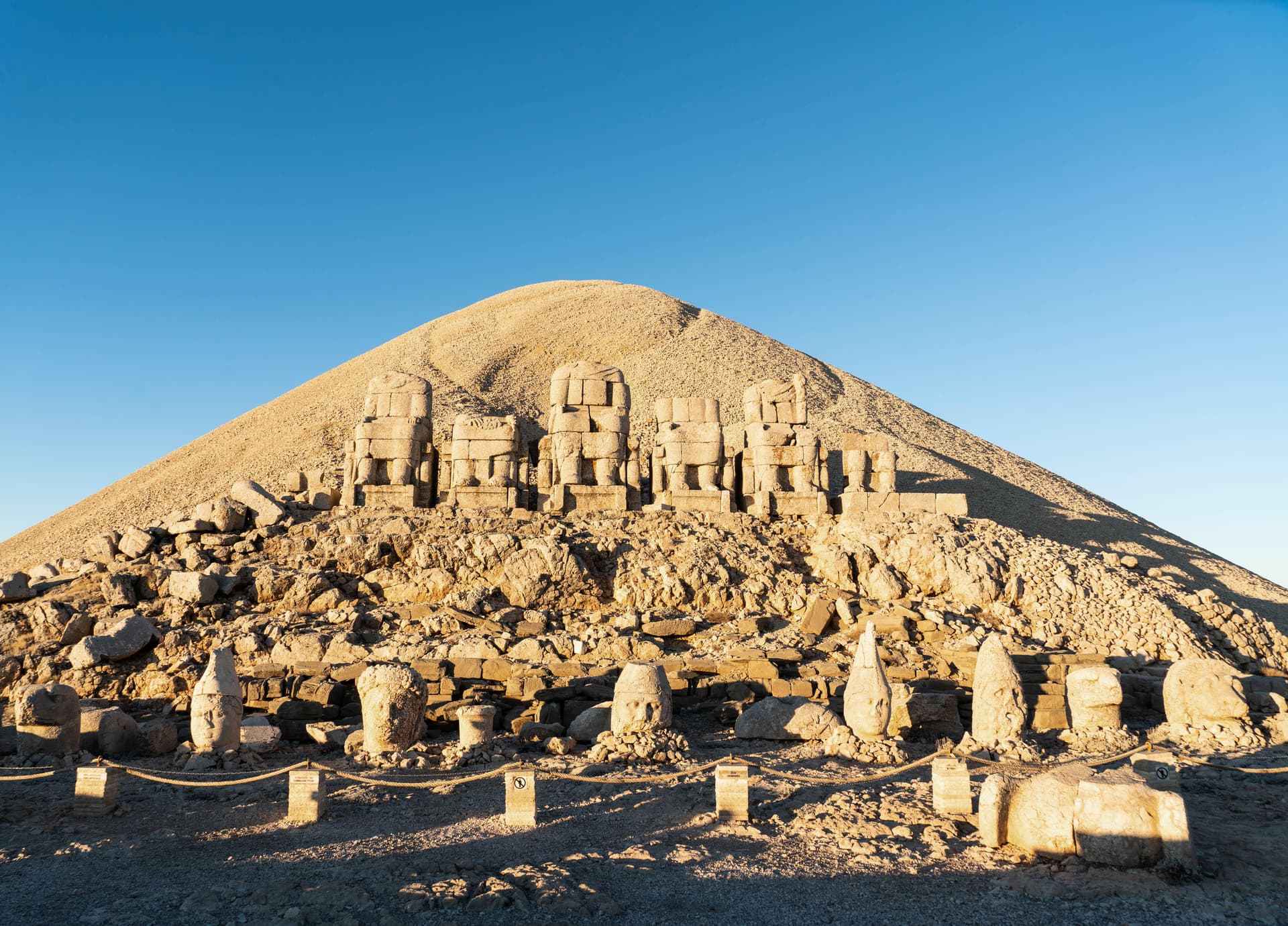
From a distance, what you see first is a single column rising from the mound with an eagle on top — the eagle that named this place Karakuş, 'Black Bird.' The mound itself is enormous and entirely human-made: 30 metres high, 150 metres in diameter, built over a 20-metre-deep burial chamber.
Nine columns in three groups of three surround the mound, each group topped with an animal: the eagle to the east (the royal soul ascending to the gods), the bull to the north (sacrificial offering, cosmic fertility), the lion to the west (royal power). A relief stele shows Mithridates II in dexiosis — the royal handshake of divine kinship — with his sister Laodice.
Karakuş is the third of the three Commagenian hierothesia alongside Nemrut Dağı and Arsameia, dedicated to the royal women of the dynasty rather than the kings. Friedrich Karl Dörner excavated the burial chamber in 1967 and found it empty — looted in antiquity, or perhaps always a cenotaph, the symbolic presence of the royal dead rather than their physical remains. A georadar survey and planned new excavation by the Turkish Ministry of Culture may yet reveal additional burial chambers.
Why this place is sacred
Karakuş is not a subtle site. Its effect derives from the contrast between the massive human-made mound and the scale of the surrounding plain: so much labour brought to bear on a single theological statement. The Commagenian kings believed that death was not ending but translation — the dead royal ascending through the planetary spheres to join the gods, aided by cult ceremonies that maintained the relationship between the living and the divine dead.
The eagle column embodies this trajectory in sculpture: the bird poised at the apex of a nine-metre column, wings not spread but folded, the whole form oriented upward. Standing beneath it and looking up, you see what the builders intended you to see — the soul's direction of travel rendered as a permanent image against the sky. The mound's emptied burial chamber adds something unexpected: the most important space in the site is hollow.
Whether through looting or design, the chamber holds nothing. A monument built to make the royal dead present now physically enacts their absence. That paradox — the enormous effort to mark a place, the emptiness at the centre — gives the site an atmosphere that more famous monuments at Nemrut Dağı, despite their grandeur, do not share.
A hierothesion — sacred burial precinct and cult installation — for three Commagenian royal women: Queen Isias (wife of Antiochos I), Princess Antiochis, and Princess Aka I. The mound and its column sculptures served as both burial monument and focal point for ongoing funerary cult ceremonies.
Built c. 30–20 BC by Mithridates II of Commagene; actively used as a cult site during the kingdom's existence until its absorption into Rome in 72 AD; burial chamber excavated by Dörner in 1967 (found empty); now an open archaeological monument without entrance fee; new georadar survey and excavation planned by Turkish Ministry of Culture.
Experience and orientation
Karakuş requires no entry fee and has no facilities; it is simply there, in the landscape, accessible. Begin from a distance — the mound and the eagle column are visible from the road, and that first view from afar is important for understanding the site's primary function: visibility, announcement, the marking of territory with an enduring symbol. As you approach, the scale of the mound becomes apparent; this is not a natural hill but an enormous deliberate construction.
Walk the perimeter rather than going directly to the best-known eagle column. The three column groups — eagle (east), bull (north), lion (west) — need to be encountered in relation to each other and to the mound they surround. The dexiosis relief on the western columns, showing Mithridates II and his sister Laodice in the royal handshake gesture, is intimate in scale compared to the mound it belongs to.
On the south face of one column base, inscriptions in Greek name the royal women for whom the monument was built — Queen Isias, Princess Antiochis, Princess Aka I. Read these names against the scale of what was built for them. In the late afternoon, the eagle column casts a long shadow across the mound.
In morning light, the eastern orientation of the eagle column is most evident — facing the direction of sunrise, of the soul's ascent toward the divine light.
Allow 20–45 minutes. No facilities, shade, or water. The site is best visited as part of the Kâhta day circuit with Arsameia (15 km north) and Cendere Bridge (5 km east) — the three sites together give a complete sense of the Commagenian sacred landscape.
Context and lineage
The Kingdom of Commagene, in its brief century of independence before absorption into Rome in 72 AD, produced a remarkable programme of monumental funerary theology. Antiochos I Theos built the grandest expression at Nemrut Dağı and commissioned the inscription at Arsameia for his father. His son Mithridates II built Karakuş for the royal women of the previous generation: Isias, the queen; Antiochis and Aka I, the princesses.
The choice of column-and-animal sculptures rather than the stone deity heads used at Nemrut Dağı may reflect a different theological register for female royalty, or simply the conventions of this monument type. The animal symbols — eagle, bull, lion — were standard Commagenian royal and cosmic vocabulary, appearing in various combinations across the kingdom's sacred programme. Dörner's 1967 excavation reached the burial chamber 20 metres below the mound's summit and found it empty.
The question of whether this emptiness results from ancient looting or from the monument always having been a cenotaph — a symbolic tomb rather than an actual burial — remains open and will be addressed by the planned new georadar survey.
Commagenian royal funerary programme (1st century BC) → Roman absorption (72 AD) → Dörner excavation (1967) → ongoing scholarly study; planned Ministry of Culture georadar survey and re-excavation
Traditions and practice
Commagenian royal funerary cult at Karakuş would have followed the pattern prescribed by Antiochos I's inscription at Arsameia: seasonal ceremonies at the monument, offerings at the column bases, and priestly maintenance throughout the year. The dexiosis relief of Mithridates II and Laodice performed the same theological function as those at Arsameia — asserting and enacting the divine kinship of the royal house.
The monuments were designed to function even in the absence of direct royal patronage: the ceremonies encoded in stone were meant to continue perpetually, maintaining the relationship between the living community and the divine dead.
None. Open archaeological monument without entrance fee.
Begin from the road, far enough back to see the eagle column silhouetted against the sky — this was the view the monument was designed to produce, announcing the presence of the royal dead across the plain. Walk the full perimeter of the mound before stopping at any individual column group. At the eagle column, look up from directly below. At the bull column, look north toward the open plain beyond.
At the western group with the dexiosis relief, spend time with the carving: the two figures in the royal handshake gesture, the inscriptions naming the royal women below. When you have completed the circuit, stand at the summit of the mound's base if accessible, and understand the spatial logic: the columns form a ring that the mound rises from, a monument that marks the earth and points toward the sky simultaneously.
Commagenian Royal Funerary Cult
HistoricalKarakuş is one of three Commagenian hierothesia. Built c. 30–20 BC by Mithridates II for Queen Isias, Princess Antiochis, and Princess Aka I, it served as burial monument and cult installation for the royal women of the dynasty. The column sculptures carry Commagenian royal and cosmic symbolism.
Seasonal funerary cult ceremonies; offerings at the column bases; the dexiosis relief of Mithridates II and Laodice performed the same theological function as reliefs at Arsameia and Nemrut Dağı.
Archaeological and Scholarly Study
ActiveFriedrich Karl Dörner excavated in 1967 and found the burial chamber empty. A new georadar survey and planned excavation under the Turkish Ministry of Culture may reveal additional burial chambers.
Ongoing academic study within the Commagenian heritage landscape; planned new excavation campaign.
Perspectives and open questions
Karakuş is interpreted within the Commagenian royal programme, but its empty burial chamber and the specificity of its dedication to royal women raise questions that straightforward dynastic interpretation does not fully resolve.
Scholarly perspective
One of three Commagenian hierothesia, integral to understanding the royal funerary programme of Antiochos I and his successors. The 1967 Dörner excavation confirmed the burial chamber's existence but its emptiness has never been satisfactorily explained — looting, design as a cenotaph, or the later removal of remains are all possible. The planned georadar survey represents a significant potential advance in understanding the monument's actual function.
Living and traditional perspectives
Within Commagenian royal religion, the mound and columns collectively enacted the apotheosis narrative: the royal dead ascending via the eagle to the divine realm, their power symbolised by the lion, their sacrificial role acknowledged by the bull. The monument was not a memorial but a cultic installation — the royal women it honoured were believed to be divine presences, accessible to veneration.
Alternative interpretations
The positioning of Karakuş, Arsameia, and Nemrut Dağı across the Adıyaman landscape may encode an astronomical alignment programme — a terrestrial map of the royal theology of divine kingship that oriented the Commagenian kingdom cosmologically, mirroring the relationship between earthly and celestial powers.
Open questions
Whether the burial chamber truly held the bodies of the royal women at any point, or was always a symbolic cenotaph, remains unknown. The results of the planned georadar survey are awaited. The full programme of ceremonies conducted at the site and the identity of the priestly personnel who maintained them are undocumented.
Plan your visit
Access and arrival
Located 12 km from Kâhta on the D875 highway toward Mount Nemrut. By car from Kâhta: take D875 north, Karakuş is signposted on the left. Dolmuş from Kâhta toward Nemrut; ask driver to stop at Karakuş. No entrance fee. No facilities at site. GPS: 37.869°N, 38.588°E.
Kâhta (12 km south) is the main base for this circuit; hotels and guesthouses at various price points. Adıyaman (50 km south) has more options.
Respectful visit
No dress code. Practical shoes for uneven ground.
Fully permitted. The eagle column in late-afternoon light or at sunrise is the best-known image of the site.
Not applicable.
Do not climb the columns or disturb the mound surface. Do not touch the dexiosis relief carving.
No shade, water, or facilities at the site. Bring sun protection and water, particularly in summer. Do not climb the columns or disturb the mound surface.
Location
Map loads as you approach this section.
Pilgrim reflections
A portrait of encounter, not a score
Pilgrims describe what they felt, how present they could become, and whether the place would shape a journey. There are no stars and no ranking of traditions.
No reviewed reflections yet
The first pilgrims can help describe the character of being here.
Share a reflection
Available after an account-backed “Been there.” Every reflection is reviewed before publication.
Nearby sacred places
Explore other sacred places in the region. Proximity does not establish access or travel time; check each place’s guidance.



References
Sources consulted for this page. Source categories describe the publication, not a guarantee that every claim is verified. Traditional accounts and outside interpretations may differ.
- 01Karakuş Tümülüsü - Cultural Inventory of TurkeyofficialOfficial Turkish cultural registry entry
- 02Nemrut Dagi and the Kingdom of Commagene - World History FoundationacademicScholarly overview of Commagenian royal monuments including Karakuş
- 03Karakuş Tumulus - WikipediaencyclopediaOverview of construction, column symbolism, 1967 Dörner excavation
- 04Karakuş Tumulus - Turkish Archaeological NewsSource contextArchaeological details and site description
- 05Georadar study to uncover mysteries of ancient tumulusSource contextReports on planned georadar and geophysical surveys before new excavation
- 06Queen's Tombs of the Kommagene Kingdom to Be Unveiled at Karakuş TumulusSource contextReports on Ministry of Culture plans to excavate queen's tombs
- 07Karakuş Mausoleum/Turkey - ArticHaeologySource contextDetailed description of columns, reliefs, and Dörner's 1967 findings
- 08Karakuş Tumulus - Following Hadrian PhotographyguidePhotographic documentation with site description
Share a photo
Help visitors recognize Karakuş Tumulus. Every submission is reviewed before publication.