Nemrut Dagi
A king's bid for immortality at 2,134 metres — the colossal faces endure, the burial sealed below
Understand sacred places, explore living traditions, and learn how to engage respectfully with Pilgrim Map.
Access has not been verified. Check current local guidance before planning a visit.
Kâhta, Adıyaman, Turkey
Read the sources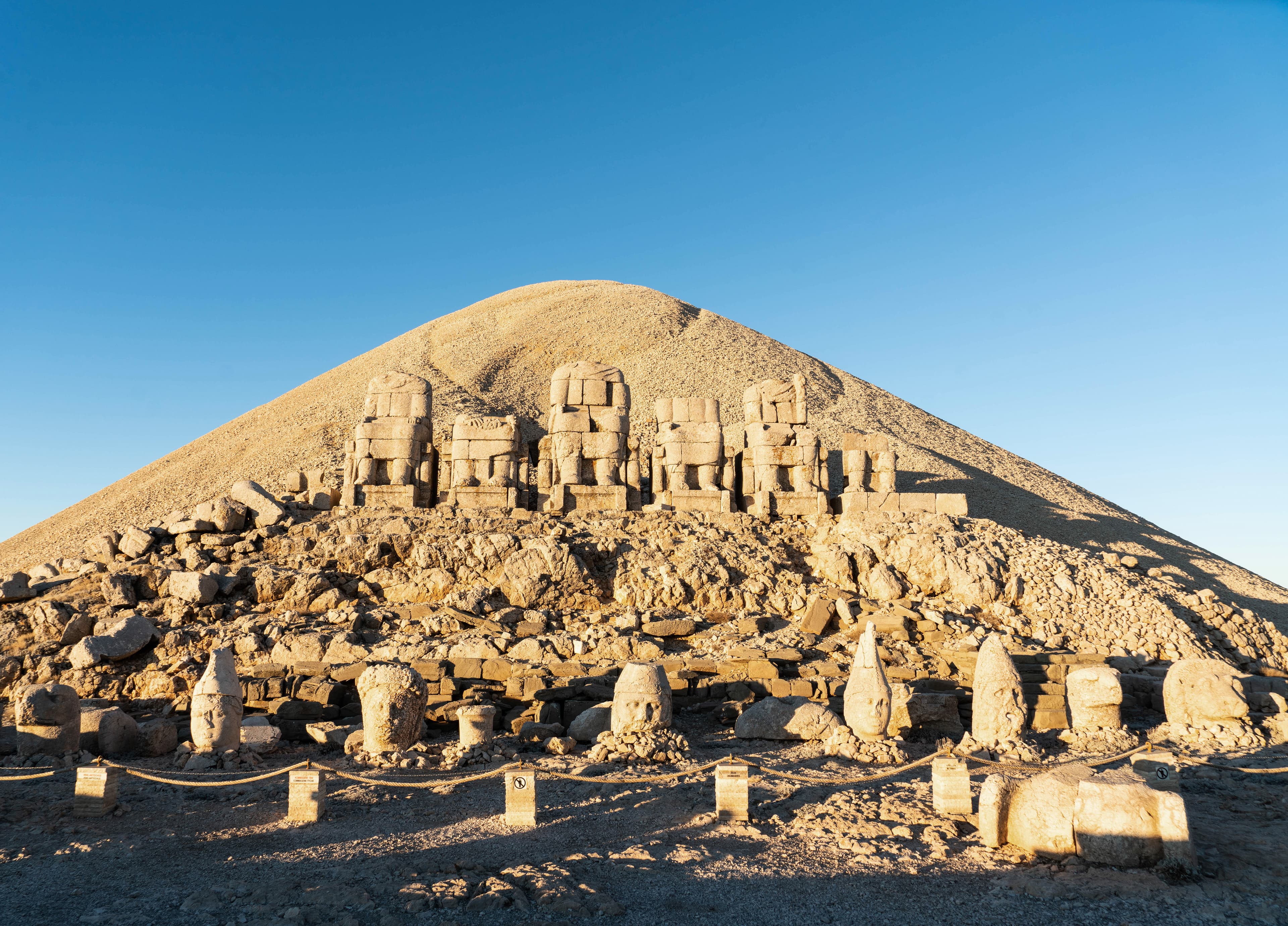
Visit essentials
A quick read before you go
- Duration
- Half day including travel from Kahta (40 km) or Karadut village (12 km); minimum 2 hours at the…
- Access
- Located 40 km north of Kahta, 75 km north of Adıyaman.
Overview
In the early first century BC, Commagene faced Rome expanding from the west and Parthia from the east. Antiochus I Theos, its king from 69 to 34 BC, claimed ancestry through Alexander the Great's generals and Darius the Great and made himself the meeting point of Greek and Persian divine lineages.
On Nemrut Dağ, at 2,134 metres the highest accessible peak of his kingdom, he built east and west terraces with five colossal limestone statues each, originally 8 to 9 metres tall: Antiochus among Zeus-Oromasdes, Apollo-Mithras, Artagnes-Heracles, and Tyche. Their deliberate Greek-Persian fusion made his theological claim visible, while the lion horoscope recorded the celestial configuration at the kingdom's founding.
Earthquakes toppled the statues' heads, which now lie beside their bodies. A 50-metre tumulus of broken limestone chips covers a burial chamber that has never been opened; Antiochus himself, if he is there, remains undisturbed.
Why this place is sacred
Antiochus did not choose this summit arbitrarily. At 2,134 metres, Nemrut Dağ rises above the plateau landscape of southeast Anatolia into a different atmospheric register. On clear mornings in spring and autumn, the summit is above the cloud layer; the terraces exist literally between earth and sky. This was the point.
The sanctuary is called a hierotheseion — a temple-tomb — and the theological principle it embodies is explicit in the inscriptions Antiochus left: that his soul, after death, would ascend to sit among the great gods. The summit was chosen as the point where that ascent was geographically closest to its destination.
The syncretistic theology of the statues — Zeus-Oromasdes, Apollo-Mithras-Helios-Hermes, Artagnes-Heracles-Ares — is not the casual eclecticism of a cultural borrower but a deliberate theological statement. Antiochus was arguing, in stone, that the apparent diversity of divine forms — Greek and Persian, Olympic and Zoroastrian — resolved into single deities when viewed from a sufficient altitude, which happened to be the altitude of his own royal consciousness.
The colossal statues of himself seated among these cosmic syntheses encoded this argument for all future generations.
The irony that persists now, twenty-one centuries later, is that the argument has outlasted the kingdom by two thousand years while being entirely refuted by the statues' condition: the heads lie on the ground, the bodies are headless, the tumulus is sealed, and whatever is inside remains unknown. Yet the faces still command attention, still orient visitors toward sunrise and sunset at the specific alignments Antiochus intended, and the mountain is still the mountain.
The bid for immortality partially succeeded in the way bids for immortality usually do — not as intended.
A hierotheseion — temple-tomb — built by Antiochus I Theos as a sanctuary where he and his syncretistic Greco-Persian deities would be worshipped, and where his soul would reside after death seated among the gods. Also functioned as a statement of royal divine authority intended to deter aggression from neighbouring powers.
Construction c. 62–38 BC → Commagene royal cult with annual festivals → absorption of Commagene into Roman province (72 AD), probable decline of active cult → abandonment → earthquake damage toppling statue heads (date unknown) → first modern documentation by Karl Sester 1881 → excavation by Theresa Goell from 1954 → UNESCO inscription 1987 → major tourism development → active heritage site with dawn/dusk visitor rituals
Experience and orientation
The logistical reality of Nemrut Dağ shapes the experience before you arrive: the summit is 40 kilometres from Kahta on roads that climb through spectacular plateau landscape, and the traditional visit involves arriving in darkness for sunrise. This is not incidental. Antiochus oriented his terraces specifically: the east terrace faces the sunrise, the west terrace faces the sunset.
The modern practice of gathering at the east terrace before dawn replicates, in secular form, the solar cult that was part of the Apollo-Mithras-Helios worship the statues represent.
In the last hour before sunrise, the east terrace fills with visitors from the overnight lodges in Karadut village below. Stand among them in the dark and let the summit wind — which at 2,134 metres is often fierce even in summer — register on your body. The first light comes as a pale thinning to the east rather than a sudden illumination.
The colossal heads — Zeus, Apollo, the king — emerge from darkness progressively, the limestone acquiring colour as the sky brightens behind them. At the moment of sunrise, the light catches the stone faces from a low angle that throws their features into relief. Viewers fall quiet at this point regardless of any shared intention.
After the crowds thin, move among the heads and bodies at close range. The scale of the original statues — heads alone are approximately 2 metres tall — becomes legible from this proximity. The carving retains extraordinary detail: the features of each deity are distinct, the hair and beard textures specific, the condition of each stone different depending on where it landed when it fell.
The eagle and lion statues flanking the human figures are largely intact; stand next to them to understand what the full installation originally looked like.
The west terrace has the same statues in the same configuration, less visited than the east terrace because sunset draws smaller crowds. If time allows, make the traverse between terraces along the path that crosses the tumulus. The tumulus itself — 50 metres of broken limestone chips — is visually underwhelming. That is the point: it was built to be impenetrable, not beautiful. What lies beneath it has not been disturbed.
Arrive at the east terrace 30–45 minutes before sunrise. After sunrise, move among the heads and bodies at close range. Traverse to the west terrace. Allow 2 full hours at the summit after arrival.
Context and lineage
Antiochus I Theos inherited the small kingdom of Commagene in southeast Anatolia at a moment of political precarity and theological ambition. His lineage gave him what he needed: he claimed descent from Alexander the Great's general Seleucus Nicator on his father's side and from the Achaemenid Persian royal line through his mother, making him the living synthesis of Greek and Persian divine authority.
The lion horoscope relief at the site records the celestial configuration of 7 July 62 BC — the date scholars have identified as either the kingdom's founding moment or Antiochus's coronation — permanently encoding this cosmic instant in stone on the summit. The Nomos, or Law, which Antiochus composed in inscriptions at the site, described his theological vision and decreed annual festivals to be celebrated by priests on his birthday and coronation anniversary.
He intended the site to function as an eternal sanctuary where his soul would sit among the great gods after death. Karl Sester, a German engineer, was the first modern person to document the site in 1881. Theresa Goell conducted the major excavation campaigns from 1954, opening the scholarly study of Commagene.
Construction c. 62–38 BC → Commagene royal ancestor cult with annual festivals → Roman provincial absorption (72 AD) and probable cult decline → earthquake damage (date uncertain) → abandonment → first modern documentation 1881 → excavation from 1954 → UNESCO inscription 1987 → current heritage site
Traditions and practice
Antiochus decreed the ritual programme in inscriptions still legible at the site: annual festival celebrations on the 16th day of the month Audnaios (his birthday) and the 10th day of Loos (his coronation anniversary). Priests were to offer fire and feast before the colossal statues on these days. The fire cult likely reflected Zoroastrian influence from the Persian side of Antiochus's theological synthesis.
Solar worship at sunrise and sunset was built into the site's physical orientation: the Apollo-Mithras-Helios figure among the statues integrated the Persian sun-god Mithra with the Greek solar deity, and the eastern terrace's orientation toward sunrise enacted this theology daily.
The modern sunrise ritual is the site's most significant active practice, though entirely secular in form: hundreds of visitors gather before dawn at the east terrace for the light-over-stone moment, which replicates the solar-divine alignment that Antiochus encoded into the site's geography. No religious ceremonies are currently conducted. Some visitors leave small stones informally near the statues.
The site's most powerful encounter is with the fallen heads at close range, with patience. Do not spend the entire visit photographing — sit down near one of the heads and look at it for ten minutes without a camera. The craftsmanship, the scale, the specific stone of which it is made, the condition of two thousand years of exposure: these register differently in sustained attention than in documentation.
Before sunrise, use the darkness to orient yourself to the summit landscape — the plateau below, the sky above, the wind. When the light comes, watch the whole terrace rather than only through a lens. After the other visitors leave for breakfast, the east terrace is briefly quiet; this is when the site's contemplative dimension is most accessible.
On the traverse between terraces, pause at the tumulus and register its inaccessibility. Something in this mountain has not been opened. That fact is its own invitation to reflection.
Commagene Royal Ancestor Cult
HistoricalAntiochus I Theos built the hierotheseion as his own mausoleum and as a sanctuary where he and his divine ancestors would be worshipped; annual festivals on his birthday and coronation day were decreed in inscriptions still legible at the site.
Dynastic ancestor worship, fire offerings before the colossal statues, priestly sacrifice, annual feast-day celebrations.
Syncretistic Greco-Persian Deity Worship
HistoricalThe colossal statues represent deliberate theological syntheses — Zeus-Oromasdes, Apollo-Mithras-Helios-Hermes, Artagnes-Heracles-Ares — asserting through iconography that Greek and Persian divine traditions converge in the Commagene royal understanding.
Sacrifice before the colossal deities, fire cult with Zoroastrian influence, solar worship at sunrise and sunset.
Modern Sunrise Pilgrimage
ActiveThe experience of watching the sun rise over the colossal fallen heads on the east terrace has become a secular pilgrimage ritual in its own right, drawing visitors from around the world who gather in silence before dawn.
Pre-dawn ascent, silent gathering at the east terrace, the moment of sunrise over the stone faces, photography and contemplation.
Perspectives and open questions
Nemrut Dağ is interpreted simultaneously as a masterwork of Hellenistic political theology, as an exceptional example of royal funerary ambition, and as a site whose solar orientation and astronomical encoding have attracted significant scholarly and popular attention.
Scholarly perspective
Scholarly consensus recognises Nemrut Dağ as the finest surviving example of Commagene art and one of the most ambitious monumental projects of the Hellenistic period. The syncretistic theology of Antiochus is well-documented in the site's inscriptions and has been thoroughly analysed. The lion horoscope has been astronomically dated to 7 July 62 BC by Otto Neugebauer and others.
The royal burial chamber within the tumulus has never been excavated — surveys suggest chambers within, but the fragile broken-limestone construction has prevented safe access. This remains one of the most significant potential archaeological discoveries in Turkey.
Living and traditional perspectives
The Adıyaman region's contemporary population takes genuine pride in Nemrut Dağ as a symbol of the region's ancient royal heritage. Local guides typically emphasise the site's distinctiveness as a product of a small, independent-minded kingdom that refused to be simply Greek or simply Persian and instead created something singular.
Alternative interpretations
Some writers interpret the astronomical precision of the site — the lion horoscope, the solar orientation of the terraces, the mountain's position relative to other Commagene monuments at Arsameia and Karakuş — as evidence of a sophisticated sacred geography programme linking earth and cosmos in the tradition of earlier Mesopotamian astral religion. In this reading, Antiochus was not creating a personal monument but aligning his kingdom with a pre-existing cosmic architecture, using the mountain as its highest expression.
Open questions
The unopened tumulus is the greatest unanswered question: whether it contains an intact burial chamber, what it might hold in terms of objects and human remains, and whether Antiochus's body is actually there or was moved elsewhere, perhaps when the kingdom was absorbed into Rome in 72 AD.
The exact ritual life of the sanctuary during the Commagene period — who officiated, the frequency of ceremony, what the festivals actually involved beyond the inscriptional decree — is known only from Antiochus's own prescriptions, not from excavated evidence.
Plan your visit
Access and arrival
Located 40 km north of Kahta, 75 km north of Adıyaman. Nearest airport: Adıyaman Airport (domestic flights from Istanbul and Ankara). By car from Adıyaman approximately 1 hour 15 minutes; from Şanlıurfa approximately 2.5 hours. Karadut village (12 km from summit) is the best base for overnight stays and sunrise visits. Shuttle buses operate the final 1–1.5 km to the trailhead (mandatory — personal vehicles not permitted to the trailhead). 25-minute stair climb to the summit.
Entrance fee approximately €10 for foreign visitors. Site open 04:00–18:00 in season (ticket sales close 17:45); early opening allows sunrise access.
Karadut village (12 km from summit, ~1,600m elevation) has small hotels and guesthouses, some with sunrise package programmes including wake-up call and shuttle transport. Kahta (40 km) has a wider range. Adıyaman city (75 km) for full hotel infrastructure.
Respectful visit
Warm layers are not optional — summit winds can make temperatures feel significantly below air temperature year-round. Bring at minimum a wind-resistant jacket even in summer. Sturdy footwear for the stair climb and the uneven terrace paths.
Widely practised and expected; flash photography of stone details is respectful and does not harm the stone.
Not formally applicable. Some visitors leave small stones near the statues — an informal custom with no ancient precedent but no particular harm.
Do not climb on any statues, heads, or stone plinths. Do not touch the stone faces — oils from hands damage ancient limestone. Do not remove any stone, fragment, or gravel from the tumulus or terraces. Stay on designated paths.
Summit temperatures are significantly lower than valley temperatures and winds can be fierce even in summer — bring warm layers regardless of the season. The 25-minute stair climb from the shuttle bus drop-off is steep; allow sufficient time, particularly in darkness for sunrise visits. The road to the summit is closed in winter (approximately November–April) due to snow. The shuttle bus service is mandatory for the final kilometre or more; personal vehicles cannot reach the summit trailhead.
Location
Map loads as you approach this section.
Pilgrim reflections
A portrait of encounter, not a score
Pilgrims describe what they felt, how present they could become, and whether the place would shape a journey. There are no stars and no ranking of traditions.
No reviewed reflections yet
The first pilgrims can help describe the character of being here.
Share a reflection
Available after an account-backed “Been there.” Every reflection is reviewed before publication.
Nearby sacred places
Explore other sacred places in the region. Proximity does not establish access or travel time; check each place’s guidance.


References
Sources consulted for this page. Source categories describe the publication, not a guarantee that every claim is verified. Traditional accounts and outside interpretations may differ.
- 01Nemrut Dağ - UNESCO World Heritage Centre — UNESCOofficialOfficial UNESCO inscription and Outstanding Universal Value description
- 02Nemrut Dağ | History, Description, & Facts — Encyclopaedia BritannicaencyclopediaAuthoritative encyclopaedia entry
- 03Smarthistory – Nemrut Dağ (tomb of King Antiochus I Theos) — SmarthistoryacademicAcademic art history and iconographic analysis
- 04The Discovery of the Colossal Coronation Horoscope of Antiochus I King of Commagene on Mt Nemrud — Academia.eduacademicPeer-reviewed study on the lion horoscope and astronomical alignment
- 05Mount Nemrut | Turkish Archaeological News — Turkish Archaeological NewsacademicArchaeological research updates
- 06Mount Nemrut - Wikipedia — Wikipedia contributorsencyclopediaComprehensive history, architecture, and archaeological overview
- 07Mount Nemrut and the God King of Commagene — Ancient OriginsacademicDetailed historical and mythological context
- 08Nemrut Dagi - World Pilgrimage Guide — Sacred Sites / Martin GrayspiritualSpiritual significance and pilgrimage context
- 09Mount Nemrut: UNESCO World Heritage Site Of The Commagene Kingdom — Chasing the DonkeyguideComprehensive visitor guide
- 10How to Visit Mount Nemrut: Turkey's Mountaintop UNESCO World Heritage Site — The Mediterranean TravellerguidePractical access, sunrise logistics, and visitor tips
Share a photo
Help visitors recognize Nemrut Dagi. Every submission is reviewed before publication.