Kanlıdivane
A 70-metre chasm the ancient world called the threshold between life and divine judgment
Understand sacred places, explore living traditions, and learn how to engage respectfully with Pilgrim Map.
Access has not been verified. Check current local guidance before planning a visit.
Mersin, Turkey
Read the sources
Visit essentials
A quick read before you go
- Duration
- 1.5–2.5 hours for a thorough visit to the sinkhole, tower, basilica ruins, and necropolis…
- Access
- Located in Erdemli district, Mersin Province.
Overview
Kanlıdivane's central sinkhole is roughly 144 metres long, 90 metres wide, and 60 to 70 metres deep, with sheer walls and small caves. In cultures treating the underworld as real and below, such a void needed little interpretation as sacred.
The Olba priest-kings' Hellenistic tower, built in the second or first century BC, consecrated what geography established. The chasm belonged to Zeus Olbios, supreme deity of the local kingdom; wild animals said to inhabit its floor were instruments of judgment, and condemned criminals were reportedly cast in. At its edge stands the 17-metre tower built by Teukros son of Tarkyares, a cultic focal point rather than fortification.
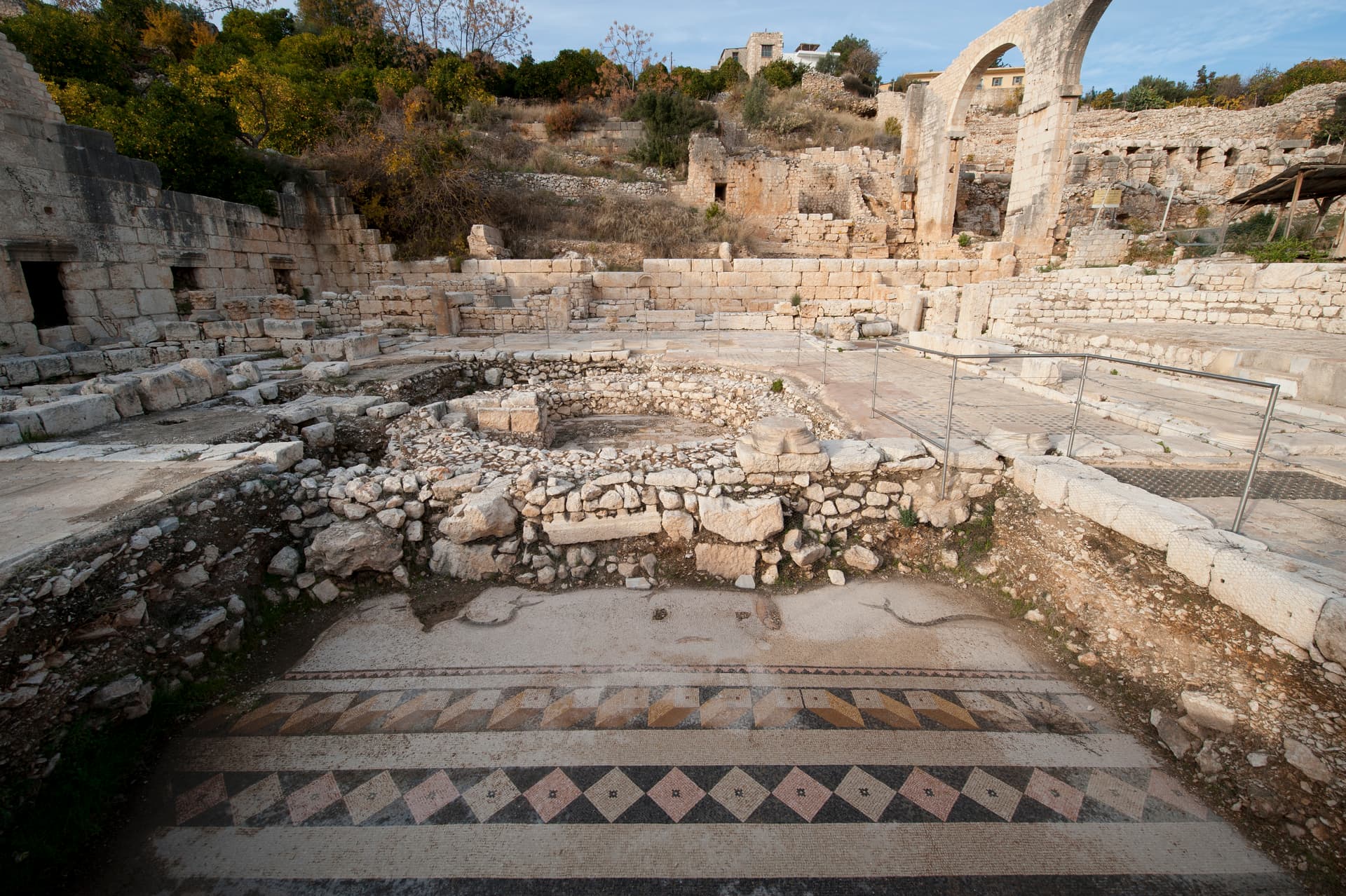
When Emperor Theodosius II refounded the city as Neapolis in the fifth century AD, four Christian basilicas turned the same precinct into a Christian center without changing its geography. The city was abandoned in the eleventh century for unknown reasons. The sinkhole remained.
Why this place is sacred
Thin places are often described as locations where the membrane between ordinary and sacred reality feels permeable. Kanlıdivane makes this phenomenological rather than metaphorical: the ground genuinely opens beneath your feet, dropping seventy metres into a chasm whose bottom holds small caves and, according to ancient report, wild beasts. The vertical distance functions as sacred architecture more effectively than any constructed temple. What is above and what is below are separated by a fall that cannot be survived.
The Olba priest-kings understood this immediately and worked with it rather than against it: they did not build over the sinkhole or around it but oriented their entire settlement toward it, using the tower to anchor the cultic axis at the void's rim.
The inscription-attested practice of casting criminals into the chasm as divine punishment is in one sense brutal, but in another sense it articulates something true about the site — this is a place where categorical distinctions (living/dead, sacred/profane, human/divine) are not gradually eroded but suddenly resolved.
The transition from Zeus Olbios to Christ worship in the fifth century did not change the site's sacred character so much as rename it: the same vertical axis, the same sense of a threshold between realms, now addressed to a Christian god. A thousand years of continuous religious use at the same chasm, across two entirely different theological systems, is among the clearest records of perennial sacred geography available in the ancient world.
Kanytelis was a sacred city of the Olba kingdom, centred on the chasm as a cultic locus of Zeus Olbios. The Hellenistic tower served as the built focal point of this cult. The surrounding settlement functioned as both a sacred precinct and a civil community under the Olba priest-kings.
The site transitioned from Olba cult centre to Roman municipal city to Byzantine Christian religious centre (renamed Neapolis under Theodosius II, r. 408–450 AD), accumulating four basilicas, a bishop's seat, and further funerary infrastructure. The city was abandoned in the eleventh century — the reasons remain undocumented — and the ruins have remained largely intact since.
Experience and orientation
The site reveals itself in layers as you move through it. Arrive and pay the small admission fee; the path leads quickly to the sinkhole rim. Stop there before anything else. Look down into the chasm — the vertical walls, the small caves in the rock below, the vegetation at the floor. Stay at the rim for longer than feels natural. The void does something to depth perception: the eye keeps recalibrating.
The ancient world's associations with divine judgment and chthonic presence were not projections onto a neutral landscape; they were accurate readings of what the landscape does to human consciousness. The Hellenistic tower rises 17 metres at the sinkhole's edge, its stones still largely intact — an anchor, a marker, a cultic instrument. Walk the perimeter of the chasm before moving to the Byzantine basilica ruins scattered across the plateau. Four churches, now roofless, their apse walls standing to varying heights.
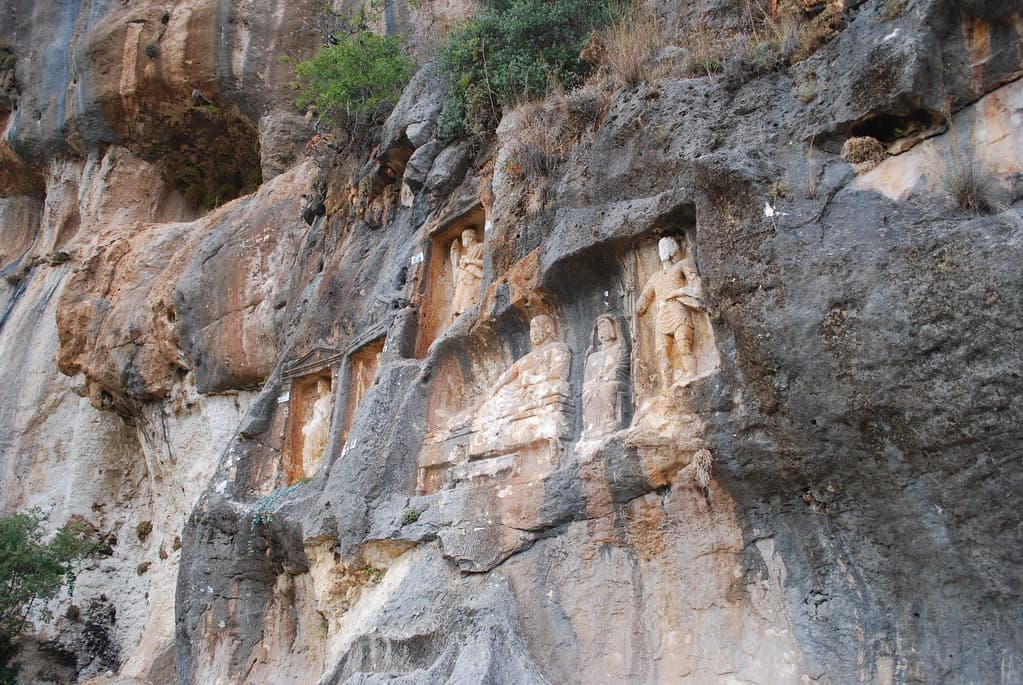
The quality of light inside the apse walls in the afternoon — raking across the dressed stone — rewards patience. Then follow the path 300 metres south or southeast to the necropolis ravine, where 1st and 2nd century AD temple-tomb facades were carved directly into the ravine walls. The carvings are finer here than their remote location suggests: family groups, military figures, a mountain goat. Look also for the carved reliefs of individuals on the cliff faces near the necropolis.
These are not anonymous decorations; they are portraits of specific people, placed in the stone to keep the dead present in the landscape of the living.
The site is roughly divided into three zones: the sinkhole and Hellenistic tower (centre); the Byzantine basilica ruins (distributed around the plateau); and the necropolis ravine (approximately 300 m to the south or southeast). A full circuit takes 1.5 to 2.5 hours. Wear footwear suitable for uneven terrain. The sinkhole rim has no barrier — maintain awareness near the edge.
Context and lineage
The Olba kingdom that dominated Rough Cilicia in the Hellenistic period was governed by a line of priest-kings who derived their authority from their role as servants of Zeus Olbios. Kanytelis — the ancient name of the site — was one of the kingdom's sacred centres. The priest-king Teukros son of Tarkyares built the 17-metre Hellenistic tower here as the cultic focal point for the Zeus Olbios worship centred on the chasm.
The sinkhole was understood as the dwelling place of wild animals associated with divine judgment, and the tradition of casting condemned criminals into it reinforced the site's function as a locus of sacred authority. Ancient sources compared the site to Lourdes in its intensity as a pilgrimage centre — a place people came to because something divine was present, not merely historically significant. The transition to Christianity under Theodosius II (r.
408–450 AD) was documented as a relatively seamless cultural continuation: the emperor refounded the city as Neapolis and built four basilicas, but the site's sacred character was not disputed, only redirected. The city flourished into the sixth century before entering decline and final abandonment in the eleventh century.
Hellenistic Olba kingdom (sacred city and Zeus Olbios cult centre) → Roman municipal city → Byzantine Christian religious centre (Neapolis, founded by Theodosius II) → decline and abandonment 11th century AD → archaeological site
Teukros son of Tarkyares
Olba priest-king who built the Hellenistic tower as cultic focal point for the Zeus Olbios worship
Emperor Theodosius II (r. 408–450 AD)
Refounded the city as Neapolis and established its four Byzantine basilicas, transforming it into a Christian religious centre
Traditions and practice
The core sacred practice at Kanytelis in the Hellenistic period was the worship of Zeus Olbios conducted in relationship to the chasm. Votive inscriptions attest to offerings made at the site. The tradition of casting condemned individuals into the sinkhole — whatever its historical frequency — functioned as a form of sacred adjudication, the divine order expressed through geography.
The necropolis 300 metres from the sinkhole hosted funerary rites from the 1st and 2nd centuries AD, with elaborate temple-tomb facades demonstrating the importance of ancestor commemoration in this community. The Byzantine basilicas that replaced these earlier structures continued the sacred life of the site in Christian form: liturgy, episcopal administration, pilgrimage. The sinkhole, now stripped of its association with Zeus, remained the site's most powerful physical feature.
No active religious community uses the site. Archaeological research and heritage tourism are the current forms of engagement. A small admission fee supports basic site maintenance.
Begin at the sinkhole rim and give it full attention before moving anywhere else. Arrive early — the morning light falls differently into the chasm at different hours, and the crowds, such as they are, thin quickly. Walk the sinkhole perimeter completely before entering the basilica ruins. In the basilica apses, stop inside and stand still; the acoustic quality of partially enclosed roofless stone is distinctive.
At the necropolis ravine, move slowly past the carved tomb facades and look carefully at the rock-cut reliefs of individuals — the faces carved in rock for an immortality that has, in some sense, been achieved, since they are still here two millennia later. If you are drawn to thresholds in the spiritual sense, spend additional time at the sinkhole rim. The vertical drop is the site's most honest theological statement.
Zeus Olbios Cult (Olba Kingdom)
HistoricalThe sinkhole was the physical centre of the Zeus Olbios cult maintained by the Olba priest-kings. The Hellenistic tower built by Teukros son of Tarkyares was the cultic focal point at the void's edge. The site was described by one ancient scholar as comparable in sacred intensity to Lourdes. Criminals condemned under divine authority were cast into the chasm.
Votive offerings; altar use; dedicatory inscriptions; judicial-sacred rites at the sinkhole.
Byzantine Christianity
HistoricalEmperor Theodosius II refounded the city as Neapolis and built four basilicas on the same sacred ground, transforming the pagan centre into a Christian religious hub. The site flourished as an episcopal city through the sixth century.
Christian liturgy; pilgrimage; episcopal administration.
Archaeological Heritage
ActiveThe site preserves exceptional karst-landscape sacred architecture including the 17 m Hellenistic tower, four Byzantine basilica ruins, a 1st–2nd century AD necropolis with temple-tomb facades, and rock-cut family and soldier reliefs. Active research continues under Turkish academic and Ministry of Culture oversight.
Academic survey and excavation; heritage tourism.
Perspectives and open questions
Kanlıdivane invites at least four distinct reading strategies: geological-sacred (the karst void as natural theology), religious-historical (the continuity of cult across paganism and Christianity), archaeological (the layering of Hellenistic, Roman, and Byzantine structures), and phenomenological (what it feels like to stand at a seventy-metre drop).
Scholarly perspective
Kanlıdivane is understood as a well-documented example of Hellenistic sacred landscape repurposed for Christian use in Late Antiquity. The Zeus Olbios cult of the Olba dynasty is one of the better-preserved records of local Anatolian Hellenistic religion. The architectural sequence — Hellenistic tower, necropolis, Roman municipal buildings, Byzantine basilicas — represents an unusually complete stratigraphic narrative of religious change across a single site over nearly a millennium.
Living and traditional perspectives
The Turkish name Kanlıdivane — 'Bloody Crazy Place' — preserves folk memory of the chasm's ancient reputation for violence and divine judgment. The name functions as an unbroken chain of oral transmission connecting the present to the ancient practice of casting criminals into the void. Local knowledge of the site as dangerous and potent predates modern archaeology.
Alternative interpretations
The sinkhole's sheer verticality and subterranean echoes attract those interested in chthonic and underworld symbolism — the idea of the earth opening as a direct expression of what lies beneath consciousness. The documented thousand-year continuity of sacred use at the same void, across two completely different theological systems, supports readings of perennial sacred geography: the place itself generates the sacred encounter, regardless of which name is given to what was met there.
Open questions
The specific ritual procedures of the Olban priestly hierarchy at the sinkhole — how sacrifices were performed, how the cult was transmitted, what the tower's interior contained — are not documented. The reasons for the city's abandonment in the eleventh century remain completely unknown, as does the fate of its population.
Plan your visit
Access and arrival
Located in Erdemli district, Mersin Province. Approximately 18 km from Erdemli town and 55 km from Mersin city. Accessible by car via the D400 coastal highway (Mersin–Silifke). A dolmuş (shared minibus) from Erdemli to the site area is possible but infrequent; car is more reliable. Small admission fee charged at entrance. Altitude approximately 230 m above sea level. No services at the site; bring water and food. Nearest services in Erdemli.
Erdemli and Kızkalesi offer accommodation ranging from pensions to mid-range hotels. Mersin city (55 km) has full facilities. The coastal corridor from Kanlıdivane east to Kızkalesi is the base for multiple Rough Cilicia sites.
Respectful visit
No specific dress requirement. Sturdy footwear with grip is essential for the uneven terrain. Sun protection is strongly recommended.
Permitted throughout the site. The sinkhole is challenging to photograph well — afternoon light gives the best depth rendering. The carved tomb facades and cliff reliefs reward macro attention.
Not applicable. The ancient cultic traditions at this site have no living continuation.
Do not climb the Hellenistic tower. Do not approach the sinkhole edge without firm footing. Do not touch or scratch carved surfaces. Do not remove any stones or fragments.
The sinkhole rim has no safety barriers. Exercise care, especially with children. The terrain around the basilica ruins and between zones is uneven. Wear footwear with grip. Summer temperatures at this latitude (36°N) can be intense — carry water and consider an early start.
Location
Map loads as you approach this section.
Pilgrim reflections
A portrait of encounter, not a score
Pilgrims describe what they felt, how present they could become, and whether the place would shape a journey. There are no stars and no ranking of traditions.
No reviewed reflections yet
The first pilgrims can help describe the character of being here.
Share a reflection
Available after an account-backed “Been there.” Every reflection is reviewed before publication.
Nearby sacred places
Explore other sacred places in the region. Proximity does not establish access or travel time; check each place’s guidance.


References
Sources consulted for this page. Source categories describe the publication, not a guarantee that every claim is verified. Traditional accounts and outside interpretations may differ.
- 01Kanytelis | Turkish Archaeological News — Turkish Archaeological NewsacademicArchaeological site profile with scholarly references
- 02Mersin Kanlı Divane (Kanytelleis) Archaeological Site — Turkish MuseumsofficialOfficial Turkish Ministry of Culture affiliated listing
- 03Kanlıdivane - Wikipedia — Wikipedia contributorsencyclopediaCovers history, sinkhole dimensions, Zeus Olbios cult, Byzantine period and abandonment
- 04Kanlıdivane - Karst Features of Turkey — Showcaves.comSource contextDetailed geological description of the sinkhole (collapse doline) with dimensions
- 05Kanlıdivane, Turkey Guide — Turkey Travel PlannerguidePractical visitor information and site description
- 06Kanytelis – Following Hadrian Photography — Following HadrianguidePhotographic essay with descriptive captions of key structures
- 07Kanlıdivane | Lonely Planet — Lonely PlanetguideTravel guide entry confirming key features and access
- 08Kanlidivane sinkhole and ancient city — Private Tour TurkeyguideGood overview of the city's Olba period sacred significance
Share a photo
Help visitors recognize Kanlıdivane. Every submission is reviewed before publication.