Ishi-no-Hoden, Himeji
Japan's floating stone mystery where two healing gods sealed their spirits for eternity
Understand sacred places, explore living traditions, and learn how to engage respectfully with Pilgrim Map.
Access has not been verified. Check current local guidance before planning a visit.
Takasago, Hyogo Prefecture, Japan
Read the sources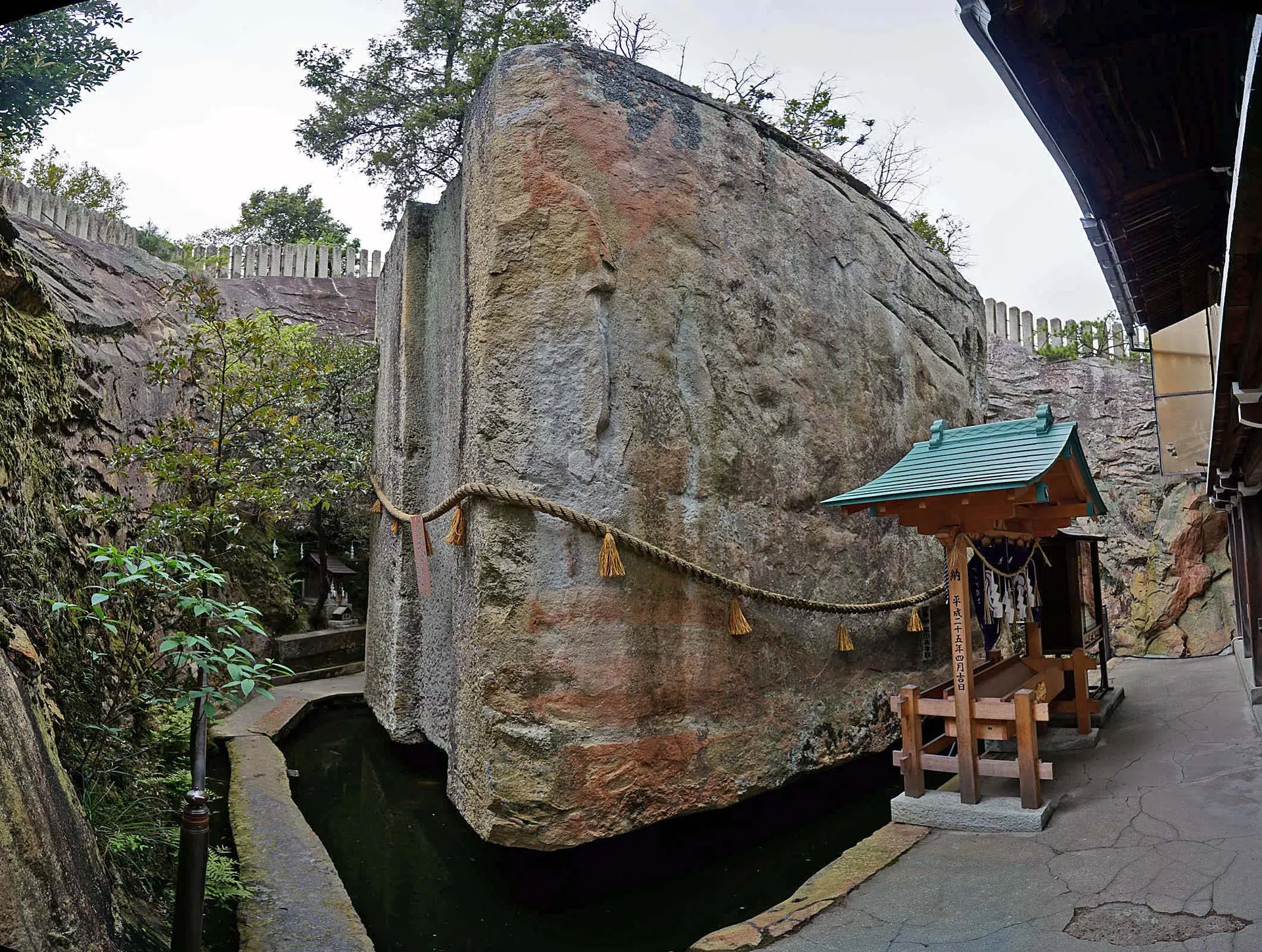
Image of Ishi-no-Hoden, Himeji. Image source · CC-BY-3.0
Visit essentials
A quick read before you go
- Duration
- 1 hour to include shrine worship and contemplation
- Etiquette
- Standard Shinto shrine etiquette applies.
Overview
Ishi-no-Hoden stands at Oshiko Shrine in Takasago as one of Japan's Three Great Wonders. Laser measurements in 2005-2006 found a carefully shaped megalith roughly 5.7 meters wide, 6.4 meters high, and 5.7 meters deep, weighing approximately 500 tons and showing no visible tool marks. A channel wide enough for one person separates it from the bedrock; water persists even in drought, creating the floating appearance behind its name Ame no Ukiishi, the Celestial Floating Stone.
The Harima Fudoki recorded it in 713-717 CE, though it may date to the Kofun period, when nearby Tatsuyama quarries supplied aristocratic sarcophagi. The apparently unfinished monument's purpose and abandonment remain unknown. According to one account in the ancient chronicles, Okuninushi and Sukunabikona left their spirits within it to pacify the land. Another tradition says that consecration under Emperor Sujin quelled a plague that killed half of Japan's population. That healing association brought increased pilgrimage during COVID-19.
Why this place is sacred
What draws pilgrims to Ishi-no-Hoden across thirteen centuries is not easily categorized. The monument presents itself as a koan in stone: massive yet appearing weightless, ancient yet precisely formed, documented yet unexplained. The floating effect is not illusion but architecture. The stone rests on a hidden pillar beneath the water's surface, but the visual impression remains: something impossible made manifest. The water itself contributes to the atmosphere of the numinous.
It never dries, locals say, even when drought affects surrounding areas. Whether this represents careful engineering or something less explicable, the perpetual presence of water surrounding the stone creates a sense of something preserved outside ordinary time. The two deities associated with the stone bring complementary powers. Okuninushi, whose primary shrine stands at Izumo Taisha, is the kami of nation-building, farming, and medicine, the great land-shaper who developed Japan in mythological times before ceding rule to Amaterasu's descendants.
Sukunabikona is tiny in stature but vast in knowledge, the kami of hot springs, healing, agriculture, and magic, who worked alongside Okuninushi to complete the building of the land. Together they represent wholeness: the great and the small, the visible and the hidden, the political and the medical. That they chose this stone as their eternal dwelling marks it as a place where healing can be found.
The shimenawa rope encircling the megalith declares what visitors already sense: this is marked territory, set apart from the ordinary. The designation as one of Japan's Three Great Wonders places it alongside two other sites that defy easy explanation: the mysterious salt cauldrons at Shiogama Shrine and the inverted spear atop Mount Takachiho. What unites these sites is not a category but an atmosphere, a quality of encountering something that exceeds available understanding.
Sacred object housing the spirits of two healing deities who promised to pacify the land.
First documented in the Harima Fudoki (713-717 CE). Continuously venerated at Oshiko Shrine. Visited and sketched by German physician Philipp Franz von Siebold in 1826. Designated a National Historic Site in 1979. Laser-measured by Takasago City and Otemae University in 2005-2006. Remains an active shrine with ongoing pilgrimage, particularly for those seeking healing.
Experience and orientation
The approach to Ishi-no-Hoden carries you up a slight rise through the grounds of Oshiko Shrine. The monument does not announce itself from a distance; you come upon it gradually, and then the scale registers. This is not a small curiosity but a massive presence, a shaped mass of rhyolite that would require modern cranes and considerable effort to move. Yet it sits in its pool of water with a lightness that seems to contradict its weight.
For a small admission fee, visitors can walk the narrow passage that circles the stone. The channel between megalith and bedrock is wide enough for only one person at a time, requiring a single-file circumambulation that becomes, almost inevitably, a form of meditation. You are alone with the stone, the water at your feet, the surface of the carved rock rising beside you. The absence of visible tool marks on this surface prompts questions that have no ready answers.
How was this made? With what? By whom? The healing ritual associated with the site involves a smaller sacred rock near the main megalith. Visitors push this stone with all their strength, then touch it and place their hand on whatever part of their body they wish to heal or strengthen. This tactile practice connects the visitor physically to the site's healing tradition, engaging body rather than just mind in the encounter.
The two enshrined deities are present in this act: Okuninushi and Sukunabikona, both associated with medicine and restoration. The shrine buildings offer the standard elements of Shinto worship: a temizu basin for purification, an offering box, omamori for purchase. But the stone itself is the heart of this place, the reason the shrine exists, and returning from your circumambulation to face it once more, you may find that the mystery has not diminished but deepened.
Enter through the shrine's torii gate. The main megalith is housed within the shrine compound. Purchase a small admission ticket to access the walkway that allows circumambulation. The healing stone ritual is performed at a smaller rock nearby. Standard Shinto worship facilities are available at the main shrine building.
Context and lineage
The primary legend tells of Okuninushi and Sukunabikona traveling from Izumo to Harima as peacemakers during troubled times. Granted a single day to build a stone palace that would foster harmony, they labored through the night only to be thwarted by rebellious local kami. Dawn broke with the structure incomplete, but the two gods declared their spirits would remain within the stone forever, pacifying the land for eternity.
A separate tradition connects the stone to epidemic protection: when an unknown plague devastated Japan during Emperor Sujin's reign, the emperor received divine instruction in a dream to consecrate this stone. Following the gods' guidance, the epidemic was quelled, and the stone became a seal of divine protection against disease.
Ishi-no-Hoden exists within a broader landscape of Japanese megaliths and sacred stones, though its size and form make it singular. The connection to Okuninushi links it spiritually to Izumo Taisha, Japan's second most important shrine. The Tatsuyama quarries surrounding the site provided stone for Kofun-period sarcophagi, suggesting a deep connection between this landscape and practices involving stone, death, and the sacred.
Okuninushi
Sukunabikona
Philipp Franz von Siebold
Traditions and practice
The healing ritual involves finding a smaller sacred rock near the main megalith, pushing it with all one's strength, then touching the rock and placing one's hand on the body part one wishes to heal. This practice invokes the blessings of the two enshrined deities, both associated with medicine. Circumambulation of the megalith has been practiced for centuries, allowing pilgrims to experience the monument from all angles while absorbed in its presence.
The shrine has traditionally attracted those seeking protection from illness, particularly epidemics.
Standard Shinto worship at Oshiko Shrine includes purification at the temizu basin, offerings, and prayer. Omamori protective amulets are available for purchase. During the COVID-19 pandemic, the shrine saw increased pilgrimage as people sought the ancient protection associated with the epidemic-quelling legend. The healing stone ritual remains popular and is accessible to all visitors.
Begin with purification at the temizu basin. Approach the main shrine for formal worship if you wish. Pay the small admission fee to circumambulate the megalith, moving slowly through the narrow passage and allowing the stone's presence to register fully. Perform the healing ritual with the smaller sacred stone if there is some aspect of yourself you wish to address. Notice the water that surrounds the stone, said never to dry.
Allow time for the mystery to work on you without demanding resolution.
Shinto
ActiveIshi-no-Hoden serves as the shintai of Oshiko Jinja shrine, the sacred object believed to house the spirits of Okuninushi and Sukunabikona. The two deities are worshipped together as divine protectors who sealed their spirits within the stone to pacify the land for eternity. The shrine is counted among Japan's Three Great Wonders and is considered a powerful place for healing.
Prayer and worship at Oshiko Jinja. Healing ritual involving pushing a smaller sacred rock and placing hands on the body part one wishes to heal. Circumambulation of the megalith. Purchasing omamori charms for protection. Pilgrimage for epidemic protection and general healing.
Perspectives and open questions
Ishi-no-Hoden presents multiple lenses for understanding: archaeological mystery, Shinto sacred object, healing shrine, and enduring cultural landmark.
Scholarly perspective
Archaeological consensus acknowledges Ishi-no-Hoden as a significant megalithic monument deserving of its 1979 designation as a National Historic Site. The 2005-2006 laser measurement study confirmed its dimensions but could not determine when, by whom, or for what purpose it was carved. The nearby Tatsuyama Stone Quarries date from the Kofun period (250-538 CE), suggesting possible contemporary construction, and the stone type matches that used for aristocratic sarcophagi.
The monument's mention in the Harima Fudoki (713-717 CE) provides the earliest written documentation. Scholars note that no tool marks are visible on the surface, though whether this indicates advanced techniques or simply weathering remains debated. The structure appears unfinished, with a protrusion at the top that may represent a planned attachment point never completed.
Living and traditional perspectives
Within Shinto tradition, the stone is understood as the eternal dwelling place of Okuninushi and Sukunabikona, two powerful deities who sealed their spirits within it to protect the land. These kami are associated with nation-building, healing, medicine, and protection against epidemics. The stone functions as a shintai, a physical object in which the kami reside, making it the sacred heart of Oshiko Shrine. The mysterious floating appearance and the water that never dries are seen as evidence of divine presence.
The designation as one of Japan's Three Great Wonders reflects its status as something that transcends ordinary understanding.
Alternative interpretations
Some alternative researchers point to the lack of visible tool marks and the precision of the carving as evidence of advanced ancient technology beyond conventional archaeological explanation. The stone's inclusion among Japan's Three Great Wonders reinforces its status as genuinely anomalous. As a 'power spot' in Japanese spiritual geography, practitioners believe it accumulates and radiates spiritual energy accessible for healing and protection.
Open questions
The exact date of carving remains unknown despite modern archaeological techniques. The construction method and tools used have not been definitively identified. The original purpose of the monument, whether it was meant to be a building foundation, a sarcophagus, or something else entirely, is uncertain. Why the construction was apparently abandoned mid-completion remains a mystery. Whether the monument predates the Kofun period quarrying activity in the area is unknown.
Plan your visit
Access and arrival
Takasago offers limited accommodation. Himeji, approximately 15 km away, provides a wider range of hotels and is easily accessible by train.
Respectful visit
No strict dress code, but modest attire appropriate for a religious site is recommended. Comfortable shoes are advisable for walking around the stone and potentially hiking to nearby viewpoints.
Photography is generally permitted in outdoor areas of the shrine and of the megalith itself. Be respectful of other worshippers and any restricted areas.
Standard offerings at the shrine are appropriate. Coins can be offered at the offertory box. Five-yen coins are traditionally considered auspicious at Japanese shrines due to the wordplay between go-en (five yen) and go-en (good relationship).
Do not touch or climb on the main megalith. Respect the shimenawa sacred rope. Follow any posted guidelines. The passage around the stone accommodates only one person at a time in places, so be patient and allow others space.
The passage around the megalith is narrow; only one person can pass at a time in places. Do not touch or attempt to climb the main megalith itself. Respect the shimenawa rope that marks the stone as sacred territory.
Current practical details
Address
Ooshiko-21 Amidachō, Takasago, Hyogo 676-0823, Japan
Phone
Hours
Hours, fees, and access can change — verify on the official source before you travel. Practical details last checked Jun 2026.
Location
Map loads as you approach this section.
Pilgrim reflections
A portrait of encounter, not a score
Pilgrims describe what they felt, how present they could become, and whether the place would shape a journey. There are no stars and no ranking of traditions.
No reviewed reflections yet
The first pilgrims can help describe the character of being here.
Share a reflection
Available after an account-backed “Been there.” Every reflection is reviewed before publication.
Nearby sacred places
Explore other sacred places in the region. Proximity does not establish access or travel time; check each place’s guidance.


References
Sources consulted for this page. Source categories describe the publication, not a guarantee that every claim is verified. Traditional accounts and outside interpretations may differ.
- 01Ishi no Hoden (Stone Treasure Hall) — Japan Tourism AgencyofficialOfficial Japanese government tourism resource
- 02Nihon Sanki (Three Great Miracles of Japan) / Ishino Houden — Takasago Tourism AssociationofficialOfficial local tourism information
- 03Ishi no Hoden - Wikipedia — Wikipedia contributorsacademicComprehensive overview with archaeological and historical details
- 04Ishi-no-Hoden: Japan's Colossal Floating 'Anti-epidemic' Megalith — Ancient OriginsspiritualDetailed mythology and cultural significance
- 05Ishi-no-Hoden cube - The Megalithic Portal — Megalithic PortalacademicDetailed archaeological measurements and coordinates
- 06The Ishi-no-Hoden megalith — The Heritage TrustacademicHistorical context and Siebold documentation
- 07Ishi no Hoden — The Brain ChamberspiritualTechnical analysis and archaeological findings
- 08Ishino Hoden Oishi Shrine, Takasago — TripAdvisorguideVisitor experiences and practical information
- 09Sukunabikona - Wikipedia — Wikipedia contributorsacademicBackground on the enshrined deity
Pilgrim glossary
- Torii
- The traditional Japanese gate marking the entrance to a Shinto sacred area.
- Shimenawa
- A sacred straw rope marking the boundary of a Shinto holy place.
- Koan
- A paradoxical question used in Zen training to break conceptual thinking.
Share a photo
Help visitors recognize Ishi-no-Hoden, Himeji. Every submission is reviewed before publication.