Iglesia de Santo Domingo & Korikancha
Where Inca gold once reflected the sun, two faiths now share sacred ground
Understand sacred places, explore living traditions, and learn how to engage respectfully with Pilgrim Map.
Access has not been verified. Check current local guidance before planning a visit.
Cusco, Cusco, Peru
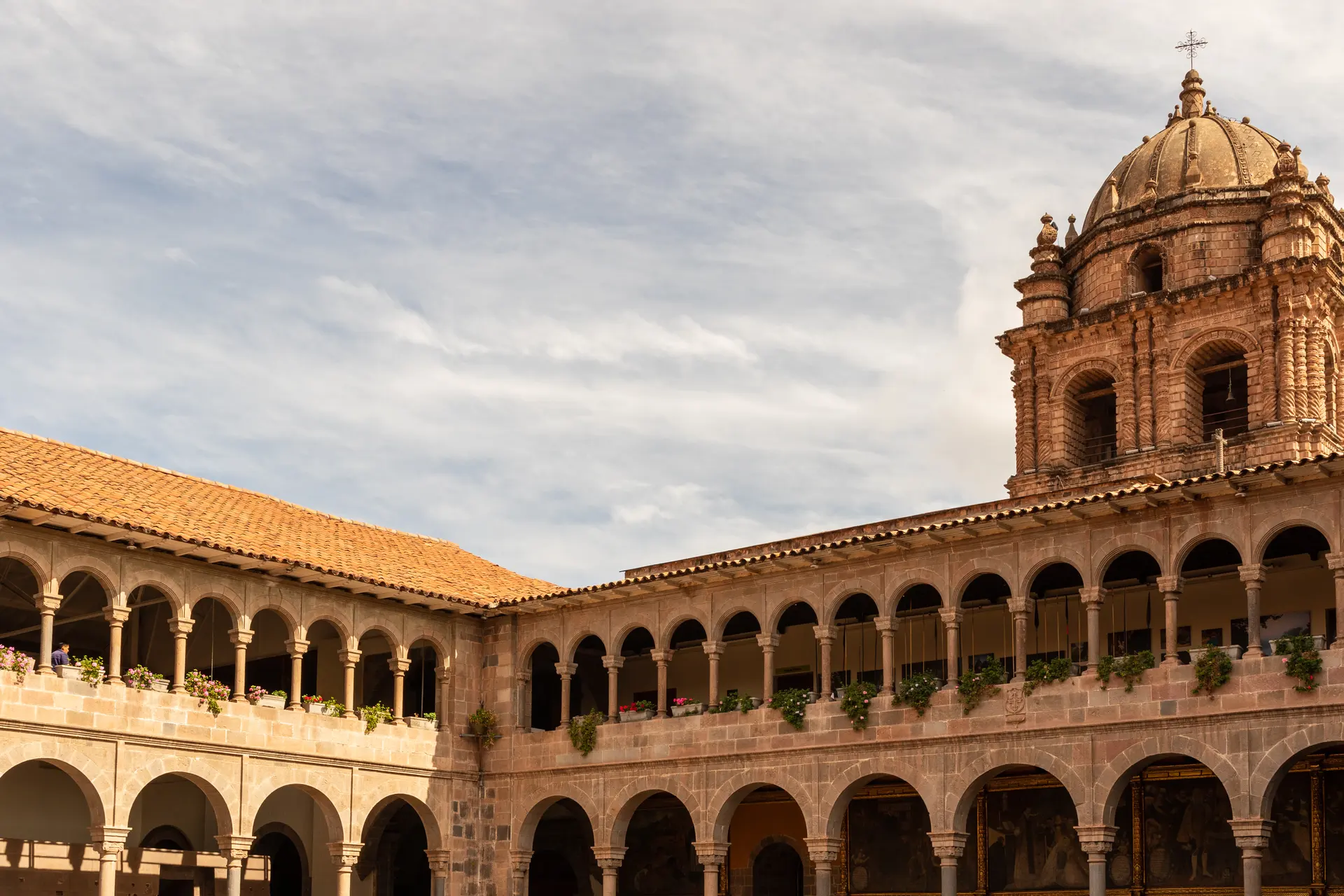
Image of Iglesia de Santo Domingo & Korikancha. Image source · CC-BY-2.0
Visit essentials
A quick read before you go
- Duration
- One to two hours allows for a thorough visit to the museum and Inca chambers.
- Etiquette
- Respectful behavior appropriate to both a religious site and a museum is expected.
Overview
Qorikancha was sheathed in 700 gold sheets to honor Inti, the solar deity from whom Inca emperors claimed descent. At the exact center of Tawantinsuyu—the Realm of Four Parts—41 ceques radiated to 328 Andean sacred sites, making the temple the world's navel where heaven met earth.
In 1533, Spanish conquistadors stripped the gold for ransom and gave the land to the Dominican Order. The Church and Convent of Santo Domingo proclaimed Christian triumph, yet the mortarless Inca foundations endured: three major earthquakes damaged the colonial work while the older walls flexed and survived. Dominican friars still pray here, and each June Inti Raymi begins at this layered site before processing to Sacsayhuaman, holding grief and wonder together.
Why this place is sacred
The concept of a thin place finds unusual expression here, where the boundaries between eras seem as permeable as those between worlds. Visitors often report a disorienting sense of temporal multiplicity—standing in the Inca chambers, the 15th century feels present; stepping into the cloister, the colonial period asserts itself; hearing Quechua spoken during Inti Raymi, something older still breaks through.
The ceque system offers a window into how the Inca understood sacred space. From Qorikancha, 41 lines extended in all directions, connecting the temple to 328 huacas—sacred sites including springs, stones, tombs, and mountain peaks. This was a living map of spiritual geography, maintained by specific family groups responsible for each ceque's shrines. The temple was not simply important in itself; it was the origin point of an entire network of the holy.
Astronomically, the site aligned with solstices and equinoxes, its architecture encoding celestial knowledge. Priests tracked the movements of sun, moon, and stars to determine planting times and ceremonial dates. The gold that covered the walls was not mere decoration but solar theology made visible—the temple literally reflected the god it honored.
When that gold was torn away and a church built in its place, some would say the site's power was broken. Others would say it simply transformed. The stones that refused to fall in earthquakes that toppled colonial towers suggest the older sacredness persists. The revival of Inti Raymi in 1944, after four centuries of suppression, suggests it can be reclaimed. Perhaps thin places cannot be erased, only layered.
Qorikancha served as the supreme temple of Inca religion, dedicated primarily to Inti (the Sun God) but also housing shrines to Mama Quilla (Moon Goddess), Illapa (Thunder God), Pachamama (Mother Earth), and other deities. It functioned as the ceremonial headquarters of empire-wide religious observance, the training ground for priests, and the astronomical observatory that governed the agricultural calendar. The temple was literally the center of the world in Inca cosmology—the point from which all sacred geography was measured.
The Spanish conquest of 1533 transformed Qorikancha through deliberate acts of religious colonization. Gold was stripped to ransom the captive emperor Atahualpa. The Dominican Order received the site in 1538 and began constructing their church and convent atop the Inca foundations, a pattern repeated at sacred sites throughout the Americas. Spanish colonial architecture rose over Inca walls, creating an involuntary synthesis. Major earthquakes in 1650 and 1950 revealed the superiority of Inca engineering—their walls survived while colonial structures crumbled.
The 1950 earthquake sparked debate about preservation, leading eventually to archaeological restoration that exposed more Inca elements. In 1944, Cusco revived Inti Raymi as a cultural celebration; by 2001, Peru declared it Cultural Heritage. The site now functions as both active Dominican convent and major heritage museum.
Experience and orientation
Entering Qorikancha through the colonial cloister, the eye catches first the Dominican arches, the fountain, the manicured garden. Then the walls begin to speak. Trapezoidal niches appear—the signature of Inca architecture—their stones fitted so precisely that a knife blade cannot penetrate the joints. No mortar holds them; their stability comes from perfect geometry and the patient work of hands that understood stone.
As you move through the chambers that survive from the original temple, the scale of what was lost becomes clear. These dark rooms once blazed with gold—not as wealth but as theology, reflecting the sun god's presence into every corner. A garden once stood in the central courtyard where corn made of gold grew from golden earth, tended by golden llamas. The conquistadors saw only treasure; the Inca had created a prayer.
The curved wall visible from the street remains one of the most photographed elements—a sweeping arc of perfectly fitted stones that has withstood five centuries and multiple major earthquakes. It demonstrates both the sophistication of Inca engineering and the profound cultural shift the conquest represented. Above this wall rises the church, and somehow both remain standing.
During Inti Raymi in June, the atmosphere transforms. Performers in traditional dress gather in the temple courtyard. The Sapa Inca is symbolically reborn. Chicha is offered to the sun. Quechua fills the air. For this moment, the older identity of the place rises to the surface, and visitors report feeling they have glimpsed something that four centuries of colonial rule could not erase.
The experience here is rarely comfortable. This is a place of conquest and resistance, erasure and survival, two faiths making claims on the same stones. The discomfort itself may be the teaching—an invitation to hold contradiction without resolution.
Visitors typically enter through the Santo Domingo church entrance off Calle Santo Domingo, proceed through the colonial cloister to the museum area where Inca chambers are displayed, then exit through the garden level. The site can be seen in one to two hours, though those wishing to sit and absorb the atmosphere should allow more time. Morning visits offer softer light in the Inca chambers.
The curved retaining wall is best viewed from Avenida El Sol at the southeast corner of the site.
Context and lineage
According to Inca mythology, the first Inca, Manco Capac, emerged from Lake Titicaca (or the cave of Tampu T'oqo) carrying a golden staff given by his father, the Sun God. He was to travel until the staff sank into the earth of its own accord, marking the center of the world. At Cusco, the staff plunged into the ground—and there Manco Capac founded both the city and its first temple to his divine father.
Archaeological evidence complicates this story, revealing structures at the site built by the Killke people before Inca dominance. But the mythological power of the origin tale shaped how the Inca understood and treated the site—as the literal navel of creation.
The site's sacred lineage begins with the Killke or Ayamarca peoples who built earlier structures around the 13th century. Inca dominance transformed it into Qorikancha, the supreme temple of a vast empire. The Spanish conquest transferred stewardship to the Dominican Order, who have maintained continuous presence since 1538. Contemporary Andean spiritual practitioners have reclaimed ceremonial access, particularly during Inti Raymi, creating a tripartite lineage where indigenous, Catholic, and syncretic traditions all hold claims.
Manco Capac
Mythological founder who built the original temple according to Inca tradition
Pachacuti Inca Yupanqui
Emperor (r. 1438-1471) who transformed Qorikancha into the magnificent temple recorded by Spanish chroniclers
Francisco Pizarro
Spanish conquistador whose forces stripped the temple of gold in 1533
Juan Pizarro
Received the temple as his share of spoils; willed it to the Dominican Order upon his death in 1536
Faustino Espinoza Navarro
Cusqueño intellectual who led the 1944 revival of Inti Raymi
Traditions and practice
In the Inca period, Qorikancha hosted elaborate daily rituals. Priests offered chicha (fermented corn drink) to Inti each morning as the sun rose. Llamas were sacrificed on important occasions, their entrails read for omens. A perpetual sacred fire burned in the temple, never allowed to extinguish. During major festivals, particularly Inti Raymi at the winter solstice, ceremonies could last for days, involving the entire empire's rulers and nobility.
The bodies of deceased emperors were brought from their palaces to sit in attendance. Capacocha sacrifices—offerings of children to mountain apus—were prepared in the temple courtyard before their processions to high peaks. Astronomical observations guided all ceremonial timing.
Dominican friars maintain a monastic presence at the convent, with regular Catholic masses and the liturgical cycle observed in the church. This continues nearly five centuries of Christian practice at the site. For Andean practitioners, Inti Raymi has become the primary ceremonial moment. Revived in 1944 after four centuries of suppression, the festival now draws hundreds of thousands of participants and spectators each June 24.
The ceremony begins at Qorikancha with invocations to Inti in Quechua, offerings of chicha, and the symbolic appearance of the Sapa Inca. The procession then moves to the Plaza de Armas and culminates at Sacsayhuaman with theatrical reenactments and (symbolic) llama sacrifice. Beyond Inti Raymi, some Andean spiritual guides offer private ceremonies for visitors seeking connection to Pachamama and ancestral traditions.
Visitors seeking a contemplative experience might time their visit for early morning when the site is quiet and light enters the Inca chambers at evocative angles. Attending mass in the church offers an opportunity to experience the Catholic dimension of the site. For those drawn to Andean spirituality, witnessing Inti Raymi requires June travel—June 24 is the main day, but related events occur throughout the month.
Working with a local paqo (Andean priest) can provide context for offerings to Pachamama, though these are typically performed at other sites. Simply sitting with the contradiction of the place—allowing both histories to be present—may be the most honest practice available.
Inca Religion / Andean Spirituality
ActiveQorikancha was the holiest site in the Inca Empire, the dwelling place of Inti and the cosmological center from which all sacred geography was measured. The temple's status as hub of the ceque system made it not just important but foundational—the origin point of the sacred map. Today, Andean spirituality maintains presence through the annual Inti Raymi celebration and through the broader movement of indigenous cultural revival in Peru.
Contemporary Andean practice at Qorikancha centers on Inti Raymi, the Festival of the Sun held each June 24. Ceremonies begin at the temple with Quechua invocations to Inti, offerings of chicha, and the symbolic appearance of the Sapa Inca (performed by an actor, not a living ruler). The procession then moves through Cusco to culminate at Sacsayhuaman. Beyond the public festival, Andean priests (paqos) may offer private ceremonies for those seeking connection to Pachamama and ancestral traditions, though these typically occur at other locations.
Roman Catholicism (Dominican Order)
ActiveThe Dominican Order has maintained continuous presence at this site since 1538, making the Church and Convent of Santo Domingo one of the oldest Christian religious establishments in South America. The deliberate construction atop Qorikancha represented the strategy of spiritual conquest—claiming indigenous sacred sites for Christianity. Nearly five centuries later, Dominican friars continue their monastic life here, maintaining a tradition of prayer, study, and pastoral ministry.
The Dominican community maintains standard Catholic liturgical observance, including daily masses and the full calendar of holy days. The church remains an active parish serving both local residents and visitors. The monastic aspect of Dominican life—prayer, study, community life under the Rule of Saint Augustine—continues in the convent portions of the complex not accessible to visitors.
Perspectives and open questions
Qorikancha invites interpretation from multiple angles, each illuminating different aspects of its significance. No single perspective captures the full complexity of a site where pre-Inca, Inca, and colonial histories are literally built atop one another.
Scholarly perspective
Historians and archaeologists recognize Qorikancha as the ceremonial nucleus of the largest pre-Columbian empire in the Americas. The ceque system radiating from the temple represents one of the most sophisticated examples of sacred geography in the ancient world, integrating astronomical observation, territorial organization, and religious practice. Scholars emphasize the deliberate nature of colonial religious architecture—building churches atop indigenous temples was standard practice throughout Spanish America, intended to symbolize and effect spiritual conquest.
The site's UNESCO World Heritage recognition as 'an outstanding cultural syncretism' reflects contemporary scholarly framing of colonial sites as complex rather than simply triumphalist.
Living and traditional perspectives
For contemporary Andean communities maintaining indigenous spiritual traditions, Qorikancha remains a living sacred site despite colonial transformation. The revival of Inti Raymi represents cultural resistance and the reclamation of ancestral practice. The Quechua concept of pachacuti—world reversal or renewal—frames understandings of the conquest period as a time of cosmic upheaval that did not destroy but transformed spiritual reality. Many practitioners maintain that the power of Inti persists at the site, accessible to those who approach with proper intention.
The stones themselves are understood as alive, as ancestors, as witnesses.
Alternative interpretations
Some researchers emphasize the astronomical precision of Inca construction, proposing that Qorikancha encoded sophisticated knowledge of celestial mechanics. The ceque system attracts comparison to ley lines and geomantic traditions elsewhere in the world. New Age interpretations sometimes frame the site as an energy vortex or power spot, though such framings can flatten the specific cultural contexts. The question of what the Inca actually knew—about astronomy, about engineering, about consciousness—remains open, with mainstream scholarship often more cautious than popular accounts.
Open questions
Despite extensive study, significant mysteries remain. The full extent of underground chambers and passages has not been mapped. The precise astronomical functions of alignments are debated. Pre-Inca religious practices at the site remain poorly understood. The total quantity of gold removed during the conquest varies wildly in historical accounts, from hundreds to thousands of gold sheets. Perhaps most fundamentally, the inner experience of Inca priests—what they actually felt and perceived during ceremonies—lies beyond recovery, accessible only through imaginative reconstruction.
Plan your visit
Access and arrival
Cusco offers abundant lodging options from hostels to luxury hotels, many in colonial buildings with Inca foundations. Staying in the historic center places you within walking distance of Qorikancha. During Inti Raymi (June), book accommodations well in advance as the city fills with visitors.
Respectful visit
Modest dress appropriate for religious sites is required—covered shoulders and knees at minimum. Cusco's high altitude (3,400m/11,150ft) and variable weather make layers practical. Comfortable walking shoes are essential for navigating uneven stone surfaces and stairs.
Photography is prohibited inside the museum and Inca chambers. Exterior architecture, the famous curved wall, and the cloister garden may be photographed. During Inti Raymi, photographing performers is generally acceptable but always ask before taking close-up images of individuals. Recording of Catholic masses without permission is inappropriate.
Traditional Andean despacho offerings are not typically made at this site by visitors, though they are part of official Inti Raymi ceremonies. If you wish to make offerings in the Andean tradition, consult a legitimate local paqo who can guide you to appropriate locations. Catholic offerings such as candles and prayers may be made in the church according to standard Catholic practice.
{"No photography inside museum areas","Do not touch any archaeological surfaces or artifacts","Maintain quiet and respectful demeanor throughout","Observe safety barriers and restricted areas","No food or drink inside the site","Flash photography prohibited everywhere","Respect active religious observances in the church"}
Visitors should approach with awareness that this is a contested sacred site. Indigenous Andean practitioners may view tourist presence at Inti Raymi with ambivalence—it is both validation of their tradition and potential commodification. Catholic religious observances in the church deserve the same respect given to any active house of worship. The pain of colonialism is not abstract here; it is encoded in the very stones.
Those seeking 'authentic' indigenous ceremony should be wary of exploitation—legitimate paqos do not typically solicit tourists. The site is not appropriate for New Age syncretism that flattens the specific histories at play.
Current practical details
Address
Ahuacpinta 659-A, Cusco 08002, Peru
Hours
Hours, fees, and access can change — verify on the official source before you travel. Practical details last checked Jun 2026.
Location
Map loads as you approach this section.
Pilgrim reflections
A portrait of encounter, not a score
Pilgrims describe what they felt, how present they could become, and whether the place would shape a journey. There are no stars and no ranking of traditions.
No reviewed reflections yet
The first pilgrims can help describe the character of being here.
Share a reflection
Available after an account-backed “Been there.” Every reflection is reviewed before publication.
Nearby sacred places
Explore other sacred places in the region. Proximity does not establish access or travel time; check each place’s guidance.
Share a photo
Help visitors recognize Iglesia de Santo Domingo & Korikancha. Every submission is reviewed before publication.