Iao Valley State Park, Maui
Where Hawaiian royalty rests in hidden caves beneath a needle of stone reaching toward the heavens
Understand sacred places, explore living traditions, and learn how to engage respectfully with Pilgrim Map.
Access has not been verified. Check current local guidance before planning a visit.
Wailuku, Hawaii, United States
Read the sources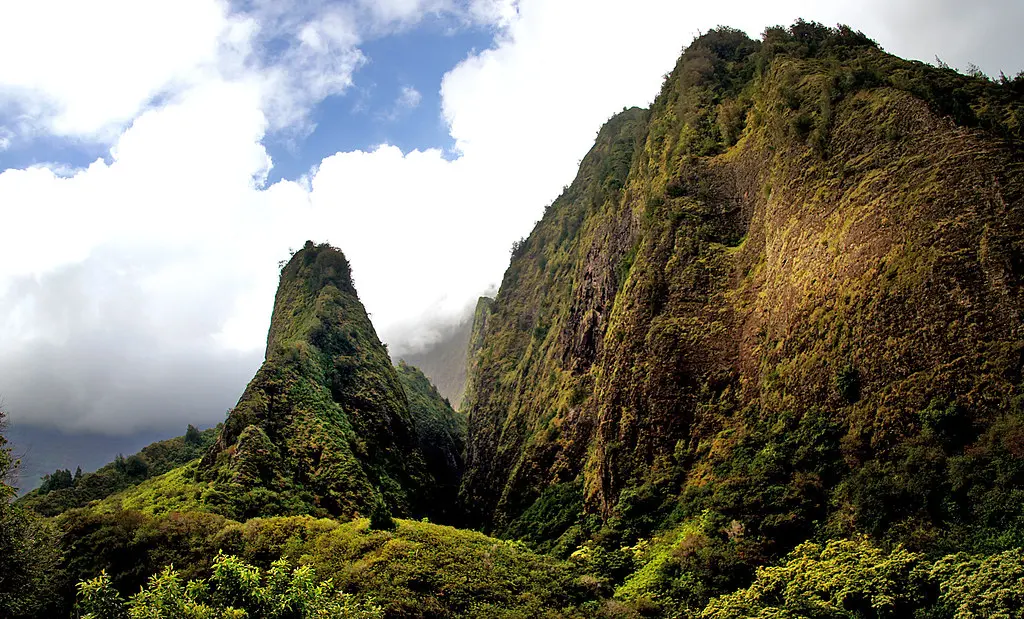
Image of Iao Valley State Park, Maui. Image source
Visit essentials
A quick read before you go
- Duration
- 1.5-2 hours to explore all trails including the Ethnobotanical Loop and Streamside Trail
- Etiquette
- Approach with reverence.
Overview
ʻĪao Valley is one of Maui's most sacred places: a living Native Hawaiian sacred landscape, royal burial ground, temple site, refuge, and battlefield. Kukaemoku, the ʻĪao Needle, rises 1,200 feet from the valley floor; ancient Hawaiians honored it as the phallic stone of Kanaloa, god of the ocean, and used it as a natural altar. ʻĪao means “supreme cloud,” and Native Hawaiian tradition understands the mist that often hides the summit as ancestral presence rather than mere scenery.
Secret cliff caves protect the bones and enduring mana of aliʻi royalty. The valley also bears the trauma of the 1790 Battle of Kepaniwai, when Kamehameha I's cannon-equipped forces defeated Kalanikūpule's warriors and bodies dammed ʻĪao Stream. Its beauty cannot be separated from Native Hawaiian history, continuing spiritual relationship, and community authority.
Why this place is sacred
ʻĪao Valley's force comes from inseparable geology, beauty, history, and sacred relationship. Volcanic erosion formed a needle that can seem placed rather than shaped, among lush walls, waterfalls, and mist. The cliffs hold secret aliʻi burials whose mana persists in Hawaiian understanding; Kukaemoku was worshiped as Kanaloa's phallic stone and a site of actual communication with deity. In 1790 the sacred valley also became a killing field.
Accounts vary between hundreds and thousands of fallen warriors, but agree that bodies dammed the stream; the name Kepaniwai preserves that horror. Hawaiian spiritual understanding holds that spirits can linger where death was violent or unexpected. Some visitors report energy streaming from the needle, converging near the bridge, or a watching presence.
Native Hawaiian tradition identifies ancestral presence here: the mist, the hidden royalty, fallen warriors, and priests belong to a valley that never ceased to be sacred after formal worship ended.
The valley served multiple sacred functions: burial ground preserving the mana of chiefs, ceremonial site for worship of Kanaloa, place of refuge offering sanctuary, and temple complex for chiefly worship including human sacrifice.
The valley has been sacred to Hawaiians for centuries. Chief Kakae declared it kapu in the late 1400s. The heiau at the valley mouth date to approximately 1200-1400 CE. Formal religious practices ended in 1819 with the abolition of the traditional Hawaiian religion, when the kapu system was dismantled, temple images removed, and heiau abandoned. But the valley never stopped being sacred. The bones of aliido not lose their mana. The ancestors do not depart.
Native Hawaiians continue to visit for cultural and spiritual observance, maintaining relationship with a place that holds their history and their dead.
Experience and orientation
The road from Wailuku enters increasingly lush terrain between the rising West Maui Mountains, creating a threshold into a place with different rules. Tropical trails lead to viewing platforms; the main ʻĪao Needle Lookout Trail climbs 133 steps to an upper viewpoint where Kukaemoku's isolated, reaching form repeatedly draws the eye. Visitors often report their strongest sensations while crossing the bridge at its base, describing downward-streaming or converging energy; whether this reflects geology, expectation, or something else remains uncertain.
Mist can fill a clear valley within minutes, obscure the needle, dampen sound, and make the space feel enclosed and watchful. Native Hawaiian tradition understands this as ancestors making themselves present. The Ethnobotanical Loop moves through plants used for medicine, food, and spiritual practice, with signs explaining traditional uses; a thatched hale stands along the Mala Garden Trail. These specifics ground the visit beyond vague impressions.
Accounts repeatedly say the valley “casts a spell,” describing a shift in attention or presence that persists after departure without resolving whether its source is royal-burial mana, battlefield resonance, stone and mist, or something beyond categorization.
Iao Valley State Park is located approximately 4.5 miles west of Kahului via Iao Valley Road (Route 32). The park sits within Mauna Kahalawai, the West Maui Mountains. Wailuku, the nearest town, is less than 3 miles away. The main trail to the Iao Needle Lookout includes 133 steps. Additional trails include the Ethnobotanical Loop and Streamside Trail. The Halekii-Pihana Heiau State Monument, preserving the two major heiau at the valley mouth, is located 2 miles from the main park.
Context and lineage
The Iao Needle carries two origin stories that intertwine without contradicting each other. In one, ancient Hawaiians honored Kukaemoku as the phallic stone of Kanaloa, god of the ocean. A stone honoring the deity was placed at its summit, and the needle served as a natural altar for ceremonies connecting earth to divine presence. In the other, Iao was the beautiful daughter of the demigod Maui. Puuokamoa, a half-fish half-man demigod, was the only one who dared approach her.
When they fell in love and Maui discovered them, he was enraged. Pele, goddess of fire, convinced Maui to transform Puuokamoa into a pillar of stone rather than burn him to death. The needle stands as a monument to forbidden love, an eternal reminder of the beloved who cannot return to human form. The valley became kapu when Chief Kakae declared it sacred and forbidden in the late 1400s. Only the highest chiefs and kahuna priests could enter certain areas.
For centuries, the inaccessible cliffs served as the burial ground for Hawaiian aliiroyalty. The bones of chiefs were hidden in secret caves to protect their mana from desecration by enemies. The heiau at the valley mouth, Halekii and Pihanakalani, hosted ceremonies including, at the luakini heiau, human sacrifices to Ku the war god. The Battle of Kepaniwai in 1790 transformed the valley from sacred to scarred.
Kamehameha I's forces, equipped with cannons obtained from foreign advisors, defeated the warriors of Kalanikupule in combat so devastating that bodies dammed the stream. Keahualono, a young girl who would later become Keopuolani, highest-ranking wife of Kamehameha and mother of kings, escaped through the valley during the battle. After victory, Kamehameha marched to Pihanakalani and offered the last human sacrifice on Maui to his war god.
The valley had witnessed the culmination of one religious tradition even as the traditional system itself would end less than thirty years later.
Iao Valley represents Hawaiian sacred geography at its most concentrated: a place where natural formation, royal burial, divine worship, refuge, and historical trauma converge. The traditions practiced here connect to the broader patterns of Hawaiian religious life that existed throughout the islands until the abolition of the kapu system in 1819. The valley's significance to Native Hawaiians has never ended, even as the forms of engagement have changed.
Kamehameha I
Kahekili II
Kalanikupule
Kakae
Keopuolani
Traditions and practice
Ceremonies at the Iao Needle altar honoring Kanaloa. Burial rites for aliiin secret caves. Worship at Halekii and Pihanakalani heiau, including human sacrifice to Ku at the luakini heiau. Puuhonua sanctuary rituals. Religious observances conducted by Chief Kahekili in the 1760s. Post-battle offerings to the war god Ku by Kamehameha I in 1790.
These practices ended with the abolition of the traditional Hawaiian religion in 1819, when King Liholiho ate publicly with women, breaking the kapu system and triggering the dismantling of temples throughout the islands.
Native Hawaiians continue to visit the valley for cultural and spiritual observance. The relationship between the Hawaiian community and this place has never ceased, even as the forms of practice have changed. Ti leaves are traditionally used to wrap offerings at sacred places. Some visitors leave simple offerings such as freshly picked guava at significant stones along the path. Cultural education programs interpret the site's significance. The valley is approached with reverence by those who understand its history.
Walk the trails slowly, allowing time for the atmosphere to reveal itself. The Iao Needle Lookout Trail provides the iconic view, but the experience extends beyond the visual. Cross the bridge at the needle's base and stand there, looking up. Many report the strongest sensations at this location. The Ethnobotanical Loop offers cultural context through interpretive signs explaining traditional plant uses. A half-day visit combining the main park with Halekii-Pihana Heiau provides fuller understanding of the valley's sacred geography.
Approaching with knowledge of what lies beneath the beauty transforms the experience.
Native Hawaiian sacred geography
ActiveIao Valley is one of Maui's most sacred places. The valley is wahi pana, a storied place imbued with mana and ancestral connection. The Iao Needle was honored as the phallic stone of Kanaloa, god of the ocean, and served as a natural altar for ceremonies. Chief Kakae declared the valley kapu in the late 1400s, establishing formal recognition of its sacredness.
Native Hawaiians continue to visit the valley for cultural and spiritual observance. Ti leaves are traditionally used to wrap offerings left at sacred places. Some visitors leave simple offerings at significant stones. The valley mist is understood as the presence of ancestors watching over the land. The relationship between the Hawaiian community and this place has never ceased.
Aliburial traditions
HistoricalThe sheer, inaccessible cliffs of Iao Valley were a burial site for Hawaiian aliiroyalty for centuries. The valley became a hallowed burying place for ancient chiefs and is the first place mentioned in historical legends as a site for secret burials of high chiefs. Ancient Hawaiians believed bones contained mana, and desecrating or stealing them could harm living descendants.
The bones of chiefs were secretly interred in hidden caves throughout the valley. The specific locations remain unknown and sacred. Notable figures including ancestors of King Kamehameha III and Queen Kaahumanu were laid to rest here. The burial practices ended with the changes to Hawaiian society in the 19th century, but the burials themselves remain.
Heiau worship (Halekii and Pihanakalani)
HistoricalTwo major heiau stand at the mouth of Iao Stream: Halekii, House of Images, and Pihanakalani, Gathering Place of Supernatural Beings. Pihanakalani was a luakini heiau dedicated to Ku the war god, where human sacrifices were performed. Chief Kahekili lived and worshiped at Halekii during religious observances in the 1760s. After the Battle of Kepaniwai, Kamehameha I offered what is recorded as the last human sacrifice on Maui at Pihanakalani.
Heiau worship included ceremonies conducted by kahuna priests, offerings to deities, and at luakini heiau, human sacrifice in times of war. In 1819, the traditional Hawaiian religion was abolished. The images were removed, structures dismantled, and the heiau abandoned. The sites now stand as preserved archaeological monuments on the National Register of Historic Places.
Puuhonua (place of refuge)
HistoricalIao Valley served as a puuhonua, a place of refuge in ancient Hawaiian culture. Those who had broken laws or violated kapu could seek sanctuary here. The puuhonua at Iao Valley was one of the most important places of refuge in ancient Hawaii.
Individuals fleeing punishment could reach the puuhonua and find protection from execution. Absolution was granted by kahuna priests. This was an integral part of Hawaiian justice and religious practice until the abolition of the traditional system in 1819.
Perspectives and open questions
Iao Valley holds multiple layers of significance that do not resolve into a single narrative. It is burial ground, temple site, battlefield, and living sacred place simultaneously.
Scholarly perspective
The valley's significance is documented through historical accounts, oral traditions, and archaeological evidence. The Battle of Kepaniwai is recognized as a pivotal moment in the unification of Hawaii under Kamehameha I. The heiau at the valley mouth have been studied by archaeologists and are listed on the National Register of Historic Places. Scholars note the site's multiple layers of meaning: burial ground, temple complex, place of refuge, and battlefield.
The valley exemplifies the Hawaiian concept of wahi pana, storied places where landscape, history, and spirituality intertwine. The 1994 determination that the entire 150,000-acre Mount Shasta region was eligible for the National Register for Native American cultural significance has no direct parallel here, but Iao Valley holds comparable concentrated significance for Native Hawaiians.
Living and traditional perspectives
For Native Hawaiians, Iao Valley is not merely historically significant but actively sacred. The valley is wahi pana, a storied place imbued with mana and ancestral connection. The mist that fills the valley is understood as the presence of ancestors, not metaphorically but actually, watching over the land and its people. The bones of aliiresting in hidden caves contain mana that has not diminished.
Approaching the valley requires awareness that the dead are present, that their power persists, that humans are guests in a place belonging to those who came before.
Alternative interpretations
Some visitors report experiences similar to those at recognized energy vortexes such as Sedona, Arizona. These include sensations of powerful energy streaming from the Iao Needle, feelings of energy converging at the base of the formation, and altered states of attention. While not supported by mainstream scholarship, these reported experiences are consistent and sincere. The valley attracts spiritual seekers alongside cultural tourists and hikers. Whether geological, geomagnetic, or other factors contribute to these experiences remains unknown.
Open questions
The exact locations of aliburial caves in the valley cliffs remain secret. The specific ceremonies conducted at the Iao Needle altar before European contact are not fully documented. The nature of the energy phenomena reported by visitors lacks scientific explanation. Complete oral traditions and chants associated with the valley may exist within Hawaiian communities but are not publicly shared. These gaps in knowledge are not deficiencies to be corrected but appropriate boundaries around sacred information.
Plan your visit
Access and arrival
No lodging within the park. Wailuku and Kahului offer full range of accommodations. Iao Valley is typically visited as a day trip from Maui resorts.
Respectful visit
Comfortable outdoor clothing appropriate for hiking. Bring rain gear. Iao Valley averages 386 inches of rainfall annually, making it the second wettest spot in Hawaii. Even on clear days, the mist can arrive suddenly.
Photography is permitted on public trails. Approach photographing sacred sites with awareness of what they represent. Be mindful if you encounter anyone engaged in cultural or spiritual practice.
Ti leaves are traditionally used to wrap offerings at sacred places. Simple offerings like freshly picked guava may be left at significant stones. Do not disturb or remove anything.
Non-resident visitors must have advance parking ($10) and entry ($5) reservations through the Go Hawaii State Parks website. Hawaii residents with valid ID enter free. Park hours are 7:00 AM to 6:00 PM daily, with last entry at 4:30 PM. Stay on designated trails. Off-trail areas and burial caves are not accessible to the public.
Do not attempt to access off-trail areas or burial caves. These are sacred and prohibited. Be aware that you are walking through a place that holds the bones of Hawaiian royalty and the memory of a devastating battle. The beauty is real, but so is the weight. Flash floods can occur with little warning; monitor weather conditions and heed any warnings.
Current practical details
Address
54 S High St, Wailuku, HI 96793, USA
Phone
Hours, fees, and access can change — verify on the official source before you travel. Practical details last checked Jun 2026.
Location
Map loads as you approach this section.
Pilgrim reflections
A portrait of encounter, not a score
Pilgrims describe what they felt, how present they could become, and whether the place would shape a journey. There are no stars and no ranking of traditions.
No reviewed reflections yet
The first pilgrims can help describe the character of being here.
Share a reflection
Available after an account-backed “Been there.” Every reflection is reviewed before publication.
Nearby sacred places
Explore other sacred places in the region. Proximity does not establish access or travel time; check each place’s guidance.

References
Sources consulted for this page. Source categories describe the publication, not a guarantee that every claim is verified. Traditional accounts and outside interpretations may differ.
- 01ʻĪao Valley State Monument — Hawaii Division of State ParksofficialOfficial state parks documentation
- 02Battle of Kepaniwai — BritannicaencyclopediaAuthoritative historical source
- 03Iao Valley State Park's Cultural Significance — Hawaii State ParksspiritualOfficial cultural significance documentation
- 04Battle of Kepaniwai — WikipediaencyclopediaHistorical battle reference
- 05Visit Iao Valley: The Beautiful Spiritual Center of Maui — Shaka GuideguideCultural context and visitor information
- 06How to Enter Hawaiian Sacred Sites — Ho'omana Spa MauispiritualHawaiian cultural etiquette
Share a photo
Help visitors recognize Iao Valley State Park, Maui. Every submission is reviewed before publication.