Mo'okini Heiau
Hawaii's oldest temple, where seventy generations of priests guard the threshold between war and healing
Hawi, Hawaii, United States
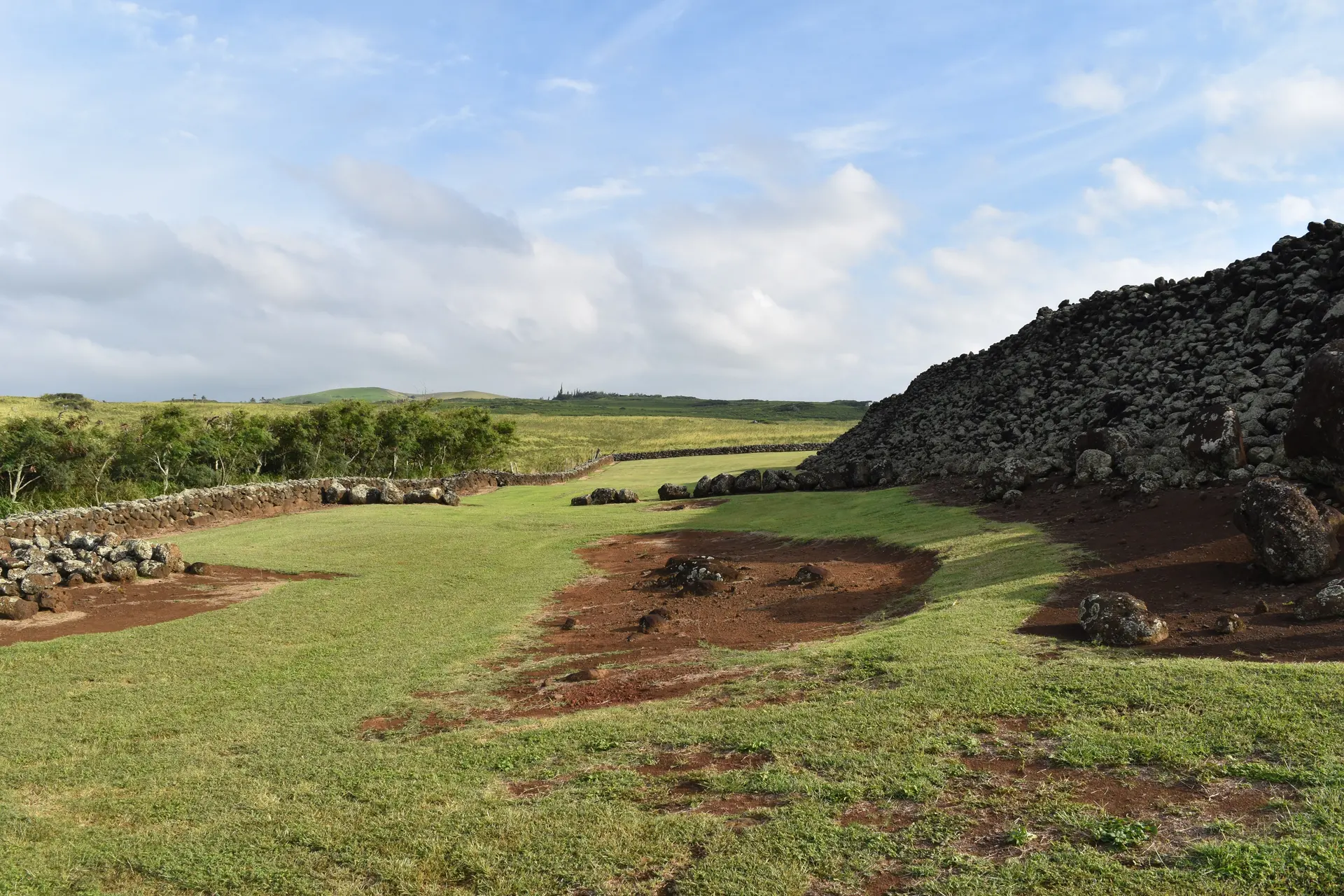
Image of Mo'okini Heiau. Image source · CC-BY-SA-4.0
Visit essentials
Before you go
- Address
- Hawi, HI 96719, USA
- Duration
- Allow thirty minutes minimum to walk the heiau and absorb its atmosphere.
- Etiquette
- Mo'okini Heiau requires the reverence due to any sacred site.
Overview
The walls rise from the earth like something half-remembered from a dream of power. Ten feet wide at their base, built without mortar, the basalt stones of Mo'okini Heiau have stood against wind and time for perhaps fifteen centuries. This is not conjecture dressed as certainty; the dating remains debated.
But what oral tradition holds, and what the Mo'okini family has passed down through seventy generations of priestly service, is that this is among the most ancient sacred sites in Hawaii.
The heiau was a luakini, the highest class of Hawaiian temple, dedicated to Ku, the god of war. Here, paramount chiefs demonstrated their power over life and death through human sacrifice. Outside the north wall, a stone called Papa-nui-o-leka once served as the altar where offerings were processed. This is not comfortable history. The sacredness of Mo'okini Heiau includes darkness, violence, and the absolute authority of the ali'i nui.
Yet the same ground holds another story. In 1758, as Halley's Comet streaked overhead, a child was born nearby and carried secretly to this temple. The priests consecrated him, and that child grew to become Kamehameha I, the warrior who unified the Hawaiian Islands. Where death was administered, greatness was blessed.
The transformation came in 1978, when Kahuna Nui Leimomi Mo'okini Lum, the seventy-first generation priestess, lifted the kapu that had restricted access to royalty and priests for fifteen centuries. She rededicated the heiau to the children of the land—ke kaiaulu o ka aina. A place of forbidden power became a place of shared heritage. The Mo'okini family still serves as guardians, maintaining the site and its protocols. Visitors who come with reverence are welcome.
What was once a site of death has been remade as a site of healing, though the stones remember everything.
Why this place is sacred
Stand within these walls and you stand where Hawaiian chiefs once demonstrated their spiritual authority through rituals we can barely comprehend today. The luakini heiau was not merely a place of worship but a place of ultimate power—the power to take life in service to the war god Ku, the power to channel divine favor into military conquest, the power to mark the boundary between who lived and who died.
The thinness here operates through accumulated intention. Oral tradition holds that eighteen thousand workers formed a human chain fifteen miles long to pass the basalt rocks hand to hand, completing the temple's enlargement in a single night. Whether literally true or not, the story speaks to the concentrated human effort embedded in these stones. Generation after generation of priests performed ceremonies within these walls.
Whatever you believe about the metaphysics of ritual, the repetition of sacred action in a single location creates something that persists.
The connection to Kamehameha adds another layer. This was his war temple before he built Pu'ukohola Heiau to fulfill the prophecy that would give him the islands. The infant who would become Hawaii's greatest ruler received his first blessing here, and some visitors report sensing that greatness still present in the stone.
But perhaps the most significant element of Mo'okini's thinness is the transformation. In 1978, Kahuna Nui Leimomi Mo'okini Lum performed what may be the most remarkable act of spiritual evolution in Hawaiian religious history. She lifted a kapu that had stood for fifteen centuries, opening to all people a site that had been restricted to the highest chiefs.
This was not abandonment of tradition but its fulfillment in a new form—the recognition that the temple's power could serve healing rather than war.
Visitors often describe a quality that is difficult to name: solemnity, presence, weight. The remote location contributes—the windswept coastal plain, the isolation, the long drive on rough roads that functions as its own purification. But something else operates here, something that causes people to lower their voices and move slowly. The stones do not explain themselves. They simply hold what they hold.
Mo'okini Heiau was a luakini, the most sacred and restrictive class of Hawaiian temple. Only the ali'i nui—the paramount chiefs—could worship here, attended by the kahuna nui (high priests). The temple was dedicated to Ku, the god of war, and rituals involved both human and animal sacrifice. The purpose was to channel divine power into chiefly authority, to ensure victory in battle, and to demonstrate the chief's control over life and death.
The Papa-nui-o-leka stone outside the north wall was where sacrificial victims were processed. This was religion as power, spirituality as sovereignty.
According to Mo'okini family chants, High Priest Kuamoo Mo'okini built the original temple in the fifth century CE with walls six feet tall. Between the thirteenth and fourteenth centuries, the legendary priest Pa'ao arrived from either Tahiti or Samoa and enlarged the heiau to its current massive scale. Pa'ao is credited with introducing human sacrifice, walled heiau architecture, and the strict kapu system to Hawaii.
The site served as Kamehameha I's war temple until he built Pu'ukohola Heiau in 1791 to fulfill a prophecy. After Kamehameha II abolished the kapu system in 1819, the traditional function of luakini heiau ended throughout Hawaii. Mo'okini Heiau fell into disuse but remained under Mo'okini family guardianship.
In 1962, the site became Hawaii's first National Historic Landmark, recognizing its historical significance. The transformative moment came in 1978 when Kahuna Nui Leimomi Mo'okini Lum lifted the ancient kapu restricting access, redededicating the temple to all people. This act reframed the heiau from a site of exclusive power to one of shared cultural heritage and healing.
Today the Mo'okini family continues as spiritual guardians, maintaining the site and its protocols while welcoming respectful visitors. The heiau exists in dual relationship with its past—honoring the traditions that created it while serving new purposes in the present.
Experience and orientation
The drive to Mo'okini Heiau is part of the experience. From the main highway near Hawi, you turn toward Upolu Point, passing the small airport before the road becomes unpaved. In dry conditions, ordinary vehicles can manage; after rain, the road becomes a river of mud requiring four-wheel drive or the willingness to walk three and a half miles. This is not a site that reveals itself casually. You must want to be here.
As you approach, the heiau appears as a massive rectangular enclosure rising from the grassy coastal plain. The Pacific stretches beyond, endless and gray-blue. Wind is constant—the trade winds funnel through this northern point of the Big Island with particular force. Bring a jacket even in summer. The isolation is immediate; you may have the site entirely to yourself.
Entering through the designated access point, you encounter walls that dwarf human scale. The basalt stones, fitted without mortar in the traditional Hawaiian dry-stack technique, vary from seven to fourteen feet in height. The base is ten feet wide, tapering both inside and out. Walk the interior slowly. The parallelogram shape—267 feet on one side, 250 on the other—takes several minutes to circumnavigate. Internal platforms and structures remain, remnants of the temple's complex ritual architecture.
Outside the north wall, look for Papa-nui-o-leka, the sacrificial stone. Stand here and contemplate what occurred on this ground. The history is not gentle. But the 1978 rededication transformed the site's energy, and many visitors report feeling not dread but a kind of solemn peace—the sense of something immense having been held and then released.
After visiting the heiau, walk south to Kamehameha's birthsite, marked by a stone about two thousand feet away. The infant who would unite Hawaii was born within sight of this temple and carried here for consecration. Standing between these two sites, you stand in the landscape of Hawaiian history at its pivot point.
The experience at Mo'okini tends toward silence. Conversation feels inappropriate. Photography seems inadequate. What remains is the simple act of presence—being here, breathing the salt wind, letting the stones speak whatever they speak.
The heiau is oriented roughly east-west, with the primary entrance traditionally on the east. The sacrificial stone lies outside the north wall. Kamehameha's birthsite is approximately two thousand feet south, a short walk across open ground. The ocean lies to the north and west, visible from within the enclosure. Position yourself to feel the relationship between temple, birthsite, and sea—all elements in the sacred geography of this place.
Context and lineage
According to Mo'okini family chants, High Priest Kuamoo Mo'okini built the original temple in 480 CE, making it one of the oldest heiau in Hawaii. The walls stood six feet tall. The specific purpose of this original construction is preserved in family tradition but not fully shared publicly.
Centuries later, the legendary priest Pa'ao arrived in Hawaii from either Tahiti or Samoa. Pa'ao ordered the heiau enlarged to its current massive scale. The story holds that eighteen thousand workers formed a human chain stretching fifteen miles from Niuli'i to pass the basalt rocks hand to hand. They completed the construction in a single night—a feat suggesting either supernatural assistance or the organizational capacity of a powerful chief.
Pa'ao's arrival marks a turning point in Hawaiian religion. He is credited with introducing human sacrifice, the kapu system of religious and social law, and the walled heiau architecture visible at Mo'okini. Whether Pa'ao was a historical figure, a composite of multiple arrivals, or a legendary condensation of gradual change remains debated. What is certain is that the traditions he is said to have established shaped Hawaiian religion until 1819.
The third origin story involves Kamehameha. In 1758, as Halley's Comet blazed overhead, a child was born at the nearby Kapakai Royal Housing Complex. Prophecies had foretold that a great chief would be born under such a sign—and such prophecies were dangerous. The infant's mother had him carried secretly to Mo'okini Heiau, where the priests consecrated him. This blessing at one of Hawaii's most powerful temples was believed to endow the child with divine strength and favor.
That child became Kamehameha the Great.
The Mo'okini family represents one of the longest documented priestly lineages in Hawaii, stretching back seventy generations to the temple's traditional founding. This unbroken custodianship is extraordinary—few sacred sites anywhere in the world can claim such continuity of spiritual guardianship.
The heiau itself belongs to the luakini tradition introduced or formalized by Pa'ao, connecting it to a broader network of Hawaiian temple architecture and practice. Luakini heiau were the highest class of Hawaiian temple, reserved for the worship of Ku and the performance of human sacrifice. Only paramount chiefs could use them.
Mo'okini Heiau's connection to Kamehameha I links it to the entire subsequent history of Hawaii. Kamehameha's later construction of Pu'ukohola Heiau, twenty-five miles south, fulfilled a prophecy that enabled his conquest of the islands. The two temples stand in relationship, marking the beginning and culmination of his rise to power.
The 1978 kapu-lifting by Leimomi Mo'okini Lum connects the ancient tradition to contemporary Native Hawaiian spirituality. Her act transformed not just access but meaning—reframing the heiau from a site of chiefly power to a site of cultural heritage accessible to all. This transformation is itself now part of the site's lineage, a new chapter in its ongoing story.
Kuamoo Mo'okini
First builder and high priest
Pa'ao
Legendary priest and reformer
Kamehameha I
Unifier of Hawaii
Leimomi Mo'okini Lum
Kahuna Nui (High Priestess)
Traditions and practice
As a luakini heiau, Mo'okini hosted the most significant and restricted rituals in Hawaiian religion. The ceremonies were performed exclusively by the ali'i 'ai moku (paramount chief), attended by kahuna (priests). Human and animal sacrifices were offered to Ku, the god of war, to ensure military victory and demonstrate chiefly power.
The rituals involved complex protocols. Victims—typically enemies captured in battle or those who violated kapu—were brought to the Papa-nui-o-leka stone outside the north wall. Here the flesh was separated from bone in preparation for offering. The specific prayers, chants, and ceremonial sequences are preserved in Hawaiian tradition but are sacred knowledge not fully shared publicly.
Kamehameha I conducted ceremonies at Mo'okini before transferring his war god to Pu'ukohola Heiau. The temple's power was understood to flow into the chief who worshipped there, making him formidable in battle and secure in his authority.
The kapu system, which governed Hawaiian religion and society, was abolished in 1819 by Kamehameha II, ending the traditional function of luakini heiau throughout Hawaii. The sacrificial and war rituals have not been performed for over two centuries.
The Mo'okini family continues to serve as spiritual guardians of the heiau. Their role has transformed from priests of Ku to custodians of cultural heritage. The family maintains the site and its protocols, ensuring that the temple is treated with appropriate reverence.
Private ceremonies may be conducted at Mo'okini Heiau with appropriate permissions from the Mo'okini family. Some Native Hawaiians return for personal or family observances. These ceremonies are private and not open to general participation or observation.
The 1978 rededication by Kahuna Nui Leimomi Mo'okini Lum transformed the heiau's spiritual function. It is no longer a site of war and sacrifice but a place of learning, cultural preservation, and healing. Visitors are welcomed as participants in this new purpose—learning about Hawaiian history and spirituality, reflecting on the site's complex legacy, and honoring the ancestors.
Mo'okini Heiau offers no prescribed ritual for visitors. The appropriate practice is presence—being here with awareness and reverence, allowing the site to work on you in whatever way it will.
Before your visit, learn what you can about Hawaiian history and the luakini tradition. Understanding what occurred here, and what the 1978 transformation meant, deepens engagement. Arrive with humility and an open heart.
Bring a flower or lei as an offering. This is customary and respectful, a way of acknowledging the sacredness of the ground. Leave your offering at an appropriate place within the heiau. Take nothing away.
Walk slowly. Speak quietly or not at all. Let the silence of the place fill you. Sit if you wish—the site invites contemplation. Pay attention to what arises in you: thoughts, feelings, sensations. The heiau does not explain itself; it simply holds space.
After visiting the temple, walk to Kamehameha's birthsite. Stand between these two points—the temple of war and the birthplace of the unifier—and feel the geography of Hawaiian history beneath your feet.
Mo'okini Family Custodianship
ActiveThe Mo'okini family has served as kahuna (priests) and guardians of this heiau for over seventy generations, making theirs one of the longest documented family traditions in Hawaii. This unbroken lineage represents extraordinary continuity of sacred responsibility through massive cultural disruption.
The family maintains the site's physical and spiritual integrity. Leimomi Mo'okini Lum lifted the ancient kapu in 1978, redededicating the heiau to all people. Current family members continue to serve as guardians, managing access and protocols. Private ceremonies may be conducted with family permission.
Luakini Royal Worship (Historical)
HistoricalMo'okini Heiau was a luakini, the highest class of Hawaiian temple, dedicated to Ku the war god. Only ali'i nui (paramount chiefs) could worship here. Human and animal sacrifice were performed to ensure military victory and demonstrate chiefly authority over life and death.
Ceremonies involved human sacrifice on the Papa-nui-o-leka stone outside the north wall. The ali'i 'ai moku conducted rituals demonstrating spiritual, economic, political, and social control. Kamehameha I used Mo'okini as his war temple before building Pu'ukohola Heiau.
Contemporary Native Hawaiian Spirituality
ActiveThe site now serves as a place for Native Hawaiians and respectful visitors to connect with ancestral Hawaiian spirituality. It represents the transformation of Hawaiian sacred practice from the kapu system to modern cultural preservation and spiritual exploration.
Visitors bring flowers or lei as offerings. Some Native Hawaiians conduct private ceremonies with appropriate permissions. The heiau serves as an educational site about Hawaiian religious history. The site invites contemplation and connection with ancestors.
Perspectives and open questions
Mo'okini Heiau invites multiple frameworks of understanding. Archaeological and historical perspectives grapple with dating controversies and the nature of Pa'ao's arrival. Native Hawaiian perspectives center the Mo'okini family's unbroken guardianship and the site's ongoing spiritual significance. The 1978 transformation adds a contemporary dimension, reframing ancient power for new purposes.
Scholarly perspective
Archaeologists and historians recognize Mo'okini Heiau as one of Hawaii's most significant ancient sites. Its designation as Hawaii's first National Historic Landmark in 1962 reflects this importance. The scholarly consensus affirms the site's connection to Kamehameha I, its function as a luakini heiau, and the exceptional continuity of Mo'okini family custodianship.
The dating remains contested. Oral tradition places the original construction in 480 CE, which would make Mo'okini one of the oldest heiau in Hawaii. Archaeological methods have not definitively confirmed this early date, and some scholars suggest the current structure may be primarily from Pa'ao's enlargement in the thirteenth or fourteenth century. The debate continues without resolution.
Pa'ao's historicity is also debated. Some scholars view him as a legendary figure embodying cultural changes that occurred gradually. Others accept the traditional account of a specific priest arriving from Tahiti or Samoa and introducing major innovations. His exact origins—Tahitian, Samoan, or perhaps from the Marquesas—remain unclear.
What scholars do not dispute is the site's importance. Mo'okini Heiau represents Hawaiian temple architecture at its most developed, luakini practice at its most elaborate, and cultural continuity at its most remarkable. The seventy-generation priestly lineage is without parallel in documented Hawaiian history.
Living and traditional perspectives
For Native Hawaiians, and particularly for the Mo'okini family, this heiau carries meanings that transcend archaeological categorization. The site is not merely historical but living—maintained by a family whose connection to these stones stretches back fifteen centuries.
The traditional understanding emphasizes the mana (spiritual power) concentrated here through generations of ritual observance. The luakini practices, though no longer performed, embedded power in the ground. The consecration of Kamehameha added another layer. The continuous guardianship of the Mo'okini family maintained the site's spiritual integrity through the colonial disruptions of the nineteenth and twentieth centuries.
The 1978 kapu-lifting is understood not as an ending but as a transformation. Kahuna Nui Leimomi Mo'okini Lum did not secularize the heiau; she redirected its spiritual purpose from war and exclusion to healing and education. The temple remains sacred, but its sacredness now serves all who approach with reverence.
The Mo'okini family's perspective emphasizes responsibility and continuity. They are not owners of the site but guardians, entrusted with its care by ancestors and obligated to pass it to descendants. This framework shapes their approach to visitors, whom they welcome as guests sharing in a heritage that belongs ultimately to the land and its gods.
Alternative interpretations
Some visitors approach Mo'okini Heiau through frameworks of earth energy or spiritual sensitivity. The site's isolation, its massive construction, and its documented history of ritual practice contribute to reports of powerful energetic experiences. Some practitioners of various traditions sense residual energy from centuries of ceremony.
These perspectives, when held with respect for Hawaiian tradition and the Mo'okini family's authority, can coexist with indigenous understanding. When they involve unauthorized ceremony, crystal placement, or claims that supersede Native Hawaiian knowledge, they become problematic appropriation.
The site's history of human sacrifice draws particular attention from those interested in the darker dimensions of sacred practice. This interest, when respectful, can be part of genuine engagement with the complexity of human spirituality. When sensationalized, it reduces Hawaiian religion to shock value.
Open questions
Genuine mysteries remain at Mo'okini Heiau. The precise dating of the original construction cannot be definitively established with current evidence. The oral tradition of 480 CE may be accurate, or the site may be younger. The specific rituals performed here—their prayers, their sequences, their full meaning—are incompletely known, preserved in Hawaiian tradition but not fully shared publicly.
Pa'ao's historical existence and exact origins remain debated. The story of eighteen thousand workers completing the enlargement in a single night clearly contains legendary elements; what kernel of historical truth it preserves is unknown. The method by which the basalt stones were actually transported and fitted remains a matter of speculation.
The spiritual mechanisms understood to operate in Hawaiian religion—how mana was generated, transferred, and concentrated—belong to a cosmology that outsiders can study but not fully inhabit. What the priests who served here for fifteen centuries understood about the nature of their practice, they did not record in terms accessible to contemporary analysis.
These mysteries need not be solved to appreciate the site. Mo'okini Heiau holds what it holds, whether or not we can name it. The appropriate response is not investigation but presence—being here, attending to what the stones and wind and silence have to say.
Plan your visit
Access and arrival
No accommodations at the site. The nearest towns are Hawi and Kapa'au, about five miles away, with limited lodging and dining options. More extensive accommodations are available in Waimea (30 minutes) or the Kohala Coast resorts (45 minutes). Kona is approximately 60 minutes south.
Respectful visit
No specific dress code applies, but dress appropriately for a sacred site. Casual, comfortable clothing suitable for the outdoor environment is acceptable. Bring a jacket—the wind at this exposed point can be strong. Comfortable walking shoes are recommended for the uneven ground.
Photography is permitted for personal use. Approach with restraint—this is a sacred site, not a photo opportunity. Do not photograph any ceremonies or practitioners without explicit permission. If other visitors are in contemplation, frame your shots to respect their privacy.
Visitors commonly bring a single flower or lei to leave as an offering. This is encouraged and represents proper respect. Leave offerings at appropriate places within the heiau. Do not leave food, alcohol, crystals, or non-biodegradable items. Take nothing from the site.
{"Site is closed on Wednesdays","Stay on designated paths at all times","Do not climb on or touch the stone walls","Do not remove any stones, sand, or artifacts","No dogs allowed","No unauthorized ceremonies","Maintain reverent silence","Respect any private ceremonies in progress"}
Respect the site's protocols absolutely. Do not climb on the walls or structures. Do not remove any stones, sand, or artifacts—this is illegal and spiritually inappropriate. Do not conduct unauthorized ceremonies or leave inappropriate offerings.
The site's history includes human sacrifice. Some visitors may find this disturbing. Approach with whatever emotional preparation you need. The darkness is part of the sacredness, not separate from it.
Do not treat Mo'okini Heiau as a tourist attraction to be consumed and photographed. Treat it as you would any place of worship—with reverence, humility, and awareness that you are a guest on sacred ground.
Current practical details
Address
Hawi, HI 96719, USA
Hours
Hours, fees, and access can change — verify on the official source before you travel. Practical details last checked Jun 2026.
Location
Map loads as you approach this section.
Pilgrim reflections
A portrait of encounter, not a score
Pilgrims describe what they felt, how present they could become, and whether the place would shape a journey. There are no stars and no ranking of traditions.
No reviewed reflections yet
The first pilgrims can help describe the character of being here.
Share a reflection
Available after an account-backed “Been there.” Every reflection is reviewed before publication.
Nearby sacred places
Explore other sacred places in the region. Proximity does not establish access or travel time; check each place’s guidance.

References
Sources consulted for this page. Source categories describe the publication, not a guarantee that every claim is verified. Traditional accounts and outside interpretations may differ.
- 01Mo'okini Heiau - U.S. National Park Service — National Park ServiceofficialOfficial NPS documentation on the National Historic Landmark
- 02Kohala Historical Sites State Monument — Hawaii Division of State ParksofficialOfficial state parks information
- 03Kohala Historical Sites State Monument — WikipediaencyclopediaGeneral reference with cited sources
- 04Mookini Luakini Heiau — To-Hawaii.comguideDetailed visitor information
- 05Mo'okini Heiau — Big Island HikesguidePractical access information
- 06Mookini Heiau — Hawaii GuideguideVisitor context and photos
- 07Kamehameha's Birthplace, and the Many-Layered History of Kokoiki, Kohala — Ke Ola MagazinenewsCultural context and local perspective
- 08Mookini And Kamehameha — Kohala AlohaSource contextLocal community perspective
Share a photo
Help visitors recognize Mo'okini Heiau. Every submission is reviewed before publication.