Heliopolis
Where the first mound rose from the waters and the sun god began creation
Understand sacred places, explore living traditions, and learn how to engage respectfully with Pilgrim Map.
Access has not been verified. Check current local guidance before planning a visit.
Qalyubia, Egypt
Read the sourcesVisit essentials
A quick read before you go
- Duration
- About 1 hour for the obelisk park; longer if combined with other Cairo sites.
- Access
- In el-Matariya / Ain Shams, northeastern Cairo; the Al-Masalla (Senusret I obelisk) is the…
Overview
Heliopolitan priests taught that before creation lay Nun, boundless dark water without shape or shore. Within their city, the first mound, the Benben, emerged; on it Atum, “the Complete One,” created himself. From him came Shu and Tefnut and the Ennead, the Nine, as creation spread outward. Iunu, “the Pillars,” later Greek Heliopolis, “City of the Sun,” became for millennia Egypt's foremost center of solar theology and the seat of Ra-Atum's priesthood.
The Benben inspired pyramidions atop obelisks and pyramids, copies of first land meeting first light, and the phoenix-like Bennu was said to alight there at dawn. Ancient Heliopolis now lies beneath Cairo's Matariya and Ain Shams; the Temple of Ra-Atum was quarried for medieval Cairo and the Benben is lost. Senusret I's twenty-one-metre obelisk, Egypt's oldest still standing, remains where Egyptian imagination placed the world's first morning.
Why this place is sacred
Heliopolis was thin in the most fundamental sense available to a culture: it was the place where being itself began. The Egyptians did not locate creation in an abstract elsewhere but on a specific hill within a specific city, the Benben mound that first parted the waters of Nun. That made Iunu the point of origin from which all order, light and life had spread, and the priesthood here developed the theology that the rest of Egypt drew upon.
The thinness was also vertical and solar: as the cult centre of Ra-Atum, the city marked the daily rebirth of the sun, and its great image — the obelisk crowned with a Benben-form pyramidion — was conceived as a petrified ray and a model of the first land catching the first light, joining earth to the sun.
The Bennu bird, the soul of Ra and prototype of the phoenix, was said to have landed on the Benben at the dawn of time, linking the place to cycles of death and renewal. Even reduced to a single obelisk amid traffic, the ground retains its claim to be where the morning of the world first broke.
Iunu was the foremost centre of the solar cult of Ra / Atum-Ra and the home of the Heliopolitan creation theology; its Temple of Ra-Atum and priesthood served the worship of the sun and the maintenance of the cosmic order that, in tradition, had begun on the Benben mound within the city.
Occupied since prehistoric times and a major religious centre through the Old and Middle Kingdoms, Heliopolis declined in later antiquity as solar theology and the city's prominence waned. Most of the temple precinct was dismantled and quarried to build medieval Cairo. Today the site survives as archaeological remains — chiefly the Senusret I obelisk and excavated foundations — within the modern Cairo districts of Matariya and Ain Shams, under ongoing excavation.
Experience and orientation
The Heliopolis a visitor encounters today is not a sweeping desert ruin but an archaeological remnant woven into the living fabric of northeastern Cairo. At Al-Masalla in el-Matariya, the twenty-one-metre granite obelisk of Senusret I rises in a small park, surrounded by apartment blocks and streets — the oldest standing obelisk in Egypt, raised in the Twelfth Dynasty, on the ground once held to be where the first land emerged.
Nearby, Egyptian-German excavations have opened areas of the lost Temple of Ra-Atum, where foundations and fragments surface from beneath the modern city. The contrast is part of the experience: the deep antiquity of the obelisk against the noise and density of contemporary Cairo.
Visitors often report a strong sense of deep time and of standing at the roots of Egyptian sacred thought — the recognition that beneath the everyday city lies the place its builders called the origin of the world.
Make for Al-Masalla in el-Matariya, where the Senusret I obelisk is the principal visitable feature and the natural starting point. Visit in the cooler morning hours to avoid Cairo's heat and traffic. Stay within designated visitor areas; active excavation zones nearby may be fenced and off-limits. Dress modestly, as you would anywhere in this residential district, and allow time to register the depth of history under an ordinary city street.
Context and lineage
The Heliopolitan creation account begins not with a god but with water. Before creation there was only Nun — the dark, boundless, inert primordial waters, without light or form. From this chaos, within the sacred ground of Iunu, the first solid land emerged: the Benben, a single mound rising above the waters. Upon it the creator god Atum, whose name carries the sense of 'the Complete One' or 'the All', brought himself into being, self-generated out of his own substance.
From Atum came the first pair of deities, produced from his own body — Shu, the god of air, and Tefnut, the goddess of moisture. The Pyramid Texts (Utterance 600) picture Atum-Khepri rising on the Benben within the Mansion of the Bennu and bringing forth this first couple.
Shu and Tefnut in turn engendered Geb (earth) and Nut (sky), and from them came Osiris, Isis, Set and Nephthys, completing the Ennead — the nine great deities of Heliopolis whose generations are the structure of the created world.
The Bennu bird, a heron-like creature linked to the sun and later mythologised as the phoenix, was said to have alighted on the Benben at the first dawn, and the mound's distinctive form was echoed forever after in the pyramidion that crowned every obelisk and pyramid. So Heliopolis held that the world began here, on a hill that rose from the waters, when the first god stood on the first land and brought light, gods and order into being.
Ancient Egyptian religion, the solar cult of Ra / Atum-Ra and the Heliopolitan cosmogony; the tradition ended in antiquity, and the site survives as an archaeological zone within modern Cairo under continuing excavation.
Atum (Atum-Ra)
Self-created creator god
Shu and Tefnut
First divine couple
The Bennu bird
Solar bird of creation
Senusret I
Twelfth Dynasty pharaoh (builder)
The Egyptian-German excavation team
Modern archaeologists / conservators
Traditions and practice
The cult centred on the worship of the sun god Ra / Atum-Ra, served by the influential priesthood of Iunu (the biblical 'priest of On'). Rites included solar offerings, the erection of obelisks crowned with Benben-form pyramidions, and veneration of the Bennu bird associated with the primeval mound and the first dawn.
There is no active cult. The site is a focus of archaeological excavation and conservation, and visitors come to see the standing obelisk and accessible excavation areas as heritage rather than for worship.
Stand before the Senusret I obelisk and read its form as the Egyptians did — a model of the first mound rising into the first light, a ray of the sun made stone. Let the contrast between the ancient monument and the modern city sharpen rather than diminish the sense of deep origin, and reflect on the idea of a single emerging hill as the beginning of everything.
Ancient Egyptian religion (solar cult of Ra / Atum-Ra)
HistoricalHeliopolis (Iunu) was the foremost centre of solar theology in ancient Egypt and the home of the Heliopolitan cosmogony. Here the first mound of land, the Benben, was believed to have risen from the primordial waters of Nun, and upon it the creator god Atum brought himself into being and began creation — bringing forth Shu (air) and Tefnut (moisture) and so generating the Ennead, the nine great deities. The Benben was the prototype of the obelisk and the pyramidion, and the city housed the great Temple of Ra-Atum.
Solar worship of Ra/Atum-Ra; the priesthood of Iunu; erection of obelisks crowned with Benben-form pyramidions; veneration of the Bennu (phoenix) bird associated with the mound.
Perspectives and open questions
Heliopolis is read through Egyptian theology, modern archaeology and popular imagination; the soundest approach keeps the creation account as belief and the recovered remains as evidence.
Scholarly perspective
Heliopolis was a paramount ancient solar-cult centre and the home of the Heliopolitan creation theology — the Benben mound, the self-created Atum, and the Ennead. The Senusret I obelisk is securely dated to the Twelfth Dynasty. Most of the temple precinct was destroyed and quarried for medieval Cairo, and excavation of the surviving foundations continues.
Living and traditional perspectives
In ancient Egyptian belief, this was the place where the first land rose from the waters of Nun and the creator god began the cosmos — the cradle of the Ennead and the seat of the sun.
Alternative interpretations
Fringe writers link the Benben to meteoritic stone or extraterrestrial themes; such claims are speculative and unsupported by evidence.
Open questions
The original form and ultimate fate of the physical Benben stone, and the full plan of the lost Temple of Ra-Atum, remain unresolved.
Plan your visit
Access and arrival
In el-Matariya / Ain Shams, northeastern Cairo; the Al-Masalla (Senusret I obelisk) is the principal visitable remnant, reachable across the modern city. Check local sources for current obelisk-park and excavation-area access before visiting.
Lodging across greater Cairo, from the central districts to suburbs near the airport, with the Matariya obelisk reachable across the city; most visitors base themselves in central Cairo or Giza.
Respectful visit
No religious dress code; modest dress is appropriate in this residential Cairo district.
Generally permitted at the obelisk park; follow any posted restrictions at active excavation zones.
None.
Stay within designated visitor areas; active dig sites may be fenced and off-limits.
Present the Benben and Atum creation account as ancient Egyptian belief, distinct from archaeological fact. Fringe claims linking the Benben to meteoritic or extraterrestrial origins are speculative and unsupported.
Current practical details
Address
Heliopolis, Al Matar, El Nozha, Cairo Governorate 4470351, Egypt
Hours, fees, and access can change — verify on the official source before you travel. Practical details last checked Jun 2026.
Location
Map loads as you approach this section.
Pilgrim reflections
A portrait of encounter, not a score
Pilgrims describe what they felt, how present they could become, and whether the place would shape a journey. There are no stars and no ranking of traditions.
No reviewed reflections yet
The first pilgrims can help describe the character of being here.
Share a reflection
Available after an account-backed “Been there.” Every reflection is reviewed before publication.
Nearby sacred places
Explore other sacred places in the region. Proximity does not establish access or travel time; check each place’s guidance.

Virgin Mary’s Coptic Church in Zeiton (Zeitoun) - Apparition Church
Cairo, Cairo, Egypt
4.2 km away
Monastery of Saint Mercurius, Cairo, Egypt
Cairo, Cairo, Egypt
14.0 km away
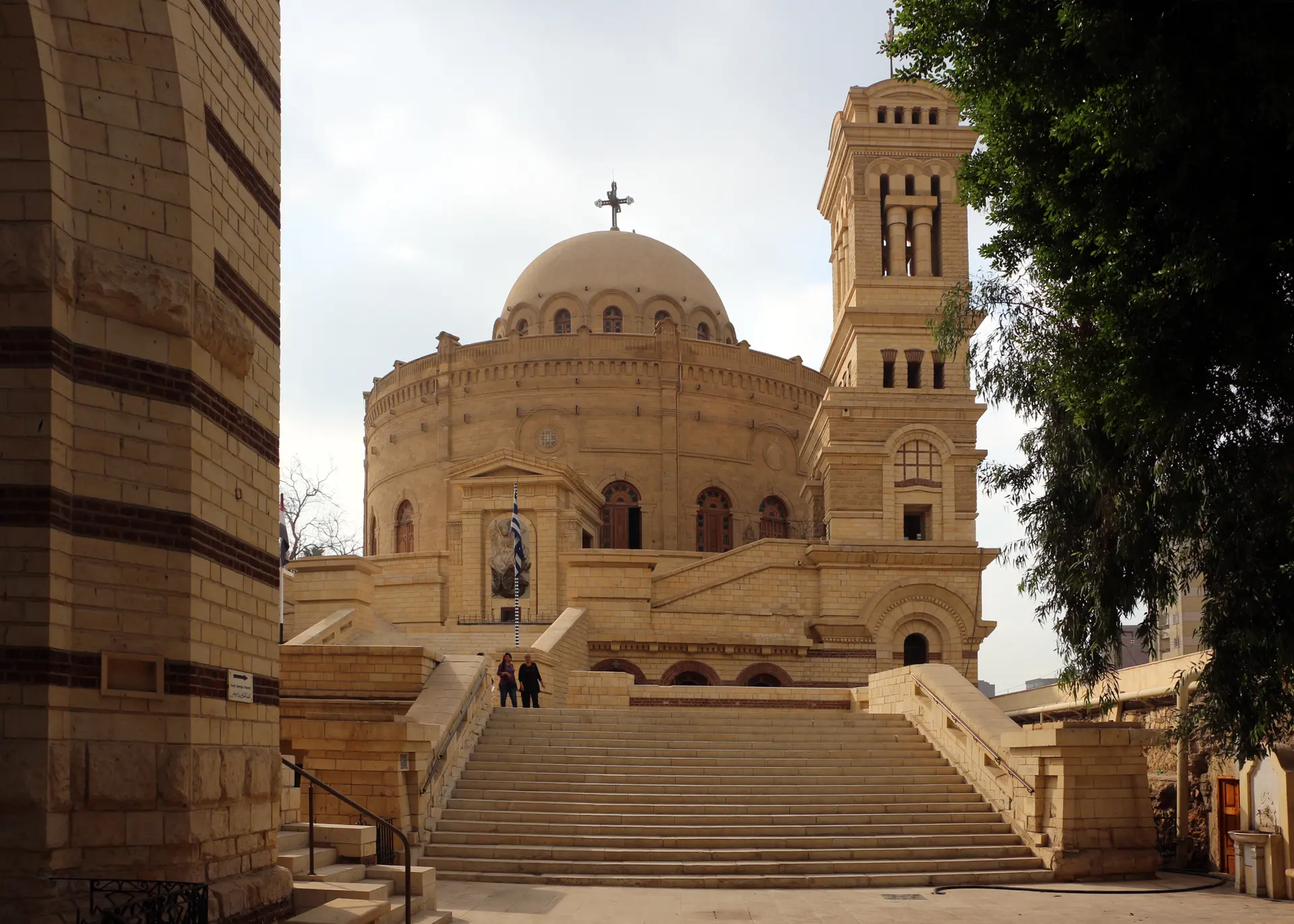
Church of Saint George, Cairo
Mit Damsis wa Kafr Abu Girg, Cairo, Egypt
14.8 km away
Saints Sergius and Bacchus Church (Abu Serga)
Old Cairo, Cairo, Egypt
14.8 km away
References
Sources consulted for this page. Source categories describe the publication, not a guarantee that every claim is verified. Traditional accounts and outside interpretations may differ.
- 01Heliopolis (ancient Egypt) — Wikipedia — Wikipedia contributorsacademicIunu / City of the Sun; capital of the 13th nome; cult of Ra/Atum-Ra; Senusret I obelisk (oldest standing, 21 m); now Ain Shams and Matariya in Cairo; temples quarried for medieval Cairo.
- 02Benben — Wikipedia — Wikipedia contributorsacademicBenben as the mound that arose from the primordial waters (Nu) on which Atum settled; Bennu bird; prototype of obelisk pyramidions.
- 03Ancient Egyptian Creation Myths: From Watery Chaos to Cosmic Egg — Glencairn Museum — Glencairn MuseumacademicMuseum overview of Nun, Atum, the primeval mound and the Heliopolitan cosmogony.
- 04Egypt's Eternal City — Archaeology Magazine (Mar/Apr 2019) — Archaeology Magazine (AIA)academicOngoing Egyptian-German excavations at the Heliopolis temple precinct in Matariya.
- 05Ancient Egyptian City of Heliopolis — World History Edu — World History EduSource contextOverview of Heliopolis as solar cult centre and home of the Ennead.
- 06Ennead of Heliopolis: Egyptian Mythology, Gods, and Creation — Egypt Fun ToursSource contextAtum, Shu, Tefnut and the nine-deity Ennead; Heliopolitan cosmology.
- 07The Benben stone, symbolic of the primeval mound of creation in Heliopolis — The Vintage News — The Vintage NewsSource contextPopular feature on the Benben; useful for symbolic framing only.
Share a photo
Help visitors recognize Heliopolis. Every submission is reviewed before publication.