Gloucester Cathedral
Where pilgrims made a murdered king holy and masons invented a new way to build
Understand sacred places, explore living traditions, and learn how to engage respectfully with Pilgrim Map.
Access has not been verified. Check current local guidance before planning a visit.
Gloucester, England, United Kingdom
Read the sources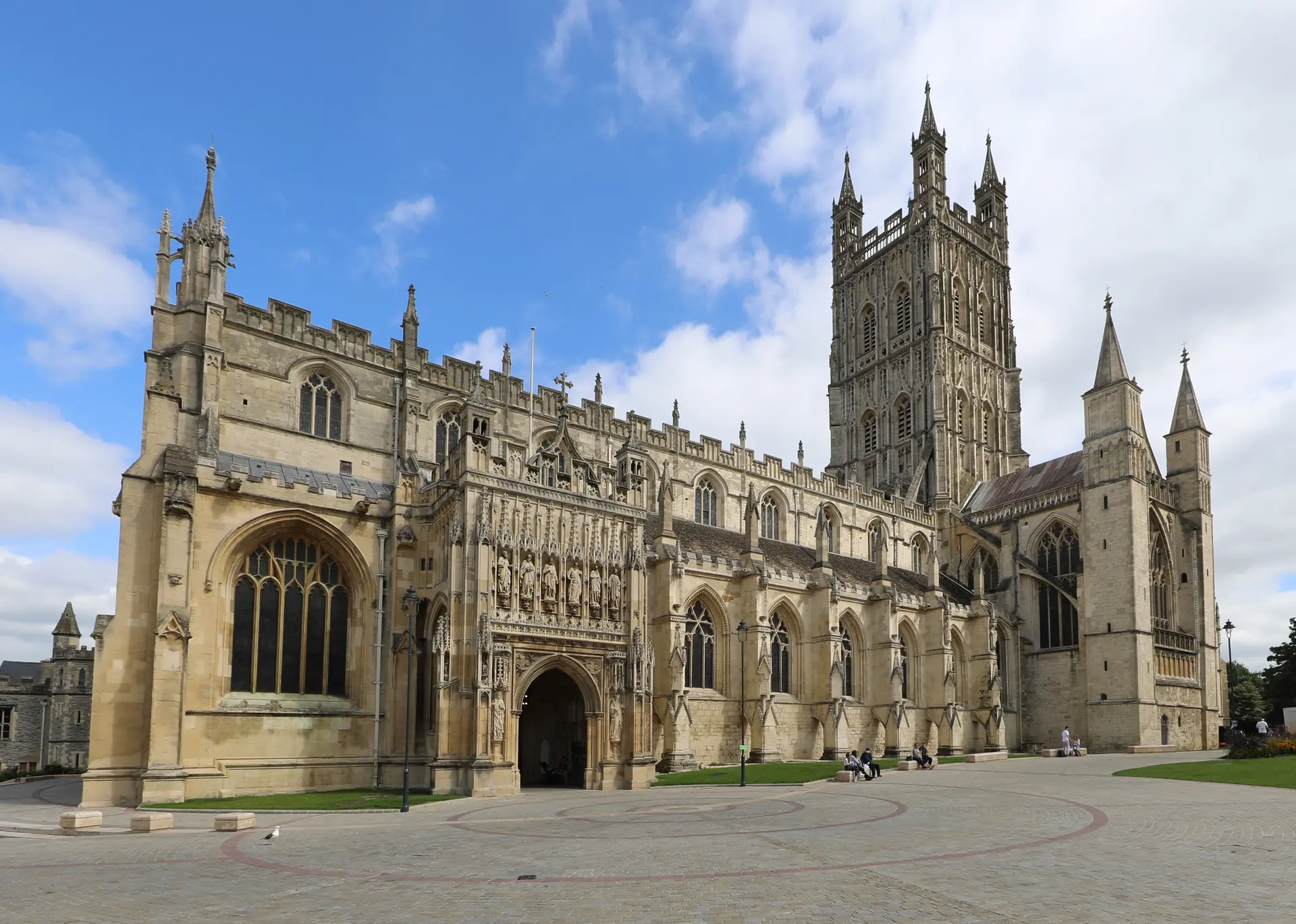
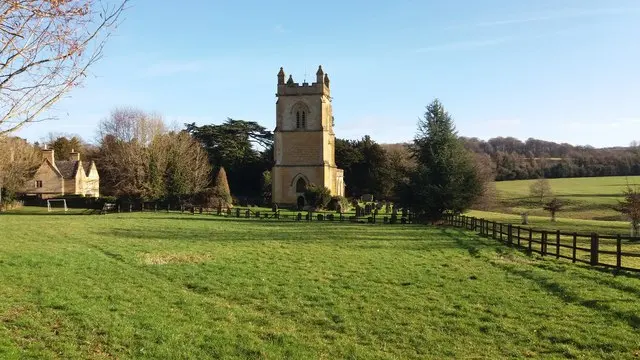
Image of Gloucester Cathedral. Image source · CC-BY-SA-4.0
Visit essentials
A quick read before you go
- Duration
- Allow 1-2 hours for a basic visit including nave, choir, Great East Window, Edward II's tomb,…
- Access
- Gloucester Cathedral is located at 12 College Green in central Gloucester.
Overview
In 1327, Gloucester Abbey accepted the body of Edward II after other religious houses refused it. The king had been killed at nearby Berkeley Castle, his death violent and politically expedient. Pilgrims soon arrived to venerate him, drawn by devotion, political sympathy, curiosity, and reports of miracles. Edward III sent royal masons and rich gifts to honor his father.
Within decades, they transformed the eastern end of the Norman abbey with vast windows, vertical lines, and elaborate tracery into the earliest surviving Perpendicular Gothic architecture.
The cloisters that followed are finer still. Completed in 1412, their fan vaults represent the earliest surviving example of this distinctively English achievement. Stone ribs spread from slender columns like the fronds of a palm, creating a canopy of mathematical precision and spiritual aspiration. To walk beneath them is to understand why medieval people saw architecture as theology made visible.
Why this place is sacred
What makes a place thin? At Gloucester, the answer begins in layers of time. Christian worship has continued here since around 679, when an Anglo-Saxon king founded a minster dedicated to St. Peter. The site has been sacred for nearly fourteen centuries. Each generation has added to what came before: Saxon timber replaced by Norman stone, Norman dimness transformed by Perpendicular light, Benedictine monasticism giving way to Anglican cathedral worship.
The prayers of all these centuries have soaked into the stone.
But there is something more specific to Gloucester's thinness. It lies in the strange alchemy by which political murder became pilgrimage, and pilgrimage became architecture. When Edward II's body arrived in 1327, the monks who received it took a risk. The king had been deposed by his own wife and her lover; his death was violent, probably by murder. Other religious houses had refused the corpse, fearing political contamination. Gloucester accepted it.
What happened next transformed the abbey. Pilgrims came, drawn by reports of miracles at the dead king's tomb. Whether Edward was genuinely holy, or whether popular sympathy for a fallen monarch created a cult, or whether political calculation by his son Edward III manufactured devotion, the result was the same: people brought their hopes and griefs to Gloucester, and left offerings. The abbey grew wealthy.
The architecture that wealth funded is where Gloucester's thinness becomes visible. The south transept, rebuilt between 1331 and 1337, is the earliest surviving example of English Perpendicular Gothic. The transformation was radical: where Norman architecture used thick walls and small windows, Perpendicular dissolved the walls into grids of glass and stone tracery. The effect is of light made architectural, of solidity yielding to transparency.
The Great East Window, measuring 22 meters high and 12 meters wide, was the largest stained glass window in the world when it was installed. Standing before it, you understand why medieval people saw their churches as anticipations of heaven.
The cloisters complete the argument. Their fan vaults, the earliest in England, represent the culmination of medieval structural imagination. Ribs of stone spread from slender columns in patterns of perfect geometry, creating a ceiling that seems to float rather than press down. The lavatorium, where monks washed before meals, features its own fan vault of extraordinary intricacy. To walk these passages is to move through space shaped by prayer.
And beneath it all lies the Norman crypt, built by Abbot Serlo after 1089, where shadows hold the prayers of monks who lived before the transformation. The crypt connects the Perpendicular light above to something older and darker, a reminder that thin places often grow from foundations we cannot see.
The site was originally an Anglo-Saxon minster founded c.679. The Benedictine abbey was established in 1017. The present Norman building began in 1089 as a great church for monastic worship and pilgrimage. The Perpendicular reconstruction from 1331 was funded largely by pilgrimage to Edward II's tomb.
Anglo-Saxon minster (c.679), Benedictine abbey (1017), Norman rebuilding (1089-1130), Perpendicular transformation of choir and transepts (1331-1377), fan-vaulted cloisters completed (1412), Lady Chapel (late 15th century), dissolution and conversion to cathedral (1541), restoration and conservation (19th-21st centuries).
Experience and orientation
The approach sets the tone. Gloucester Cathedral rises above College Green, its central tower a landmark visible across the city. The west front speaks Norman confidence, its doorway recessed beneath layers of carved stone arches.
Inside, the contrast between Norman and Perpendicular becomes the cathedral's defining experience. The nave preserves Abbot Serlo's 11th-century vision: massive cylindrical pillars, nearly 7 meters in circumference, march toward the crossing. These are among the largest columns in any English church, their bulk expressing the weight of stone and the solidity of faith. The ceiling above them dates from later reconstruction, but the pillars remain essentially as the Norman masons left them.
Move east through the crossing and everything changes. The south transept, rebuilt in the 1330s, introduces Perpendicular Gothic: vertical lines dominating, walls becoming frameworks for glass, tracery creating lace-like patterns in stone. This is where the new style first appeared in England, though whether royal masons brought it from London or invented it here remains debated.
The choir continues the transformation. The Great East Window fills the entire eastern wall, 22 meters high and 12 meters wide. When installed in the 1350s, it was the largest stained glass window in the world. Much of its medieval glass survives, depicting ranks of saints, kings, and bishops beneath the image of Christ's coronation of the Virgin. In certain light, the choir becomes a chamber of color, the stone tracery almost disappearing behind the luminosity.
Behind the high altar, in the north ambulatory, Edward II's tomb demands attention. The alabaster effigy shows a dignified king, whatever the reality of his life and death. The limestone canopy above is a masterwork of Perpendicular elaboration, its pinnacles and niches rising in intricate tiers. For centuries, pilgrims pressed close, seeking healing and hope. The marks of their presence wear into the stone.
But the cloisters may be Gloucester's supreme achievement. Exit through the south door and enter a space that feels both intimate and infinite. The fan vaults begin near the south transept and extend around the entire cloister garth. Each bay's vault spreads from a central column in patterns of ribbed geometry, the stone carved with the precision of lace. The lavatorium, where monks washed before meals, features the most elaborate vault of all. Silence gathers here.
The cloisters have a second fame now. They served as Hogwarts corridors in the Harry Potter films, and many visitors arrive seeking that recognition. The irony is gentle: fictional magic draws people to a space where the real achievement of medieval craft and devotion awaits discovery.
The Norman crypt lies beneath the choir, accessible by guided tour. Here Abbot Serlo's original structure survives largely unchanged, its low vaults and squat pillars creating an atmosphere of weight and shadow. The contrast with the Perpendicular light above could not be greater.
If timing permits, attend Choral Evensong. The choir's voices, the candlelight, the architecture designed to hold and amplify sound: all combine into an experience that the medieval builders intended but could not have anticipated in exactly this form. This is what the space was made for.
Enter through the west door off College Green. The Norman nave leads east to the crossing; the choir and Great East Window are beyond. Edward II's tomb is in the north ambulatory behind the high altar. The Lady Chapel extends at the far eastern end. The cloisters are on the north side, accessed through a door near the north transept. The crypt beneath the choir is accessible by guided tour (book at Welcome Desk).
The central tower can be climbed (book in advance). Allow 1-2 hours minimum; more for tower, crypt tour, or services. Choral Evensong typically late afternoon during term time (check schedule). Entry by donation (suggested £5).
Context and lineage
The story begins around 679 when Osric, king of the Hwicce, a sub-kingdom of Mercia, founded a minster dedicated to St. Peter on this site. His sister Kyneburga became the first abbess. For over three centuries, religious life continued here through the upheavals of the Anglo-Saxon period.
In 1017, the community was refounded as a Benedictine abbey. But by 1072, it had declined to just two monks. The Norman Conquest changed everything: William the Conqueror appointed Serlo as abbot, and the community revived. After a fire damaged earlier structures, Serlo began the present church in 1089. The massive Norman nave, crypt, and east end rose rapidly; the eastern parts were dedicated in 1100, the nave completed by around 1130.
For two centuries, Gloucester Abbey continued as a prosperous Benedictine house. Then came the event that transformed it. In 1327, Edward II, deposed by his wife Isabella and her lover Roger Mortimer, was murdered at nearby Berkeley Castle. The body was offered to several religious houses; all refused, fearing political repercussions. Abbot Thoky of Gloucester accepted it and buried the king with honors.
Almost immediately, pilgrims began arriving at the tomb. Whether genuine devotion, political sympathy, or orchestrated propaganda drove the cult, the result was transformative. Edward III lavished gifts and royal masons on the abbey in honor of his father. The pilgrimage revenue funded a revolutionary reconstruction of the choir and transepts in a new style: Perpendicular Gothic, with its walls of glass, vertical emphasis, and intricate tracery. The cloisters followed, their fan vaults the first of their kind.
A murdered king's cult had created an architectural revolution.
The site has been Christian since c.679 (Anglo-Saxon minster). Benedictine abbey from 1017 to 1540. Anglican cathedral since 1541. The current community includes the Dean and Chapter, the Cathedral Choir (mixed voices), and an active congregation. The cathedral is the mother church of the Diocese of Gloucester and seat of the Bishop of Gloucester.
Osric, King of the Hwicce
Founder of the Anglo-Saxon minster
Abbot Serlo
Builder of the Norman cathedral
King Edward II
King whose tomb transformed the abbey
King Edward III
Patron of the Perpendicular reconstruction
King Henry VIII
Creator of the cathedral
Traditions and practice
The Benedictine monks who lived here from 1017 to 1540 observed the full round of daily offices: Matins, Lauds, Prime, Terce, Sext, None, Vespers, and Compline. Their day was structured by the rhythm of prayer in the choir. The Chapter House hosted daily community meetings. The cloisters provided space for reading, meditation, and procession.
Pilgrimage to Edward II's tomb was the abbey's distinctive devotion from 1327 onward. Pilgrims came seeking miracles, leaving offerings, hoping for the intercession of a king they regarded as a martyr. The cult was never officially sanctioned by the Church, but popular devotion flourished for approximately 70 years. The revenue transformed the building.
The elaborate medieval liturgy featured processions through the cloisters, particularly on feast days. The choral tradition established by the monks continued after the Dissolution, evolving into the Anglican cathedral choir.
Daily services follow the Anglican pattern. Morning Prayer, Holy Communion at various times, and Evensong structure the day. Choral Evensong, sung by the Cathedral Choir during term time, represents the continuation of centuries of sung worship. Sunday services center on Sung Eucharist at 10:30am and Choral Evensong.
The cathedral observes the full Christian year with special services at Christmas, Easter, and other festivals. Regular concerts and events take place throughout the year, using the architectural acoustics that the medieval builders created.
Guided tours explore the building's different dimensions: Highlights tours cover the main features; Tower tours (requiring advance booking and significant stair climbing) offer views across Gloucestershire; Crypt tours descend into Abbot Serlo's Norman foundations; Library tours reveal medieval manuscripts and rare books.
Attend Choral Evensong if possible. The combination of the choir's voices, candlelight, and the Perpendicular architecture creates an experience that transcends aesthetic appreciation. The service lasts approximately 45 minutes; arrive early for seating in the choir.
Spend time in the cloisters. Walk the full circuit slowly, noticing how the fan vaults change from bay to bay. The lavatorium, where monks washed before meals, rewards close attention. The space invites silence.
Visit Edward II's tomb and consider the strange journey that brought this architecture into being: a murdered king, pilgrims seeking miracles, royal patronage, and the masons who invented something new.
The crypt tour offers a different experience entirely: the weight of Norman stone, the shadows of the building's foundations, the prayers of monks who lived before the Perpendicular transformation.
Church of England (Anglican Communion)
ActiveGloucester Cathedral is the mother church of the Diocese of Gloucester and the seat of the Bishop of Gloucester. It has been a place of continuous Christian worship for over 1,300 years, first as an Anglo-Saxon minster, then as a Benedictine abbey, and since 1541 as an Anglican cathedral. The building is recognized as one of the most architecturally significant medieval churches in England, birthplace of Perpendicular Gothic architecture and home to the earliest fan vaulting.
Daily services include Morning Prayer, Holy Communion, and Evensong. Choral Evensong is sung by the Cathedral Choir during term time. Sunday services center on Sung Eucharist and Choral Evensong. The cathedral observes the full Christian year with special services at Christmas, Easter, and other festivals. Educational programs, concerts, and tours explore the building's heritage.
Benedictine monasticism
HistoricalFrom 1017 to 1540, Gloucester was a Benedictine abbey following the Rule of St. Benedict. The monks' daily round of offices structured life here for over five centuries. The monastic buildings, particularly the remarkable cloisters with their pioneering fan vaults, survive as testimony to this heritage. The abbey's transformation through pilgrimage to Edward II's tomb represents a distinctive chapter in Benedictine history.
The monks observed the Divine Office throughout the day and night, centered on the abbey church. The Chapter House served for daily meetings. The cloisters provided space for reading, meditation, and procession. The monks were responsible for hospitality, education, and maintaining the shrine of Edward II. The lavatorium in the cloisters shows where they washed before meals.
Medieval pilgrimage cult of Edward II
HistoricalFollowing Edward II's murder in 1327, his tomb at Gloucester became a major pilgrimage destination. For approximately 70 years, pilgrims flocked to venerate the king, whom many regarded as a martyr despite his never being canonized. The revenue and royal patronage generated by this cult funded the revolutionary Perpendicular Gothic reconstruction that makes Gloucester architecturally significant.
Pilgrims visited the elaborate canopied tomb in the north ambulatory, leaving offerings and seeking intercession. Edward III and Queen Philippa sent rich gifts to honor the dead king. Reports of miracles circulated, though the Church never officially recognized Edward's sanctity. The cult flourished through popular devotion rather than institutional sanction.
Perspectives and open questions
Gloucester Cathedral invites interpretation from multiple angles: as the birthplace of Perpendicular Gothic architecture, as a monument to the strange alchemy of pilgrimage and patronage, as a living place of worship, and as a site where medieval craft achieved transcendence in stone.
Scholarly perspective
Architectural historians recognize Gloucester Cathedral as one of the most significant medieval buildings in England. The south transept (1331-1337) is definitively the earliest surviving example of English Perpendicular Gothic, though scholars debate whether royal masons invented the style in London and transmitted it to Gloucester, or whether it emerged at Gloucester itself.
The Perpendicular transformation of the Norman choir created a revolutionary effect: the original Norman structure was retained but clad in a new skin of tracery and glass, demonstrating remarkable economy and architectural boldness.
The fan-vaulted cloisters (completed 1412) are acknowledged as the earliest surviving example of fan vaulting, a distinctively English achievement that would reach its culmination at King's College Chapel, Cambridge, a century later. The mathematical precision of the vault ribs, spreading from slender columns in patterns of perfect geometry, represents the height of medieval structural and aesthetic ambition.
Nikolaus Pevsner, the architectural historian, suggested that royal patronage rather than pilgrimage revenue was the primary funding source for the Perpendicular reconstruction. This debate continues, but the result is not in doubt: whatever the economics, a murdered king's presence transformed a Norman abbey into something unprecedented.
Living and traditional perspectives
For Christians, particularly Anglicans, Gloucester Cathedral is a place where worship has continued for over 1,300 years. The daily offices maintain a rhythm of prayer that connects the present community to generations of monks and clergy who prayed here before them. The choral tradition, expressed in daily Evensong during term time, represents one of the finest expressions of Anglican worship.
The medieval pilgrimage to Edward II's tomb was never officially sanctioned; Edward was never canonized. But popular devotion flourished, and the architecture that devotion funded continues to inspire worship. The Perpendicular choir, with its walls of glass, creates a space where light itself becomes theological: the medieval builders understood their churches as anticipations of heavenly Jerusalem.
The survival of the Norman crypt beneath the Perpendicular choir offers another dimension: connection to the prayers of monks who lived before the transformation, a reminder that sacred places hold layers of devotion.
Alternative interpretations
Some visitors experience the cloisters' fan vaults as creating a particular quality of sacred space, their geometry generating patterns that seem to resonate beyond mere architecture. The mathematical precision of the vaulting has attracted interest from those who see sacred geometry embedded in medieval building practice.
The pilgrimage cult of Edward II raises questions that remain partly unanswered. Was popular devotion genuine, or politically manufactured? Did miracles occur at the tomb, or were reports propaganda? The transformation of a murdered king into an object of veneration speaks to the human capacity to find meaning in suffering, whatever the historical facts.
The cathedral's location within Gloucester's urban geography, and its relationship to even older structures like St Mary de Lode next door, suggests layers of sacred significance that predate the Christian foundation.
Open questions
The exact circumstances of Edward II's death at Berkeley Castle remain debated. Some historians question whether he was actually murdered or whether he escaped and lived out his days in obscurity. The nature of any miracles reported at his tomb is not recorded in detail.
The identity of the master masons who developed the revolutionary Perpendicular style remains unknown. Whether they worked first in London or at Gloucester, and how they conceived their innovation, is lost to history.
The full extent of medieval painted decoration, now lost or obscured, is unknown. The cathedral we see today is largely undecorated stone, but medieval churches were typically ablaze with color. What Gloucester looked like in its Perpendicular prime can only be imagined.
What structures preceded the Norman building, and what Roman or pre-Roman significance the site may have held, remains archaeologically uncertain.
Plan your visit
Access and arrival
Gloucester Cathedral is located at 12 College Green in central Gloucester. The train station is 10-15 minutes on foot. Trains run from London Paddington (2 hours via Bristol or direct), Bristol (40 minutes), and Birmingham (1 hour). Bus services connect to the city center. City center car parks are available nearby; limited disabled parking at the cathedral.
Gloucester offers a range of accommodations from budget to boutique hotels within walking distance of the cathedral. The Cotswolds countryside nearby offers country house hotels and B&Bs. Cheltenham (8 miles) provides additional options.
Respectful visit
No formal dress code. Modest, respectful casual attire is appropriate. Comfortable shoes recommended for exploring the full building, especially if climbing the tower.
Photography permitted for personal use in most areas. No flash. No tripods or professional equipment without permission. Do not photograph during services.
Entry by voluntary donation (£5 suggested). Candles available for lighting. Tour tickets available at the Welcome Desk. Shop and cafe in the cloisters.
Some areas may be closed during services, weddings, or special events. Check the daily calendar. Tower, crypt, and library tours require booking. The tower involves many steps with no elevator access.
The cathedral is an active place of worship. Services take priority; visitor access may be limited during worship, weddings, or special events. Check the calendar before visiting. Be quiet during services even if observing rather than participating. The tower tour involves many steps and is not suitable for those with mobility limitations.
Current practical details
Address
12 College Grn, Gloucester GL1 2LX, UK
Phone
Hours, fees, and access can change — verify on the official source before you travel. Practical details last checked Jun 2026.
Location
Map loads as you approach this section.
Pilgrim reflections
A portrait of encounter, not a score
Pilgrims describe what they felt, how present they could become, and whether the place would shape a journey. There are no stars and no ranking of traditions.
No reviewed reflections yet
The first pilgrims can help describe the character of being here.
Share a reflection
Available after an account-backed “Been there.” Every reflection is reviewed before publication.
Nearby sacred places
Explore other sacred places in the region. Proximity does not establish access or travel time; check each place’s guidance.
References
Sources consulted for this page. Source categories describe the publication, not a guarantee that every claim is verified. Traditional accounts and outside interpretations may differ.
- 01Gloucester Cathedral — Gloucester CathedralSource contextOfficial cathedral website with heritage and visitor information
- 02Gloucester Cathedral — The Association of English CathedralsSource contextOfficial cathedral association overview
- 03Architecture - Gloucester Cathedral — Gloucester CathedralSource contextDetailed architectural history from official source
- 04Gloucester: The cathedral and close — British History OnlineacademicVictoria County History scholarly resource
- 05Gloucester Cathedral — WikipediaencyclopediaWell-referenced article with architectural and historical details
- 06Gloucester Cathedral, St Oswald's Priory, St Mary de Lode Church — British Pilgrimage TrustSource contextPilgrimage context and traditions
- 07Gloucester Cathedral — Sacred DestinationsSource contextSacred site and tourism perspective
- 08Gloucester Cathedral — Britain ExpressSource contextHistorical and visitor information
Photo gallery
3 curated photos
Share a photo
Help visitors recognize Gloucester Cathedral. Every submission is reviewed before publication.