Gelati Monastery
Where Georgian kings built a second Jerusalem, and nine centuries of prayer still saturate the stones
Understand sacred places, explore living traditions, and learn how to engage respectfully with Pilgrim Map.
Access has not been verified. Check current local guidance before planning a visit.
Kutaisi, Imereti, Georgia
Read the sources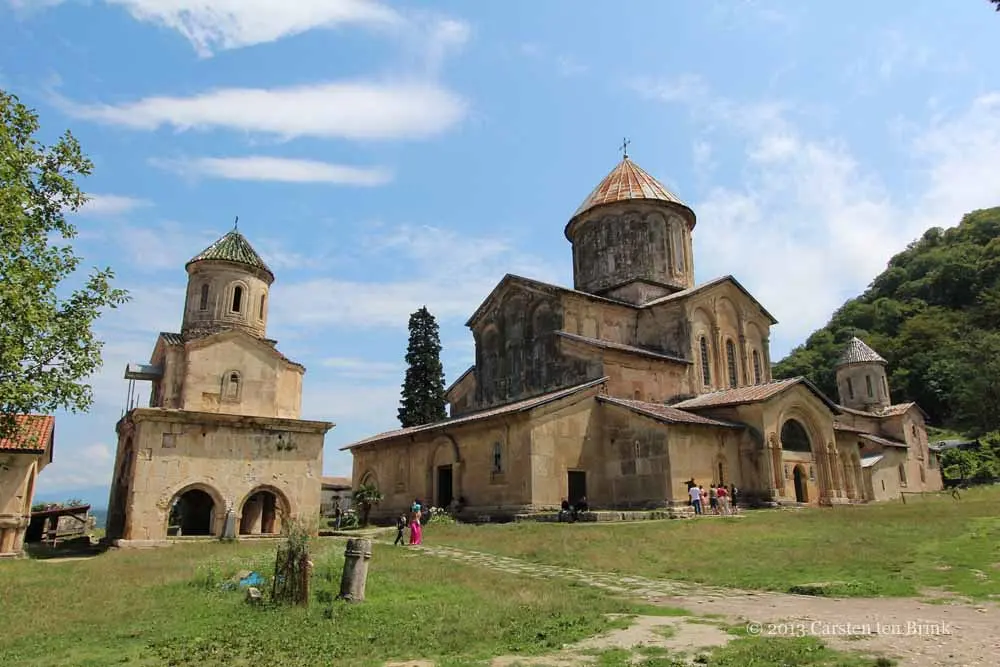
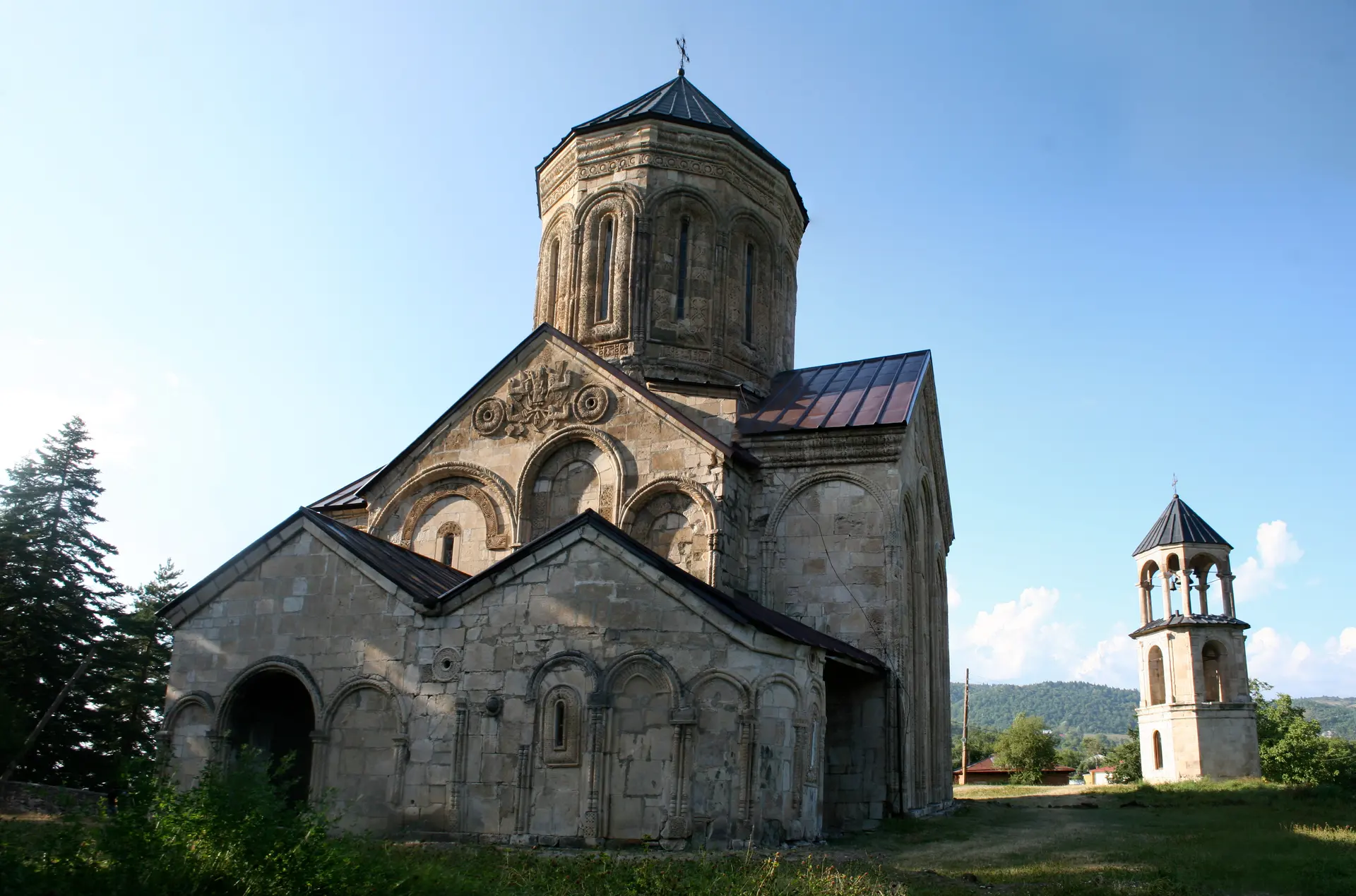
Image of Gelati Monastery. Image source
Visit essentials
A quick read before you go
- Duration
- Allow 1.5-2 hours to explore the full complex: the main Church of the Virgin, the Church of St.
- Access
- Gelati is approximately 10 kilometers northeast of Kutaisi.
Overview
By design, every Gelati visitor passes over a king's grave. David IV, who unified Georgia and built Gelati as his crowning achievement, asked burial at the entrance so all arriving to pray would step on his resting place—an enduring act of humility. The monastery rises on forested slopes above Kutaisi, Georgia's ancient capital, over the valley where the Tskaltsitela flows toward the Rioni.
Founded in 1106 during Georgia's Golden Age, it was conceived as a Second Jerusalem where heaven and earth, learning and devotion might meet; its academy rivaled medieval centers of thought. Across nine centuries, Mongol, Ottoman, and Persian invasions scarred the complex, and Soviet authorities closed it for sixty-five years, yet prayer never entirely broke. Georgian Orthodox monks again chant liturgy, and pilgrims stand before golden mosaics glowing for nearly a millennium.
For believer or visitor, accumulated devotion asks attention beyond historical observation.
Why this place is sacred
King David IV did not simply build a monastery. He built a cosmos in miniature, a place designed to concentrate sacred power. Medieval chroniclers called it 'a foreshadowing of the second Jerusalem in the whole East, a school of all virtue, an academy of instruction.' This was no metaphor but statement of intention.
The site itself speaks to this purpose. Perched on a wooded hillside above a river valley, Gelati occupies an elevated position that creates natural separation from ordinary life. The approach requires ascent—a physical enactment of rising toward the sacred. The surrounding forest enfolds the complex in living green, while views open westward across the valley, connecting the monastery to the land it was meant to bless.
Within the katholikon—the main Church of the Virgin—the 12th-century apse mosaic of the Virgin and Child ranks among the great achievements of medieval Eastern Christian art. Gold tesserae catch whatever light enters, glowing as if lit from within. The Virgin's gaze meets yours across nine centuries. This is not decoration but theology in visual form, an icon meant to function as window between realms.
Frescoes layer the walls, painted and repainted from the 12th through the 17th centuries as traditions and tastes shifted, yet maintaining continuity of purpose. Light falls through narrow windows at specific angles. The architecture shapes sound so that liturgical chanting seems to emerge from the stones themselves.
But what truly makes Gelati a thin place is time—nine hundred years of monks praying the same prayers in the same spaces. The accumulated weight of devotion does something to a place. Visitors who know nothing of Orthodox Christianity consistently report a quality of stillness here, a sense of presence that does not explain itself but insists on being noticed.
David IV conceived Gelati as a multidimensional achievement: spiritual center, intellectual academy, royal necropolis, and statement of Georgian power and Orthodox faith. The monastery was to embody the highest aspirations of his reign—a reign that saw Georgia rise from a fragmented collection of principalities to a unified kingdom capable of driving out the Seljuk Turks and standing as the major Christian power in the Caucasus.
The academy he founded alongside the monastery was no afterthought. David summoned the greatest scholars of the age, including the Neoplatonic philosopher Ioane Petritsi, who translated Proclus into Georgian, and Arsen Ikaltoeli, whose Aristotelian-influenced Dogmatikon became foundational to Georgian theology. Ecclesiastic councils met here to affirm Orthodox doctrine against heresies. Scribes copied and compiled manuscripts. Learning and prayer were understood as aspects of a single pursuit of truth.
The Golden Age did not last. After Queen Tamar's reign ended in 1213, Georgia faced successive invasions—Khwarezmians, Mongols, Timur's forces, Ottomans, Persians—each leaving damage to the complex and disrupting monastic life. Yet the monastery rebuilt and endured. By the 18th century, it had declined but still functioned.
The Soviets delivered the final blow—or so it seemed. In 1923, they closed the monastery, dispersing the monks and converting the complex to a museum. For sixty-five years, no liturgy was sung. The mosaics and frescoes remained, but the living tradition they served fell silent.
Reopening came in 1988, as the Soviet grip loosened. Monks returned. Services resumed. Today, Gelati functions again as both monastery and pilgrimage site, though restoration work continues to address centuries of accumulated damage. The thread was thin, but it did not break. Something of what David intended still lives in these stones.
Experience and orientation
The first encounter is with death—or rather, with humility in the face of it. Before entering the main church, you pass through the south gate, and beneath your feet lies the tombstone of King David IV. The inscription reads: 'This is my resting place forever: here will I dwell for I desired so.' Every footstep that has entered this monastery for nine centuries has passed over his grave. This was his explicit wish.
For Georgian pilgrims, this moment carries the weight of national identity as much as religious devotion. David is remembered not only as saint but as the king who made Georgia great. Tears are common. International visitors, unaware of the significance, often learn of it afterward and find the experience reframed—the casual step was actually participation in a ritual of humility that has repeated billions of times.
Inside the katholikon, attention immediately rises to the apse. The Virgin and Child mosaic, created by Byzantine masters around 1130, holds the space with quiet authority. Gold tesserae catch the light, seeming to glow even on overcast days. The Virgin's expression is neither warm nor distant but present—a gaze that witnesses rather than judges. Many visitors find themselves standing for minutes at a time, simply looking, as if the mosaic were looking back.
The layered frescoes covering the walls record centuries of devotion—kings and saints, biblical narratives and theological symbols, some damaged and faded, others preserved with startling clarity. Walking through the complex, from the katholikon to the smaller churches of St. George and St. Nicholas to the ruined academy building, one moves through Georgian history made visible.
Those who arrive during Sunday morning liturgy around 10am encounter Gelati as living tradition rather than museum. Georgian Orthodox chanting—polyphonic, ancient, utterly distinctive—fills the space. The monks move through rituals unchanged for centuries. Visitors who are not Orthodox may participate by silent presence, and many report that the experience provides a kind of context that pure tourism cannot: this is what the mosaics were made for, what the stones have witnessed, why anyone built this place at all.
Gelati rewards unhurried attention. The temptation is to photograph the mosaics and move on, but the site asks for more. Consider entering the katholikon without your camera first. Let your eyes adjust to the light. Let the silence—or the chanting, if you arrive during services—establish itself.
The experience shifts if you know who lies beneath your feet at the entrance. Before entering, pause. You are about to participate in something King David designed: an act of humility performed by every visitor, whether they intend it or not.
If possible, visit twice—once to explore, once to sit. The second visit, with the novelty subsided, allows something subtler to emerge. Find a seat in the katholikon when services are not in session. Notice how light moves through the space. Notice how the Virgin's gaze meets yours. This is not passive experience; it is dialogue with intention encoded in stone and gold.
Context and lineage
David IV inherited a Georgia fragmented by internal conflict and threatened by Seljuk Turkish expansion. Through military skill and political cunning, he reunified the kingdom and drove out the invaders, earning the epithet 'the Builder' not only for his construction projects but for his rebuilding of the nation itself.
In 1106, at the height of his power, he began construction of Gelati near his capital Kutaisi. This was no ordinary monastery. David envisioned a place that would embody his dynasty's legitimacy, his people's faith, and the intellectual achievements of Christian civilization. He called it a Second Jerusalem, a New Athens—claims that might seem grandiose but which the institution would largely fulfill.
The main Church of the Virgin was completed by 1130, after David's death, under his son Demetrius I. The younger king added his own mark: the famous apse mosaic, commissioned from Byzantine masters, and the Khakhuli Triptych, an extraordinary assemblage of enamel, gold, and gems now housed in Tbilisi.
Most dramatically, Demetrius brought the Gates of Ganja to Gelati in 1138—iron doors captured from the city of Ganja (in present-day Azerbaijan) as war trophy, still visible at the monastery's entrance as monument to Georgian victory.
David himself did not live to see his vision completed. He died in 1125 and was buried, by his own request, at the monastery entrance. His tomb remains there, walked upon by all who enter, exactly as he intended.
For nine centuries, monks have maintained the cycle of prayer at Gelati—a chain broken only during the Soviet period from 1923 to 1988. The institution has witnessed the full arc of Georgian history: the heights of the Golden Age under David, Demetrius, and Tamar; the catastrophic Mongol invasions of the 13th century; the long centuries of decline and foreign domination; and finally, the modern Georgian state.
The royal burials at Gelati link the monastery to Georgian national identity as much as religious devotion. David IV, Demetrius I, and other Bagrationi monarchs rest here—though the exact locations of most graves have been lost to centuries of disruption. The tradition of venerating David at the entrance has never ceased.
Today, the monastery operates under the Georgian Orthodox Patriarchate. Monks reside on site. Restoration work continues, addressing damage from centuries of neglect and conflict. The Khakhuli Triptych, once housed here, now resides in the Georgian National Museum in Tbilisi. But the mosaics remain, and the liturgy continues, and pilgrims still come to stand where kings and monks have stood for a thousand years.
David IV of Georgia
historical
King of Georgia (1089-1125), known as 'David the Builder.' He unified Georgia, expelled the Seljuk Turks, and founded Gelati as the spiritual and intellectual center of his realm. He is venerated as a saint in the Georgian Orthodox Church. His tomb lies at the monastery entrance.
Demetrius I of Georgia
historical
Son of David IV, king 1125-1156. He completed the katholikon's apse mosaic, commissioned the Khakhuli Triptych, and brought the Gates of Ganja to Gelati. He is also buried at the monastery.
Queen Tamar
historical
Georgia's most celebrated ruler (1184-1213), who presided over the apex of the Golden Age. She contributed to the Khakhuli Triptych, donating a caliph's standard captured in battle. Venerated as a saint.
Ioane Petritsi
historical
Philosopher at the Gelati Academy, known for translating Proclus and other Greek texts into Georgian. He bridged ancient classical thought and medieval Georgian Christianity.
The Virgin Mary
deity
The monastery is dedicated to the Theotokos (Mother of God). The 12th-century apse mosaic depicts her with the Christ Child, and she remains the primary figure of veneration at the site.
Traditions and practice
Historical practice at Gelati followed the full cycle of Georgian Orthodox liturgy—the Divine Liturgy, the Hours, vigils, and feast day celebrations. The monastery hosted ecclesiastic councils under David IV to affirm Orthodox doctrine. Monks copied and illuminated manuscripts. Scholars at the academy lectured on philosophy, theology, astronomy, and music.
The site served as a necropolis for Georgian royalty, with burial rites and memorial services for kings and nobles. The Khakhuli Triptych, one of the most precious objects in Georgian art, was venerated here as a miraculous icon of the Virgin—Queen Tamar donated a captured caliph's standard to honor it.
Pilgrims came to venerate the relics and tombs, to receive blessing at the holy site, and to participate in the liturgical rhythm that gave structure to medieval Christian life.
Today, the monastery maintains Georgian Orthodox liturgical practice. Divine Liturgy is celebrated, with the most accessible service for visitors being Sunday morning around 10am. The chanting is polyphonic—a distinctive Georgian tradition where multiple voices weave together in harmonies unlike Western or Greek Orthodox music. Major feast days, including Orthodox Easter and Saint George's Day, draw large crowds of Georgian pilgrims.
Monks continue to reside at the monastery, maintaining the cycle of prayer. The complex also functions as a heritage site open to visitors, creating a dual identity as both living monastery and museum of medieval Georgian achievement.
If you visit on a Sunday morning, arrive by 9:30am to find a place before the liturgy begins. Stand quietly at the back or sides of the katholikon—there are no pews, as is customary in Orthodox churches. Allow the chanting to work on you without trying to understand it intellectually. The sound, developed over centuries to resonate in these specific acoustics, is itself a form of prayer.
Before entering through the south gate, pause at David's tomb. Whether or not you consider yourself religious, take a moment to acknowledge what you are about to do: step over the grave of a king who asked to be walked upon as an act of humility before God.
In the katholikon, spend time with the apse mosaic. Let the Virgin's gaze meet yours. Notice how the gold tesserae respond to changing light. This is not art meant for quick appreciation; it was made to be lived with.
If ceremony is not occurring, find a quiet corner and simply sit. The accumulated centuries of prayer have done something to this space. Let it work on you.
Georgian Orthodox Christianity
ActiveGelati Monastery is one of the most important spiritual centers of the Georgian Orthodox Church. Founded in 1106 by King David IV as a 'Second Jerusalem,' it was conceived as a place embodying both religious devotion and intellectual achievement. The monastery played a key role in strengthening the Georgian Orthodox Church during Georgia's Golden Age and continues to serve as a major pilgrimage destination. For Georgians, Gelati represents the apex of their medieval civilization—a fusion of faith, learning, and national identity that remains foundational to Georgian self-understanding.
Regular Orthodox liturgical services are held, including Divine Liturgy. Sunday morning services feature traditional Georgian Orthodox polyphonic chanting. Major religious celebrations such as Orthodox Easter and Saint George's Day draw large crowds of pilgrims. The monastery maintains the full cycle of Orthodox worship, with monks in residence.
Gelati Academy Tradition
HistoricalThe Gelati Academy, established alongside the monastery in 1106, was one of the most important centers of learning in the medieval Orthodox world. Called a 'second Athens' and 'second Athos,' it rivaled the great intellectual institutions of its era. The academy taught geometry, arithmetic, music, philosophy, rhetoric, and astronomy, producing scholars whose translations and commentaries shaped Georgian thought for centuries.
The academy hosted ecclesiastic councils under David IV to affirm Georgian Orthodox doctrine. Scholars translated Greek philosophical and theological texts, including Proclus and Aristotle. Scribes compiled manuscripts in the Georgian language. The institution created a synthesis of Christian devotion and classical learning that defined Georgian intellectual culture.
Perspectives and open questions
Gelati invites interpretation through multiple lenses: art historical, theological, national, and experiential. The scholarly emphasis on Byzantine artistic influence, the Georgian Orthodox understanding of sacred continuity, and the personal encounters of contemporary visitors each reveal dimensions the others miss. Honest engagement holds these perspectives together without forcing resolution.
Scholarly perspective
Art historians recognize Gelati as containing some of the finest Byzantine-influenced medieval art outside the Byzantine Empire itself. The 12th-century apse mosaic of the Virgin and Child is compared to masterworks at Torcello and other Venetian churches—work of the highest craftsmanship placed at the eastern edge of the Byzantine artistic sphere.
Historians view the Gelati Academy as a genuine center of learning that contributed to the transmission of Greek philosophical texts. Ioane Petritsi's translations of Proclus and other Neoplatonic thinkers bridged ancient thought and medieval Georgian Christianity in ways that parallel developments in Western scholasticism.
The UNESCO designation recognizes Gelati as reflecting the 'golden age' of medieval Georgia—a period when the kingdom achieved political, cultural, and religious achievements that shaped Georgian identity for centuries to come.
Living and traditional perspectives
For Georgian Orthodox Christians, Gelati is not merely historically significant but spiritually alive. The monastery is a place where nine centuries of prayer have sanctified the ground, where the presence of saints—David, Demetrius, Tamar—creates ongoing connection between heaven and earth.
King David IV's tomb at the entrance carries particular significance. The tradition of walking over his grave is understood as participation in his humility, a blessing extended to all who enter. Pilgrims often pray at the tomb before entering the church.
The mosaics and icons are not art objects but windows to the divine—means by which the faithful enter into the presence of Christ and the Theotokos. The continuing liturgy is understood as joining the worship of angels, part of a cosmic liturgy that has never ceased.
Open questions
Genuine mysteries remain at Gelati. The exact locations of most royal burials have been lost to centuries of invasion, looting, and reconstruction—only fragmentary archaeological evidence identifies where specific monarchs lie. The fate of the academy's library and manuscripts after the various invasions is incompletely documented.
The full extent of Byzantine diplomatic and artistic exchanges that brought Georgian culture into dialogue with Constantinople, and produced works like the enamel pieces later incorporated into the Khakhuli Triptych, remains partially obscure. Some sources suggest monastic life continued through all disruptions except the Soviet period; others indicate earlier interruptions during invasions. The precise continuity of tradition is difficult to verify across nine centuries.
Plan your visit
Access and arrival
Gelati is approximately 10 kilometers northeast of Kutaisi. By marshrutka (minibus): Bus 33 departs from near Dinmart Supermarket behind the Drama Theatre in Kutaisi. Reported departure times: 7:30am, 11:00am, 2:00pm, 4:00pm, 6:00pm. Fare approximately 3 GEL, journey 20-30 minutes. Last return bus from Gelati around 4:30pm—verify locally. By taxi: round-trip from Kutaisi costs approximately 25-30 GEL, or 30-35 GEL including Motsameta Monastery. Entry to the monastery is free.
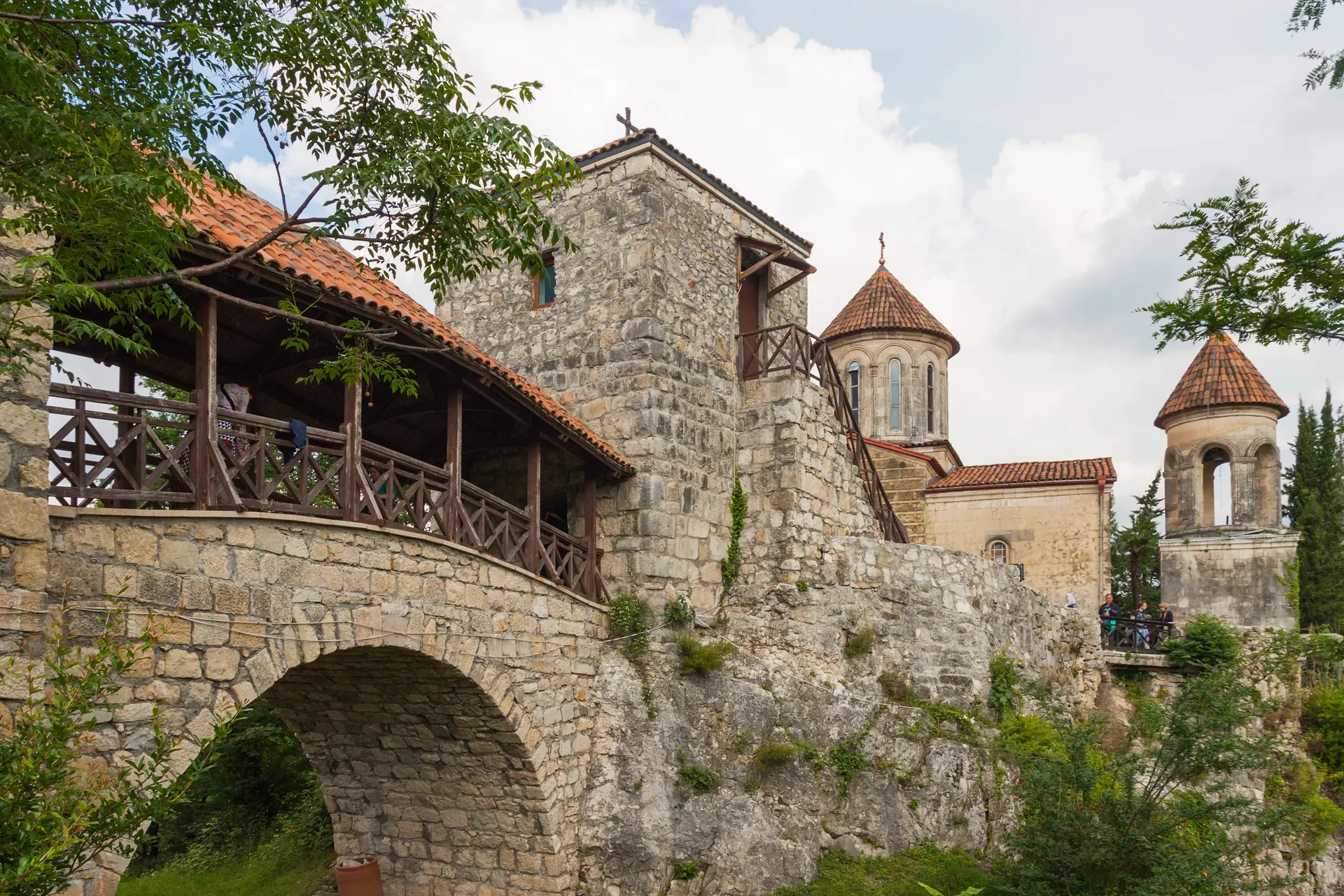
Kutaisi offers lodging at all price points, from budget guesthouses to boutique hotels. The city is the natural base for visiting Gelati and other sites in the Imereti region. Some visitors combine Gelati with Motsameta Monastery in a single half-day trip from Kutaisi.
Respectful visit
Modest dress is required. Shoulders and knees must be covered for both men and women. Women should bring a scarf or head covering for entering the churches—this is standard Orthodox practice. Some visitors report that scarves may be available at the entrance, but it is better to bring your own.
Dress practically for the site itself: comfortable walking shoes for uneven terrain, layers for changing temperatures between outdoors and the cool church interiors.
Photography is permitted in the monastery grounds and exterior areas. Inside the main church, photography is restricted or prohibited, particularly without flash. During services, photography is not appropriate. Professional photography or filming requires advance permission from the monastery.
Consider whether your photography serves the experience or replaces it. The mosaics will appear in any guidebook; what cannot be reproduced is the effect of standing before them in person.
Candles can be purchased and lit in the traditional Orthodox manner. Donations support the monastery's maintenance and ongoing restoration work. These forms of offering are appropriate and welcomed.
Some areas may be closed for restoration—respect these closures. Do not touch frescoes, mosaics, or other historic surfaces. Do not climb on structures or sit on walls. The monastery is a UNESCO World Heritage Site; preservation depends on visitor restraint.
Gelati remains an active monastery, not a museum. Behavior appropriate to a house of worship is expected. During services, visitors should remain quiet and refrain from moving around. Photography during liturgy is inappropriate.
Do not attempt to enter areas closed to visitors. Restoration work is ongoing, and some sections may be inaccessible for preservation reasons.
Note that as of recent reports, some areas of the main church are under scaffolding for restoration. This may affect visibility of frescoes and the overall experience. Check current conditions locally before visiting.
Current practical details
Address
7QV9+V69, Rd to Gelati Monastery, Motsameta, Georgia
Phone
Hours, fees, and access can change — verify on the official source before you travel. Practical details last checked Jun 2026.
Location
Map loads as you approach this section.
Pilgrim reflections
A portrait of encounter, not a score
Pilgrims describe what they felt, how present they could become, and whether the place would shape a journey. There are no stars and no ranking of traditions.
No reviewed reflections yet
The first pilgrims can help describe the character of being here.
Share a reflection
Available after an account-backed “Been there.” Every reflection is reviewed before publication.
Nearby sacred places
Explore other sacred places in the region. Proximity does not establish access or travel time; check each place’s guidance.
References
Sources consulted for this page. Source categories describe the publication, not a guarantee that every claim is verified. Traditional accounts and outside interpretations may differ.
- 01Gelati Monastery - UNESCO World Heritage Centre — UNESCOofficialOfficial UNESCO World Heritage listing and description
- 02Gelati History - Gelati Monastery History — Gelati Rehabilitation ProjectofficialOfficial rehabilitation project documentation
- 03Gelati Monastery - Crossing Frontiers — Courtauld Institute of ArtacademicAcademic art history source
- 04The Byzantine Monastery of Gelati in Georgia: Echoes of East and West — Liturgical Arts JournalacademicAcademic analysis of Byzantine artistic connections
- 05Academy of Europe: Gelati Academy — Academia EuropaeaacademicAcademic recognition of Gelati Academy's significance
- 06Gelati Monastery and Academy — World Monuments FundofficialConservation organization documentation
- 07Transforming Religious and Monarchial Power: The Iron Gate of Ganja within the Gelati Monastery — Journal of Islamic ArchaeologyacademicAcademic article on the Gates of Ganja
- 08Gelati Monastery - WikipediaacademicComprehensive overview with citations
- 09Gelati Monastery: A Timeless Testament to Georgia's Golden Age — History ToolsacademicHistorical narrative overview
- 10Khakhuli triptych - WikipediaacademicOverview of the famous triptych with citations
- 11Gelati Monastery | Attractions - Lonely Planet — Lonely PlanetguidePractical visitor information
- 12Gelati Monastery: UNESCO Heritage Site in Kutaisi, Georgia — Georgia.toofficialGeorgian tourism official source
Share a photo
Help visitors recognize Gelati Monastery. Every submission is reviewed before publication.