Gavurkale
A Hittite hilltop sanctuary where three gods were carved in stone at the frontier of the Bronze Age empire
Understand sacred places, explore living traditions, and learn how to engage respectfully with Pilgrim Map.
Access has not been verified. Check current local guidance before planning a visit.
Ankara, Turkey
Read the sources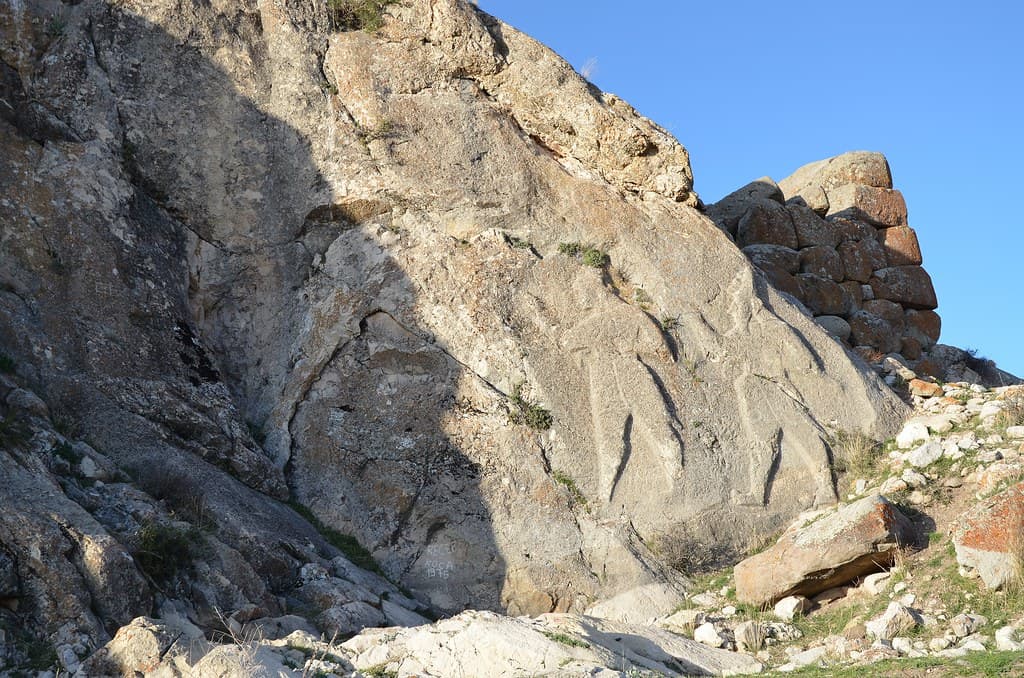
Image of Gavurkale. Image source
Visit essentials
A quick read before you go
- Duration
- 2–3 hours including the stream crossing and hill ascent.
- Access
- Approximately 60 km southwest of Ankara in the Haymana district.
Overview
Gavurkale—‘Infidel Castle’ in Turkish—records how later people understood an unexplained hilltop with figures from an older religion; its Hittite name is unknown. Above the Babayakup stream valley at 1,180 meters on the Anatolian plateau, the Hittites made the rocky hill a place for gods. Unlike royal-authority reliefs, its three figures are deities: a seated goddess and two standing gods, each sword-bearing and wearing a horned conical hat of divinity.
A cyclopean-walled precinct and stone chamber show that cultic activity occurred beside the carvings, perhaps ritual meals, libations, or rites no longer nameable. Sixty kilometers from Ankara, Gavurkale shows Hittite sacred geography projected into frontier territory by making carved hilltops divine. Excavations in 1930 and the 1990s left its full purpose debated, yet it remains among the clearest examples of landscape as a Hittite medium for the divine.
Why this place is sacred
In Hittite religious geography, hilltops were natural loci for divine presence. Height brought proximity to sky deities; isolation brought distance from the mundane; the view over surrounding landscape made the hilltop a natural point of command — which the Hittites understood as belonging to gods as much as kings.
What distinguishes Gavurkale from most Hittite rock monuments is this: the carved figures are not a king. They are three deities. The seated goddess — likely connected to the Hittite sun goddess tradition — and the two standing, sword-bearing gods were carved here to inhabit this hilltop, not to proclaim a ruler's presence. The site is not a territorial marker but a sanctuary: the gods were installed here, in stone, to remain.
The cyclopean walls and the stone chamber amplify this reading. Walls suggest an enclosed sacred space; a chamber suggests enacted ritual — not passive veneration but something happening here, regularly, involving people, fire, food, or utterance. What that was, we cannot fully recover. But the form survives: the enclosed hilltop, the carved gods, the built space for human approach.
The thinness of Gavurkale lies in the fact that this structure — divine presences carved into a frontier hilltop with space for human ritual — has been present continuously here since the Bronze Age. The gods are worn; the chamber is ruined; but the arrangement of sacred space in this landscape has not changed.
A Hittite frontier sanctuary: a hilltop consecrated by divine imagery and enclosed cultic space to project sacred authority into the periphery of the empire, likely serving both administrative and religious functions for the surrounding region.
After the collapse of the Hittite Empire around 1180 BCE, the site's function ceased. The reliefs remained visible and were presumably recognized by Phrygian populations who later occupied the plateau, though no evidence of reuse as a sacred site has been confirmed. The Seljuk and Ottoman Turkish populations named the place 'Infidel Castle,' marking it as a ruin of a pre-Islamic religion.
Modern excavations (1930, 1993–1998) have begun to reconstruct the site's purpose, but interpretive disagreement about the stone chamber continues.
Experience and orientation
Reaching Gavurkale requires commitment. From Dereköy village — itself reached by road through the Haymana district southwest of Ankara — you cross the Babayakup stream and walk approximately one to one and a half kilometers north to the hill. The approach is unmanaged: no path, no signs, no facilities. The effort is part of what the site offers.
The hill rises about sixty meters above the surrounding valley. The approach from below reveals the cyclopean walls — large, fitted stones laid without mortar at the hilltop's edges — before the reliefs themselves become visible. When you reach the smoothed vertical rock face, the three carved figures emerge: at left, a goddess seated on what may be a throne; flanking her, two standing male gods in horned conical hats with swords.
The carving is in the Hittite convention — profile figures with formal posture, each figure communicating status through hat and weapon. The surface has weathered significantly over three thousand years but the figures remain legible.
The stone chamber is nearby — a roofless rectangular structure built from cut stone, its function debated between funerary and ritual interpretations. Walk the perimeter of the cyclopean precinct. Consider the elevation, the view — southwest toward the plateau, east toward Ankara's distant haze. This is where the Hittite Empire's sacred presence was planted in frontier territory: not by a king but by three gods, held in stone at 1,180 meters, watching the approach roads for three millennia.
GPS: 39.5316°N, 32.5590°E. From Ankara take the D260 southwest toward Haymana. From Dereköy village, cross the Babayakup stream and proceed north on foot approximately 1–1.5 km to the hill. No signage. Sturdy footwear required; the stream crossing may require stepping stones or wading depending on season.
Context and lineage
In the 14th or 13th century BCE, during the height of Hittite imperial power, this hilltop on the Anatolian plateau was selected for a permanent sacred installation. The choice was likely administrative and religious simultaneously: the plateau southwest of what is now Ankara was frontier territory for the Hittite Empire, and establishing a hilltop sanctuary here served to extend the sacred geography of the empire's core into its periphery.
The Hittites smoothed a section of the hilltop's rock face and carved three deities: a seated goddess and two armed standing gods. Unlike reliefs where a king's image dominates, at Gavurkale the divine figures are the primary subjects. This distinction matters: the site was not made sacred by a king's presence but by the gods' own. The cyclopean precinct walls — large stones fitted without mortar — enclosed a defined sacred space.
Within it, a stone-built chamber served purposes that remain debated: the excavator H. H. von der Osten, who worked here for the University of Chicago in 1930, proposed a funerary function; Stephen Lumsden's more recent excavations (Bilkent University, 1993–1998) suggest cultic use.
The site name reflects its post-Hittite history: 'Gavurkale' (Infidel Castle) is a Turkish designation applied to pre-Islamic ruins across Anatolia. The Hittite name and any record of specific deities depicted here have not been recovered.
Gavurkale belongs to the Hittite tradition of rock sanctuaries at strategically significant hilltops — a practice documented across central and western Anatolia. The use of divine rather than royal imagery places it closer to formal temple practice than to the pass-marking royal reliefs of Karabel or the Taurus mountains. It may represent a category of frontier sanctuary where the empire established permanent divine presence without deploying a king's image.
H. H. von der Osten
Archaeologist, conducted the first formal excavation for the Oriental Institute, University of Chicago, in 1930; proposed funerary interpretation of the stone chamber
Stephen Lumsden
Archaeologist, Bilkent University; conducted excavations 1993–1998 suggesting cultic rather than funerary use of the chamber
Horst Ehringhaus
Documented the Hittite rock reliefs including Gavurkale in comprehensive publication (2005)
Traditions and practice
The Hittite cultic program at hilltop sanctuaries typically included libations and food offerings to the gods depicted, invocations spoken by priests or royal officials, and possibly ritual meals in associated chamber spaces. The enclosed precinct at Gavurkale defined a bounded sacred zone where these activities occurred. The carved deities were not merely viewed — they were addressed, tended, and propitiated as living presences inhabiting the stone.
No active practices. Occasional visits by archaeologists, students of Hittite civilization, and heritage tourists, with no organized program.
Approach the hill slowly from the valley below — the effort of the ascent was part of what made hilltop sanctuaries distinct in every tradition, including the Hittite. As the cyclopean walls become visible, pause at the precinct boundary before entering. The enclosure was intentional: it marked a transition from ordinary space into sacred space.
At the rock face, spend time with each of the three carved figures. The horned conical hats identify them unambiguously as divine in Hittite convention — the same headgear worn by the greatest Hittite gods. The seated goddess and the standing armed gods are not decorative: they are presences installed here to inhabit this hilltop. Let yourself sit with the question of what it means that people returned here, regularly, in the Bronze Age, to address these figures.
Walk the perimeter of the cyclopean precinct walls. Sit in or near the stone chamber and consider the debate between funerary and cultic functions — both interpretations suggest this was a space for sustained, repeated human activity in relationship to the divine. Before descending, look out from the hilltop in the direction the carvings face: across the plateau, toward routes that connected this frontier sanctuary with the empire's heartland.
Hittite Royal and Divine Cult
HistoricalA frontier hilltop sanctuary where three Hittite deities were carved and enclosed within a cyclopean precinct, likely serving as a cultic installation projecting Hittite sacred authority into peripheral territory.
Cultic rituals including libations, offerings, and priestly or royal invocations of the depicted deities; the stone chamber may have been used for ritual meals or enclosed rites.
Archaeological / Scholarly
ActiveOne of the clearest surviving examples of Hittite sacred landscape projection beyond the empire's core territories; the site has been formally excavated twice and is included in specialist Hittite heritage programs.
Academic fieldwork, site documentation by Ehringhaus (2005), inclusion in specialist Hittite monument tours.
Perspectives and open questions
Gavurkale is read differently depending on whether one approaches it as a political monument, a religious installation, or an exercise in frontier sacred geography — all three framings illuminate something true.
Scholarly perspective
Scholarly consensus places Gavurkale in the Hittite Empire period (14th–13th century BCE) as a frontier sanctuary. The distinction between this site and political Hittite reliefs — the carved figures are gods, not kings — is significant for understanding how the Hittites extended religious authority into peripheral territories. Excavations by von der Osten (1930) and Lumsden (1993–1998) have partially clarified the site's stratigraphy, but the debate over the chamber's function (funerary vs. cultic) has not been fully resolved.
Horst Ehringhaus' comprehensive documentation of Hittite rock monuments (2005) remains the primary reference.
Living and traditional perspectives
No living tradition is directly associated with Gavurkale. Later Turkish-speaking populations named the site 'Infidel Castle' — a generic designation for pre-Islamic ruins. No descendant community of the Hittite tradition maintains the site or claims cultural connection to it.
Alternative interpretations
From a sacred landscape perspective, Gavurkale represents a deliberate act of divine installation: the Hittites did not merely mark territory, they sacralized it by placing gods in it. The hilltop was not merely convenient for surveillance — it was appropriate for the divine, elevated above the human world.
The question of whether the carved goddess is the same sun goddess worshipped at Hattusha, or a more local divine power, points to how the Hittite sacred landscape was both unified and particular: the same divine types, differently expressed in different places.
Open questions
The identities of the three deities depicted remain unconfirmed. The specific ritual program conducted at the stone chamber has not been fully reconstructed. Whether Gavurkale was part of a network of frontier hilltop sanctuaries connected by pilgrimage or royal visitation routes is not yet established.
Plan your visit
Access and arrival
Approximately 60 km southwest of Ankara in the Haymana district. GPS: 39.5316°N, 32.5590°E. Drive to Dereköy village; from there cross the stream and walk approximately 1–1.5 km north. No formal parking area, no signage, no visitor facilities. Private vehicle required. The Museum of Anatolian Civilizations in Ankara holds extensive Hittite collections and provides essential context for the site.
Ankara offers all accommodation options. Haymana has limited local accommodation. No facilities near the site.
Respectful visit
No specific requirements. Sturdy footwear is essential for the approach and the hill. Practical outdoor clothing.
Photography permitted. The relief surface is best photographed in morning light or under overcast conditions that minimize harsh shadows on the low-relief carving.
None appropriate. This is an archaeological site with no active religious practice.
Do not touch the carved surface. Do not climb or disturb the cyclopean walls or stone chamber. The stream crossing should be attempted cautiously in high water.
The site is steep and the approach pathless. The stream crossing may be difficult in high water. Do not touch the carved surface. The walls and chamber are structurally fragile; do not climb or disturb the stones.
Location
Map loads as you approach this section.
Pilgrim reflections
A portrait of encounter, not a score
Pilgrims describe what they felt, how present they could become, and whether the place would shape a journey. There are no stars and no ranking of traditions.
No reviewed reflections yet
The first pilgrims can help describe the character of being here.
Share a reflection
Available after an account-backed “Been there.” Every reflection is reviewed before publication.
Nearby sacred places
Explore other sacred places in the region. Proximity does not establish access or travel time; check each place’s guidance.


References
Sources consulted for this page. Source categories describe the publication, not a guarantee that every claim is verified. Traditional accounts and outside interpretations may differ.
- 01Hittite Monuments - Gavurkale — Hittite Monuments ProjectacademicSpecialist site documenting Hittite rock monuments with detailed architectural and iconographic analysis
- 02Gâvurkale Hittite Rock Reliefs — ResearchGateacademicPeer-reviewed publication on the reliefs' iconography and significance
- 03Gavurkale Relief - Cultural Inventory — Kulturenvanteri.com (Turkish cultural heritage inventory)officialOfficial Turkish cultural heritage database entry
- 04Gâvurkale Hitit Kaya Kabartmaları (BELLETEN journal article) — Türk Tarih Kurumu (Turkish Historical Society)academicTurkish academic publication on the Hittite rock reliefs at Gavurkale
- 05Gavurkale - Vici.org — Vici.org contributorsguideArchaeological site inventory with location and excavation history
- 06Excavations in Central Turkey — World ArchaeologyacademicContext for central Anatolian Hittite archaeological programs
- 07More than a gray capital: Ankara's hidden Hittite ruins offer adventure into history — Daily SabahguideGeneral visitor and travel context for Hittite sites near Ankara including Gavurkale
Share a photo
Help visitors recognize Gavurkale. Every submission is reviewed before publication.