Exeter Cathedral
Where nearly a millennium of prayer has shaped stone, and the longest medieval vault draws the eye toward heaven
Understand sacred places, explore living traditions, and learn how to engage respectfully with Pilgrim Map.
Access has not been verified. Check current local guidance before planning a visit.
Exeter, England, United Kingdom
Read the sources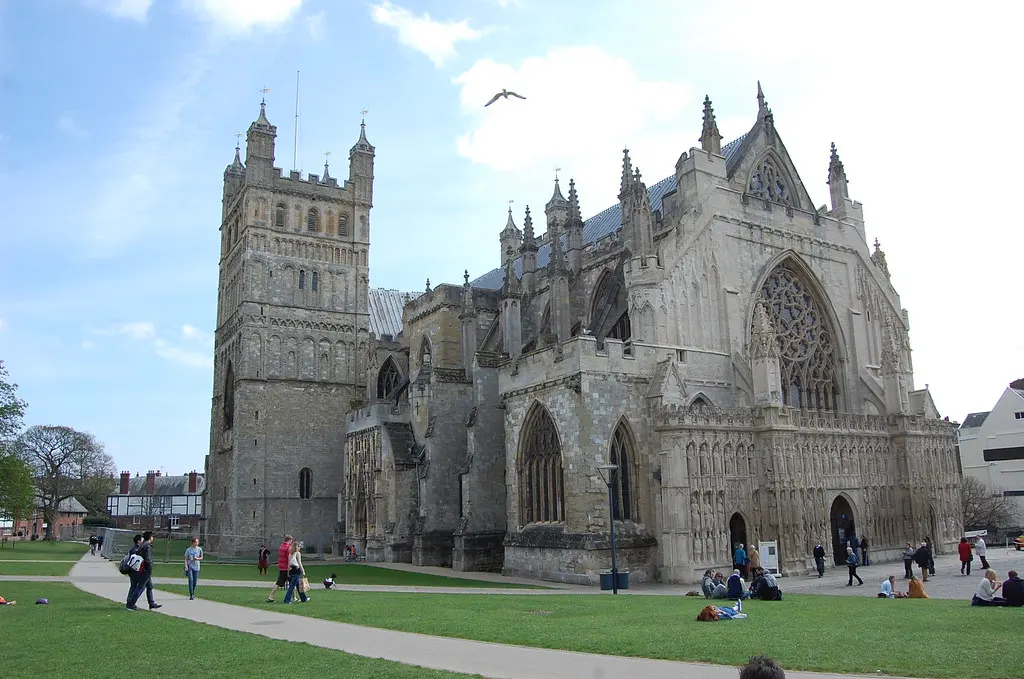
Image of Exeter Cathedral. Image source
Visit essentials
A quick read before you go
- Duration
- A thorough visit requires at least two hours—longer if you wish to attend a service or explore…
- Access
- The cathedral stands in Exeter city centre, a short walk from both Exeter Central and Exeter St…
Overview
Exeter Cathedral has accumulated prayer as stone gathers moss. Its ribbed nave vault stretches ninety-six metres without interruption—the longest medieval ceiling of its kind anywhere—because builders placed the towers at the transepts rather than the crossing. Its lines draw the eye forward and upward together.
Over a century, medieval craftsmen transformed Norman walls into Decorated Gothic splendour, treating architecture as prayer. Bosses, carved angels in the Minstrels' Gallery, and misericords beneath choir seats served practical and devotional purposes. The famous elephant, carved from description by someone who had never seen one, reflects a faith willing to imagine the unwitnessed.
A Roman bathhouse came first, then a Saxon monastery where Saint Boniface learned the faith he carried to Germany. Norman conquest, medieval rebuilding, Reformation, Civil War, and the Blitz destruction of St James Chapel each left a mark without erasing what preceded it. The choir still sings Evensong most afternoons, continuing centuries of song. Visitors are welcome into a space that asks attention and was designed to lift the human spirit, maintained by those who believe that lifting matters.
Why this place is sacred
The builders of medieval cathedrals understood themselves as creating heaven on earth—not metaphorically but architecturally. The pointed arches lifting the eye upward, the light filtering through stained glass, the acoustic space designed to make human voices resonate as if joined by angels: all of this was theology in stone.
Exeter's Gothic rebuilding, spanning nearly a century from 1275 to 1369, created a unified vision of this theology. Where other English cathedrals show the seams between different building campaigns, Exeter achieved something approaching coherence. The Decorated Gothic style reached its English peak here, in the intricate tracery of the windows, the carved bosses studding the vault, the soaring Bishop's Throne that Nikolaus Pevsner called 'the most exquisite piece of woodwork for its date in England and perhaps in Europe.'
But the thinness visitors report is not merely aesthetic response to beautiful architecture. Something else operates here. The cathedral has never stopped being a place of worship. Morning Prayer, Evensong, Eucharist—these have continued through centuries of change, through plague and reformation and world war. The accumulated weight of all those prayers, all those voices lifted, seems to persist in the stone itself.
Visitors use different language for this. Some speak of peace, of a quality of stillness that cuts through mental noise. Others describe feeling suddenly aware of their own smallness within something vast. Still others simply say the space feels different from ordinary buildings—more charged, more present, more attentive. Whether this reflects psychology, accumulated human intention, or something beyond conventional explanation, the reports are consistent enough to take seriously.
The cathedral was founded in 1050 when Edward the Confessor transferred the bishop's seat from Crediton to Exeter, establishing it as the mother church of a diocese covering Devon and Cornwall. The original Norman building, begun in 1114, served both liturgical and political functions—a statement of Norman authority as much as a house of prayer.
The Gothic rebuilding beginning around 1275 transformed this into something more deliberately celestial: a space designed to lift worshippers into contemplation of the divine through the language of light, proportion, and ascending stone.
The site's sacred history predates Christianity. Roman legionaries built their bathhouse here around 50-75 AD—the second stone building in all of Britain, suggesting the location's importance even then. When Christianity came to Roman Exeter, the city became one of England's earliest bishoprics. The Saxon monastery that followed educated Boniface, whose mission would convert northern Germany and earn him the title 'Apostle of the Germans.'
The Reformation stripped the building of its relics and much of its ornament, yet worship continued in the new Anglican form. The English Civil War brought more destruction; Cromwell's forces stabled horses in the nave. Yet still the building stood, still the services resumed.
The twentieth century's greatest trauma came on 4 May 1942, when a German bomb struck St James Chapel during the Baedeker Blitz—raids targeting England's most beautiful cities. The chapel was destroyed, but the main structure survived. Today's visitor sees a building that has absorbed each blow and emerged intact, its identity shaped by survival as much as by original intention.
Experience and orientation
The first thing most visitors notice is the vault. Looking up from the nave, the ribs of the ceiling converge toward the east end in unbroken perspective, pulling the eye along nearly one hundred metres of medieval stonework. The effect is both horizontal and vertical—you are drawn forward toward the altar and upward toward something the builders clearly intended you to sense but not quite see.
The second thing is the quality of light. On a bright day, the stained glass suffuses the interior with coloured luminance; on a grey one, the stone takes on a quiet glow. Either way, the light here differs from daylight outside, filtered and transformed by passing through images of saints and sacred story.
Then, if you stay long enough, comes the third thing: a settling. The mind that entered carrying the concerns of the day—appointments, worries, the small urgencies of ordinary life—begins to quiet. This happens gradually, almost without noticing, until you realize you have been standing still for several minutes, simply looking.
Those who time their visit to include Evensong describe the experience as unexpectedly profound. The choir processes in, the ancient words of the liturgy fill the acoustic space, and something shifts. Visitors who arrived as tourists sometimes find themselves moved in ways they did not anticipate. The beauty of the music combines with the beauty of the space to create a third thing—neither architecture nor sound alone but something that uses both to reach elsewhere.
The misericords reward close attention. These carved wooden seats, hinged to allow standing clergy a discreet rest during long services, bear carvings from the mid-thirteenth century—among the oldest in England. The subjects range from sacred to profane: an elephant rendered by someone who had only heard descriptions of the creature, a mermaid, a naked woman riding a stag, the Green Man's foliate face. Medieval faith held room for strangeness.
The Astronomical Clock, with its earth-centred universe and face that has marked time since the fifteenth century, offers another kind of contemplation. Here is how humans once imagined the cosmos—wrong by current understanding, yet beautiful, and reflecting a world where heaven was literally above and time moved in predictable circles. Standing before it, one feels the distance between that certainty and our own uncertainties.
Exeter Cathedral rewards unhurried attention. Enter through the west door if possible, allowing the full length of the nave to unfold before you. Resist the impulse to photograph immediately; let the space register in your body before you try to capture it.
If you are seeking more than architecture, consider timing your visit to attend a service. Evensong takes place most afternoons at 5:30 PM (weekdays) or 4:00 PM (Sundays); no ticket is required, no belief is demanded. Simply take a seat and let the centuries-old liturgy wash over you. You need not follow along; you need not understand all the words. The cathedral will do the work if you let it.
For those drawn to the contemplative, the side chapels offer spaces for quiet sitting. You may light a candle if the gesture holds meaning for you—many do, believers and seekers alike.
Before leaving, spend a moment with the Exeter Book, displayed in the Treasures exhibition. This collection of Anglo-Saxon poetry, over a thousand years old, is the oldest surviving book of English literature. Someone preserved these riddles, elegies, and verses through all the centuries that followed. Standing before it, you join a chain of readers stretching back to the unimaginable past.
Context and lineage
The story of sacred presence at this site begins before Christianity. Roman legionaries established their fortress here around 50-75 AD, building one of Britain's earliest stone bathhouses on ground that would later hold the cathedral. When the empire withdrew and Christianity consolidated its hold on Saxon England, the location retained its importance.
Around 670, a Benedictine monastery was founded within the old Roman walls. Here, a Devon boy named Wynfrith received his education in the late seventh century. He would later take the name Boniface and become the apostle who converted much of northern Germany to Christianity, giving his life as a martyr in 754. Devon's patron saint learned his faith in the shadow of what would become this cathedral.
The bishopric came to Exeter in 1050, when Edward the Confessor—himself later canonised—transferred the seat from rural Crediton to the walled city. The cathedral that arose was Norman, begun by Bishop Warelwast (nephew of William the Conqueror) in 1114. Two great towers at the transepts survive from this building, giving Exeter its distinctive profile among English cathedrals.
But the Norman church would be transformed. Beginning around 1275 under Bishop Walter Bronescombe, and continuing for nearly a century, the entire structure was rebuilt in the Decorated Gothic style. Only the towers remained. When the work was complete around 1369, Exeter possessed one of the most unified Gothic interiors in England—and the longest uninterrupted medieval vault in the world.
The cathedral's lineage connects it to the earliest Christianity in Britain. Roman Christians likely worshipped here when Exeter was Isca Dumnoniorum, one of England's earliest bishoprics. The Saxon monastery continued this presence; the Norman and Gothic cathedrals transformed it architecturally while maintaining liturgical continuity.
The Reformation changed the form of worship but not its continuation. Anglican liturgy replaced Catholic Mass; the Book of Common Prayer replaced Latin rite. Yet the daily offices continued—Morning Prayer, Evensong—linking post-Reformation practice to medieval rhythm.
Today's cathedral serves as the seat of the Bishop of Exeter and mother church of a diocese covering Devon. The choir that sings Evensong most afternoons represents one of England's great choral traditions, children and adults whose voices join a chain of song stretching back centuries. Each generation learns from the last; each passes the tradition forward.
Saint Boniface
saint
Born in Crediton around 675 AD, educated at the monastery on the cathedral site, Boniface became the 'Apostle of the Germans' and is venerated as Devon's patron saint. His feast day is 5 June.
Saint Edward the Confessor
founder
The king who established the cathedral in 1050 by transferring the bishopric from Crediton. Later canonised, Edward is remembered as one of England's royal saints.
Bishop Warelwast
builder
Nephew of William the Conqueror, he began construction of the Norman cathedral in 1114, establishing the footprint that would be transformed in the Gothic rebuilding.
Bishop Walter Bronescombe
builder
Initiated the Gothic rebuilding around 1275, setting in motion the century of construction that would create the cathedral visitors see today.
Saint Peter
dedication
The cathedral's patron, depicted in the Rose Window holding his keys to heaven. The dedication to Peter connects Exeter to the apostolic foundations of Christianity.
Traditions and practice
The cathedral follows the liturgical patterns of the Church of England, which trace their origins through the Reformation to medieval Catholic practice. Daily offices of Morning Prayer and Evensong structure the rhythm of each day, as they have for centuries. The Eucharist—Holy Communion—is celebrated regularly, with particular solemnity on Sunday mornings.
Choral Evensong represents one of the distinctive gifts of English cathedral tradition. The service follows the Book of Common Prayer, with much of the liturgy sung by the choir rather than spoken. Psalms, canticles, and an anthem fill the acoustic space with music composed across five centuries—Tudor polyphony, Victorian hymnody, contemporary commissions. The congregation's role is primarily to listen and receive, though responses and hymns invite participation.
While the liturgical forms are traditional, the cathedral welcomes contemporary engagement. The Sunday morning Eucharist at 10:00 AM includes a crèche for young children and a Cloister Club for those aged four to twelve. BSL interpreters attend the first Sunday service each month. The service is live-streamed for those unable to attend in person.
The 'In Conversation with...' series, held on the second Sunday of most months, brings guest speakers to discuss faith, art, and social justice, followed by the contemplative service of Compline. This programming reflects an understanding that ancient buildings can host contemporary questions.
Morning Prayer is available via Zoom for those who wish to begin their day with the community but cannot be present physically. The cathedral also hosts concerts, lectures, and exhibitions that extend its reach beyond strictly liturgical functions.
For those seeking spiritual engagement without prior familiarity with Anglican worship, Evensong offers the most accessible entry point. Arrive a few minutes early, take a seat in the nave or choir (as directed by stewards), and allow the service to unfold around you. No response is required beyond quiet attention. The music and words will do their work.
If you prefer solitude, visit during a quiet weekday morning. Find a seat in one of the side chapels—St James Chapel, rebuilt after the Blitz, offers particular stillness. Light a candle if the gesture holds meaning. Sit with whatever you brought through the door. The building is practiced in holding human concerns.
Before the Treasures exhibition, stand for a moment before the Exeter Book. This thousand-year-old manuscript contains riddles, poems, and elegies that connect you to minds unimaginably distant. One riddle describes what appears to be a bookworm: 'A moth ate words. When I learned of that wonder, it seemed to me a strange event.' Someone wrote this line before the Norman Conquest. You are reading it now.
Church of England (Anglican)
ActiveExeter Cathedral serves as the seat of the Bishop of Exeter and mother church of the Diocese, which covers Devon. It represents the continuous tradition of episcopal Christianity in this region since the seventh century, adapted through Reformation into the particular synthesis of Catholic heritage and Protestant reform that characterises Anglicanism.
Daily offices of Morning Prayer and Evensong structure the cathedral's worship life. Choral Evensong, sung by the cathedral choir most afternoons, represents the distinctive gift of English cathedral tradition. Sunday Eucharist gathers the wider community; Holy Communion is offered at various times throughout the week. The liturgical calendar marks seasons of Advent, Christmas, Lent, Easter, and ordinary time with appropriate solemnity and celebration.
Medieval Catholicism
HistoricalFor over five hundred years, from the cathedral's founding until the Reformation, this was a Catholic church under the authority of Rome. The Gothic rebuilding, the creation of the great medieval artworks, the accumulation of relics—including claimed fragments of the True Cross and hair from Saint Peter's beard—all occurred within this tradition.
Medieval worship centred on the Mass, celebrated daily at multiple altars. Pilgrims came seeking intercession through relics and saints. The liturgical year, with its fasts and feasts, structured both religious and civic life. Chantry priests said masses for the dead; the great festivals drew the entire community.
Saxon Christianity
HistoricalThe monastery that educated Saint Boniface in the seventh century represents the earliest documented Christian community on or near the cathedral site. This was the Christianity that converted the Anglo-Saxon kingdoms, establishing the patterns of parish, diocese, and monastic community that would shape English religion for centuries.
The Benedictine monks who educated Boniface followed the Rule of Saint Benedict, with its rhythm of prayer, work, and study. The daily offices—ancestors of today's Morning Prayer and Evensong—structured their hours. The monastery served as a centre of learning and mission, sending Boniface forth to convert the Germanic peoples.
Perspectives and open questions
Exeter Cathedral invites multiple ways of seeing. Art historians find one of England's finest examples of Decorated Gothic architecture; archaeologists trace layers of occupation back to Roman Britain; liturgists witness a choral tradition maintained across centuries of change. The building is large enough to hold these perspectives together without forcing resolution.
Scholarly perspective
Architectural historians place Exeter Cathedral among the great achievements of English Decorated Gothic. Nikolaus Pevsner's assessment of the Bishop's Throne—'the most exquisite piece of woodwork for its date in England and perhaps in Europe'—reflects scholarly consensus on the building's importance. The unified Gothic interior, the result of a century of consistent building, distinguishes Exeter from cathedrals showing the seams of multiple campaigns.
Archaeological investigation has revealed the site's deep history. The Roman bathhouse discovered in 1971, one of the earliest stone buildings in Britain, establishes occupation from the first century AD. Medieval cloisters demolished in 1656 have been partially traced through excavation. Recent work continues to uncover layers connecting Roman fortress to Saxon monastery to Norman church to Gothic cathedral.
The Exeter Book, held in the cathedral's collection and inscribed on the UNESCO Memory of the World Register, represents one of medieval England's most significant literary manuscripts. Its preservation here connects the cathedral to the transmission of culture across centuries.
Living and traditional perspectives
Within Anglican understanding, Exeter Cathedral serves as the seat of the Bishop and mother church of the Diocese. The daily offices of Morning Prayer and Evensong, the regular celebration of Eucharist, the pastoral care extended through the cathedral's ministry—all of this fulfills the building's primary purpose as a house of prayer and centre of Christian community.
The dedication to Saint Peter connects Exeter to apostolic Christianity. The connection to Saint Boniface, educated here before his mission to Germany, gives the cathedral particular significance in the history of European Christianity. The unbroken tradition of worship—through Reformation, Civil War, and world war—testifies to the resilience of faith in this place.
For those who pray here, the building is not merely beautiful but functional: it works to lift the soul toward God. This is what the medieval builders intended; this is what worshippers still find.
Alternative interpretations
The cathedral's position above Roman foundations, its alignment along traditional sacred axes, and its reported atmosphere have attracted attention from those interested in earth energies, ley lines, and pre-Christian sacred geography. Some suggest the site's continuous sacredness reflects something inherent in the location itself, independent of whichever tradition has claimed it.
The ghost stories associated with the cathedral—the phantom nun, the spectral monks, the murdered choirmaster Walter Lechlade—point to a folk understanding of the building as a place where boundaries are thin. Exeter is sometimes called one of England's most haunted cities, with the cathedral as one of its most active sites. Whether these accounts reflect psychology, folklore, or something more, they indicate a popular sense that ordinary categories do not quite apply here.
Open questions
Genuine mysteries remain. The exact circumstances of the site's earliest Christian use are unclear—Roman Christianity in Exeter is attested but not documented in detail. The monastery that educated Boniface left few records. Much of what visitors confidently assert about the cathedral's history relies on inference and tradition.
What happened during the years of disruption—the Reformation's stripping of altars and images, the Civil War's desecration—can be partially reconstructed but not fully known. The cathedral that emerged from each crisis was changed in ways both visible and invisible.
And the question of why certain buildings accumulate a sense of presence while others do not—why Exeter feels, to so many visitors, like more than the sum of its stones—remains unanswered by any discipline. The effect is consistent enough to take seriously; the explanation remains open.
Plan your visit
Access and arrival
The cathedral stands in Exeter city centre, a short walk from both Exeter Central and Exeter St Davids railway stations. No visitor parking is available; the cathedral recommends using park-and-ride facilities and taking a bus to the town centre. The building is accessible to those with mobility limitations, and BSL interpreters attend the Sunday 10:00 AM Eucharist on the first Sunday of each month.
Exeter offers accommodation at all price points, from budget hostels to boutique hotels. Staying overnight allows attendance at both Evensong and Morning Prayer, experiencing the full daily rhythm of cathedral worship. For those seeking retreat-style accommodation, the region offers various options, though none are directly affiliated with the cathedral.
Respectful visit
There is no strict dress code, but modest attire appropriate to a place of worship is expected. Shorts and sleeveless shirts are acceptable in warm weather but may draw glances. Remove hats upon entering—a traditional sign of respect in Western sacred spaces, though this applies more strictly to men in this cultural context.
Personal photography is generally permitted for non-commercial use. Flash should not be used, as it disturbs both worshippers and the preservation of delicate surfaces. Tripods and professional equipment require advance permission. Photography is restricted during services—if in doubt, ask staff. Drones are not permitted.
Consider whether your photograph serves the experience or substitutes for it. The building will still be here after your visit; what matters is what you carry away in memory.
Candles may be lit in designated areas—the gesture is welcomed regardless of your beliefs. A donation box accompanies the candle stands. If you wish to make an offering of prayer or intention, the building is designed to receive it.
The voluntary donation for entry supports the cathedral's ongoing maintenance and ministry. If you are able to give, your contribution helps ensure the building remains open for future visitors.
Only assistance dogs are permitted inside the cathedral. Opening hours can change at short notice due to services and events—check the website before visiting. Outside guides must arrange permission in advance through the Visitors Officer. Certain areas may be closed for private prayer, special events, or conservation work.
Visitors should be aware that this is an active place of worship. Services take priority over sightseeing; if you arrive during a service, you are welcome to stay but should remain quiet and refrain from moving about. Photography may be restricted during worship.
The cathedral requests voluntary donations for entry (currently in effect until 31 January 2026). While no one will be turned away for inability to pay, contribution supports the building's maintenance and the continuation of its ministry.
Groups must prebook, and outside guides are permitted only by prior arrangement with the Visitors Officer. This protects both the building's atmosphere and the quality of interpretation visitors receive.
Current practical details
Address
1 The Cloisters, Exeter EX1 1HS, UK
Phone
Hours
Hours, fees, and access can change — verify on the official source before you travel. Practical details last checked Jun 2026.
Location
Map loads as you approach this section.
Pilgrim reflections
A portrait of encounter, not a score
Pilgrims describe what they felt, how present they could become, and whether the place would shape a journey. There are no stars and no ranking of traditions.
No reviewed reflections yet
The first pilgrims can help describe the character of being here.
Share a reflection
Available after an account-backed “Been there.” Every reflection is reviewed before publication.
Nearby sacred places
Explore other sacred places in the region. Proximity does not establish access or travel time; check each place’s guidance.

References
Sources consulted for this page. Source categories describe the publication, not a guarantee that every claim is verified. Traditional accounts and outside interpretations may differ.
- 01Exeter Cathedral - Wikipediaencyclopedia
- 02Exeter Cathedral Official Websiteofficial
- 03Exeter Cathedral - The Association of English CathedralsSource context
- 04Exeter Cathedral - Sacred Destinationsguide
- 05Exeter Cathedral - British Pilgrimage Trustguide
- 06Exeter Memories - The history of Exeter CathedralSource context
- 07Exeter Ghosts, Folklore and Forteana - Paranormal DatabaseSource context
- 08Roman legionary fortress unearthed next to UK cathedral - Live Sciencenews
- 09Exeter Cathedral GPS Coordinates - TripExpressguide
- 10Company of St Boniface - Diocese of Exeterofficial
Photo gallery
3 curated photos
Share a photo
Help visitors recognize Exeter Cathedral. Every submission is reviewed before publication.