Fernworthy Stone Circle
A Bronze Age sanctuary where fire once transformed the dead, now embraced by forest and silence
Understand sacred places, explore living traditions, and learn how to engage respectfully with Pilgrim Map.
Access has not been verified. Check current local guidance before planning a visit.
West Devon, England, United Kingdom
Read the sources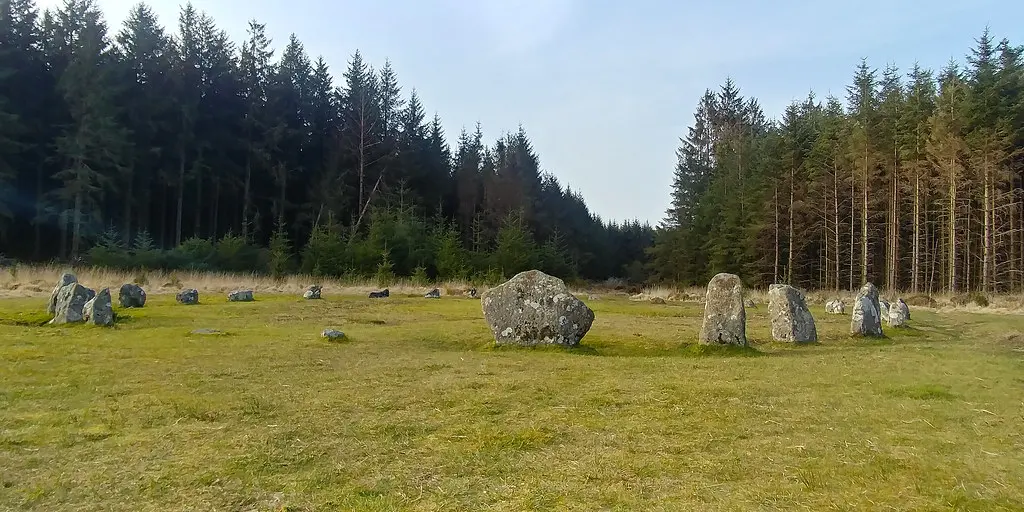
Image of Fernworthy Stone Circle. Image source
Visit essentials
A quick read before you go
- Duration
- One to two hours permits unhurried exploration of the circle and immediate stone rows.
- Etiquette
- Fernworthy Stone Circle welcomes all visitors but requires respectful treatment befitting both a…
Overview
A forest path opens suddenly onto Fernworthy's clearing and twenty-seven intentionally arranged granite stones. Built about four thousand years ago without surviving explanation, the circle preserves a charcoal layer from centuries of repeated fires—perhaps funeral pyres or unknown ceremonies—and nearby burial cairns held goods carefully placed for the dead as though for a journey.
A twentieth-century conifer plantation transformed what was open moorland into an unintended sanctuary, a circle of sky above a circle of stone that visitors describe as a fairy ring outside ordinary time. Usually uncrowded and without Stonehenge's ropes or scheduled access, Fernworthy allows visitors to stand among and, if they choose, touch the stones or sit where fires burned. Its power lies in that intimate encounter with enduring, unexplained silence.
Why this place is sacred
Fernworthy stands on a gentle east-facing slope above the South Teign valley within a coordinated network of eight northeast Dartmoor circles, each roughly two kilometers from its neighbors. It and Merrivale are the only two whose circle centers a ceremonial complex. Fernworthy's three radiating stone rows end at burial cairns, suggesting procession toward or away from the focus.
Excavation in 1897 found charcoal covering the original ground, evidence of repeated fires over centuries. Cremation pyres seem likely; communal feasts where fire transformed food for the living and the dead, or seasonal celebrations marking the turning year, remain possible. The stones grade from north to south, from barely above the heather to over a meter. Astronomical alignment, processional direction, or other symbolism may explain this intentional order.
Slight east-west flattening and a northern kink remain debated as original design or later disturbance.
Visitors commonly report a watched feeling, unusual stillness, and separation from modern time. The forest intensifies this response, though similar accounts occur at exposed circles. The stones' placement or accumulated activity continues to register without explaining itself.
Archaeological evidence indicates Fernworthy Stone Circle served as the ceremonial center of a ritual complex used for fire-based rituals, likely including cremation ceremonies and possibly communal gatherings. The associated burial cairns contained cists with grave goods: a bronze knife, flint knife, pottery beaker, Kimmeridge shale button, and burnt bone. This assemblage suggests ancestor veneration and funerary rites conducted over generations.
The grading of stone heights and the complex's orientation toward the river valley may reflect cosmological beliefs about direction, ascent, or the journey of the dead.
For millennia after its construction, Fernworthy stood in open moorland. The communities that built it eventually ceased their ceremonies; the reasons, like the rituals themselves, are lost. The circle endured while empires rose and fell on distant continents. Local Dartmoor farmers knew the stones, giving them the name Froggymead, but no continuous tradition of use survived.
In 1917, the Duchy of Cornwall purchased the surrounding farmland. Afforestation followed, and by the mid-twentieth century, conifers encircled the site. What might have been an act of erasure became, unexpectedly, an act of enclosure. The forest created a clearing, a room without a roof, intensifying the sense of separation that visitors now describe. When the plantation is eventually felled, Fernworthy will stand exposed once more, and its character will shift again.
Today, the circle draws spiritual seekers alongside archaeologists and walkers. Small offerings appear among the stones, left by those who approach the site as more than historical curiosity. The meanings projected onto it have multiplied, but the stones themselves remain silent on the question of what they once meant or might mean now.
Experience and orientation
The first thing visitors notice is the transition. The forest path, hemmed by conifers, opens without warning into a clearing. The shift is almost physical: from enclosed to exposed, from path to arrival. Many pause at the threshold before entering, as though recognizing they are about to cross into somewhere different.
Within the circle, the quality of silence changes. This is not the empty quiet of absence but something fuller, what some describe as a listening quality. The stones do not speak, yet they seem to attend. Visitors frequently report feeling observed, not in a threatening way, but as though the site notices their presence.
Whether this reflects the psychological impact of the enclosed clearing, some property of the stones themselves, or accumulated centuries of human attention, the effect is consistent enough to take seriously.
The intimacy of Fernworthy distinguishes it from larger, more famous circles. At twenty meters across, it is modest in scale. You can stand in the center and see each stone clearly, sense the intended proportions. Unlike sites surrounded by interpretation boards and roped pathways, Fernworthy invites physical engagement. You can walk among the stones, rest your hand against their rough granite, sit where fires once burned. This accessibility contributes to experiences visitors describe as personal, unmediated, direct.
Time behaves strangely here. Visitors intending to stay twenty minutes find an hour has passed. The rhythm of the modern world, with its schedules and urgencies, seems to lose traction within the circle. Some describe this as peaceful; others find it slightly unsettling, as though something has slipped. The forest clearing, with its bounded sky, reinforces the sense of having stepped out of ordinary time into a space where different rules apply.
Those who visit during quieter hours, early morning or approaching dusk, report the most profound experiences. Encounters with horses wandering through the circle, mist rising from the surrounding forest, the particular quality of Dartmoor light filtering through the trees all contribute to what visitors struggle to name but consistently recognize. The word that appears most often in their accounts is presence.
Fernworthy rewards unhurried arrival. The walk from the car park, though only fifteen minutes, serves as transition, allowing the modern world to recede before you reach the stones. Resist the temptation to photograph immediately. Enter the circle first. Stand or sit within it. Let the silence accumulate around you.
If you come with a question, something genuinely unsettled in your life, you need not believe the stones will answer. Simply holding the question in a place where humans have gathered for four thousand years can shift its weight. The circle does not solve problems, but it can provide perspective that problems struggled with elsewhere lack.
Consider visiting the stone rows that extend from the circle, tracing the paths Bronze Age people walked toward burial cairns. The whole complex forms a landscape of ceremony, and the circle makes most sense when understood as its center rather than its totality. Walk slowly. Let the site reveal itself at its own pace.
Context and lineage
No founding narrative survives from the Bronze Age builders of Fernworthy. What we know comes from the stones themselves and what archaeologists have uncovered around them.
Sometime around four thousand years ago, communities living on Dartmoor began constructing ritual landscapes across the moor. They raised standing stones into circles, laid out rows of smaller stones extending across the terrain, and built cairns to hold the remains of their dead. At Fernworthy, they created something particularly elaborate: a circle that would serve as the focal point of a ceremonial complex.
The builders chose a gentle east-facing slope above the South Teign valley. They gathered granite stones and arranged them in a ring approximately twenty meters across, grading them carefully so the tallest rose in the south, the shortest in the north. From this center, they extended three stone rows outward, each ending at a burial cairn. The overall design suggests movement, procession, perhaps the journey of the dead from the living world toward whatever destination they imagined lay beyond.
Within the circle itself, fires burned. Not once, but repeatedly over centuries, until a layer of charcoal covered the ground. Whether these flames cremated the dead, cooked ceremonial feasts, or served purposes we cannot reconstruct, they were central to what happened here. The charcoal layer is not incidental debris but evidence of sustained, intentional use.
Local folklore offers later narratives that may or may not preserve fragments of older memory. The name Froggymead derives from the meadow landscape that once surrounded the site. Stories speak of earth gnomes inhabiting the area, earning a fearsome reputation that warned farmers away. The broader Dartmoor tradition of maidens turned to stone for dancing on the Sabbath sometimes attaches to stone circles, though no specific petrification legend is documented for Fernworthy.
These stories, whatever their origins, speak to the site's enduring capacity to evoke the uncanny.
The communities who built Fernworthy left no written records and no continuous tradition linking their practices to the present. When the Bronze Age ended, when iron replaced bronze and new peoples moved across the land, the circle's original meanings faded. The stones remained, but the knowledge of what to do within them was lost.
For perhaps three thousand years, the circle stood in open moorland, known to local farmers but unused for ceremony. Antiquarians rediscovered it in the nineteenth century, bringing tools of measurement and documentation rather than ritual. Their excavations revealed the charcoal layer, proving the circle was once a place of fire, but they could not recover what the fires meant.
In 1965, the site received protection as a Scheduled Monument. In the decades since, it has drawn a new kind of pilgrim: seekers who approach the stones with spiritual intent, even without a tradition to guide them. Small offerings appear within the circle. Solitary practitioners meditate among the stones. The site has become, in its quiet way, active again, though the practices are invented or adapted rather than inherited.
What passes between the stones and their contemporary visitors remains private, undocumented, beyond scholarly reach. Perhaps this is appropriate. The original ceremonies were likely similarly private, known only to those who participated, leaving only charcoal and silence for those who came after.
Samuel Rowe
historical
The first antiquarian to describe the stone circle in detail, documenting it in 1830 and bringing it to scholarly attention.
Robert Burnard
historical
Leader of the Dartmoor Exploration Committee, which excavated the circle in 1897 and discovered the charcoal layer indicating repeated ritual fire use.
R. Hansford Worth
historical
Early twentieth-century scholar who documented and studied Dartmoor antiquities, recording twenty-six stones and contributing to understanding of the site's significance.
Traditions and practice
The traditional practices of the Bronze Age builders remain largely unknown. Archaeological evidence indicates fire-based rituals conducted repeatedly within the circle, likely including cremation ceremonies for the dead. The association with burial cairns containing grave goods suggests ancestor veneration and beliefs about an afterlife requiring material provisions. The grading of stone heights and the alignment of stone rows may have held cosmological significance related to direction, the sun's path, or the journey of the dead.
No indigenous tradition survives to interpret these practices. Local Dartmoor folklore includes stories of earth gnomes and dancing maidens turned to stone, but these appear to be later additions rather than continuous memory of Bronze Age ceremony. What the builders believed, what words they spoke within the circle, what they understood the fires to accomplish, remains beyond recovery.
Modern visitors engage with Fernworthy according to their own spiritual frameworks. Contemporary pagans and earth spirituality practitioners are drawn to the site as part of Dartmoor's network of ancient sacred places. Individual practices include meditation within the circle, dowsing to sense energetic qualities, and personal rituals marking seasonal transitions or life events.
Unlike Stonehenge or Avebury, Fernworthy does not host organized group ceremonies or maintain a ritual calendar. This absence is part of its character. The site offers space for personal encounter rather than communal spectacle. Those who come seeking structured ceremony will find themselves creating their own.
Small offerings appear among the stones, left by visitors for reasons they likely do not explain aloud. These offerings, when biodegradable, are generally tolerated. The line between meaningful gesture and littering is a matter some visitors navigate more thoughtfully than others.
If you come to Fernworthy seeking more than historical interest, consider these invitations.
Enter the circle slowly. Stand in the center where fires once burned. You need not believe anything in particular about the site's power. Simply notice what arises when you stop, when the forest quiet settles around you, when four thousand years of human intention meets your attention.
Touch the stones if you feel called to. They have been touched before, by hands that raised them, by generations who gathered here when the charcoal was fresh. Let your hand rest on the rough granite. Notice its temperature, its texture, what it feels like to make contact with something so old.
Walk the stone rows that extend from the circle. Follow them to the burial cairns. Consider what it might have meant to make this walk four thousand years ago, accompanying the dead to their resting place. The path remains. The destination is the same.
Before leaving, offer something internal: a moment of gratitude, an intention, a silent acknowledgment that you have stood where others stood across unimaginable time. The stones ask nothing. But giving something can complete the encounter.
Bronze Age Ceremonial Practice
HistoricalFernworthy Stone Circle was the central component of a ceremonial complex used for fire-based rituals over an extended period. The charcoal layer discovered during excavation indicates repeated fires within the circle, most likely cremation ceremonies for the dead. Associated burial cairns containing grave goods, including bronze and flint knives, pottery, and burnt bone, suggest ancestor veneration and beliefs about an afterlife requiring material provisions.
The specific practices remain unknown. Archaeological evidence indicates fire rituals conducted repeatedly within the circle. The association with burial cairns suggests funerary ceremonies, possibly including procession along the stone rows from circle to cairn. The grading of stone heights and complex orientation may have held cosmological significance that guided ritual activity. No documentation of specific ceremonies survives.
Contemporary Earth Spirituality
ActiveModern spiritual practitioners regard Fernworthy as one of Dartmoor's network of sacred sites, valued for its ancient atmosphere, forest enclosure, and ceremonial associations. The circle serves as a place for personal spiritual practice rather than organized group ceremony, attracting those who seek connection with the land and with ancestors understood broadly.
Individual visitors engage in meditation, energy work, dowsing, and personal rituals. Small offerings are occasionally left within the circle. Some practitioners approach the site through shamanic frameworks, seeking communication with spirit of place or ancestors. Unlike larger sites, Fernworthy does not host organized ceremonies or maintain a ritual calendar, making it suited to solitary practice.
Perspectives and open questions
Fernworthy Stone Circle invites interpretation from multiple angles: the archaeological, the folkloric, and the experiential. Each offers genuine insight while acknowledging what remains unknown. Honest engagement with the site requires holding these perspectives together without forcing premature resolution.
Scholarly perspective
Archaeological consensus classifies Fernworthy as one of Dartmoor's most complete prehistoric ritual complexes, dating from the Late Neolithic to Bronze Age period, approximately 2400-2000 BCE for the stone alignments, with the circle possibly earlier. The excavation of 1897 by Robert Burnard and the Dartmoor Exploration Committee produced the key evidence: a layer of charcoal covering the original ground surface, indicating repeated ritual fire use over an extended period.
Scholars interpret the site as the ceremonial center of a complex including three stone rows and five burial cairns. The grading of stone heights from north to south and the complex's orientation toward the South Teign valley suggest intentional planning, though the specific cosmological beliefs informing this design remain uncertain. The charcoal evidence most likely indicates cremation ceremonies, though communal feasting or other fire-based rituals cannot be excluded.
Fernworthy forms part of a broader pattern: Dartmoor contains over half of England's surviving stone alignments, and the northeast sector shows evidence of coordinated planning between Bronze Age communities. The sacred crescent of eight circles, spaced approximately two kilometers apart, suggests landscape-scale organization of ceremonial activity. What beliefs unified this planning, what rituals communities conducted, and why this particular area held such significance are questions the archaeological record cannot fully answer.
Living and traditional perspectives
No indigenous tradition survives from the Bronze Age builders of Fernworthy. Local Dartmoor folklore provides later narratives of uncertain origin. Stories speak of earth gnomes inhabiting the Fernworthy area, known for their fearsome reputation. One tale claims a farmer of Fernworthy crossed these gnomes and suffered the consequences, though details vary.
The broader Dartmoor tradition of maidens turned to stone for dancing on the Sabbath sometimes attaches to stone circles in the region, though no specific petrification legend is documented for Fernworthy itself. These stories likely reflect medieval Christian attempts to explain and warn against ancient pagan sites rather than continuous memory of Bronze Age practice.
The name Froggymead, by which the circle was historically known, derives from practical landscape description: frog, the amphibian, and mead from Old English meaning edge of meadow land. The name speaks to the wet grassland that once surrounded the site before afforestation transformed the terrain.
Alternative interpretations
Contemporary spiritual practitioners sometimes describe Fernworthy as an earth energy site or power spot within Dartmoor's network of ancient places. Some interpret the circle's position within the sacred crescent of eight circles through ley line frameworks, suggesting the sites mark intersections of terrestrial energy currents. Dowsers report detecting energetic qualities within the circle that they associate with its ceremonial history.
The charcoal evidence is occasionally interpreted through an esoteric lens as indicating the site's power for ritual transformation and communication with ancestral spirits. Some visitors describe perceiving a watching presence at the site, which they understand as spirit of place rather than psychological projection.
These interpretations lack archaeological support in their specific claims. However, they often emerge from genuine experiences visitors have within the circle. The language of energy and presence may represent attempts to articulate something real that resists conventional vocabulary. Taking the experiences seriously does not require accepting any particular explanatory framework.
Open questions
Genuine mysteries remain at Fernworthy, and intellectual honesty requires acknowledging them.
The exact nature of the ritual fires evidenced by charcoal deposits cannot be determined. Whether they cremated the dead, cooked ceremonial meals, or served purposes entirely beyond our reconstruction, the evidence does not specify.
The relationship between the stone circle and the surrounding cairns and stone rows remains uncertain. Were they constructed simultaneously as a unified complex, or did the circle come first with rows and cairns added over subsequent generations? The relative chronology is not firmly established.
Why the stones were graded in height from north to south is unknown. Astronomical alignment, processional direction, symbolic hierarchy, and aesthetic preference have all been proposed. None can be confirmed.
The significance of the sacred crescent arrangement of northeast Dartmoor circles invites speculation about Bronze Age territorial organization, shared ceremonial calendars, or pilgrimage routes between sites. Evidence to confirm any specific interpretation is lacking.
The original appearance of the ceremonial complex before forestry plantation cannot be precisely recovered. The enclosed, intimate atmosphere visitors experience today differs significantly from the open moorland setting in which the circle stood for millennia. How this shift affects the site's experiential qualities is a matter for visitors to consider, not archaeologists to answer.
Plan your visit
Access and arrival
Limited accommodation exists near Fernworthy itself. Chagford, five kilometers away, offers pubs, bed and breakfasts, and small hotels. Moretonhampstead provides additional options. Camping is not permitted within Fernworthy Forest.
Respectful visit
No formal dress requirements apply. Practical outdoor clothing is essential. Dartmoor weather changes rapidly; waterproof layers are advisable year-round. The walk to the circle can be muddy, particularly after rain or in winter. Sturdy footwear with good grip will serve you better than fashion.
Photography is permitted and the site is photogenic, particularly in morning or evening light. Be mindful of others seeking contemplative space. If someone is meditating within the circle, allow them privacy rather than including them in your frame. Consider spending time with the stones before reaching for your camera. The site will still be there after you have actually seen it.
Small, fully biodegradable offerings may be left with discretion. Flowers, leaves, seeds, or poured water are acceptable. Do not leave crystals, coins, ribbons, or other objects that accumulate and require removal. If in doubt, offer something internal, a prayer, an intention, a moment of gratitude, rather than something external.
Fernworthy Stone Circle is a Scheduled Monument. Metal detecting, excavation, and interference with the stones are prohibited by law. No fires or barbecues are permitted within Fernworthy Forest. No camping or overnight stays in vehicles. Stay on paths where possible, both within the forest and approaching the site. These restrictions protect both the ancient site and the managed forest ecosystem.
As a Scheduled Monument, Fernworthy is protected by law. Do not dig, do not use metal detectors, do not interfere with or remove stones. The preservation of the site depends on visitors treating it with care.
Avoid leaving non-biodegradable offerings. Crystals, coins, ribbons, and other objects accumulate and must eventually be removed. If you wish to leave something, make it genuinely biodegradable, a flower, a few drops of water, or simply your attention.
Be aware that other visitors may also be seeking contemplative experience. Maintain quiet. Give others space. The site's intimacy is a gift; do not diminish it for those who follow.
Fires are prohibited within Fernworthy Forest. Whatever the Bronze Age builders did here, contemporary visitors cannot recreate it with actual flames.
Current practical details
Address
Newton Abbot TQ13 8EY, UK
Hours
Hours, fees, and access can change — verify on the official source before you travel. Practical details last checked Jun 2026.
Location
Map loads as you approach this section.
Pilgrim reflections
A portrait of encounter, not a score
Pilgrims describe what they felt, how present they could become, and whether the place would shape a journey. There are no stars and no ranking of traditions.
No reviewed reflections yet
The first pilgrims can help describe the character of being here.
Share a reflection
Available after an account-backed “Been there.” Every reflection is reviewed before publication.
Nearby sacred places
Explore other sacred places in the region. Proximity does not establish access or travel time; check each place’s guidance.


References
Sources consulted for this page. Source categories describe the publication, not a guarantee that every claim is verified. Traditional accounts and outside interpretations may differ.
- 01A stone circle, known as Fernworthy Circle, three stone alignments and five cairns — Historic EnglandofficialOfficial Scheduled Monument listing (List entry 1017984), designated 22 November 1965
- 02Devon & Dartmoor Historic Environment Record — Heritage GatewayofficialRegional Historic Environment Record entry MDV6534
- 03Fernworthy Forest — Forestry EnglandofficialOfficial land manager for the forest surrounding the stone circle
- 04Fernworthy circle [Froggymead] Stone Circle — The Megalithic PortalSource contextComprehensive megalithic site database with GPS coordinates and detailed measurements
- 05Fernworthy Circle — Legendary DartmoorSource contextDetailed historical and archaeological information with local folklore
- 06Fernworthy Forest Stone Circle - History and Facts — History HitSource contextPopular heritage tourism website with visitor-oriented information
- 07Fernworthy (Stone Circle) — The Modern AntiquarianSource contextCommunity-contributed megalithic site database with visitor experiences
- 08Fernworthy Ceremonial Complex — Dartmoor WalksSource contextDetailed site description with walking routes and archaeological context
- 09Saints and Stones: Fernworthy Ceremonial Complex — Saints and StonesSource contextSpiritual and archaeological perspective on the ceremonial complex
- 10Dartmoor Stone Circles — The MoorlanderSource contextRegional news and tourism publication covering Dartmoor's ancient sites
- 11Fernworthy Stone Circle — Holiday in DartmoorSource contextTourism website with practical visitor information
- 12Meeting the Spirit of Place at Fernworthy stone circle — Shamanic DowsingspiritualPersonal spiritual experience account from a modern practitioner
Share a photo
Help visitors recognize Fernworthy Stone Circle. Every submission is reviewed before publication.