Effigy Indian Mound, Iowa
Where ancestors shaped earth into bear and bird, and twenty tribes still come to pray
Understand sacred places, explore living traditions, and learn how to engage respectfully with Pilgrim Map.
Access has not been verified. Check current local guidance before planning a visit.
Allamakee County, Iowa, United States

Visit essentials
A quick read before you go
- Duration
- 2-4 hours allows time for one or two major trails and adequate contemplation.
- Etiquette
- This is sacred burial ground for twenty tribes.
Overview
Effigy Mounds National Monument preserves 206 earthen mounds, 31 shaped like animals, built from 400 to 1200 CE on bluffs above the Mississippi River. The Great Bear is 137 feet long; ten bears in the Marching Bear Group proceed single-file for nearly a quarter mile. Each was intentionally sculpted by moving earth basket by basket.
Their full meanings remain partly unknown. The Ho-Chunk, one of twenty culturally affiliated tribes, hold that creator Mauna placed medicine in the earth through the mounds and 'had them rise up and show us who we are, where we're from, and that those will always be there for us.' They are living connections between seen and unseen worlds, not mere constructions.
Archaeologists relate their forms to a three-world cosmology: birds and Thunderbirds of the Upper World, bears of earth, and water spirits and panthers of the underwater realm. Groups often unite several worlds in balance, embodying a theology in earth.
Twenty tribes remain connected, and prayer bundles and flags mark living practice. In 2022, the Iowa Tribe of Kansas and Nebraska and the National Park Service signed the first Tribal Sister Park agreement, linking this place to Ioway Tribal National Park. Vice Chairman Lance Foster acknowledged their 'long and difficult history' and called it 'one step forward together towards the future.'
Why this place is sacred
At Fire Point, the Mississippi moves below while the Great Bear rests almost invisibly beneath the forest cover. The place holds builders' intentions, ancestors' bones, and descendants' continuing prayers.
In Ho-Chunk understanding, creator Mauna placed medicine in these forms so they rose to show the people who they are and where they come from. Bear, bird, and water spirit are not metaphors but living clan presences. Springs are revered as entrances below; panther-shaped mounds point their tails toward these passages, whose water brings something of the underworld into ordinary experience.
The landscape balances an Upper World of birds and Thunderbirds, an Earth World of bears and land animals, and a Water World of serpents and panthers. Most groups join multiple realms, making theology physical.
Prayer bundles, tobacco ties, and colored flags along the trails are active offerings from members of the twenty affiliated tribes. They make this a place of continuing sacred practice, not only archaeology or past history.
Archaeologists believe the mounds served multiple purposes. Some, particularly the conical mounds, contained burials of important individuals—civic and religious leaders whose placement in shaped earth marked their significance. But most effigy mounds contain no burials at all. They likely served as clan symbols, territorial markers, ceremonial grounds, and gathering places. Processions may have wound along the contours of the effigies. Seasonal ceremonies aligned with celestial events may have occurred at specific mounds.
The construction process itself was likely ceremonial, requiring coordination of many people over extended periods—community-building as religious practice.
The Effigy Mound culture flourished from roughly 400 to 1200 CE—eight centuries of continuous mound-building in the Upper Midwest. Only in this region did a culture regularly build mounds in animal shapes. Wisconsin alone once contained perhaps 20,000 effigy mounds; today about 4,000 survive, with the largest concentration anywhere in the world.
European colonization devastated both the mounds and the peoples who built them. Agriculture plowed under thousands of effigies. Urban development destroyed others. The descendants of the builders were forced from their lands. The Ho-Chunk were removed multiple times, yet kept returning to Wisconsin. The Iowa Tribe was pushed to Kansas and Nebraska.
Preservation efforts began in the early twentieth century. The Marching Bear Group was first mapped in 1910. In 1949, President Truman proclaimed Effigy Mounds a National Monument—recognition of significance that came, as it often does, after most of what existed had already been lost.
The relationship between the National Park Service and affiliated tribes has been fraught. In 1990, just days after the Native American Graves Protection and Repatriation Act (NAGPRA) was introduced in Congress, the monument's superintendent illegally removed ancestral remains—the bones of about forty-one people—and concealed them in his garage for over twenty years. When discovered, he pleaded guilty. The wounds from this betrayal are not healed.
The 2022 Sister Park agreement with the Iowa Tribe represents an attempt at repair. It is, as Vice Chairman Foster said, 'one step forward together towards the future.' Whether more steps follow remains to be seen.
Experience and orientation
Begin at the visitor center with its film and exhibits, then climb through deciduous forest. Fire Point Trail gains several hundred feet to the bluffs, revealing the mounds' deliberate relationship to river, visibility, and sky.
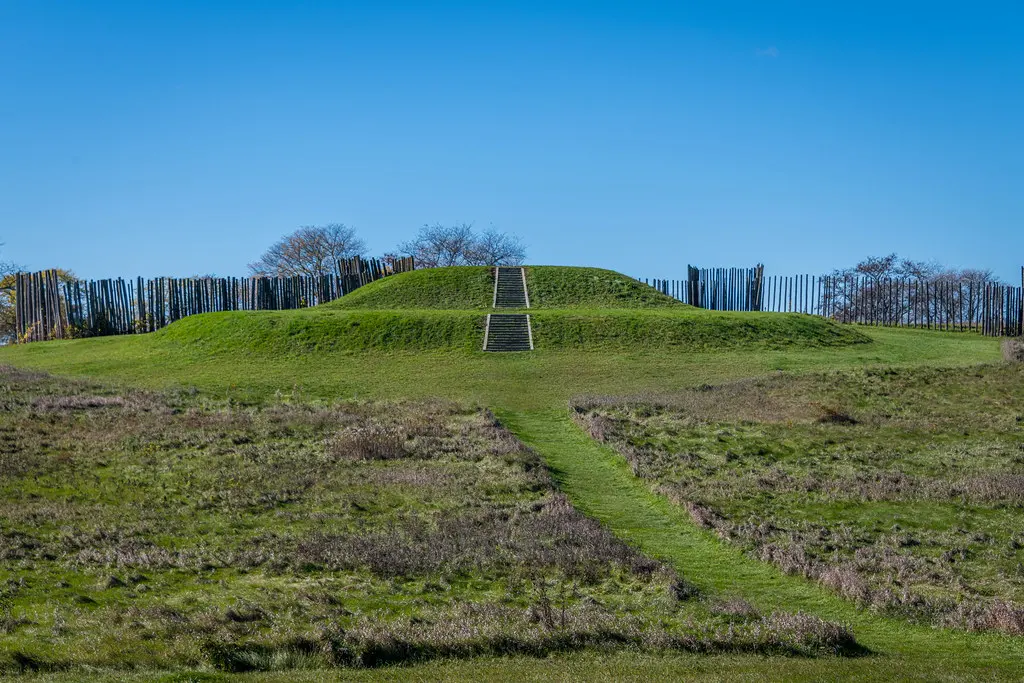
Under leaves and forest duff, the earthworks emerge slowly. Even the Great Bear—137 feet long, 70 feet across its shoulders, and about three feet high—is subtle. Learning to see it reveals conical, linear, compound, and effigy forms throughout the landscape.
The South Unit's Marching Bear Group requires a four-mile hike through restored tallgrass prairie and hardwood forest. Ten bears proceed along a ridge for nearly a quarter mile; their direction and purpose remain unanswered because the builders left no written explanation.
Prayer bundles, tobacco ties, colored cloth, and flags are current offerings, not artifacts for examination or photography. They mark private relations among living people, ancestors, and spiritual worlds. Fire Point and other overlooks open onto the Mississippi, Wisconsin's far bluffs, and a broad sky, allowing visitors to stand where mound-builders stood in a landscape meaningful for millennia.
The monument consists of three units. The North Unit (67 mounds) and South Unit (29 mounds) are contiguous and accessible from the visitor center. The Sny Magill Unit (112 mounds) lies eleven miles south with no visitor facilities. Most visitors focus on the North and South Units, where the major trails and most famous mound groups are located.
The Mississippi River flows along the eastern boundary. Wisconsin lies on the far shore. The mounds are positioned on bluffs overlooking the river—the relationship to water is essential to their meaning. Springs emerge from the bluffs, revered in indigenous tradition as passages to the world below.
Context and lineage
The Ho-Chunk tell of their ancestors searching for direction and foundation. They prayed to their creator, Mauna, who answered them. According to the tradition, Mauna said he would put medicine in the earth in the form of these mounds. He 'had them rise up and show us who we are, where we're from, and that those will always be there for us.'
This is not origin in the archaeological sense—not a story of who first moved earth into animal shapes. It is origin in the spiritual sense—a story of where the mounds came from in terms of sacred rather than human agency. The mounds are not construction but emergence, not human achievement but divine gift.
The three-world cosmology provides another layer of origin. The world is divided into Upper and Lower realms, the Lower further divided into earth and water. Birds and Thunderbirds belong to the sky. Bears belong to the earth. Panthers and water spirits belong to the waters below. The effigies bring these realms into relationship—they are, in one scholar's phrase, 'living and animated connections between worlds, built to be alive, actively bringing together the natural and supernatural worlds.'
Why effigy mound building ceased around 1200 CE remains unknown. Climate change, social change, the arrival of new peoples or ideas—scholars speculate but cannot say with certainty. What is certain is that the tradition ended, leaving these monuments as its primary legacy.
Effigy Mounds National Monument preserves 206 mounds, 31 of them effigies. But this is only a fraction of what once existed. Wisconsin alone contained perhaps 20,000 effigy mounds; about 4,000 survive. The Effigy Mound culture extended from Dubuque north into Minnesota, across Wisconsin to Lake Michigan—a regional tradition unique in North America.
The builders were ancestors of peoples who still inhabit the region or were displaced from it. The Ho-Chunk, forcibly removed multiple times, kept returning to Wisconsin. The Iowa Tribe was pushed to Kansas and Nebraska, where they established their own Ioway Tribal National Park in 2020. The cultural continuity is real: descendants of the mound-builders still pray at these sites.
The mound-building tradition connects to broader patterns in eastern North America—the earlier Hopewell culture, the later Mississippian culture that built Cahokia. But the effigy form is distinctive. Only in the Upper Midwest did people regularly shape mounds like animals. This remains unexplained.
Mauna
Creator deity in Ho-Chunk tradition
The Effigy Mound Builders
Ancestors who constructed the mounds
Charles R. Keyes and Ellison Orr
Archaeologists who surveyed and advocated for preservation
Lance Foster
Vice Chairman, Iowa Tribe of Kansas and Nebraska; Tribal Historic Preservation Officer
Traditions and practice
The mounds served multiple ritual purposes. Conical mounds often contained burials—important leaders placed in shaped earth. But most effigy mounds held no burials at all. They were clan symbols, territorial markers, ceremonial grounds.
Construction itself was likely ceremonial. Building a mound the size of the Great Bear required moving thousands of cubic feet of earth, basket by basket, without metal tools or draft animals. This required coordination of many people over extended periods. The work was probably accompanied by fasting, prayer, and ritual observance. Community-building and mound-building were inseparable.
Seasonal ceremonies may have occurred at the mounds. The animal forms may have marked gatherings of specific clans. Processions may have wound along the effigies' contours. Springs near the mounds, understood as entrances to the underworld, may have been sites of particular ritual attention. But specifics remain uncertain—the builders left no written records, and oral traditions are held by tribal communities as sacred knowledge.
Ceremonies continue at Effigy Mounds, though specifics are not publicly shared. Prayer bundles, tobacco ties, and colored flags appear throughout the park, evidence of recent and ongoing practice. These offerings are made by members of the twenty affiliated tribes who maintain connection to this place.
The 2022 Sister Park agreement with the Iowa Tribe has opened new channels for co-stewardship. The National Park Service and the tribe share indigenous knowledge, environmental and cultural education techniques, and ecotourism practices. This represents a shift from management of the site as a federal resource to partnership with tribal nations for whom it is ancestral ground.
Ranger programs operate from mid-June through Labor Day, including guided hikes and prehistoric tool demonstrations. These programs interpret the site from archaeological perspectives while acknowledging the ongoing sacred significance to indigenous peoples.
For visitors who are not members of affiliated tribes, the appropriate practice is quiet contemplation. Walk the trails slowly. Allow the mounds to reveal themselves under the forest cover. Sit at the overlooks and take in the river below. Let the scale of what the builders achieved—the coordination, the effort, the devotion—work on your understanding.
If you encounter prayer bundles or flags, treat them as you would offerings in any sacred space. Do not touch, photograph, or disturb them. Their presence is a reminder that you are walking through an active sacred site, not merely an archaeological preserve.
Learning the Ho-Chunk creation story before your visit deepens the experience. Understanding that Mauna placed medicine in the earth, that the mounds 'rose up' to show the people who they are—this transforms perception. You begin to see not human construction but spiritual manifestation. The mounds become, as they are for the Ho-Chunk, living presences rather than ancient artifacts.
Ho-Chunk Ancestral Spiritual Connection
ActiveThe Ho-Chunk (Winnebago) Nation holds effigy mounds as sacred sites where the creator Mauna placed medicine in the earth. According to their tradition, Mauna caused the mounds to rise up and 'show us who we are, where we're from, and that those will always be there for us.' The mounds are not human constructions but manifestations of spiritual forces—living connections between worlds.
Prayer, reflection, ceremonial visits. Prayer bundles, ties, and flags are placed throughout the park. Specific ceremonial practices are held privately and are not shared publicly. The animal forms—bear, bird, panther—represent clan affiliations connecting individuals to spiritual guides.
Iowa Tribe (Báxoje) Ancestral Connection
ActiveThe Iowa Tribe of Kansas and Nebraska maintains ancestral connection to Effigy Mounds as one of twenty culturally affiliated tribes. In 2022, they signed the first-ever Tribal Sister Park agreement with NPS, linking Effigy Mounds to their own Ioway Tribal National Park. Vice Chairman Lance Foster described this as 'one step forward together towards the future' after a long and difficult history.
Co-stewardship partnership, sharing of Indigenous knowledge, environmental and cultural education exchange, heritage preservation. The Iowa Tribe established their own national park in 2020, the second tribal nation to do so.
Late Woodland Effigy Mound Culture
HistoricalBetween 400 and 1200 CE, the Effigy Mound culture built conical, linear, compound, and animal-shaped mounds across the Upper Midwest. This was the only culture to regularly build mounds in animal shapes—bears, birds, panthers, water spirits. The mounds represented a three-world cosmology and served as clan symbols, territorial markers, burial sites, and ceremonial grounds.
Mound construction, burial of important leaders, ceremonial dances, clan identification, territorial marking, seasonal ceremonies. Construction was communal and likely ceremonial, requiring coordination of many people over extended periods.
Pan-Tribal Sacred Site Reverence
ActiveTwenty federally recognized tribes maintain cultural ties to Effigy Mounds National Monument, including Ho-Chunk, Iowa, Sac and Fox, Omaha, Otoe-Missouria, Winnebago of Nebraska, Santee Sioux, and others. The mounds are considered sacred burial grounds and ceremonial sites across these diverse tribal nations.
Ceremonial visits, prayer offerings, pilgrimage, ancestor reverence. Prayer bundles and flags placed throughout the park evidence ongoing practice by multiple tribal communities.
Perspectives and open questions
Effigy Mounds invites multiple frameworks of understanding. Archaeologists approach the mounds as cultural artifacts of the Late Woodland Period. Indigenous peoples—particularly the Ho-Chunk and the twenty affiliated tribes—understand them as living sacred sites where the creator placed medicine in the earth. These perspectives are not opposed but complementary, addressing different dimensions of the same reality.
Scholarly perspective
Archaeologists agree that the mounds were built during the Late Woodland Period, roughly 400-1200 CE, by cultures ancestral to modern Ho-Chunk, Iowa, and related peoples. The effigy forms—bear, bird, panther, water spirit—represent a three-world cosmology widespread in indigenous North American thought: Upper World of sky beings, Earth World of land creatures, Water World of underwater spirits.
Most effigy mounds contain no burials; they were not primarily graves but ceremonial sites, clan markers, or territorial boundaries. The mound groups typically include representatives of multiple cosmic realms, suggesting a concern with balance between worlds. Construction was communal and likely ceremonial, requiring coordination of many people over extended periods.
The Marching Bear Group and Great Bear Mound at Effigy Mounds National Monument are among the best-preserved and most significant surviving examples of this uniquely Upper Midwestern tradition. The monument's 206 mounds represent only a fragment of what once existed—Wisconsin alone may have contained 20,000 effigy mounds—but they offer the most concentrated and protected assemblage available for study and contemplation.
Living and traditional perspectives
The Ho-Chunk and affiliated tribes understand the mounds not as archaeological artifacts but as living sacred sites. According to Ho-Chunk tradition, the creator Mauna placed medicine in the earth through these mounds. Mauna 'had them rise up to show us who we are, where we're from, and that those will always be there for us.' The mounds are not human constructions but manifestations of spiritual forces.
This perspective does not contradict the archaeological view but operates on a different register. The question of who moved the earth and when matters less than what the mounds are and what they do. They are living connections between worlds. The animal forms are not symbols of animals but actual spiritual presences. The springs near the mounds are not geological features but entrances to the underworld.
Prayer and ceremony continue at Effigy Mounds. Twenty tribes maintain cultural ties to the site. The prayer bundles and flags encountered on trails are evidence of ongoing practice. For these peoples, the mounds are not history but present—the ancestors are not gone but here.
Alternative interpretations
No significant alternative or esoteric interpretations complicate understanding of Effigy Mounds. The archaeological and indigenous perspectives, while differing in emphasis, are broadly aligned in recognizing the mounds' sacred and ceremonial significance. This is refreshing contrast to sites where fringe theories obscure indigenous achievement.
Open questions
Genuine mysteries remain. The specific meanings of individual mound shapes and groupings are unknown. The reasons for the concentration of bears in some areas, birds in others, have not been fully explained. How the mound-builders coordinated construction across such large areas remains unclear. Why effigy mound building ceased around 1200 CE is unknown.
But perhaps the deepest mystery is why this tradition emerged uniquely in the Upper Midwest. Only here did people regularly shape mounds like animals. What made this region distinctive? What was the relationship between the mound-building cultures and their neighbors? The answers lie somewhere between the earth and the sky, between the worlds the mounds were built to connect.
Plan your visit
Access and arrival
Harpers Ferry and Marquette, Iowa have limited lodging options. Prairie du Chien, Wisconsin, across the Mississippi River, offers more choices. Decorah, Iowa, about 25 miles west, is a larger town with more extensive accommodations. The monument has no camping facilities.
Respectful visit
Practical hiking attire is essential. The trails involve significant elevation gain and can be muddy. Sturdy shoes or boots are recommended. In summer, the forests can be hot and humid; in winter, trails may be icy or snow-covered. Dress for the weather and the physical demands of the hike.
Photography is permitted in most areas. Use respectfully. Do not photograph prayer offerings without considering whether that is appropriate—in general, it is not. The mounds themselves may be photographed, though their subtlety makes them difficult subjects. The river overlooks offer more dramatic photographic opportunities.
Do not leave offerings unless you are a member of an affiliated tribe. If you encounter offerings left by others, do not touch or disturb them. These are private spiritual communications. Your role as a visitor is to witness, not to participate.
{"Do not walk on, climb on, or disturb the mounds","Stay on designated trails at all times","Do not remove any artifacts, natural objects, or plant materials","Do not disturb prayer offerings (bundles, ties, flags)","Leash pets at all times—this is both a park rule and a matter of respect","Treat the site as sacred burial ground—because it is"}
The wounds at Effigy Mounds run deep. In 1990, just as NAGPRA was being enacted to protect indigenous remains, the monument's superintendent removed ancestral bones—about forty-one individuals—and hid them in garbage bags in his garage for over twenty years. When discovered, he pleaded guilty. Tribal leaders described his actions as 'racist and bigoted.'
This history should inform how visitors approach the site. The federal government's relationship with affiliated tribes has been marked by betrayal. The 2022 Sister Park agreement is a step toward repair, but repair takes time. Visitors should understand themselves as guests on sacred ground, not consumers of heritage tourism.
Do not attempt your own ceremonies or rituals. Do not leave offerings unless you are a member of an affiliated tribe. These are not restrictions on spiritual freedom but recognitions that this place belongs to peoples who have paid dearly for their connection to it.
Current practical details
Address
151 IA-76, Harpers Ferry, IA 52146, USA
Phone
Hours
Hours, fees, and access can change — verify on the official source before you travel. Practical details last checked Jun 2026.
Location
Map loads as you approach this section.
Pilgrim reflections
A portrait of encounter, not a score
Pilgrims describe what they felt, how present they could become, and whether the place would shape a journey. There are no stars and no ranking of traditions.
No reviewed reflections yet
The first pilgrims can help describe the character of being here.
Share a reflection
Available after an account-backed “Been there.” Every reflection is reviewed before publication.
Nearby sacred places
Explore other sacred places in the region. Proximity does not establish access or travel time; check each place’s guidance.


Share a photo
Help visitors recognize Effigy Indian Mound, Iowa. Every submission is reviewed before publication.