Edzna Archaeological Zone
Where water and sky meet in stone, a Maya city rises from engineered waters
Understand sacred places, explore living traditions, and learn how to engage respectfully with Pilgrim Map.
Access has not been verified. Check current local guidance before planning a visit.
Municipio de Campeche, Campeche, Mexico
Read the sources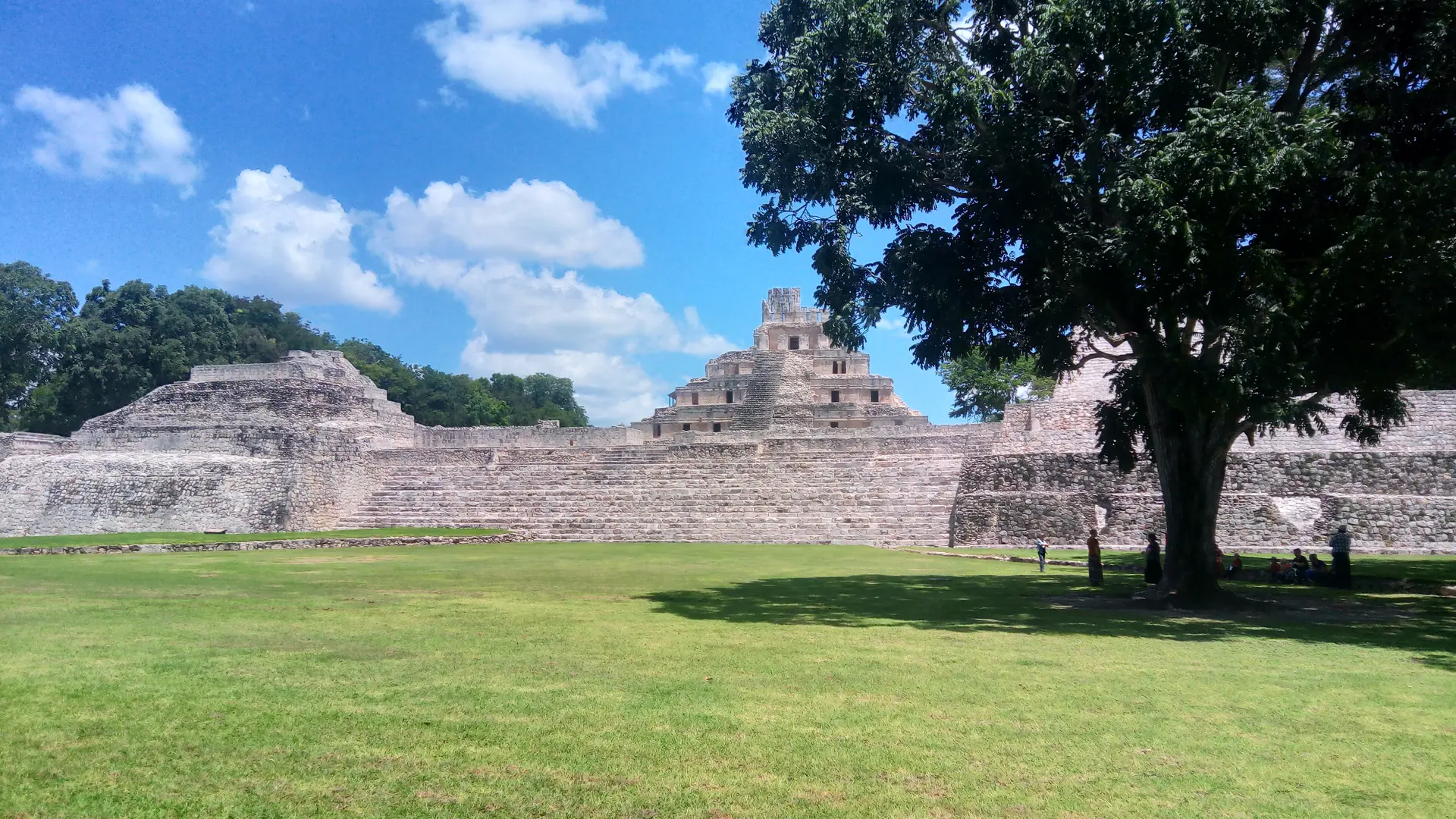
Image of Edzna Archaeological Zone. Image source · CC-BY-SA-4.0
Visit essentials
A quick read before you go
- Duration
- 1.5-2 hours for site exploration; add 45 minutes for the new museum.
- Etiquette
- Approach Edzna as a site of profound cultural heritage.
Overview
Edzna—House of the Itzaes, with itz also heard as sorcery or enchantment—grew from a settlement founded around 600 BCE into a city by 200 CE. On Campeche's clay-rich plains, Maya engineers answered alternating flood and drought with canals and reservoirs that remade hostile terrain into productive homeland.
The forty-metre Five-Story Building combines temple and palace: each level's roof terraces the next, and a cross-shaped summit sanctuary once carried decorated stucco into the dawn light as priests performed rites for royal legitimacy and rain. Thirty-three stelae record dynasties from 633 to 830 CE, including at least one woman governor, through enthronements, ballgames, alliances, and conquests.
Ceremonial red-and-blue stucco masks remain on the facades; the temazcal recalls purification; and dry canals trace a culture in which sacred vision and water management sustained both survival and power.
Why this place is sacred
The threshold at Edzna opens where human ingenuity meets cosmic order. The Maya who built this city faced a fundamental challenge: the land flooded violently, then baked to hardness. Rather than accept limitation, they reimagined the relationship between water and earth, creating a hydraulic system so sophisticated that it sustained perhaps twenty-five thousand people for over a millennium.
This engineering was never merely practical. The canals that prevented flooding also created sacred geography, channeling water as offerings flow toward altars. The reservoirs that stored rainwater became mirrors of the sky, holding celestial patterns in their stillness. When the Five-Story Building catches morning light, it participates in the same solar drama that the canals' orientation celebrated.
The stucco masks that guard the temples speak to this unity. Painted in the colors of different directions and cosmic forces, they were not decoration but presence—the faces of gods manifest in stone, watching over a city that understood itself as intersection between the mortal and divine realms. The ballcourt, where rulers enacted cosmic struggles, connected earthly politics to the movements of planets and the cycles of maize.
What makes Edzna thin is this refusal to separate categories that other cultures divide. Engineering is prayer here. Governance is ritual. The careful recording of dates and rulers on stelae participates in the same sacred function as the temple ceremonies they commemorate. To stand in the Great Plaza is to occupy space that was designed—through extraordinary technical skill and unwavering religious conviction—to be permeable to forces beyond the visible.
The city's abandonment around 1450 CE left these intentions intact. The masks still watch. The pyramid still rises toward the sun it was built to honor. The visitor who climbs the restored structures participates, however briefly, in a dialogue between earth and sky that the Maya sustained for nearly two thousand years.
Edzna served as a major regional capital and ceremonial center, where political power was legitimized through rulers' relationships with deities. The sophisticated hydraulic system supported both practical agriculture and religious cosmology.
Occupied from approximately 600 BCE to 1450 CE, Edzna evolved from a simple Preclassic village through its zenith as a Classic period regional power allied with Calakmul, to its gradual abandonment. Rediscovered in 1907 and excavated since 1958, it opened to visitors in the 1970s. The new Museo de Sitio de Edzna opened in June 2024.
Experience and orientation
Arrive early, when morning light slants across the Great Acropolis and the Five-Story Building glows against Campeche's humid sky. This is the moment the Maya architects intended: sunrise catching the temple summit, illuminating what darkness concealed.
Begin at the Great Plaza, where the scale of Maya ambition becomes clear. The Five-Story Building rises before you, its terraced levels inviting ascent. Unlike many restored sites, Edzna still permits climbing most structures. Take the broad stairway slowly, feeling the pyramid's pull. At each level, turn to survey the plaza below, imagining it filled with ceremony—dancers, musicians, the careful choreography of royal power.
From the summit, the logic of the site reveals itself. The surrounding forest stretches to every horizon, but here the Maya imposed order. The canals that once prevented flooding trace geometric lines. The ballcourt, the North Temple, the subsidiary platforms—all occupy positions that speak to planning spanning generations.
Descend and explore the stucco masks in the Temple of the North. These faces, restored to something approaching their original polychrome brilliance, carry the weight of religious conviction. The reds, blues, and ochres were not aesthetic choices but cosmological statements. Spend time with them. Let their watching presence become familiar.
The new museum, opened in 2024, houses over 1,600 artifacts. Here the portable objects tell stories the architecture cannot: the tools of scribes, the offerings of believers, the daily objects of people who lived, not just worshipped, in this remarkable place.
End at the temazcal, the steam bath. Purification rituals performed here prepared bodies and spirits for ceremony. Though you cannot use it today, sitting beside its ancient stones invites reflection on what it meant to take cleanliness—physical and spiritual—seriously enough to build it into the sacred center of a city.
Located 55 km southeast of Campeche City, accessible via Highway 180 to Km 45, then Highway 261. The site spreads across four main complexes; allow 1.5-2 hours for thorough exploration. The Five-Story Building dominates the Great Acropolis at the site's center.
Context and lineage
The land that would become Edzna presented what seemed an impossible challenge. The clay-rich soil of the Campeche lowlands flooded violently during rainy season, then baked to impermeable hardness as waters receded. Somewhere around 600 BCE, settlers decided to stay anyway.
Their solution was audacious. Rather than work around the flooding, they channeled it. Canals carried excess water to reservoirs; these same canals later distributed stored water during drought. The system was self-reinforcing: excavated soil became raised platforms for buildings; channels became defensive moats; reservoirs became mirrors for astronomical observation.
By 200 CE, this practical foundation supported a true city. Contact with major powers—Tikal, Piedras Negras, and especially Calakmul—brought influences that shaped Edzna's distinctive architecture, blending Peten, Puuc, and Chenes styles. The Five-Story Building, begun during this period, represented an innovation: a pyramid whose stepped chambers functioned as terraces, combining residential, administrative, and ceremonial functions in a single ascending structure.
The Classic period (250-900 CE) brought glory. Stelae document governors celebrating enthronements, ballgame victories, and political alliances. At least one woman ruled, her name carved with the same authority as her male predecessors. The city joined the great Calakmul polity, participating in the rivalries and alliances that defined Maya political life.
Then, gradually, Edzna fell quiet. By 1450 CE, the last inhabitants had departed. The forest reclaimed what had taken a millennium to build. When explorers rediscovered the site in 1907, they found masks still watching from vine-covered temples, waiting for the attention that would bring them back to light.
Edzna passed through Olmec influence during the Preclassic period, developed its distinctive character during the Classic Maya era as part of the Calakmul sphere, and likely experienced Mixtec contact before abandonment. No continuous lineage of practitioners remains, though the site serves Maya cultural heritage.
The Governors of Edzna
Rulers (633-830 CE)
Traditions and practice
Maya religious practice at Edzna integrated cosmic cycles with political power. Rulers legitimized their authority through public rituals: ballgames that reenacted cosmic struggles, bloodletting ceremonies that opened portals to the gods, and stela dedications that fixed royal achievements in eternal stone. The temazcal steam bath provided purification before major ceremonies.
As a protected archaeological zone, Edzna does not host active religious practice. However, visitors can explore the architectural contexts where ancient ceremonies occurred: the ballcourt where ritual games took place, the temple summits where offerings were made, and the plazas where crowds gathered for royal displays.
Visit the Five-Story Building at sunrise to experience the light conditions the Maya architects intended. Spend contemplative time with the stucco masks, considering what it meant to carve divine faces into stone. Walk the ancient canal routes to appreciate the engineering that made sacred life possible. Allow the site's relative quiet (compared to more famous ruins) to create space for reflection.
Maya Civilization / Classic Period Ceremonialism
HistoricalEdzna served as a major ceremonial and political center for nearly two millennia, where rulers demonstrated their connection to cosmic forces through public ritual, architectural achievement, and the sophisticated management of water that made civilization possible.
Ritual ballgames, bloodletting ceremonies, stela dedication rituals, steam bath purification, royal enthronements, and calendrical observances.
Perspectives and open questions
Edzna can be understood as a triumph of Maya engineering, as a ceremonial center where political and religious power merged, or as evidence of the sophisticated water management that made civilization possible in challenging environments.
Scholarly perspective
Archaeological research has revealed Edzna's innovative hydraulic system and documented its political connections to major Maya centers. The site's architectural blend of Peten, Puuc, and Chenes styles reflects its role as a regional crossroads. Epigraphic work on the stelae has identified rulers and political events spanning two centuries.
Living and traditional perspectives
For contemporary Maya communities, Edzna represents ancestral achievement—evidence that their forebears created complex civilization while Europeans still struggled with simpler challenges. The site participates in broader Maya cultural pride.
Alternative interpretations
Some visitors sense energetic qualities in Maya sites, attributing significance to pyramid geometry and astronomical alignments. While not supported by archaeological evidence, such perspectives reflect ongoing human need to find meaning in ancient sacred spaces.
Open questions
The specific reasons for Edzna's gradual abandonment remain debated. The identities of the earliest builders and their precise relationship to later Itzaes remain subjects of scholarly investigation. The full meaning of the distinctive stucco mask imagery continues to be interpreted.
Plan your visit
Access and arrival
Limited facilities near the site. Full services in Campeche City. Guides available at entrance for approximately MX$500 per group.
Respectful visit
Comfortable walking shoes essential for uneven terrain and pyramid climbing. Light clothing appropriate for Campeche's tropical heat. Sun protection strongly recommended.
Photography permitted throughout most of the site. Video cameras and tripods may require additional permits. Respect any posted restrictions, particularly around fragile stucco work.
Contemporary offerings are not part of the site's practice. Donations support ongoing preservation through entrance fees.
Some structures closed for ongoing restoration. Do not climb on areas marked as restricted. Touching carved surfaces accelerates deterioration.
Respect all barriers and restricted areas. Do not touch stucco surfaces or carved elements. The site's restoration is ongoing; areas may close without notice. Photography is permitted but tripods require additional fees.
Current practical details
Address
JQ2C+3P, 24570 Edzna, Campeche, Mexico
Phone
Hours
Hours, fees, and access can change — verify on the official source before you travel. Practical details last checked Jun 2026.
Location
Map loads as you approach this section.
Pilgrim reflections
A portrait of encounter, not a score
Pilgrims describe what they felt, how present they could become, and whether the place would shape a journey. There are no stars and no ranking of traditions.
No reviewed reflections yet
The first pilgrims can help describe the character of being here.
Share a reflection
Available after an account-backed “Been there.” Every reflection is reviewed before publication.
Nearby sacred places
Explore other sacred places in the region. Proximity does not establish access or travel time; check each place’s guidance.

References
Sources consulted for this page. Source categories describe the publication, not a guarantee that every claim is verified. Traditional accounts and outside interpretations may differ.
- 01Edzna - WikipediaSource context
- 02Edzna - INAHSource context
- 03Edzna archaeological site - Mexican RoutesSource context
- 04Edzna - The Mayan Ruins WebsiteSource context
- 05Archaeological Map of the Maya Ruins of EdznaSource context
- 06Edzna Archaeological Zone in CampecheSource context
Photo gallery
3 curated photos
Share a photo
Help visitors recognize Edzna Archaeological Zone. Every submission is reviewed before publication.