Dunchraigaig Cairn
A Bronze Age burial cairn in Kilmartin Glen bearing Scotland's oldest known animal carvings
Understand sacred places, explore living traditions, and learn how to engage respectfully with Pilgrim Map.
Access has not been verified. Check current local guidance before planning a visit.
Kilmartin, Scotland, United Kingdom
Read the sources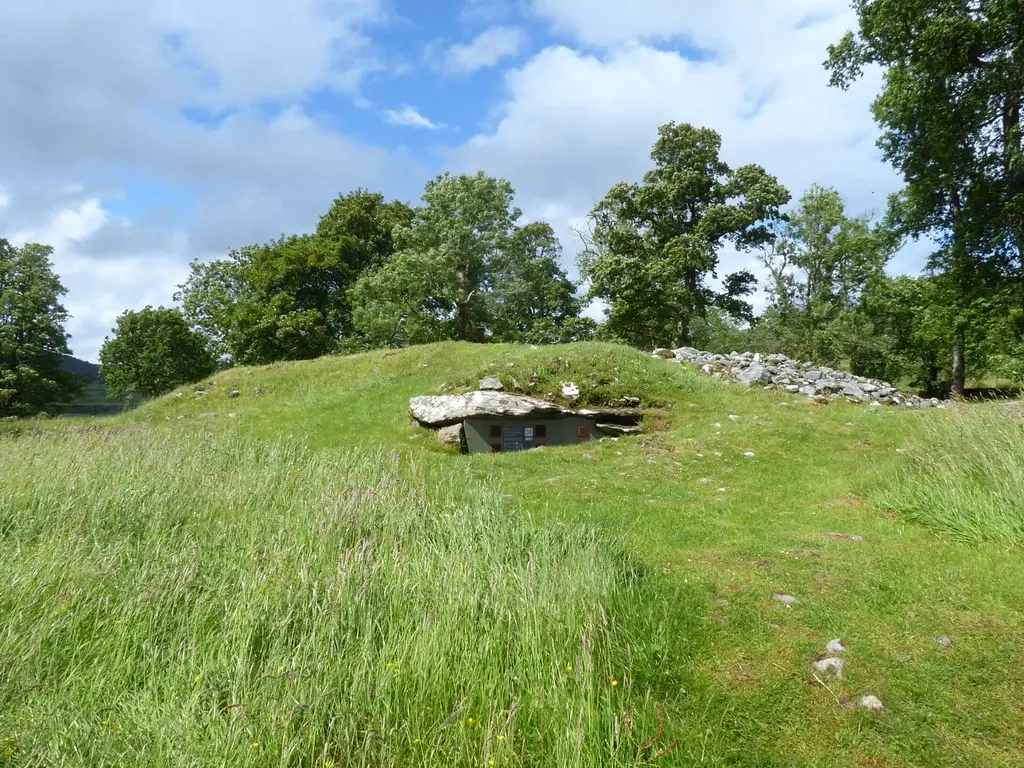
Image of Dunchraigaig Cairn. Image source
Visit essentials
A quick read before you go
- Duration
- Twenty to forty minutes for the cairn alone.
- Access
- Free open access at all times.
Overview
Dunchraigaig stands apart from Kilmartin Glen's main linear cemetery, which extends northward as a chain of burial mounds. Its builders chose a separate tree-covered terrace to the southeast, raising a thirty-metre circle of stone two and a half metres above the grass.
Canon William Greenwell and the Reverend Reginald Mapleton opened the cairn in 1864 and found three cists. The eastern held only cremated bone. In the central cist, a full-length body lay atop the cover slab, cremated remains inside, and a crouched body beneath rough paving. The southeast cist, dug into the ground, had drystone cobbled walls and a massive capstone; it held eight to ten individuals, some cremated and some not, with a greenstone axe, flint knife, whetstone, and pottery.
Known for these unusual burials for over a century and a half, the cairn changed again in autumn 2020 when visitor Hamish Fenton shone a torch beneath the great capstone and saw an antlered deer. Structured-light scanning confirmed at least five pecked animals: two identifiable red deer stags with branching antlers and careful anatomy, plus three less distinct figures that may be younger deer.
Dated to between four and five thousand years ago, they are Scotland's earliest known animal engravings and have stylistic parallels in Northwest Iberia.
Why this place is sacred
The thinness of Dunchraigaig operates through intimacy rather than grandeur. This is not a monument that overwhelms with scale. It draws you close. The cists are partially exposed, and standing at the edge of the southeast chamber, peering down into the space where eight to ten people were once laid together, the distance between the living and the dead narrows to the depth of a stone-lined grave.
The deer carvings intensify this proximity. They were carved on the underside of the capstone, a surface that would be hidden once the stone was placed over the dead. Whether the carvings were made before or after the stone became a burial seal remains unknown, but their placement carries undeniable significance. These images were not meant to be seen by the living. They faced downward into the darkness of the grave, toward the bodies and bones below.
Whatever the deer represented to the people who carved them, the message was directed at the dead, or at the transition between life and death.
The animals themselves contribute to the site's power. Red deer stags, with their branching antlers and seasonal cycles of growth and shedding, have long carried associations with renewal and transformation across European cultures. In the Bronze Age, when these carvings were made, deer were among the largest and most impressive animals in the Scottish landscape. Their presence on a burial capstone suggests they served as guides, companions, or symbols of regeneration for those making the journey beyond life.
Kilmartin Glen amplifies the cairn's contemplative weight. Over eight hundred ancient monuments lie within six miles of this place. To stand at Dunchraigaig is to occupy one point in a vast web of prehistoric sacred geography that once, for reasons we cannot fully recover, mattered profoundly to its inhabitants.
Dunchraigaig was constructed as a communal burial cairn during the Early Bronze Age, approximately 2000 BCE. The three cists suggest the cairn served the community over an extended period, receiving successive interments. The diversity of burial methods, both cremation and inhumation, indicates complex beliefs about death and the afterlife. The extraordinary southeast cist, with its multiple occupants, may represent a family tomb, a plague burial, or a status-related communal interment.
The deer carvings on the capstone point to ritual practices connected to the burial that we cannot reconstruct.
After its Bronze Age construction and use, Dunchraigaig stood undisturbed for approximately four thousand years. Canon William Greenwell, an acknowledged expert in prehistoric monuments and author of the influential book 'British Barrows,' excavated the cairn in 1864 alongside the Reverend Reginald Mapleton, a local minister. Their work revealed the three cists and their contents, but unfortunately all finds were subsequently lost, preventing radiocarbon dating of the bones. The cairn became a scheduled monument under Scottish heritage law.
In 2020, Hamish Fenton's chance discovery of the deer carvings added an entirely new dimension to the monument's significance, prompting scholarly publication in the Cambridge Archaeological Journal and renewed public interest. Today the cairn is managed by Historic Environment Scotland and receives visitors year-round, though in smaller numbers than the more prominent Kilmartin Glen monuments.
Experience and orientation
The cairn reveals itself gradually. From the car park, a short path leads through trees to where the mound rises, larger than expected, its surface covered with moss and partially screened by branches. The initial impression is of a natural hill until the eye begins to distinguish the gathered stones from the surrounding landscape.
Approaching the cairn, the first cist comes into view. The eastern chamber is the simplest: a stone box open to the sky, its contents long since removed by the 1864 excavators. Moving around the mound, the central cist presents the strange arrangement that puzzled Greenwell and Mapleton: a cover slab that once bore a full-length body on its surface, with more remains beneath.
The southeast cist demands attention. Here the massive capstone still covers the chamber, and the drystone-lined walls of the burial space are visible. This is where the deer carvings wait. Visitors who have brought a torch, and those who have not quickly wish they had, can lie on the ground or lean into the gap between capstone and earth to shine light on the underside of the stone.
In that moment, four thousand years of darkness yield to torchlight, and the antlered forms of red deer stags emerge from the rock. The experience of seeing them is not passive observation but active revelation, images appearing from stone as the light moves across pecked surfaces.
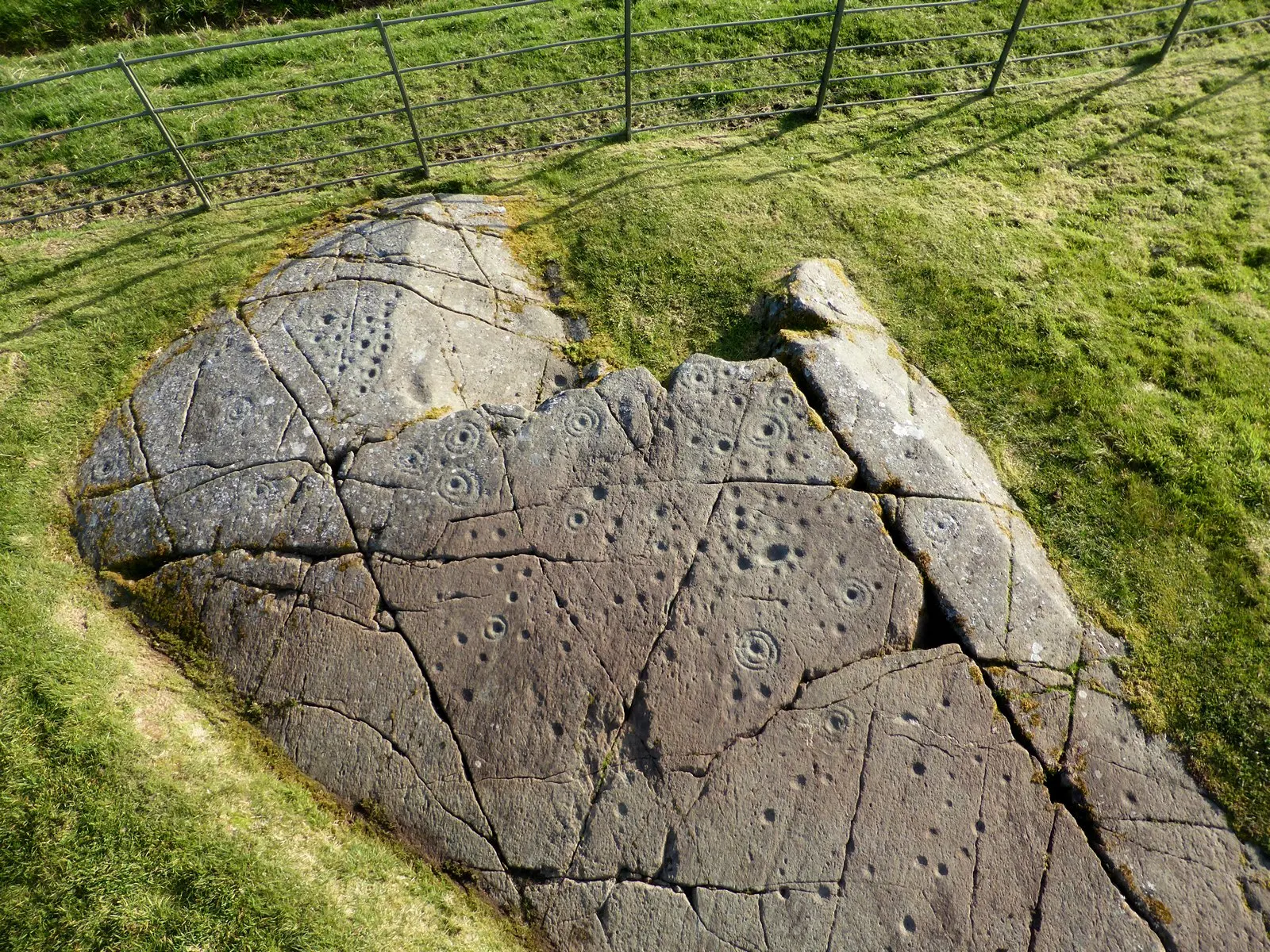
The wider setting rewards those who linger. Baluachraig, one of Scotland's finest cup-and-ring-marked rock outcrops, lies just two hundred metres away, accessible from the same car park. The main Kilmartin cairns and Temple Wood stone circles are within walking distance to the north. Dunadd, the inauguration site of early Scottish kings, rises from the flatlands to the south. Dunchraigaig serves well as either a beginning or an ending for a day spent moving through this ancient landscape.
Dunchraigaig Cairn lies on the west side of the A816, approximately 1.5 miles south of Kilmartin village. The signed car park is clearly visible from the road. Follow the footpath southwest for approximately fifty yards to reach the cairn. The tree cover provides shelter in light rain. Bring a torch to view the deer carvings on the underside of the southeast capstone. After visiting the cairn, walk to the Baluachraig rock art panel accessible from the same car park.
For broader context, visit Kilmartin Museum in the village before or after exploring the monuments.
Context and lineage
No origin narratives survive from the prehistoric builders of Dunchraigaig. The name appears to derive from Gaelic, possibly combining 'dun' (mound or fort) with a personal name or descriptive element, but no mythology attaches to the site. What survives is the physical record of careful burial: stone chambers built and sealed, bodies and ashes placed with tools and pottery, and deer carved into a surface that would be seen only by the dead.
Dunchraigaig's lineage traces from anonymous Bronze Age builders through Victorian antiquarian investigation to contemporary archaeological reinterpretation. The people who constructed the cairn around 2000 BCE left no names, no written beliefs. Kilmartin Glen's communities built, buried, and carved across millennia, leaving a landscape dense with monuments whose full meaning escapes reconstruction. Greenwell and Mapleton's 1864 excavation placed the cairn within the scholarly record, though the loss of all excavated finds limited subsequent analysis.
For over 150 years, Dunchraigaig was known as an unusual but secondary monument in the Kilmartin group. Fenton's 2020 discovery and the subsequent academic publication in the Cambridge Archaeological Journal transformed the cairn's significance, establishing it as the location of Scotland's earliest known animal art. Historic Environment Scotland now manages the site as a scheduled monument of national importance.
Canon William Greenwell
Reverend Reginald Mapleton
Hamish Fenton
Traditions and practice
Original Bronze Age funerary practices at Dunchraigaig cannot be reconstructed in detail. The archaeological evidence indicates complex, multi-method burial customs. Some individuals were cremated, others buried whole. At least one body was placed on top of a cist cover rather than inside. Up to ten individuals shared the southeast chamber, an unusual practice in the Bronze Age when individual burial was more common. Grave goods accompanied the dead: a greenstone axe, a flint knife, a whetstone, and pottery vessels.
The deer carvings on the capstone suggest animal symbolism played a role in funerary ritual, though whether the stags served as guides for the dead, symbols of renewal, or something entirely beyond modern understanding remains unknown.
No formal ceremonies take place at Dunchraigaig. Visitors engage through quiet observation, photography, and personal reflection. Some visitors leave small natural offerings, though this is not historically documented practice at this site.
Bring a torch. The deer carvings are the heart of the site's contemporary meaning, and seeing them requires illuminating the underside of the capstone. Approach the cists with awareness that they once held human remains. Sit quietly with the cairn and allow the weight of four thousand years to settle.
If exploring the wider Kilmartin landscape, consider Dunchraigaig as a starting point: its car park provides easy access, and the quieter atmosphere here offers preparation for the more visited monuments to the north.
Bronze Age Funerary Practice
HistoricalDunchraigaig served as a communal burial monument for the Bronze Age communities of Kilmartin Glen. The cairn's three cists contain evidence of both cremation and inhumation, an unusual combination suggesting complex beliefs about death and transformation. The southeast cist, with its multiple occupants and grave goods, indicates that some burials held particular communal or ceremonial significance. The deer carvings on the capstone, facing the dead rather than the living, point to ritual beliefs connected to animals and the afterlife.
Both cremation and whole-body burial were practiced within the same monument. Grave goods including tools and pottery accompanied the dead. The deer carvings on the capstone may have served ritual purposes connected to the burial ceremony, perhaps intended as guides or companions for the deceased. The full range of funerary practices cannot be reconstructed from the archaeological evidence alone.
Perspectives and open questions
Dunchraigaig invites interpretation but resists certainty. The archaeological evidence establishes what was built and broadly when, but the meaning behind the unusual burials and the hidden deer carvings lies beyond definitive recovery. This honest uncertainty is itself part of the site's power.
Scholarly perspective
Archaeologists classify Dunchraigaig as an Early Bronze Age burial cairn, approximately four thousand years old, forming part of the wider sacred landscape of Kilmartin Glen. The three cists with their diverse burial practices represent some of the most unusual funerary arrangements in Scotland. The 2021 publication in the Cambridge Archaeological Journal established the deer carvings as the earliest unambiguous depictions of animals of prehistoric date in Scotland and among the earliest in Britain and Ireland.
Scholars have noted stylistic parallels with deer engravings from Northwest Iberia dating to a similar period, suggesting possible cultural connections across Atlantic Europe's Atlantic seaboard. Despite the partial excavation of 1864, the cairn retains significant archaeological potential, as the loss of all original finds means modern scientific methods have never been applied to the material.
Living and traditional perspectives
No continuous tradition survives from the prehistoric builders. The Gaelic-speaking communities who later inhabited the glen apparently developed no mythology specific to this cairn. Unlike some Scottish prehistoric monuments that attracted folk practices around healing or divination, Dunchraigaig appears to have passed out of active cultural memory, standing as a mute monument whose original significance was lost.
Alternative interpretations
Some contemporary visitors perceive the cairn as holding particular energy within the Kilmartin sacred landscape. The hidden deer carvings have prompted speculation about shamanic practice and animal spirit guides in Bronze Age spirituality, drawing parallels with deer imagery in other European traditions. The southeast alignment of the cairn entrance toward the winter sunrise has been noted by those interested in archaeoastronomy, though this alignment has not been formally verified.
Open questions
Fundamental questions remain unanswered. The communal burial of up to ten individuals in the southeast cist is exceptional for the Bronze Age, when individual burial was standard practice, and no convincing explanation has achieved consensus. Whether the deer carvings were made before or after the stone was used as a capstone remains undetermined.
The loss of all finds from the 1864 excavation means the bones have never been radiocarbon dated, the pottery has never been typologically classified, and the tools have never been properly analyzed. Why Dunchraigaig sits apart from the main linear cemetery rather than in alignment with the other cairns is unknown. And the connection between the Scottish deer carvings and similar depictions in Northwest Iberia raises questions about Bronze Age cultural networks that have only begun to be investigated.
Plan your visit
Access and arrival
Free open access at all times. Signed car park on the A816, approximately 1.5 miles south of Kilmartin village, Argyll. The cairn is fifty yards from the car park along a footpath. The site is generally accessible for those with moderate mobility but the ground is uneven. Not wheelchair accessible. Nearest town: Lochgilphead (6 km south). Nearest larger towns: Oban (30 km north), Glasgow (approximately 2.5 hours by car).
Limited accommodation in the immediate area. Kilmartin Hotel and local B&Bs near the village. More options in Lochgilphead (6 km) and Oban (30 km). For immersive experience, consider staying nearby to allow exploration of the glen at different times of day.
Respectful visit
No dress code. Practical outdoor clothing and waterproof boots recommended. The terrain is generally dry near the cairn but surrounding ground can be muddy.
Photography freely permitted and encouraged. A torch provides essential illumination for photographing the deer carvings. Low-angle light can reveal surface details of the cairn stones.
Leaving offerings is not historically associated with this site. If moved to leave something, choose only natural and biodegradable items, and ensure they do not damage the monument or create litter hazards for grazing animals.
Do not disturb, excavate, or damage any part of the monument. The cairn is protected as a scheduled monument under Scottish law. Do not touch the deer carvings or the capstone surfaces. Do not remove stones or artifacts.
The cairn is a scheduled monument. Do not disturb stones, attempt excavation, or remove anything from the site. Do not climb on the cairn structure. The drystone walls of the cists are fragile and should not be touched or leaned upon. Respect the site as what it is: a place where people were buried.
Current practical details
Address
A816, Kilmartin, Lochgilphead PA31 8RQ, UK
Hours
Hours, fees, and access can change — verify on the official source before you travel. Practical details last checked Jun 2026.
Location
Map loads as you approach this section.
Pilgrim reflections
A portrait of encounter, not a score
Pilgrims describe what they felt, how present they could become, and whether the place would shape a journey. There are no stars and no ranking of traditions.
No reviewed reflections yet
The first pilgrims can help describe the character of being here.
Share a reflection
Available after an account-backed “Been there.” Every reflection is reviewed before publication.
Nearby sacred places
Explore other sacred places in the region. Proximity does not establish access or travel time; check each place’s guidance.
Baluachraig Cup and Ring Marks
Kilmartin, Scotland, United Kingdom
0.2 km away
Ri Cruin Cairn
Kilmartin, Scotland, United Kingdom
0.8 km away
Ballymeanoch Neolithic site, Kilmartin Glen
Kilmartin, Scotland, United Kingdom
0.9 km away
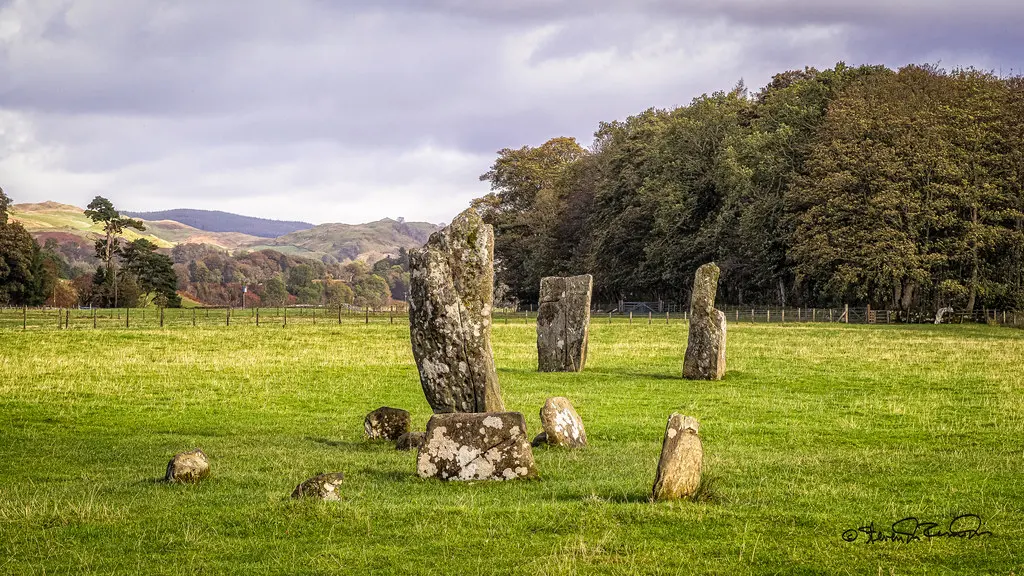
Nether Largie standing stones, Argyll, Scotland
Kilmartin, Scotland, United Kingdom
0.9 km away
References
Sources consulted for this page. Source categories describe the publication, not a guarantee that every claim is verified. Traditional accounts and outside interpretations may differ.
- 01Kilmartin Glen: Dunchraigaig Cairn — Historic Environment ScotlandofficialOfficial heritage body managing the monument; primary authority for visitor and historical information
- 02Dunchraigaig Cairn: History — Historic Environment ScotlandofficialDetailed historical account of excavations and burials from the official heritage body
- 03Prehistoric animal carvings discovered for the first time in Scotland — Historic Environment ScotlandofficialOfficial announcement of the 2021 deer carving discovery
- 04Revealing the Earliest Animal Engravings in Scotland: The Dunchraigaig Deer, Kilmartin — Cambridge Archaeological Journal / Cambridge CoreacademicPeer-reviewed academic publication on the deer carvings
- 05Dunchraigaig — Canmore (Historic Environment Scotland National Record)officialOfficial national record of the scheduled monument
- 06Dunchraigaig Cairn [Duncraigaig] — The Megalithic PortalacademicSpecialist megalithic site database with coordinates and archaeological details
- 07Dunchraigaig Cairn Feature Page — Undiscovered ScotlandguideComprehensive visitor information and historical context
- 08Dunchraigaig Cairn and Baluachraig Rock Art in Kilmartin — Atlas ObscuraguideVisitor-oriented description with practical information
- 09Deer carvings at Dunchraigaig — The Hazel TreeblogDetailed narrative account of the deer carving discovery and interpretation
- 10Dunchraigaig Cairn: Scotland's 5,000 Year Old Animal Carvings — History HitspiritualPopular history account with accessible description of the carvings
- 11Dunchraigaig Cairn - History, Travel, and accommodation information — Britain ExpressguideTravel guide with visitor-practical details
Share a photo
Help visitors recognize Dunchraigaig Cairn. Every submission is reviewed before publication.