Doric Temple of Segesta
A perfect Greek temple built by a people who were not Greek
Understand sacred places, explore living traditions, and learn how to engage respectfully with Pilgrim Map.
Access has not been verified. Check current local guidance before planning a visit.
Calatafimi Segesta, Trapani, Italy
Read the sources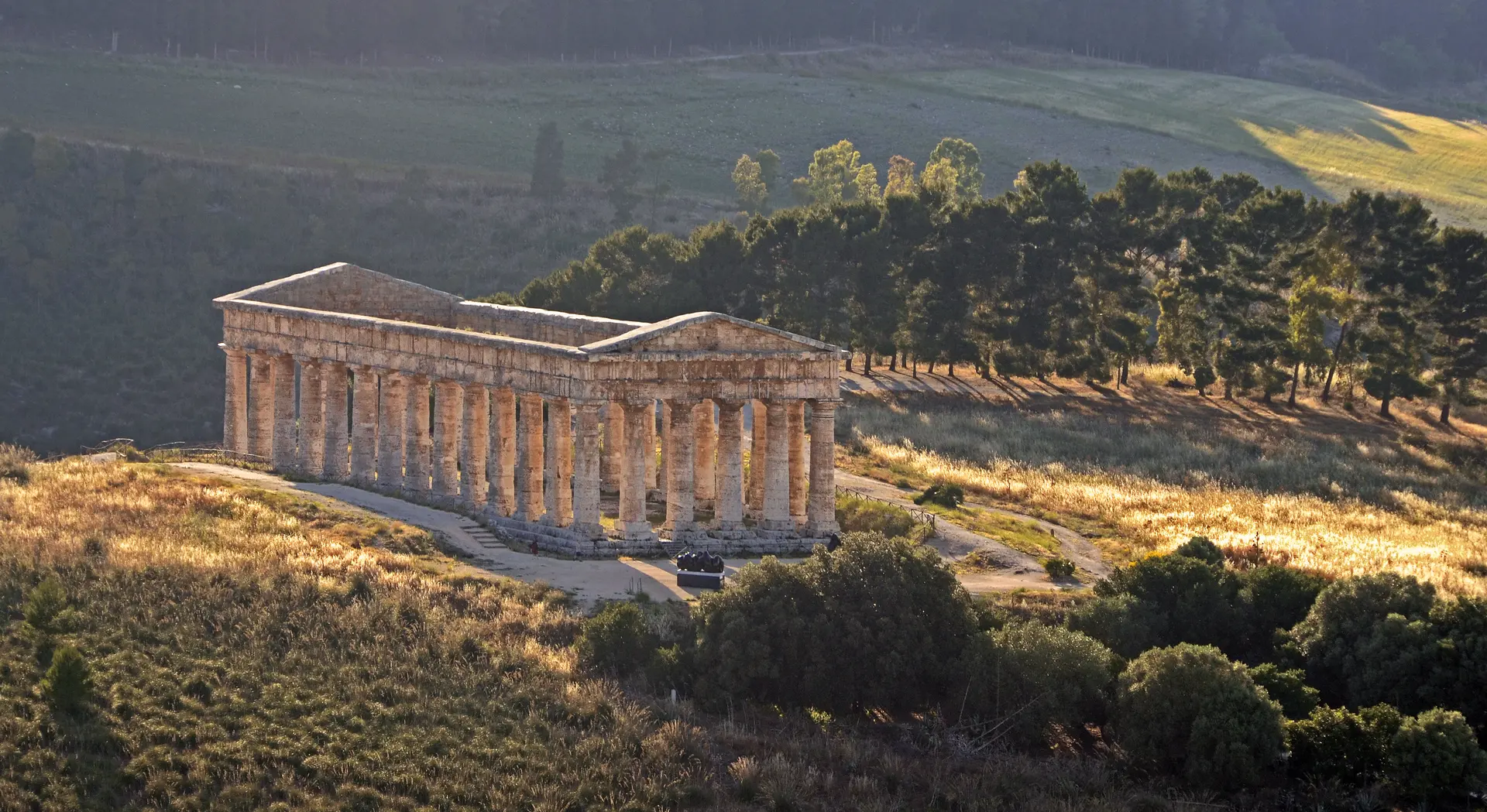
Image of Doric Temple of Segesta. Image source · CC-BY-SA-2.0
Visit essentials
A quick read before you go
- Duration
- 2-3 hours for thorough visit including temple and theater.
- Etiquette
- Treat the ruins with respect as both archaeological heritage and potential sacred ground.
Overview
Segesta's temple was built by the Elymians, one of ancient Sicily's three Indigenous peoples. They traced themselves to Trojan refugees, though modern scholars consider that legend baseless. They were not Greek, yet between 430 and 420 BC, probably with an Athenian architect, produced one of the Mediterranean's finest Doric temples.
It was never finished: columns remain unfluted, lifting bosses stay on the stylobate, and neither roof nor cella was built. Apparently complete from afar, it reveals incompletion nearby. Whether war interrupted construction or an open-air sanctuary was intended for Elymian rather than Greek worship remains unknown.
Paradoxically, incompletion may have preserved it. After Segesta's tenth-century abandonment amid Arab raids, the lack of dressed blocks and carved elements made the structure unattractive as a quarry, leaving thirty-six columns on the hillside.
Today this almost pristine Greek temple stands alone in a landscape little changed since antiquity, without urban or later buildings competing for attention. At 304 meters above sea level, it faces the distant sea and surrounding Sicilian mountains, offering unusual contemplative space.
Why this place is sacred
The Temple of Segesta thins the boundary between worlds through negation. We do not know to which deity it was dedicated. We do not know why it was never finished. We do not know what rituals the Elymians performed among its columns. The usual explanations that frame ancient temples, the narratives of specific gods and recorded practices, are simply unavailable.
This absence of answers creates a particular quality of presence. When you stand within the colonnade, you are free from the interpretive apparatus that accompanies most ancient sites. There is no cult statue to reconstruct, no festival calendar to imagine, no priestly hierarchy to populate. There is only the temple itself, complete in its incompleteness, offering its form without prescribing its meaning.
The columns rise nine meters into the Sicilian sky. They are massive, weighing tons each, cut from local limestone and transported to this hilltop by methods we can only approximate. They were never fluted, so they lack the characteristic vertical grooves of finished Doric columns. This gives them a different quality than the temples at Agrigento or Selinunte, rougher, more immediate, more like the raw material of holiness than its polished product.
The setting amplifies the thinness. Segesta stands alone. The nearest village is kilometers away. The surrounding hills are covered with wild vegetation, the same plants that grew here when the temple was built. Hawks circle overhead. Wind moves through the columns. On clear days, you can see the sea from which the Elymians' legendary Trojan ancestors were said to have come.
The Elymians themselves remain mysterious, their language barely attested, their customs largely unknown. They adopted Greek architectural vocabulary while apparently maintaining their own religious practices. The temple may represent not imitation but translation, the forms of one culture adapted to serve the content of another. That translation remains unfinished, permanently open, a question that invites but does not answer.
The Elymians' religious practices remain largely unknown. The temple's lack of enclosed space suggests open-air worship that may have differed significantly from Greek temple cult.
The temple's preservation through abandonment rather than continued use has left it suspended between construction and completion, between Greek form and Elymian purpose.
Experience and orientation
Arrive early if possible. Segesta fills with visitors as the day progresses, and the temple's power lies partly in solitude. From the ticket office, a path leads approximately 400 meters to the temple, climbing gently through vegetation that includes the wild olive and carob that have grown in Sicily for millennia.
The temple reveals itself gradually. First the pediment appears above the hillside, then the full colonnade comes into view. Stop before approaching. Let the first impression settle. Notice the proportions, the relationship of column to entablature, the way the structure both dominates and belongs to its setting.
Approach and begin to circle. The thirty-six columns, six on each short side and fourteen on each long side, create a rhythm that walking completes. Notice how the columns appear complete from a distance but reveal their unfinished state up close. The characteristic vertical fluting was never carved; instead, the columns show the smooth surface of partially worked stone.
On the stylobate, the stepped platform that supports the colonnade, you can still see the lifting bosses, the stone protrusions used to position blocks that would normally be removed as a finishing step.
Enter the peristyle if access is permitted. Stand where the cella would have been, where the cult statue would have stood, where priests would have performed their rituals. Nothing is here except the sky. The temple frames emptiness. Whatever the Elymians worshipped, they worshipped in the open, under the sun and stars, with no walls between them and their gods.
After the temple, take the shuttle bus or walk the 1.7 kilometers to Mount Barbaro, where the ancient theater is carved into the hillside. The view from here encompasses the temple, the distant sea, the surrounding mountains. In summer, performances are held in this theater, as they were over two thousand years ago. The theater and temple together create a sacred landscape on the scale that ancient peoples intended.
The temple is located approximately 400 meters from the ticket office, accessible via a gentle uphill path. The ancient theater is on Mount Barbaro, accessible via shuttle bus (2-2.50 euros round trip) or a 1.7 km walk. Total walking distance to see all major features is approximately 4 km.
Context and lineage
The Elymians were one of three indigenous peoples in ancient Sicily, along with the Sicani and the Sicels. Greek tradition, recorded by Thucydides, claimed they descended from Trojan refugees who settled in western Sicily after the fall of Troy. Modern scholars consider this founding legend baseless, though the Elymians themselves may have embraced it to establish kinship with the Greek world.
Segesta was their major city, positioned strategically between Greek eastern Sicily and Carthaginian western Sicily. The rivalry with neighboring Selinunte, a wealthy Greek colony, defined Segesta's history. The Elymians walked a constant tightrope between Greek and Carthaginian spheres of influence.
Between 430 and 420 BC, during a period of relative peace and prosperity, Segesta began constructing a Doric temple. The design was likely the work of an Athenian architect, and the project may have been timed to impress Athenian ambassadors visiting to assess Segesta's value as an ally against Selinunte. If so, the diplomacy succeeded. Athens eventually supported Segesta against Selinunte, though the catastrophic Sicilian Expedition (415-413 BC) resulted in Athens' worst military defeat.
The temple was never completed. Whether war intervened, whether funds ran out, or whether the structure was always intended as an open-air sanctuary without roof or cella, remains debated. In 408 BC, Segesta succeeded in destroying Selinunte with Carthaginian aid, but later suffered its own destruction by Agathocles of Syracuse in 307 BC. The city limped on until Arab raids in the tenth century prompted final abandonment.
The temple survived simply by being ignored. Its incompleteness made it valueless for quarrying. Its remote location protected it from incorporation into later buildings. It stood alone through the Middle Ages, through the Renaissance, through the modern period, until early visitors began to recognize its extraordinary preservation and importance.
The Elymian religious tradition remains largely unknown. The temple's Greek form was adopted but apparently adapted to indigenous practice. No continuous religious tradition survived the city's abandonment.
Unknown Athenian Architect
Designer
Thucydides
Historian
Traditions and practice
The Elymians' religious practices are poorly documented. The temple's lack of cella, altar, and roof suggests worship that did not require enclosed space, possibly involving sky-oriented rituals or ceremonies conducted in the open air. Greek practices would have included animal sacrifice, but whether Elymians followed this pattern is unknown.
No active religious community serves Segesta. The Archaeological Park hosts summer performances in the ancient theater, continuing the site's cultural function. Visitors frequently describe contemplative or meditative experiences at the temple.
Approach the temple as a place for contemplation rather than information gathering. Circle the columns slowly. Enter the peristyle and stand where the cella would have been. Let the absence of answers create space for your own questions. Visit the theater for the larger landscape view. If possible, visit at sunrise or sunset when the light transforms the stone.
Elymian Religion
HistoricalThe temple was built by the Elymians, an indigenous Sicilian people, in Greek architectural style. Their religious practices remain largely unknown, making the temple a monument to mystery rather than to a specific documented tradition.
Unknown. The temple's lack of enclosed space suggests open-air worship. The Elymians claimed Trojan ancestry and may have worshipped deities associated with that legendary heritage.
Greek Doric Architecture
HistoricalThe temple exemplifies the Doric order at its most refined, with proportions conforming to Greek mathematical ratios. It demonstrates the spread of Greek architectural influence beyond Greek ethnic communities.
Greek Doric temples typically housed cult statues and served as focal points for outdoor sacrifice and procession. The Segesta temple's lack of these features suggests adaptation to non-Greek purposes.
Perspectives and open questions
The Temple of Segesta can be understood as an architectural masterpiece, as evidence of cultural exchange between indigenous and Greek peoples, as a meditation on incompleteness and preservation, or as a sacred space whose original meaning remains open.
Scholarly perspective
Architectural historians recognize Segesta as one of the best-preserved examples of Doric temple architecture in the world. The temple's incompleteness has paradoxically preserved features normally removed during construction, allowing detailed study of building techniques. Scholars debate whether the lack of interior elements reflects interrupted construction or intentional adaptation to Elymian religious practice.
Living and traditional perspectives
No continuous tradition of worship at Segesta has survived. However, some contemporary pagans and polytheists honor the temple as a sacred site, even though its original dedication remains unknown.
Alternative interpretations
The temple's mystery creates space for diverse interpretations. Some visitors experience it as evidence that sacred architecture transcends the specific deities to which it is dedicated, that the impulse to create sacred space is universal and the forms are vehicles rather than ends.
Open questions
The deity to whom the temple was dedicated remains unknown. The reasons for its incompleteness are debated. The specific religious practices of the Elymians are poorly documented. The temple invites questions it cannot answer.
Plan your visit
Access and arrival
Limited options in Calatafimi-Segesta. More choices in Trapani or Castellammare del Golfo.
Respectful visit
Practical clothing suitable for walking in Mediterranean conditions. Sturdy shoes recommended.
Photography is permitted throughout the site. The temple photographs beautifully in morning and late afternoon light.
Modern offerings are not traditional at archaeological sites. If leaving any token, ensure it will not degrade the site.
Do not climb on structures. Stay on marked paths. Do not remove any material from the site, including small fragments.
The site is exposed to sun and wind. Bring water and sun protection. Some terrain is uneven. The shuttle to the theater runs on schedule; plan accordingly.
Current practical details
Address
Contrada Barbaro, 91013 Calatafimi-Segesta TP, Italy
Phone
Hours
Hours, fees, and access can change — verify on the official source before you travel. Practical details last checked Jun 2026.
Location
Map loads as you approach this section.
Pilgrim reflections
A portrait of encounter, not a score
Pilgrims describe what they felt, how present they could become, and whether the place would shape a journey. There are no stars and no ranking of traditions.
No reviewed reflections yet
The first pilgrims can help describe the character of being here.
Share a reflection
Available after an account-backed “Been there.” Every reflection is reviewed before publication.
Nearby sacred places
Explore other sacred places in the region. Proximity does not establish access or travel time; check each place’s guidance.



References
Sources consulted for this page. Source categories describe the publication, not a guarantee that every claim is verified. Traditional accounts and outside interpretations may differ.
- 01Segesta - WikipediaSource context
- 02Doric Temple of Segesta: History & Facts | Study.comSource context
- 03Segesta - History and Facts | History HitSource context
- 04The Ancient Temple of Segesta - Atlas ObscuraSource context
- 05Segesta - Wonders of SicilySource context
- 06A Classical Doric Temple in Sicily Built by a Mysterious Population | Ancient OriginsSource context
- 07Segesta Tourist Information | Segesta WelcomeSource context
Share a photo
Help visitors recognize Doric Temple of Segesta. Every submission is reviewed before publication.