Teatro di Segesta
An ancient theatre built over a sacred spring, where performances still unfold against the Sicilian hills
Understand sacred places, explore living traditions, and learn how to engage respectfully with Pilgrim Map.
Access has not been verified. Check current local guidance before planning a visit.
Calatafimi-Segesta, Trapani, Italy
Read the sources
Visit essentials
A quick read before you go
- Duration
- 2-3 hours for the full archaeological park including temple and theatre
- Access
- Segesta Archaeological Park, near Calatafimi-Segesta, province of Trapani.
Overview
At the summit of Monte Barbaro, the Theatre of Segesta occupies ground sacred long before any seats were carved. Beneath the cavea, a spring cave served as the center of prehistoric Elymian worship; Bronze Age pottery dates sacred activity there to approximately 1,000 years before the theatre's construction between the 3rd and 2nd centuries BC.
The Elymians, an indigenous Sicilian people who claimed descent from Trojan refugees, chose the mountain for its defensive position, sacred springs, and prospect. The semicircular cavea, partly carved from living rock and partly supported by a massive retaining wall, seats approximately 4,000 spectators facing northwest toward rolling hills and the Gulf of Castellammare.
The theatre records a transition from Greek to Roman architecture. Its originally Greek-style converging analemmata were cut back parallel to the stage during Roman renovations. Twenty seating rows, divided by a diazoma and six stairways into seven wedge-shaped sections, preserve the classical geometry of communal viewing.
Each summer, Greek tragedies and contemporary works return the theatre to its original function, continuing three millennia of public gathering and dramatic art on this hillside.
Why this place is sacred
The Theatre of Segesta is thin through accumulation. Each layer of its history deepens the sense of sustained human attention to this place. The Bronze Age spring worshippers who first recognized the cave as sacred knew nothing of Greek drama, yet they established the sanctity that would draw later builders to this exact spot. The Elymians who conducted rites in the cave were not yet imagining a theatre, but they were already gathering for communal acts of witnessing.
The Greek-style theatre formalized what was already happening. And the modern performances that fill the seats each summer complete a cycle that is not repetition but deepening. The panoramic view — hills, fields, the distant sea — serves as the permanent backdrop against which all human drama, ancient and modern, unfolds.
The cave beneath the theatre served Elymian sacred rites connected to the spring. The theatre itself served Greek-style dramatic performances and civic gatherings, later adapted for Roman theatrical conventions.
Bronze Age: sacred spring and cave worship. Elymian period: rites at the cave continued. 3rd-2nd century BC: theatre constructed in Greek style. Roman period: stage area modified for Roman theatrical conventions. Modern era: summer performance seasons continue the tradition of theatrical gathering.
Experience and orientation
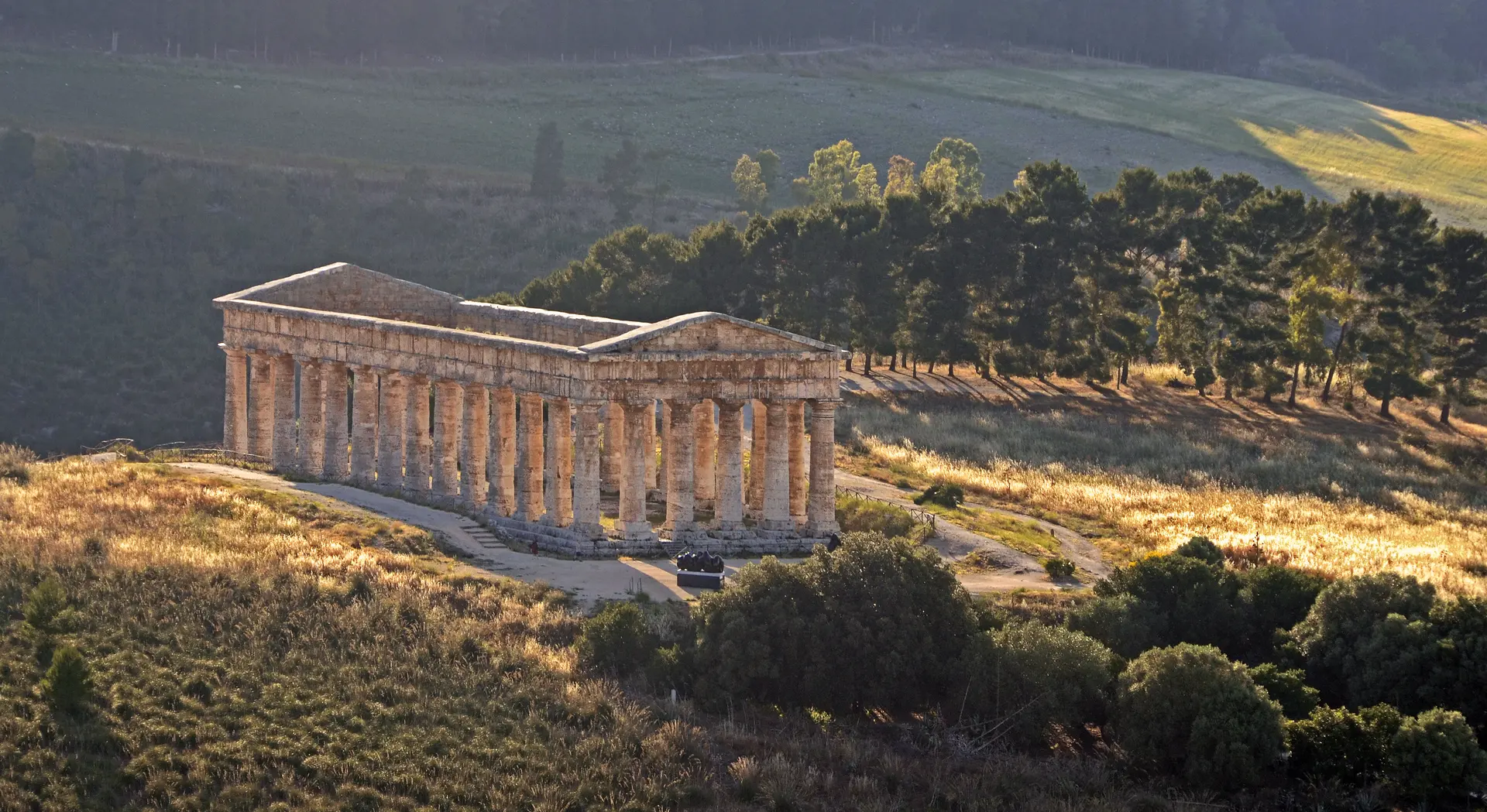
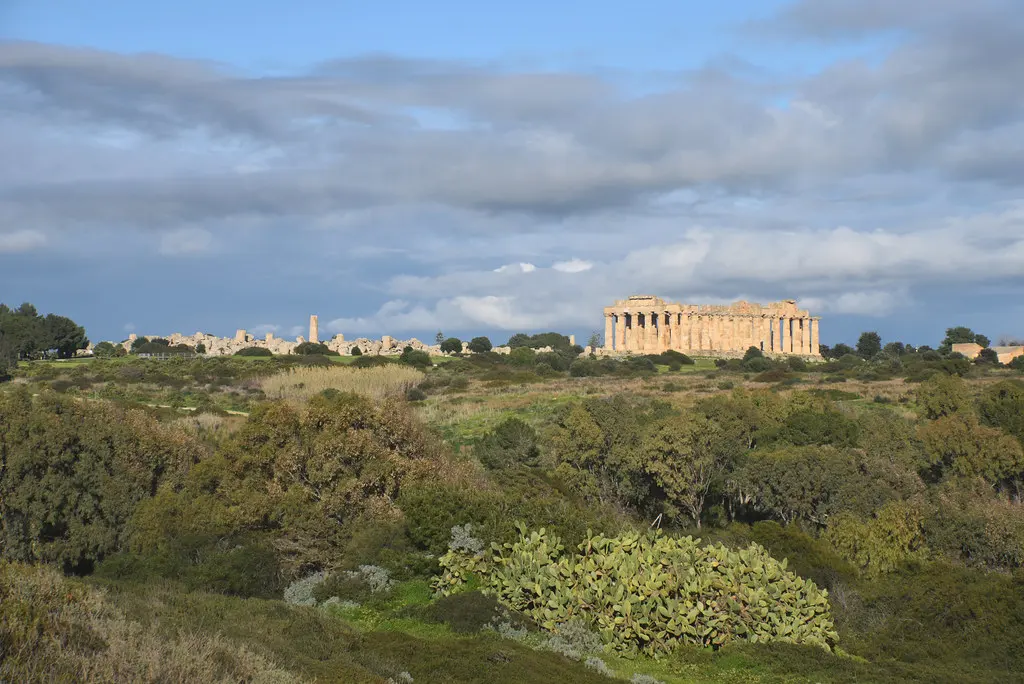
The approach to the theatre begins at the base of Monte Barbaro, where the famous unfinished Doric temple stands in its field — a building that was never completed and never roofed, yet whose proportions remain among the purest in Greek architecture. The walk uphill, or the shuttle ride for those who prefer, creates a sense of pilgrimage: ascending from the solitary temple toward the communal space of the theatre.
Arriving at the summit, the cavea opens outward toward the northwest. The twenty rows of stone seating curve in a perfect semicircle, their geometry responding to both the hillside's contour and the requirements of acoustics. Sitting in the upper rows, the view extends over the stage area to the hills beyond, rolling in soft undulations toward the coast. On clear days, the Gulf of Castellammare gleams on the horizon.
The stone seating retains the warmth of the sun well into the evening. During summer performances, audiences gather as the light changes, occupying the same positions that audiences have occupied for over two millennia. The acoustics, shaped by the natural amphitheatre of the hillside, carry voices clearly to the upper rows.
Below the seating, invisible to visitors, the cave and its spring persist. The water that drew the first worshippers to this summit still flows beneath the theatre, a hidden continuity that connects the prehistoric to the contemporary through the medium of moving water.
From the park entrance, the temple and the theatre are the two main destinations. Walk or take the shuttle to the summit for the theatre. Arrive in late afternoon for the best light across the hills. During the summer performance season, attending an evening event transforms the visit from archaeological to experiential.
Context and lineage
The Elymians settled in the strategic hills of western Sicily, establishing Segesta as their principal city. Ancient authors connected them to refugees from Troy — a claim that, whether historical or mythological, shaped Segesta's identity and its political alliances for centuries. The site on Monte Barbaro was chosen for defense, for its sacred springs, and for the panoramic beauty of its setting.
The cave beneath the future theatre was among the earliest sacred sites, its spring serving as the center of rites whose nature is now largely lost. The theatre, built in the 3rd-2nd century BC during a period of Hellenization, represented the adoption of Greek cultural forms by a people who were not ethnically Greek — a meeting of traditions that the architecture itself embodies.
The theatre represents the intersection of Elymian sacred tradition and Greek theatrical culture. The cave worship predates the theatre by approximately a millennium, suggesting that the builders consciously placed their structure over existing sacred ground — a practice common across the ancient Mediterranean.
The Elymians
Indigenous Sicilian people who founded Segesta
Traditions and practice
The Elymians conducted rites at the sacred spring in the cave beneath the theatre. The nature of these rites is largely unknown, but the cave's sanctity is attested by Bronze Age pottery deposits. Once the theatre was built, Greek-style dramatic performances — tragedies, comedies, and civic ceremonies — filled the space with the communal act of witnessing narratives of human and divine encounter.
The Theatre of Segesta hosts a summer performance season featuring Greek tragedies, contemporary theatre, and musical events. Conservation efforts continue under Italian cultural heritage authorities.
Visit the temple first, then walk uphill to the theatre, allowing the ascent to build anticipation. Sit in the upper rows of the cavea and take in the panoramic view before attending to the theatre's architecture. If visiting during the summer performance season, attend an evening event to experience the living continuity of the space.
At any time, sit quietly in the ancient seats and listen — the wind, the birds, the occasional distant sound of human activity create their own performance.
Elymian Sacred Tradition
HistoricalThe Elymians established the sanctity of this summit through worship at the sacred spring in the cave beneath the theatre, over a millennium before the theatre was built.
Rites at the sacred spring. Specifics unknown; attested by Bronze Age pottery deposits.
Greek-Roman Theatrical Tradition
ActiveThe theatre formalized communal gathering and dramatic performance in a space already sacred to the Elymians. Summer performances continue this tradition.
Performance of dramatic works including Greek tragedies, comedies, and contemporary pieces. Civic gatherings and musical events.
Perspectives and open questions
The Theatre of Segesta bridges Elymian sacred tradition, Greek theatrical culture, and the modern performing arts.
Scholarly perspective
The theatre is exceptionally well preserved and documents the transition from Greek to Roman theatrical architecture. Its construction over a Bronze Age sacred cave demonstrates the persistence of sacred geography across cultures. Recent scholarship has debated the dating, with proposals ranging from the late 4th century to the 2nd century BC. The modification of the analemmata from Greek converging to Roman parallel form provides physical evidence of cultural transformation.
Living and traditional perspectives
The Elymians, though influenced by Greek culture, maintained distinct traditions rooted in western Sicily's pre-colonial past. The sacred spring beneath the theatre connects to widespread Mediterranean traditions of water worship and the sanctity of natural springs. The legendary Trojan origin of the Elymians linked them to one of the foundational narratives of Western civilization.
Alternative interpretations
Some interpret the theatre's placement over the sacred spring as reflecting geomantic awareness — a deliberate positioning of human construction over a point of natural energy. The panoramic orientation toward the coast and setting sun has been read in terms of solar symbolism and the connection between dramatic performance and cosmic cycles.
Open questions
The exact nature of the Elymian rites performed in the cave remains unknown. The relationship between Elymian, Greek, and Roman sacred practices at this specific site continues to be investigated. Whether the cave is accessible beneath the theatre and what further archaeological evidence it might contain are open questions.
Plan your visit
Access and arrival
Segesta Archaeological Park, near Calatafimi-Segesta, province of Trapani. Entrance €16 for adults. Shuttle to the theatre summit €2 round trip. Open year-round with seasonal hours (9 AM to 5-7:30 PM depending on season). Last entry 90 minutes before closing.
Calatafimi-Segesta, Alcamo, or Trapani offer accommodation options at various price points.
Respectful visit
Comfortable walking shoes for the uphill path; bring a layer for evening performances as the summit can be cool
Permitted during regular visits; may be restricted during performances
Not applicable
Stay on designated paths | Follow performance-specific guidelines during events | Do not climb on fragile stone areas if cordoned
The walk from temple to theatre is uphill and can be strenuous in summer heat. A shuttle is available for a nominal fee.
Current practical details
Address
Area Archeologica di Segesta, Acropoli Nord, 91013 Calatafimi TP, Italy
Phone
Hours
Hours, fees, and access can change — verify on the official source before you travel. Practical details last checked Jun 2026.
Location
Map loads as you approach this section.
Pilgrim reflections
A portrait of encounter, not a score
Pilgrims describe what they felt, how present they could become, and whether the place would shape a journey. There are no stars and no ranking of traditions.
No reviewed reflections yet
The first pilgrims can help describe the character of being here.
Share a reflection
Available after an account-backed “Been there.” Every reflection is reviewed before publication.
Nearby sacred places
Explore other sacred places in the region. Proximity does not establish access or travel time; check each place’s guidance.


References
Sources consulted for this page. Source categories describe the publication, not a guarantee that every claim is verified. Traditional accounts and outside interpretations may differ.
- 01Segesta - The Ancient Theatre Archive — Ancient Theatre ArchiveacademicDetailed architectural and archaeological analysis
- 02Segesta - Britannica — Encyclopaedia BritannicaencyclopediaHistorical overview of Segesta and the Elymians
- 03Segesta Archaeological Park - CoopCulture — CoopCultureofficialOfficial ticketing and visitor information
- 04Segesta - Peter Sommer Travels — Peter Sommer TravelsguideArchaeological travel perspective with sacred cave information
- 05Exploring The Ancient Elymian Ruins Of Segesta - The Geographical Cure — The Geographical CureguideCultural context and visitor experience
Share a photo
Help visitors recognize Teatro di Segesta. Every submission is reviewed before publication.