Dolmen of Dombate
Galicia's painted passage grave, still lit by the winter solstice sunrise
Understand sacred places, explore living traditions, and learn how to engage respectfully with Pilgrim Map.
Access has not been verified. Check current local guidance before planning a visit.
Cabana de Bergantiños, A Coruña, Spain
Read the sources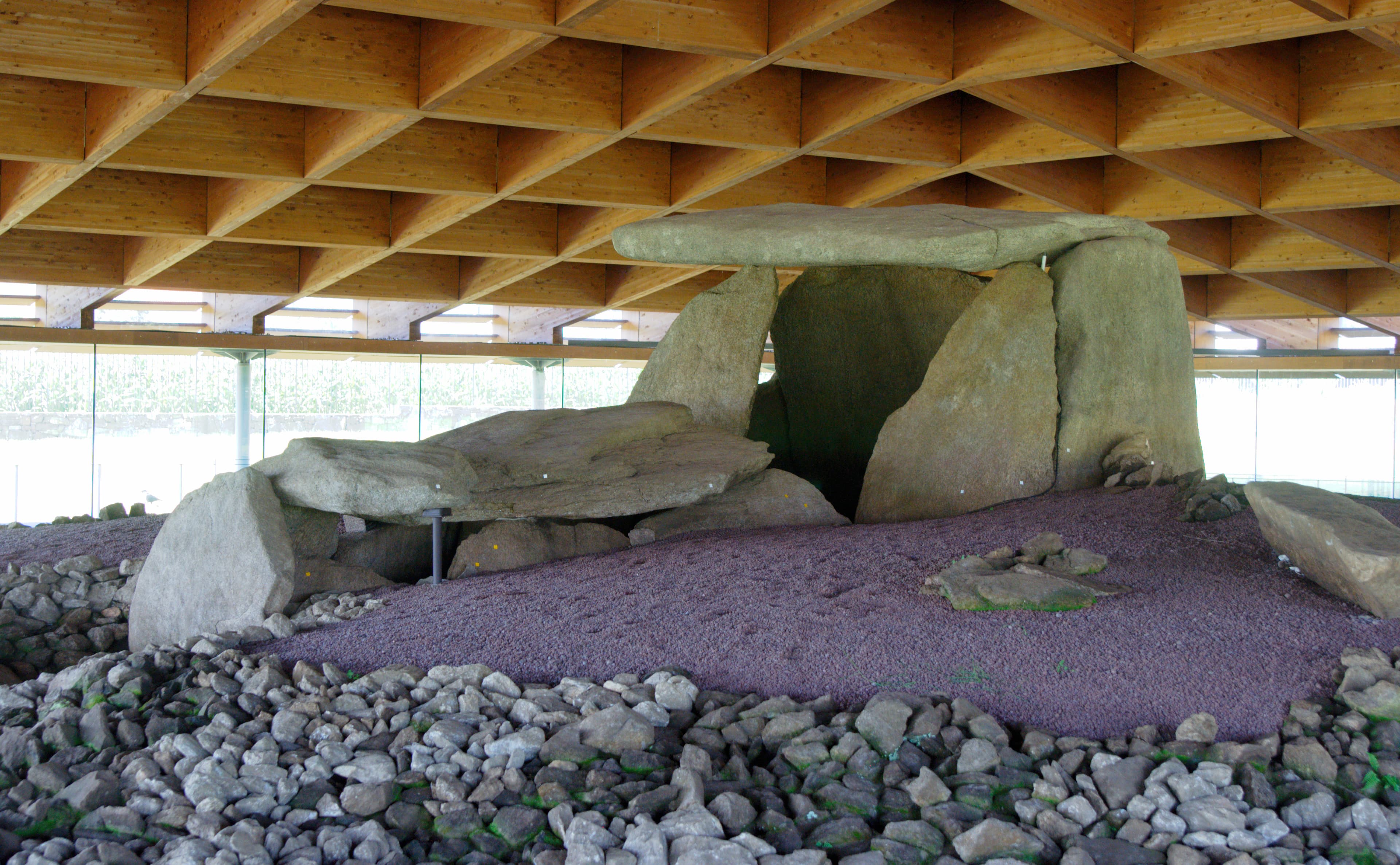
Image of Dolmen of Dombate. Image source
Visit essentials
A quick read before you go
- Duration
- A standard guided visit to the interpretation center, replica chamber, and dolmen exterior takes…
- Access
- Dombate sits in the Borneiro parish of Cabana de Bergantiños municipality, A Coruña province, on…
Overview
Dombate's original chamber cannot be entered. Red-ochre and charcoal zigzags, waves, and lattice on pale granite, with roughly twenty carved anthropomorphic figures near the entrance, are too fragile for touch, breath, and daylight. A modern shelter encloses them, while a full-scale replica in the interpretation center receives visitors.
The monument grew in phases: a smaller chamber was absorbed by a larger one, a three-part corridor was added in the first half of the 4th millennium BCE, and a closing stone sealed the opening sometime between roughly 3011 and 2586 BCE. During its open centuries, the chamber received the dead with flint blades, polished axes, and beads, and researchers argue that its painted panel was positioned for particular light.
Around the winter solstice, for about a month, dawn enters the passage and climbs the back wall to—but not beyond—the red painted band, a precision peer-reviewed research considers intentional. Nineteenth-century Galician nationalists cited the wall as evidence of regional distinctiveness. Today it is quieter: a landscape form apparently keeping the same solar appointment for nearly six thousand years.
Why this place is sacred
Most Iberian megaliths that once bore painted decoration have lost it entirely — pigment does not survive centuries of exposure, damp, and disturbance. Dombate's chamber is a rare exception: red ochre and charcoal motifs, applied to a whitened granite ground, remain visible on several orthostats, alongside roughly twenty incised anthropomorphic figures clustered near the chamber's entrance.
This alone would make the site exceptional; a 2024 peer-reviewed photogrammetry study treats it as one of the best-documented examples of Iberian megalithic rock art anywhere.
What elevates Dombate further is the relationship between that painting and light. A 2019 Cambridge Archaeological Journal study of the chamber's construction phasing found that for roughly a month around the winter solstice, sunrise light entering the passage climbs the chamber's back stone and stops almost exactly at the level where the red geometric painted register begins — a correspondence the researchers argue was designed rather than coincidental, tying the site's visual symbolism directly to its architecture and orientation.
More recent statistical work across many Galician megaliths complicates a simple single-target reading of that alignment, showing that orientations across the region fit several plausible solar and lunar targets rather than one exclusively — a caution against overstating how deliberate any single monument's alignment was, even as the light-and-shadow effect itself remains well documented at Dombate specifically.
The result is a monument whose thinness is more architectural and symbolic than mystical in the folkloric sense: a structure built, apparently twice — an earlier chamber later enlarged into a much larger one — with enough care in its final form that painting, orientation, and solar event align.
Local oral tradition adds its own layer, attributing the monument's construction not to a community of Neolithic farmers but to an enchantress and the mouros, underground guardian beings recurring across Galician folklore wherever a prehistoric structure defies easy explanation.
Dombate served as a collective passage-grave tomb, built and enlarged by Neolithic and Chalcolithic communities to receive burials over an extended period — the earlier, smaller 'Ancient Dombate' chamber later supplemented by the larger, painted 'Recent Dombate' chamber and corridor, both apparently oriented to interact with winter solstice sunrise.
After its corridor was sealed by a closing stone sometime around 3011-2586 BCE, active funerary use appears to have ended, and the monument passed out of ritual use by the Bronze Age.
It resurfaced in written history in the 19th century, when Galician historian Manuel Murguía studied it (mistakenly attributing it to a 'Celtic' culture) and poet Eduardo Pondal wrote of it in 1895, folding the dolmen into the Rexurdimento, Galicia's cultural and literary revival, as physical evidence of the region's deep antiquity. Systematic excavation under José María Bello Diéguez in 1987-1989 established its true chronology and uncovered the painted chamber's extent.
Legal protection followed in 1978 as a Bien de Interés Cultural, and a purpose-built shelter completed in 2011-2012 now encloses the fragile original chamber, with a full-scale replica installed in the adjoining interpretation center so visitors can see the paintings up close without endangering them.
Experience and orientation
The approach is understated: a modern glass-and-wood shelter rising out of Costa da Morte farmland, more architecture than ruin from a distance. Inside, the original chamber sits protected behind its enclosure, visible but held at a remove — you can see the true stones, the true scale, but not touch them, and in low light the painted motifs are not easy to make out with the naked eye.
The replica chamber inside the interpretation center is where the experience sharpens. Built to the same scale and painted to match the original as closely as research allows, it lets visitors stand inside the space the Neolithic dead once occupied, close enough to see the zigzags and lattice patterns and the roughly twenty carved figures near the entrance that no photograph fully conveys. Visitors and guides alike describe this replica, rather than the shielded original, as the visit's actual highlight.
Guided tours, offered free and roughly every half hour in high season, are described by visitors as close to essential — on-site signage in English is limited, and the significance of what you are looking at, particularly the light-and-shadow phenomenon, is not something the stones communicate on their own.
Those who time a visit to the weeks around the winter solstice describe a different, quieter register of experience: watching a beam of dawn light climb a painted wall exactly as far as its makers seem to have intended, and no further.
Treat the interpretation center and the dolmen as two parts of one visit rather than a quick stop at a ruin. Take the guided tour rather than skipping it — the site's real content is largely intellectual and visual rather than atmospheric, and a guide supplies context the stones themselves withhold.
If a winter visit is possible, ask locally whether a solstice-timed opening is being offered that year; it is not guaranteed annually, but when available it is the closest thing to witnessing the monument do what it was apparently built to do.
Context and lineage
Archaeology gives one account: an initial, smaller chamber — 'Ancient Dombate' — built first, later judged insufficient or superseded, and enlarged into the much larger seven-orthostat 'Recent Dombate' chamber with its three-part corridor, constructed in the first half of the 4th millennium BCE.
The builders painted the new chamber's interior in red ochre and charcoal and, per recent peer-reviewed analysis, positioned the painted register to interact with winter solstice sunrise — a decision requiring the kind of long-term architectural planning not always assumed of Neolithic communities. Sometime between roughly 3011 and 2586 BCE, a closing stone sealed the corridor, ending the phenomenon's visibility to whoever had been observing it and, apparently, ending the tomb's active use.
Galician oral folklore gives a different account entirely: local legend holds that an enchantress carried the capstone into place balanced on her head while making bobbin lace, and that the mouros — mythical underground guardian beings recurring across Galician folk tradition — built the dolmen along with a golden tunnel connecting it to the nearby Castro de Borneiro hillfort.
These are folk narratives rather than archaeological claims, but they persist alongside the scientific account as the region's other way of explaining a structure whose true builders left no name behind.
Active funerary use ended with the sealing of the corridor sometime around 3011-2586 BCE, after which the site passed out of ritual practice entirely — there is no evidence of continuous or later revived use through the Bronze Age or beyond. Its next lineage was literary and nationalist rather than archaeological: 19th-century Galician intellectuals, working with limited and partly mistaken information, adopted it as proof of the region's deep antiquity.
Rigorous excavation in the late 1980s replaced myth with method, and the subsequent decades have made Dombate a site of ongoing scientific attention — excavation, photogrammetric documentation, and statistical astroarchaeology — layered onto a parallel lineage of local oral folklore that has never stopped attributing its construction to the mouros and an enchantress, regardless of what the archaeologists conclude.
José María Bello Diéguez
archaeologist
Directed the 1987-1989 excavations that established Dombate's construction phasing (Ancient Dombate followed by Recent Dombate) and revealed the extent of its painted decorative program, work later built upon by the 2019 Cambridge Archaeological Journal light-and-shadow study.
Manuel Murguía
historian
Galician historian who studied Dombate in the 19th century, mistakenly attributing it to a 'Celtic' culture — an early, inaccurate account that nonetheless folded the dolmen into the Rexurdimento's project of asserting Galicia's ancient, distinct identity.
Eduardo Pondal
poet
Wrote the 1895 poem 'O Dolmen de Dombate,' recalling a boyhood encounter with the monument; the poem remains the clearest literary trace of Dombate's role in 19th-century Galician cultural memory.
Gail Higginbottom and A. César González-García
archaeoastronomers
Led the 2022-2023 statistical reanalysis of Galician megalith orientations, including Dombate's, which complicated the single-target 'winter solstice temple' narrative by showing multiple solar and lunar alignments are statistically plausible across the region's monuments.
Deputación da Coruña and Cabana de Bergantiños town council
conservators and stewards
Acquired the site in 1975, built the protective shelter enclosing the original chamber in 2011-2012, operate the free interpretation center and its full-scale replica chamber, and periodically organize solstice-timed and night guided visits.
Traditions and practice
The Neolithic and Chalcolithic funerary rite practiced here is not recoverable in its specifics — no account of mourning customs, ceremonial sequence, or the words or gestures accompanying burial survives.
What the archaeological record shows is collective interment across an extended period, grave goods including arrowheads, flint blades, polished axes, beads, and later Chalcolithic pottery, and a decorative program of painted and engraved motifs applied to the chamber's interior in apparent coordination with its solar orientation — evidence of a symbolic system that was clearly sophisticated, even though its content is closed to us.
The town council of Cabana de Bergantiños periodically organizes night-time guided tours and, around the winter solstice, dawn visits timed to the light-and-shadow phenomenon — framed consistently by regional tourism and heritage bodies as an archaeoastronomical and educational event rather than a religious observance. These are not held every year and should be confirmed locally in advance.
Separately, Galician oral folklore about the mouros and the enchantress continues to circulate as living local storytelling, a different kind of contemporary practice: not ritual, but the ongoing telling of a story about who really built this place.
Begin at the replica chamber rather than the shelter enclosing the original — it is where the painted motifs are actually visible, and understanding what you're looking at there will change how you look at the real, more distant structure afterward.
Trace the geometric bands with your eyes rather than reaching for your phone first; the patterns reward slow looking; zigzags give way to lattice, lattice to wave forms, in a sequence that took someone real time to plan and execute.
If your visit falls near the winter solstice and a dawn opening is available, take it. Position yourself to watch the light enter the passage and climb the back wall, and notice where it stops — the same boundary, researchers argue, that the builders themselves marked with paint six thousand years ago.
Ask your guide about the mouros and the enchantress before you leave. The folklore is not decoration; it is the region's other, older way of explaining a structure whose true builders it never knew by name — worth hearing in its own right, not just as color for the archaeology.
Neolithic/Chalcolithic megalithic funerary tradition
HistoricalDombate is one of the largest and most thoroughly studied passage-grave monuments in Galicia, built and used by Neolithic and Chalcolithic communities as a collective burial and ceremonial monument. Its rare, well-preserved painted and engraved orthostats — geometric motifs and roughly twenty anthropomorphic figures — make it exceptional evidence for the symbolic life of NW Iberian megalith builders, even though the belief system behind that symbolism is not directly recoverable.
Collective, successive interment inside the megalithic chamber over an extended period, with grave goods including arrowheads, flint blades, polished axes, necklace beads, mortars, and Chalcolithic pottery; application of red-ochre-and-charcoal paintings and carved motifs to the interior orthostats, coordinated with the chamber's solar orientation; and architectural enlargement over time, from an initial smaller chamber to the larger painted chamber and corridor.
Galician oral folklore (mouros and encantadora legends)
ActiveAs with many megaliths and hillforts across Galicia, local folk memory attributes Dombate's construction to supernatural agents rather than prehistoric human builders — a pattern common across NW Iberian popular tradition for monuments whose true origin predates written history.
Oral storytelling recounting an enchantress who allegedly carried the capstone atop her head while doing bobbin lace, and stories about the mouros, supernatural underground guardian beings said to have built the dolmen and a legendary golden tunnel connecting it to the nearby Castro de Borneiro hillfort.
Archaeological and scientific research tradition
ActiveDombate remains an active subject of academic study, from the foundational 1987-1989 excavations through the 2019 light-and-shadow analysis to recent statistical astroarchaeology and 3D photogrammetric documentation of its rock art, keeping the monument's interpretation open to revision rather than settled.
Ongoing excavation-derived analysis, peer-reviewed publication, and high-resolution 3D documentation of the painted and engraved surfaces for conservation and research purposes.
Heritage conservation and tourism stewardship
ActiveAs a Bien de Interés Cultural since 1978, Dombate is actively managed by the Deputación da Coruña and the Cabana de Bergantiños town council, which built the protective shelter and interpretation center and continue to operate the site as Galicia's lead megalithic heritage destination.
Site protection, the 2011-2012 shelter construction, operation of the free interpretation center and replica chamber, regular guided tours, and periodic special openings tied to the winter solstice.
Perspectives and open questions
Dombate carries at least three distinct interpretive layers that rarely speak to each other: a rigorous and still-evolving archaeological account of construction and orientation, a 19th-century nationalist reading that used the monument as identity evidence, and a persistent local folklore that explains the same stones through entirely different agents. None of the three needs to defeat the others.
Scholarly perspective
Archaeologists agree Dombate was built and enlarged in phases — an earlier 'Ancient Dombate' chamber followed by the larger, painted 'Recent Dombate' chamber and corridor constructed in the first half of the 4th millennium BCE — and remained in funerary use until a closing stone sealed it sometime around 3011-2586 BCE. Its painted and engraved orthostats are recognized as an exceptionally well-preserved example of Iberian megalithic art.
A 2019 Cambridge Archaeological Journal study argues the chamber's southeast orientation and the placement of its red painted register were deliberately designed to interact with winter solstice sunrise; more recent statistical astroarchaeological work by Higginbottom, González-García, and colleagues (2022-2023) nuances that single-alignment narrative, finding that Galician megaliths as a group fit multiple plausible solar and lunar targets rather than one exclusive 'solstice temple' design.
Both studies are taken seriously here; the more recent one asks for caution rather than certainty about how singular the solstice framing really is.
Living and traditional perspectives
No living indigenous or devotional community claims ritual custodianship of Dombate. The closest thing to a 'traditional' perspective is Galician regional oral folklore — the mouros and the enchantress — alongside the 19th-century Galician nationalist intellectual tradition of Manuel Murguía and Eduardo Pondal, which adopted the dolmen not as an object of worship but as literary and political proof of the region's ancient, distinct identity during the Rexurdimento cultural revival.
Alternative interpretations
Broader New Age and neopagan discourse around European megaliths sometimes frames sites like this as nodes on ley lines or sources of earth energy. No reliable source found ties such claims specifically to Dombate, and this content treats that absence as a genuine gap in the record rather than filling it with unattributed speculation.
What can be said with confidence is that the site's real esoteric layer is its own regional folklore of the mouros, which long predates and has no connection to modern ley-line frameworks.
Open questions
The specific beliefs, cosmology, and funerary rites of the builders remain fundamentally unrecoverable; while the winter solstice light phenomenon is well documented, whether it reflects a solar cult, an ancestor-veneration calendar marker, or some other symbolic system cannot be settled from physical evidence alone. The meaning of the roughly twenty anthropomorphic figures carved near the chamber's entrance is likewise debated rather than resolved — one of the site's genuine open questions rather than a footnote to a settled answer.
Plan your visit
Access and arrival
Dombate sits in the Borneiro parish of Cabana de Bergantiños municipality, A Coruña province, on Galicia's Costa da Morte, reached by car via local roads from Cabana de Bergantiños or Carballo. Free on-site parking is available at the interpretation center, and admission to both the center and the dolmen is free.
No information on mobile phone signal reliability at the site was available at time of writing; visitors should not assume connectivity in this rural coastal area and should plan navigation accordingly before leaving Carballo or Cabana de Bergantiños.
For current hours, guided-tour availability, and any solstice-season openings, contact the interpretation center directly at +34 981 754 020, +34 619 914 973, or +34 672 435 736 — treat published hours as indicative rather than fixed, per the center's own seasonal variation.
No accommodation information specific to Dombate itself was available at time of writing. Carballo and Cabana de Bergantiños, the nearest towns, offer the practical lodging base for visitors; check current listings directly, as this was not detailed in research sources.
Respectful visit
No dress code applies; standard outdoor and heritage-site clothing is appropriate given the open shelter structure and surrounding farmland.
No formal photography restrictions are documented for the exterior or replica areas, though visitors are advised against flash near any fragile painted surfaces as a general courtesy rather than an enforced rule.
Public entry into the original megalithic chamber is not permitted under any circumstances; it is enclosed within a protective shelter built in 2011-2012 specifically to shield the painted orthostats from humidity, light, and touch damage. Visitors experience the painted chamber instead through a full-scale, faithful replica inside the interpretation center.
There is no tradition of leaving offerings at Dombate, and doing so would be out of place at a managed heritage site rather than a place of active devotion. Do not attempt to enter or touch the original chamber — it is enclosed specifically to protect painted surfaces that light, humidity, and touch actively damage, and public access is restricted to the shelter's exterior view and the interpretation center's replica.
Location
Map loads as you approach this section.
Pilgrim reflections
A portrait of encounter, not a score
Pilgrims describe what they felt, how present they could become, and whether the place would shape a journey. There are no stars and no ranking of traditions.
No reviewed reflections yet
The first pilgrims can help describe the character of being here.
Share a reflection
Available after an account-backed “Been there.” Every reflection is reviewed before publication.
Nearby sacred places
Explore other sacred places in the region. Proximity does not establish access or travel time; check each place’s guidance.


References
Sources consulted for this page. Source categories describe the publication, not a guarantee that every claim is verified. Traditional accounts and outside interpretations may differ.
- 01Domesticating Light and Shadows in the Neolithic: The Dombate Passage Grave (A Coruña, Spain) — Cambridge Archaeological JournalacademicPeer-reviewed study on the winter solstice sunrise light-and-shadow phenomenon, its relationship to the painted decorative program, excavation history (Bello Diéguez, late 1980s), and construction phasing (Ancient Dombate vs Recent Dombate chamber, closing-stone date c. 3011-2586 cal BC).
- 02Landscape, orientation and celestial phenomena on the 'Coast of Death' of NW Iberia — Gail Higginbottom, A. César González-García, Benito Vilas-Estévez, Víctor López-López, Felipe Criado-BoadoacademicStatistical astroarchaeological reanalysis of Galician megalith orientations (Costa da Morte, including Dombate's region); shows Dombate's SE orientation toward winter solstice sunrise fits within a broader, more complex pattern of solar/lunar targets rather than a single simple alignment.
- 03Dolmen de Dombate — Turismo de Galicia (Xunta de Galicia) — Xunta de GaliciaofficialOfficial regional government tourism record; source for precise coordinates (43°11'24.9"N, 8°58'09.9"W), parish (Borneiro/San Xoán), municipality (Cabana de Bergantiños), and Bien de Interés Cultural heritage designation.
- 04Dombate Dolmen — Turismo da Deputación da Coruña — Deputación da CoruñaofficialOfficial provincial heritage body page; confirms 1975 acquisition by the Provincial Council, structural description (24m-diameter recent tumulus, seven-orthostat polygonal chamber with three-part east-facing corridor; older nine-orthostat sub-structure), and seasonal visitor hours (free visits July 1-Sept 15, 11:00-14:00 and 16:00-20:00).
- 05SfM Photogrammetry for Cost-Effective 3D Documentation and Rock Art Analysis of the Dombate Dolmen (Spain) and the Megalithic Sites of Chã dos Cabanos and Chã da Escusalha (Portugal) — MDPI Remote Sensing (peer-reviewed)academicPeer-reviewed 3D documentation study of Dombate's rock art (paintings and engravings) confirming the exceptional, rare preservation of the polychrome decorative program relative to comparable Iberian megaliths.
- 06Dolmen de Dombate — Wikipedia (Spanish) — Wikipedia contributorsSource contextConfirms parish location (Borneiro, San Xoán), 1978 BIC monument declaration (RI-51-0004271), Manuel Murguía's 19th-century (mistaken 'Celtic') study, José María Bello Diéguez's 1987-1989 excavations, painted motif description (zigzags, vertical/oblique bands, waves, lattice in red ochre and charcoal on white ground), and the 2012 protective replica-chamber building.
- 07Poemas para os megálitos (I): 'O dolmen de Dombate', de Eduardo Pondal — crebas.galSource contextDocuments the 1895 poem 'O Dolmen de Dombate' by Galician Rexurdimento poet Eduardo Pondal (published in Revista Gallega, later collected in Queixumes dos Pinos), recalling his boyhood encounter with the monument; corroborated by Grokipedia/Turismo de Galicia blog entries on Pondal's literary geography.
- 08Dolmen de Dombate, Galicia — The Megalithic Portal — The Megalithic PortalSource contextSpecialist (though crowd-sourced) megalith-recording site; used for corroborating structural description and general visitor orientation, cross-checked against official sources.
- 09The Dombate Dolmen, the Cathedral of Megalithic Galicia — Costa da Morte tourism board (visitacostadamorte.com)Source contextRegional tourism-board article; source for popular 'cathedral of megalithism' framing, overview of the two overlapping tumuli (Ancient/Recent Dombate), and grave-goods inventory (arrowheads, flint blades, axes, beads, pottery).
- 10El dolmen de Dombate, joya del megalitismo gallego — dondeestaesto.comSource contextGeneral-interest Spanish travel site; used only, with explicit epistemic framing ('according to local legend'), for the folkloric material — the 'encantadora' (enchantress) who allegedly carried the capstone on her head while bobbin-lacing, and the 'mouros' (mythical underground guardian folk) said to have built the monument and a golden tunnel to the nearby Castro de Borneiro. These are folk narratives, not archaeological claims.
Share a photo
Help visitors recognize Dolmen of Dombate. Every submission is reviewed before publication.