Daorson megalithic site, Bosnia
Where Illyrian kings built walls like Mycenae and serpent myths became stone
Understand sacred places, explore living traditions, and learn how to engage respectfully with Pilgrim Map.
Access has not been verified. Check current local guidance before planning a visit.
Poprati, Herzegovina-Neretva, Bosnia and Herzegovina
Visit essentials
A quick read before you go
- Duration
- 1-2 hours at Daorson for thorough exploration.
- Etiquette
- Standard archaeological site etiquette applies.
Overview
Before Rome conquered the Balkans, before the Slavic migrations that shaped modern Bosnia, the Illyrians flourished along the eastern Adriatic coast. Among them, the Daorsi tribe built their capital on a strategic hill near present-day Stolac. They called it Daorson.
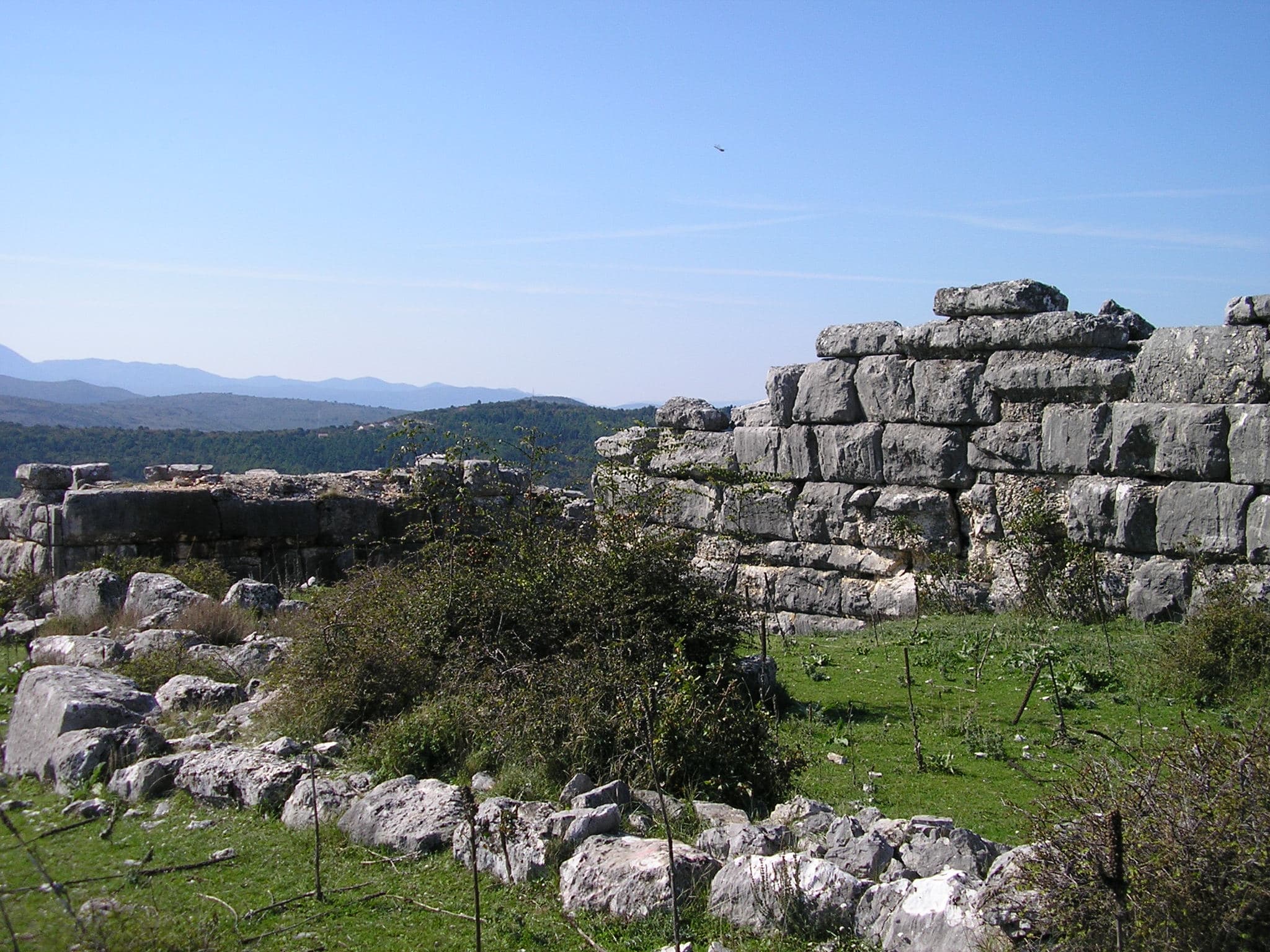
What they built still stands: cyclopean walls constructed from massive stone blocks without mortar, rising up to 7.5 meters high. This style of construction—often called Mycenaean after the famous Greek fortress—appears rarely outside the Aegean world. At Daorson, it marks an Illyrian people who absorbed Greek culture while maintaining their own identity. They adopted the Greek alphabet. They traded wine and ceramics. They minted coins bearing their name.
And on their acropolis, they raised temples to gods whose names we no longer know.
But Daorson holds more than archaeology. Greek mythology tells us that Cadmus, founder of Thebes, and his wife Harmonia traveled to Illyria in exile. There, they were transformed into serpents—a fate Cadmus himself had wished for. Their youngest son, Illyrius, became the mythical ancestor of the Illyrian peoples. At Daorson, archaeologists found a sculpture of Cadmus and Harmonia, decorated with thirteen serpents and five pairs of eagle's wings. The myth had become stone.
The Romans destroyed Daorson in the first century BCE during their campaigns against the Delmati. The site was never reoccupied. For two thousand years it waited, until rediscovery in 1891. Today it remains largely unexcavated, a National Monument of Bosnia and Herzegovina, a place where visitors walk among questions that have no answers.
Why this place is sacred
The veil thins at Daorson through the accumulation of what cannot be known. This is not a site where guides explain what happened here. It is not interpreted or staffed. The massive walls stand, and the questions they raise receive no official answers.
The first question is architectural. Why did the Daorsi build in the Mycenaean style? The technique—fitting massive irregular blocks without mortar—appears in Greece, in the walls of Mycenae and Tiryns, in sites associated with legendary kings. At Daorson, an Illyrian tribe adopted this method for their acropolis walls. The resemblance is unmistakable: blocks up to 4.2 meters wide, walls rising 7.5 meters high, the same irregular yet interlocking construction.
Whether they learned from Greek traders or inherited a shared tradition from deeper antiquity remains debated.
The second question is religious. The acropolis housed temples, but to which gods? The Daorsi adopted Greek language and alphabet, and the bronze helmet found here depicts Aphrodite, Nike, Helios, Dionysus, the Muses, and Pegasus. Yet Illyrian religion was not Greek religion. The two merged here into something neither fully one nor the other. The Cadmus and Harmonia sculpture—with its serpents and eagles—hints at a mythology that connected the Daorsi to Greek legendary tradition while marking them as distinctly Illyrian.
The third question is human. Who walked between these walls? What did they see when they climbed to the acropolis? What did they feel when they offered sacrifice or witnessed ceremony? These people minted coins, produced elaborate metalwork, and built walls meant to last millennia. Then they were conquered, dispersed, absorbed. The Daorsi vanished as a people. What remains is their architecture, their artifacts, and the silence of everything they did not write down.
This silence is Daorson's thinness. The place demands imagination because it offers no easy answers. The veil thins where meaning must be brought rather than received.
Daorson served as the capital of the Daorsi tribe from approximately 300-50 BCE. The acropolis—the fortified hilltop—housed administrative, public, and religious buildings. From this center, the Daorsi governed the Neretva River valley, controlled trade routes between the interior and the Adriatic coast, and maintained relations with Greek traders and, later, Roman authorities.
But Daorson's purpose extended beyond politics. The acropolis was sacred space. Archaeological evidence suggests temples where the Daorsi practiced a syncretic religion blending indigenous Illyrian traditions with elements borrowed from the Greeks. The bronze helmet with its parade of Greek deities indicates that these gods were honored here—perhaps alongside Illyrian divinities whose names have been lost. The Cadmus and Harmonia sculpture suggests that Illyrian origin mythology was not merely told but embodied in religious art.
Before the Daorsi, the site served another purpose. A Bronze Age fortified settlement occupied this hill from approximately 1700-800 BCE. We know almost nothing about these earlier inhabitants, but their choice of this location—strategic, defensible, overlooking fertile valleys—was inherited by the Daorsi. The hill held significance across cultures and centuries.
Daorson's evolution spans roughly 2,700 years from first settlement to final destruction.
The Bronze Age hill fort (c. 1700-800 BCE) represents the earliest known occupation. Archaeological evidence is limited, but the site appears to have been continuously or periodically inhabited for nearly a millennium before the historical Illyrian period.
The Daorsi settlement emerged around the 4th century BCE, when the cyclopean walls were constructed. This was the period of expansion and contact with the Greek world. The Daorsi adopted Greek cultural practices while developing their own urban center. The acropolis reached its peak between the 3rd and 2nd centuries BCE, when Daorson functioned as a major regional center.
A turning point came in 168/167 BCE, when Rome defeated the Illyrian kingdom and granted the Daorsi special status as Roman allies. This immunity allowed them to mint their own coins—a privilege that speaks to their importance. But Roman protection proved temporary.
The end came in the mid-1st century BCE during Roman wars against the Delmati, a neighboring Illyrian tribe. Daorson was destroyed in the fighting. Unlike other sites that rose again, Daorson was abandoned permanently. No Roman town replaced the Illyrian capital. The walls remained, weathering into the hillside.
Rediscovery came in 1891. Excavation began but was never completed—the site remains largely unexcavated today. It became a National Monument of Bosnia and Herzegovina and is now part of the Stolac cultural ensemble on UNESCO's Tentative List.
Experience and orientation
The road to Daorson begins in Stolac, a small town in southeastern Herzegovina known for its Ottoman heritage and proximity to medieval tombstones. From the town center, a gravel road winds uphill toward the village of Ošanići. The drive takes about twenty minutes, gaining elevation with each switchback. There are no signs to follow except at the initial turnoff. The road grows rougher. You pass farmhouses, goat pastures, fig trees.
Then the walls appear.
They rise from the hill's crest, massive blocks fitted together without mortar, weathered to gray-brown but unmistakably intentional. No fence surrounds them. No ticket booth guards the approach. You park where the road ends and walk the final distance on foot.
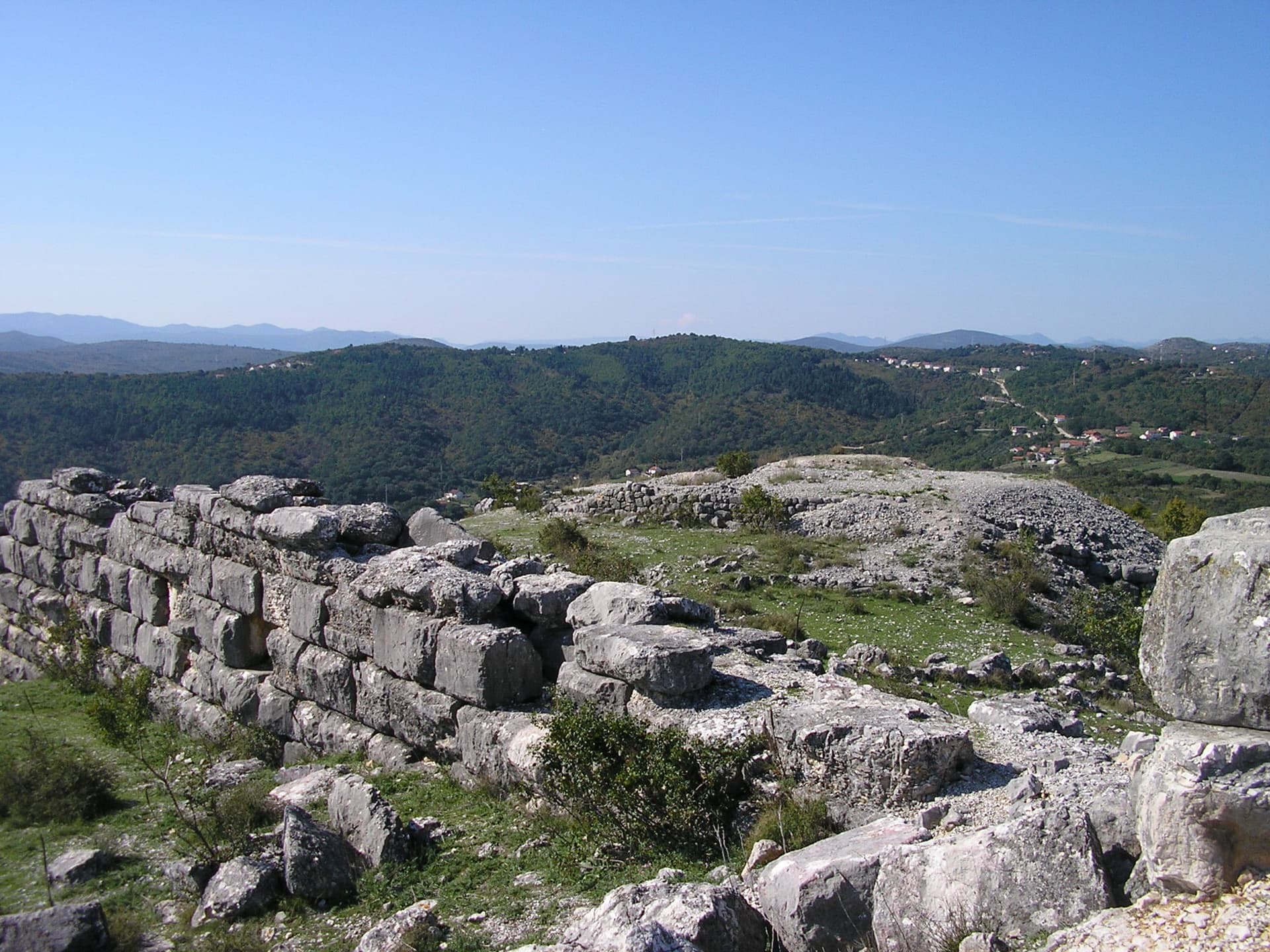
The first impression is scale. The defensive wall on the southeastern approach stretches 65 meters, rising up to 7.5 meters high in places. The blocks vary in size—some could fit in your arms, others would take machinery to move today. Yet they interlock with precision, each irregularity accommodated by the next stone. This is not rough rubble construction. This is architecture.
Beyond the wall, the acropolis opens into a broader area where buildings once stood. Foundations remain, but the superstructures have fallen or been taken. Here the Daorsi built their temples, their assembly halls, their seats of power. Today grass grows between the stones. Wildflowers mark the spring and summer seasons.
The views command attention. From the acropolis, the Neretva valley spreads in every direction—green river bottoms, terraced hillsides, the distant haze of mountains. On clear days, the panorama extends for kilometers. It is easy to understand why the Daorsi chose this place. It is easy to understand why they defended it.
Most visitors find themselves alone. Daorson is not a major tourist destination. The absence of interpretation—no plaques, no audio guides, no reconstructions—means the experience depends on what you bring. Those who have read about the Cadmus and Harmonia connection can imagine serpent-worship. Those who have studied Mycenaean architecture can trace parallels. Those who simply want to sit among ancient stones and watch the light change will find ample opportunity.
The site asks nothing but attention. It offers nothing but questions.
From Stolac, Daorson is approximately 5 kilometers by gravel road (20 minutes by car). No public transportation reaches the site. The road may be difficult in wet weather. Plan 1-2 hours at Daorson itself, more if you wish to explore thoroughly or sketch/photograph. Combine with the Radimlja necropolis (UNESCO World Heritage Site, 3km west of Stolac) and Stolac Old Town for a full day. Bring water—there are no facilities at the site.
Context and lineage
The origin mythology of the Illyrians—and by extension the Daorsi—comes from Greek sources. According to legend, Cadmus, the legendary founder of Thebes, and his wife Harmonia traveled to Illyria after suffering a series of tragedies in Greece. Their children had died or been driven mad. Seeking escape, they found the Encheleans, an Illyrian tribe under attack from neighbors.
An oracle had foretold that the Encheleans could only win if they made Cadmus their king. So they did. Cadmus led them to victory, ruled as king, and fathered a son named Illyrius. But the curse that had haunted Cadmus in Greece followed him. Eventually, he declared that if the gods so valued the life of a serpent, he would wish that life for himself. Immediately, he began to transform—scales spreading, legs fusing.
Harmonia embraced her changing husband and asked to share his fate. She too became a serpent. The couple was sent to Elysium.
Illyrius, their youngest son, became the progenitor of the Illyrian peoples.
At Daorson, archaeologists found a sculpture of Cadmus and Harmonia decorated with thirteen serpents and five pairs of eagle's wings. Whether this represents religious worship, ancestral commemoration, or artistic expression remains uncertain. But the presence of the sculpture confirms that the myth mattered here. The Daorsi understood themselves as connected to this legendary lineage.
The Daorsi were one of many Illyrian tribes who inhabited the western Balkans before Roman conquest. They occupied a strategic position in the Neretva River valley, controlling trade routes between the Adriatic coast and the interior. Their neighbors included the Delmati to the northwest and various other Illyrian peoples.
Following Roman conquest, the Illyrian tribal structures dissolved. The peoples of the region were absorbed into the Roman provincial system, eventually blending with later migrants—including the Slavic peoples who arrived in the 6th-7th centuries CE and whose descendants constitute the modern populations of Bosnia and Herzegovina.
No contemporary people claims direct descent from the Daorsi specifically. The Illyrians as a whole are considered ancestors of modern Albanians, whose language shows pre-Slavic Balkan roots. But the specific culture that built Daorson—its religion, its daily life, its language—did not survive as living tradition. What remains is archaeology: walls, coins, sculpture, the echo of a world that existed for a few centuries and then was gone.
Cadmus and Harmonia
Legendary figures from Greek mythology who, according to tradition, traveled to Illyria and were transformed into serpents. Their youngest son Illyrius was the mythical ancestor of the Illyrian peoples. A sculpture depicting them was found at Daorson.
The Daorsi
The Illyrian tribe who built and inhabited Daorson. They adopted Greek language and alphabet, minted their own coins after 168/167 BCE, and maintained trade relations with the Greek world while preserving Illyrian identity.
Praetor Vatinius
Roman military commander whose campaigns against the Delmati in the mid-1st century BCE resulted in the destruction of Daorson.
Traditions and practice
Archaeological evidence provides fragments of Daorsi religious practice, but the full picture remains elusive. The acropolis at Daorson included temple buildings, indicating organized worship. The bronze helmet found at the site—decorated with Aphrodite, Nike, Helios, Dionysus, the Muses, and Pegasus—suggests that Greek deities were honored here, either imported through trade contact or syncretized with Illyrian divinities.
The Cadmus and Harmonia sculpture offers another window. Its thirteen serpents and five pairs of eagle's wings combine symbols that may have held religious significance. The serpent was central to Illyrian origin mythology—Cadmus and Harmonia became serpents, and their son Illyrius founded the Illyrian peoples. Whether the Daorsi practiced serpent worship, venerated serpents as ancestral symbols, or used serpent imagery purely decoratively cannot be determined.
The site has also yielded evidence of skilled metalwork, ceramic production, and trade goods. Whether these activities had religious dimensions—as craft often did in the ancient world—is unknown. Burial practices of the Daorsi are not well documented at this site, though the nearby Radimlja necropolis shows medieval continuation of elaborate tomb traditions in this region.
No active ceremonial practices occur at Daorson. The Daorsi ceased to exist as a distinct cultural entity following Roman conquest, and no contemporary people claims religious connection to the site. It is managed as an archaeological monument, open to the public for secular exploration.
Visitors engage with Daorson through contemplative exploration rather than ceremonial practice. Walk the circuit of the walls slowly, observing how the massive blocks fit together. Consider the labor required—cutting, transporting, positioning stones without wheels or cranes. Sit within the acropolis where temples once stood and consider what might have been worshiped here.
The Cadmus and Harmonia mythology offers a framework for contemplation. Transformation is central to the story: the legendary couple becoming serpents, exile becoming founding, loss becoming origin. Those who come to Daorson in periods of personal transition may find resonance in these themes.
The views from the acropolis invite their own practice. Simply looking across the Neretva valley—tracing where the Daorsi's world extended, imagining the boats on the river, the traders arriving with Greek wine—constitutes a form of engagement with what was once alive here.
Daorsi Illyrian Religion
HistoricalThe Daorsi practiced a syncretic religion that blended indigenous Illyrian traditions with elements adopted from Greek culture through trade contact. The acropolis at Daorson housed temple buildings where this worship occurred. Archaeological finds—including a bronze helmet decorated with Greek deities and a sculpture of Cadmus and Harmonia with serpent imagery—suggest a pantheon that merged Illyrian and Hellenistic elements.
Religious ceremonies at the acropolis, worship of syncretic Greek-Illyrian deities, possible serpent veneration connected to Illyrian origin mythology, votive offerings, burial rituals. Specific details are not documented.
Bronze Age Hill Fort Tradition
HistoricalBefore the Daorsi developed their Hellenized settlement, the hill at Ošanići hosted a prehistoric fortified settlement from the early Bronze Age (c. 1700 BCE) through the late Bronze Age (c. 800 BCE). This thousand-year occupation preceded the historical Illyrian period by centuries, indicating that the site held significance across cultures and millennia.
Details unknown. Prehistoric hillfort practices typical of Balkan Bronze Age would have included fortification, domestic occupation, and likely some form of religious observance, but no specific evidence survives from Daorson's Bronze Age phase.
Perspectives and open questions
Daorson invites multiple readings: an archaeological site documenting Illyrian civilization, a monument to cultures lost to Roman expansion, a meditation on what cyclopean walls and serpent myths might mean. These perspectives need not be reconciled. The site holds all of them.
Scholarly perspective
Scholarly consensus recognizes Daorson as one of the best-preserved Illyrian settlements in the Balkans. Archaeological evidence confirms occupation from the Bronze Age (c. 1700 BCE) through the Hellenistic period, with the cyclopean walls dating to approximately the 4th century BCE. The Daorsi are documented in Greek and Roman sources as a significant tribe, granted special immunity by Rome in 168/167 BCE and permitted to mint their own coins.
The architectural comparison to Mycenae is well-established: the technique of fitting large irregular blocks without mortar appears in both locations and at a few other sites across the Mediterranean. Whether this represents cultural diffusion, shared prehistoric tradition, or independent development remains debated.
The site has been a National Monument of Bosnia and Herzegovina and is part of the Stolac cultural ensemble on UNESCO's Tentative List. However, archaeological excavation remains incomplete since initial discovery in 1891. Much of what lies beneath the surface is unknown.
Living and traditional perspectives
No contemporary people claims direct religious or ceremonial connection to Daorson. The Illyrians are considered ancestors of modern Albanians, whose language preserves pre-Slavic Balkan elements. But the specific culture of the Daorsi—their religion, their daily practices, their understanding of the world—did not survive Roman conquest and subsequent population movements.
The Cadmus and Harmonia mythology links the Illyrians to Greek legendary tradition, but this is Greek literature, not Illyrian self-expression. How the Daorsi understood their own origins, their relationship to these myths, and their place in the cosmos remains unknown.
Alternative interpretations
Some alternative archaeology sources present Daorson as evidence of a 'megalithic civilization' with mysterious knowledge, comparing it to sites like Stonehenge. These interpretations emphasize the mystery of cyclopean construction and suggest possible astronomical or energetic significance. Such claims exceed scholarly evidence. The comparison to Mycenae is architectural—the construction technique is shared—but does not imply spiritual connection.
The serpent symbolism found at Daorson has also attracted esoteric interpretation, connecting it to serpent-worship traditions documented or theorized across Mediterranean cultures. While serpent imagery certainly appears at the site, its meaning within Daorsi religious practice cannot be determined from available evidence.
Open questions
Significant mysteries persist. The exact religious practices of the Daorsi are not documented. The function of specific acropolis buildings remains unclear. The meaning of the serpent and eagle symbolism in the Cadmus and Harmonia sculpture is uncertain. Why the site was never reoccupied after Roman destruction raises questions. The relationship between Bronze Age and Hellenistic period occupation is poorly understood. The full extent of the settlement awaits excavation.
Plan your visit
Access and arrival
Limited guesthouse accommodations are available in Stolac. Mostar (30km north, approximately 40 minutes by car) offers a full range of hotels and is the most common base for visiting the region. Day trips from Mostar to Stolac, Daorson, and Radimlja are a popular itinerary.
Respectful visit
Comfortable outdoor attire with sturdy walking shoes. The site is reached via gravel road and involves walking on uneven ground with exposed stones. Sun protection is advisable in summer; rain gear in spring and autumn.
Photography is permitted throughout the site. Golden hour light (early morning or late afternoon) provides the best conditions for photographing the walls. The views from the acropolis are equally photogenic.
Not applicable. This is an archaeological site without active religious practice. Do not leave items at the site.
{"Do not remove any artifacts, stones, or materials from the site","Do not climb on walls or structures","Do not dig or probe the ground","Stay on established paths where possible to avoid erosion","Leave no trace—carry out all trash"}
Daorson is an unstaffed archaeological site, with no guides to prevent damage and no security against theft. The walls have survived 2,300 years; help them survive the next visitor.
Current practical details
Address
4W3G+JP9, Ošanjići, Bosnia and Herzegovina
Phone
Hours, fees, and access can change — verify on the official source before you travel. Practical details last checked Jun 2026.
Location
Map loads as you approach this section.
Pilgrim reflections
A portrait of encounter, not a score
Pilgrims describe what they felt, how present they could become, and whether the place would shape a journey. There are no stars and no ranking of traditions.
No reviewed reflections yet
The first pilgrims can help describe the character of being here.
Share a reflection
Available after an account-backed “Been there.” Every reflection is reviewed before publication.
Nearby sacred places
Explore other sacred places in the region. Proximity does not establish access or travel time; check each place’s guidance.
Daorson Illyrian City
Stolac, Herzegovina-Neretva, Bosnia and Herzegovina
0.1 km away

Radimlja Stećak Necropolis
Near Stolac, Near Stolac, Herzegovina-Neretva Canton, Bosnia and Herzegovina
1.3 km away

Boljuni Stećak Necropolis
Boljuni, Boljuni, Stolac Municipality, Herzegovina-Neretva Canton, Bosnia and Herzegovina
9.5 km away

Žitomislić Monastery
Žitomislići, Žitomislići, Mostar, Herzegovina-Neretva Canton, Bosnia and Herzegovina
15.5 km away
Share a photo
Help visitors recognize Daorson megalithic site, Bosnia. Every submission is reviewed before publication.