Cyzicus
Where the largest temple in the ancient world returns to silence
Understand sacred places, explore living traditions, and learn how to engage respectfully with Pilgrim Map.
Access has not been verified. Check current local guidance before planning a visit.
Balıkesir, Turkey
Read the sources
Visit essentials
A quick read before you go
- Duration
- 2–4 hours for a thorough walk of the main monument zones — temple area, amphitheatre, and…
- Access
- The ruins are located near the village of Belkıs, approximately 5–8 km west of Erdek on the…
Overview
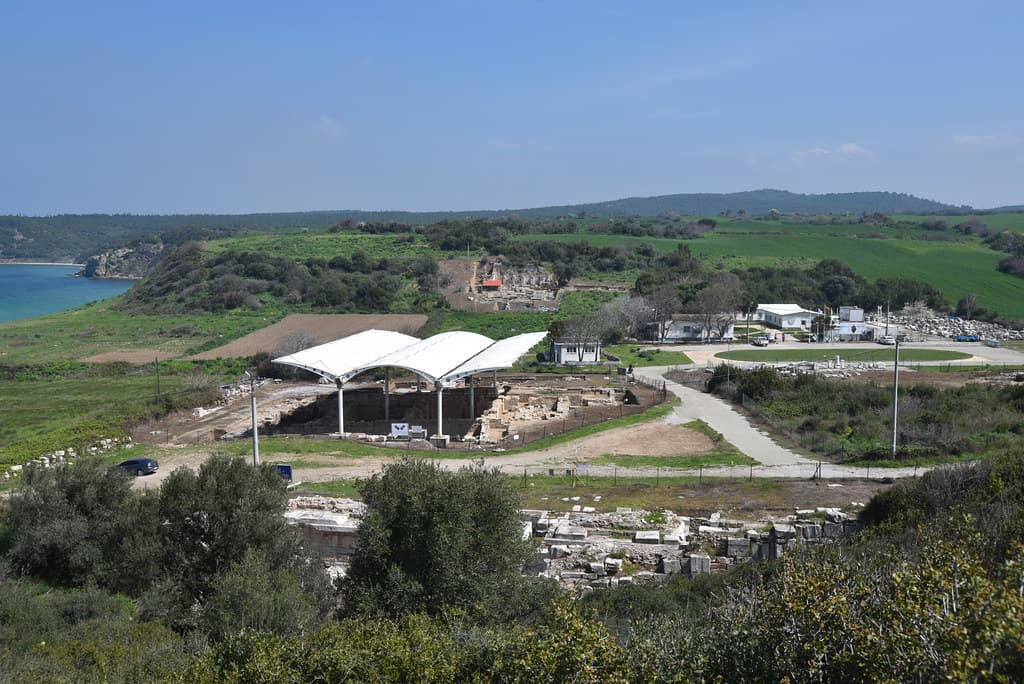
On the Kapıdağ Peninsula in the Sea of Marmara, ancient Cyzicus has returned from extraordinary religious prestige to near-silence. Once home to cults of Persephone, Demeter, and Apollonis, it later held a temple to Hadrian whose column drums still dwarf visitors. Those drums lie in fields; person-high Corinthian capitals sit half-buried in scrub; from nearby high ground the outline of an amphitheatre among the ancient world's largest remains legible; and bats inhabit the temple ruins.
Only birdsong and wind off the Propontis interrupt the quiet.
There is no fence, ticket booth, or audio guide. Encountering such evidence of sacred ambition in a place that has largely forgotten it gives slow-moving visitors rare contemplative intensity: the absence of heritage infrastructure forces an intimate reckoning with what was built and lost.
Why this place is sacred
The thinness of Cyzicus is of an unusual kind: not the thinness of a site where the sacred is still actively sought, but the thinness of a place where the accumulated weight of millennia of sacred striving is present in the very stones — enormous, uncollected, unarranged — and where no living tradition mediates between the visitor and that weight.
Cyzicus held neokoria, the Roman imperial honor of maintaining a temple to the emperor as god, a distinction that made it one of the foremost religious cities of the whole Roman East. Its Temple of Hadrian had the tallest columns ever raised in antiquity, its Corinthian capitals requiring four meters of stone to carve.
The city once hosted the Soteria and Koreia festivals for Persephone — here venerated as Soteira, the Saviour — and its athletes competed in the Hadrianeia games that carried the city's name across the Mediterranean world.
All of this striving toward the sacred, all of this accumulated offering and ceremony and architectural ambition, is now present mainly as mass and scale: the sheer size of the fallen pieces, the dimensions of the amphitheatre's sweep visible in the vegetation pattern, the depth of silence where the Hytos harbour once received pilgrims.
The myths that clung to the place add another register: Persephone herself, in the local tradition, shaped the island of Besbicus across the water to protect the city from Giants. A king, Cyzicus, was accidentally killed by heroes returning from their quest. The sacred history of this peninsula is old, layered, and largely unmourned.
The city was a major Hellenistic religious centre hosting multiple divine cults — primarily Persephone as Soteira and Demeter — and later received neokoria status through the Temple of Hadrian, making it one of the premier imperial sacred cities of Asia Minor.
From a Milesian Greek colony founding (8th–7th century BCE) through Hellenistic religious flourishing, Roman imperial cult elevation, and Byzantine Christian presence, the city was gradually abandoned during the medieval period. Its stone was systematically quarried by later inhabitants. What remains is now the subject of ongoing archaeological excavation since 2009 by Bandırma Onyedi Eylül University.
Experience and orientation
Cyzicus asks you to navigate without guidance. There is no marked path through the ruins, no reconstruction drawing posted at the entrance, no audio explanation of what the enormous stone cylinder lying in the field beside you once supported. You arrive knowing, or not knowing, and the site does not help you decide. This is its power.
The Temple of Hadrian, once considered a wonder of the ancient world, is now legible only in pieces: column drums over two meters in diameter scattered across an area the size of several city blocks; Corinthian capitals of a scale that makes their floral carving visible from ten meters away.
The amphitheatre — 155 by 180 meters, one of the largest in the ancient world — is present as an earthen oval visible in the terrain, its seating banks now grass, its entrances still traceable. Bat colonies have claimed the remaining vaulted spaces of the temple substructure, and at dusk the movement of bats through the temple zone is one of the site's genuine experiences.
The coastal location creates changing light: morning mist off the Propontis, afternoon clarity that makes the fallen stones read sharp against the sky. In recent years, a drop in sea level has exposed the ancient Hytos harbour, where ships once docked to bring pilgrims and merchants to this sacred city. Walk toward the water at low tide and the harbour outline becomes visible in the wetland margin — a detail that rewards attentive visitors and is easy to miss entirely.
The main ruins lie near the village of Belkıs, approximately 5–8 km west of Erdek on the Kapıdağ Peninsula. No formal site map is distributed. Bring water, wear layered clothing for the variable coastal weather, and plan for rough terrain. The most legible ruins — temple zone and amphitheatre outline — are accessible within a 30-minute walk from the village approach road.
Context and lineage
Greek mythological tradition attributed the city's name to Cyzicus, king of the Doliones, who was accidentally slain by the Argonauts during their return from a night expedition — a story that tied the city's founding to tragedy and misrecognition, the hero killed by his own guests. In another tradition, Persephone herself shaped the nearby island of Besbicus to shield the city from Giants, an act that anchored divine protection into the geography of the peninsula.
The historical founding is placed in the 8th to 7th century BCE as a colony from Miletus, with archaeological evidence supporting a mid-6th century BCE establishment on the peninsula's strategic position between the Aegean and the Black Sea.
The city evolved from a Milesian Greek colony into a powerful Hellenistic city, then into a Roman provincial centre of extraordinary religious prestige, then into a Byzantine town, and finally into a source of building stone for later Anatolian construction. The site has never been formally abandoned — it simply contracted until the medieval period ended active urban life on the peninsula.
Traditions and practice
The city's religious calendar was substantial. The Soteria and Koreia festivals honoured Persephone as Soteira — the Saviour — with processions, sacrificial rites, and celebratory games. The Pherephattia festival formed part of the same cycle. When the city gained neokoria under Hadrian, the Hadrianeia athletic games added an imperial dimension to the festive calendar, making Cyzicus a destination for athletes and pilgrims from across the Mediterranean.
Sacrificial offerings were made at the temple of Persephone, at the temple of Demeter, at the sanctuary of Apollonis of Cyzicus (the Attalid queen deified by her sons), and eventually at the vast Temple of Hadrian — whose dedication ceremonies upon completion in 139 CE would have been among the most spectacular religious events in the Roman East.
No religious community currently practises at the site. The active engagement at Cyzicus is archaeological: ongoing excavation campaigns directed by Bandırma Onyedi Eylül University continue to reveal the scale and complexity of the ancient city, with recent work on the Hadrian Temple's columns shedding light on Roman artistic and theological programs. The site has been proposed for UNESCO Tentative List nomination.
Come without an agenda for 'seeing' particular monuments. Instead, choose a direction from the village approach road and walk until a fragment stops you. Sit with the scale of a fallen column drum — measure it against your own body, notice what it tells you about the ambition of what was built here. Move toward the amphitheatre from above where the earthen oval is legible in the grass.
At dusk, wait near the remaining vaulted arches of the temple substructure and watch the bats emerge. If sea conditions have lowered the water level, walk to the coastal margin and look for the harbour outline in the wetland. Bring binoculars for both the architectural details and the coastal birdlife. The site rewards the visitor who is willing to see ruins as evidence of magnitude rather than disappointment at incompleteness.
Greek Polytheism
HistoricalCyzicus hosted several major divine cults: Persephone venerated as Soteira (Saviour), Demeter, and Apollonis of Cyzicus — the Attalid queen deified by her sons Eumenes and Attalus. These cults gave the city substantial religious prestige and attracted pilgrims and athletes from across the Aegean world.
Soteria, Koreia, and Pherephattia festivals; sacrificial rites; votive offerings at multiple temple complexes
Roman Imperial Religion
HistoricalCyzicus received neokoria from Hadrian, making it one of the officially designated imperial cult cities of the Roman East. The Temple of Hadrian, completed in 139 CE, was the largest Roman temple ever constructed, with the tallest columns in antiquity. The city hosted the Hadrianeia athletic games and was a centre of imperial religious ideology.
Imperial cult sacrifice; Hadrianeia athletic and religious games; public festivals and processions
Archaeological Scholarship
ActiveOngoing excavations since 2009 are progressively revealing the scale and complexity of ancient Cyzicus, contributing significantly to understanding of Hellenistic and Roman urbanism in the Propontis region.
Annual excavation campaigns; architectural and epigraphic documentation; UNESCO Tentative List nomination preparation
Perspectives and open questions
Cyzicus can be read as a monument to imperial hubris, as a window into Hellenistic goddess religion, or simply as a landscape that has compressed three thousand years of sacred ambition into a field of fallen stone.
Scholarly perspective
Archaeological consensus identifies Cyzicus as one of the most important Greek and Roman cities of the Propontis. Its Temple of Hadrian was the largest sacred structure in the Roman Empire by column height — columns of 21.35 meters, Corinthian capitals reaching four meters, the overall structure likely surpassing even the Temple of Artemis at Ephesus in scale.
Ongoing excavations (Bandırma Onyedi Eylül University, begun 2009) continue to reveal previously unknown dimensions of the ancient city, including harbour infrastructure exposed by recent sea-level change. Recent (2024–2025) work on the temple's sculptural program is clarifying the theological content of imperial apotheosis at this site.
Living and traditional perspectives
No surviving indigenous religious tradition claims Cyzicus. The site's Greek cults — particularly the veneration of Persephone as Soteira — have no living descendants in the region. Turkish villagers around Belkıs have historically used the site's stone as building material, a practice common across Anatolia that reflects a pragmatic relationship with the ancient past rather than hostile erasure.
Alternative interpretations
Some researchers have noted the possible astronomical orientation of the Hadrian Temple in connection with imperial apotheosis theology — the alignment of cult spaces with celestial phenomena as a means of enacting the emperor's passage to divinity. No formal archaeoastronomical study has been published, and this remains speculative.
Open questions
Approximately 90% of ancient Cyzicus remains unexcavated. The location of the city's main archive, the full extent of the pre-Hellenistic sanctuary complex, the layout of the harbour and its sacred processional approaches, and the relationship between the city's multiple divine cults are all substantially unknown. The sacred geography of the peninsula before Greek colonisation has not been investigated.
Plan your visit
Access and arrival
The ruins are located near the village of Belkıs, approximately 5–8 km west of Erdek on the Kapıdağ Peninsula, Balıkesir Province. From Bandırma (the ferry terminal for Istanbul–Bandırma crossings), drive or take a bus to Erdek (c. 30 km), then taxi or car to Belkıs. No direct public transport to the site. Free entry as of 2026.
Erdek (7–8 km east) offers the nearest accommodation — modest hotels and pensions, more plentiful in summer when the peninsula attracts Turkish domestic tourism. Bandırma (c. 30 km) has a wider range of options and better transport connections.
Respectful visit
No religious dress requirements. Practical footwear for uneven terrain is essential. Layered clothing for the coastal microclimate.
Photography is permitted throughout the open site.
Not applicable. There is no active religious community here.
Respect all fencing around active excavation areas. Do not remove stones, potsherds, or architectural fragments of any size. Do not attempt to climb unstable masonry.
Active excavation areas are marked and must not be disturbed or entered. The terrain is uneven; ankle support is recommended. There is no shade infrastructure — sun exposure in summer is significant. Carry sufficient water. Do not remove any fragments, however small they appear.
Location
Map loads as you approach this section.
Pilgrim reflections
A portrait of encounter, not a score
Pilgrims describe what they felt, how present they could become, and whether the place would shape a journey. There are no stars and no ranking of traditions.
No reviewed reflections yet
The first pilgrims can help describe the character of being here.
Share a reflection
Available after an account-backed “Been there.” Every reflection is reviewed before publication.
Nearby sacred places
Explore other sacred places in the region. Proximity does not establish access or travel time; check each place’s guidance.
References
Sources consulted for this page. Source categories describe the publication, not a guarantee that every claim is verified. Traditional accounts and outside interpretations may differ.
- 01Cyzicus | Turkish Archaeological News — Turkish Archaeological NewsacademicSpecialist archaeology news site covering ongoing excavations
- 02Kyzikos: An Ancient City on the Kapıdağ Peninsula in Türkiye — Ancient History SitesacademicDetailed historical and archaeological summary
- 03Cyzicus - Wikipedia — Wikipedia contributorsencyclopediaGood overview of history and monuments
- 04Ancient city of Cyzicus in Turkey eyes UNESCO nomination — Daily SabahSource contextReports on UNESCO Tentative List aspirations
- 05Columns of Türkiye's Cyzicus Hadrian Temple shed light on Roman art, faith — Türkiye TodaySource contextRecent (2024–2025) excavation findings on Hadrian Temple columns
- 06The Temple of Hadrian at Cyzicus was the Largest Built in Antiquity — La Brújula VerdeSource contextDetailed treatment of the Hadrian Temple's architectural superlatives
- 07Cyzicus (Kyzikos): Exploring an Archaeological Site in Turkey — Nomadic NikoguideVisitor guide with practical access information
- 08Cyzicus – following hadrian photography — Following HadrianblogPhotographic documentation and brief historical notes
Share a photo
Help visitors recognize Cyzicus. Every submission is reviewed before publication.