Parion
Threshold city of the Hellespont, where Praxiteles' Eros guarded the crossing between Europe and Asia
Understand sacred places, explore living traditions, and learn how to engage respectfully with Pilgrim Map.
Access has not been verified. Check current local guidance before planning a visit.
Çanakkale, Turkey
Read the sources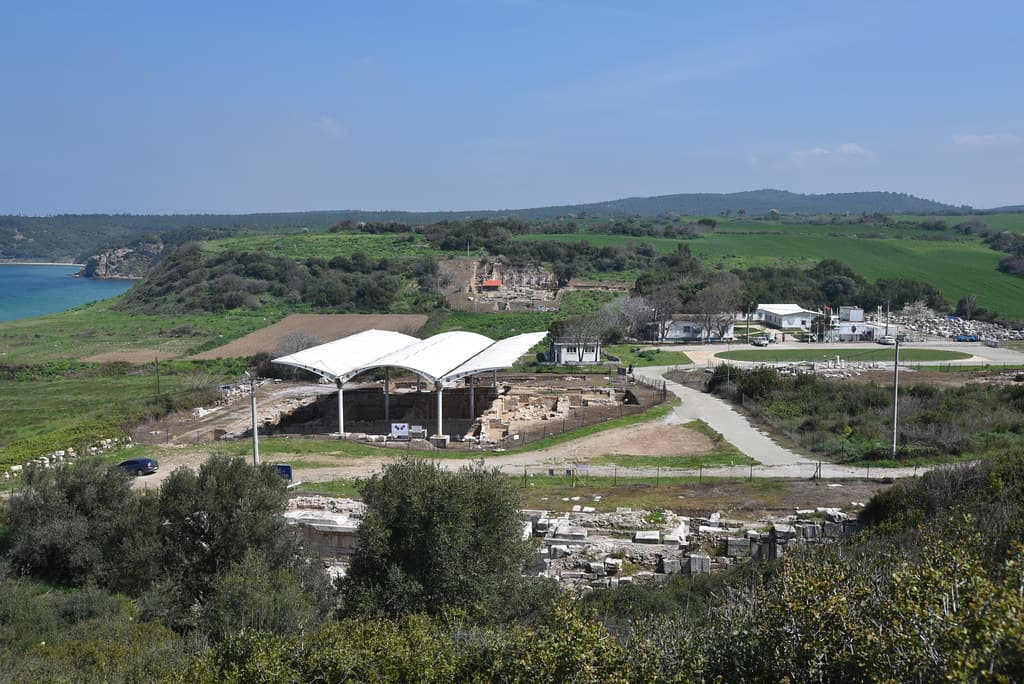
Visit essentials
A quick read before you go
- Duration
- 2–3 hours for a thorough exploration of the necropolis, theater area, and coastal margin.
- Access
- Located in Kemer village, Biga municipality, Çanakkale Province, on the Marmara Sea coast.
Overview
The Hellespont and Propontis—the narrow straits linking Europe and Asia—were understood in antiquity as the world's seam, where continents met and cultural identities became porous. Parion controlled the main Propontic crossing and served as the customs point through which goods and people from Greece and the Aegean entered Asia Minor.
Praxiteles, the Athenian master sculptor of the 4th century BCE, created for Parion a cult statue of Eros that became the city's preeminent sacred image and was copied across the Greek world. Ancient writers locate copies from Cyprus to the far reaches of the Hellenistic sphere. The statue is gone—no physical trace has yet been excavated—but its influence persisted in Mediterranean marble and bronze for centuries.
The crossing-point city's choice of the god of desire and sacred love carried meaning. In the Platonic tradition current in 4th-century BCE Parion, Eros was not mere romantic sentiment but the force drawing the soul toward its proper home, the divine form of beauty. At a threshold between continents, this gave crossing sacred significance beyond commerce and migration.
Remote, undeveloped, and demanding effort to reach, Parion offers an excavation in progress, sarcophagi and theater ruins above the Marmara, and the atmosphere of a geographic threshold that retains its ancient charge.
Why this place is sacred
Parion's sacred significance was inseparable from its geography. The Propontis crossing — the same narrow water that Xerxes bridged with ships, the same threshold that separates Europe from Asia — was not merely strategic but cosmological in ancient understanding. Threshold positions in the ancient world consistently attracted sacred investment: the point where categories meet, where identity becomes uncertain, where one thing ends and another begins, was the point where divine presence was most felt.
The choice of Eros as Parion's primary cult image deepens this reading. In its most philosophical form — the form available to Hellenistic educated people who had encountered Plato — Eros was the divine force that draws the soul toward beauty, ultimately toward the Form of Beauty itself, and therefore toward the divine.
To place such a figure at a geographical threshold between continents was to map the city's sacred identity onto the soul's journey: crossing here, arriving here, was not just a transit but a potential encounter with the divine through the form of beauty.
The Dionysiac votive finds — the bronze amphora depicting the god's ecstatic procession, dated to 2,400 years ago — add an ecstatic dimension to the more Platonic Eros. Dionysus moves through boundaries as readily as he moves through the boundary of the self; his presence at a threshold city is natural and resonant.
The necropolis, stretching across the coastal plain in elaborate sarcophagi fields, extends the threshold theme into death — Parion as a place where the living and the dead were always in proximity, always at the edge of passage.
Greek colonial harbor city at a primary Propontic crossing; customs and trade hub; center of Eros and Dionysus cult
Founded 709 BCE by Parian and Eretrian colonists; grew as a Propontic customs and trade hub; sacred image of Eros by Praxiteles established 4th century BCE; Roman city with theater, baths, and agora; Byzantine continuation; medieval/Ottoman abandonment; modern village of Kemer; systematic excavations since 2005
Experience and orientation
Parion requires preparation and willingness. There is no visitor center, no restaurant, no hotel within the village of Kemer, no signage along the road. The journey from Çanakkale — over an hour by car, through Biga and then to the coast — is long enough to constitute its own form of approach, a separation from the more-visited Aegean world.
The site announces itself through its necropolis. The sarcophagi fields — elaborately carved stone coffins lying in rows and clusters across the coastal terrain — are the most immediately visible element of Parion's ancient life. Do not pass through them quickly.
Stand among them and notice the scale: these were wealthy people, or their families had means, and the money spent on stone preservation speaks to how seriously death and the body's persistence were taken in this city at the threshold. The 'princess of Parion' — an elaborately decorated sarcophagus now in a museum — was found in this ground.
The Roman theater, its cavea partially excavated and visible, faces the Marmara. From the upper seating rows the sea is present as context, not merely background — the same water Parian and Eretrian colonists crossed in 709 BCE to found this city. In clear weather, the European shore is visible across the straits.
The site's ongoing excavation — annual campaigns by Ondokuz Mayıs University — is frequently visible in the active trenches and equipment. Walking at a respectful distance from active work, you can observe the process by which a city is recovered from soil: the careful removal, the trowel-pace that contrasts with the human-scale drama of what is being found.
The absence of the Praxiteles Eros — not yet located, perhaps never to be found — creates a specific quality of seeking. You are standing where it stood, in a city whose primary sacred image was the god of love, in a place defined by threshold and passage. That the statue is gone makes its presence more felt, not less.
Arrive with food, water, and fuel — Kemer village has none of these available reliably. Park where the road ends near the site. The necropolis is immediately visible; walk through it toward the theater area. The site is not formally marked or gated. Active excavation trenches are cordoned; stay outside them. Allow 2–3 hours minimum.
Context and lineage
Parion was founded in 709 BCE by Greek colonists from the island of Paros and from Eretria on Euboea; some accounts also include Milesian settlers. The site was chosen for its position on the Propontis — the Sea of Marmara — at one of the principal crossing points between Europe and Asia, making it immediately valuable for customs collection and trade facilitation.
The city's name is connected in ancient tradition either to Paris, son of the Trojan king Priam (giving Parion a mythological connection to the adjacent Trojan war landscape), or to the island of Paros, whose marble-working culture the colonists carried with them. The Parian connection to fine stone sculpture may have set a cultural context for the city's later choice of the master sculptor Praxiteles to create its primary cult image.
Praxiteles worked in Athens in the 4th century BCE and was considered the greatest Greek sculptor of his generation. His cult statue of Eros for Parion was celebrated enough to generate copies across the Greek world; an unnoticed copy was recently identified on Cyprus at Salamis. The statue gave Parion a sacred reputation that extended far beyond its commercial and strategic importance.
Parian-Eretrian Greek colonial; Propontic Greek city-state; Hellenistic cultural center; Roman provincial city; Byzantine continuation; post-Byzantine abandonment; modern Kemer village adjacent
Praxiteles
Athenian sculptor; creator of the celebrated Eros cult statue
Hegesias and Euphranor
Other sculptors with works attested at Parion
Prof. Dr. Vedat Keleş
Lead excavator, Ondokuz Mayıs University
Traditions and practice
The Eros sanctuary at Parion was the city's most prestigious sacred space — the location of Praxiteles' cult statue, which drew visitors from across the Greek world. Worship at the Eros sanctuary would have combined civic religious practice with the more personal and philosophical dimensions of Eros devotion: the god who drew the soul toward beauty and the divine was not only a figure of romantic sentiment but a metaphysical principle in the Platonic tradition current in Hellenistic educated culture.
The Dionysiac tradition evidenced by the 2,400-year-old bronze amphora — depicting the god's procession with its characteristic ecstatic participants — points to a second mode of sacred practice at Parion: not the contemplative pull toward beauty but the dissolution of boundaries in collective ecstatic ritual.
Dionysus at a threshold city makes structural sense: the god who crosses the boundary between sober and ecstatic, between self and other, between life and whatever lies beyond it, was at home in a place defined by geographic threshold.
The elaborate necropoleis — multiple periods of burial, sarcophagi of significant craft and expense, the 'princess of Parion' burial among them — document the city's sustained investment in funerary practice and the preservation of the dead.
No active religious ceremonies. Annual archaeological excavation season. The 'princess of Parion' sarcophagus and the bronze Dionysiac amphora are held in regional museums.
Begin with the sarcophagus fields before doing anything else. Move among the stone coffins slowly — not as objects to be photographed but as the physical remains of a specific attitude toward death and persistence. Notice the workmanship; notice what the investment implies about how seriously this community took the threshold of death. Then find the theater and sit facing the Marmara. Let the water carry your attention toward the European shore visible in clear weather.
You are at the crossing point that shaped the city's entire sacred meaning — the place Xerxes bridged, the place where east and west met in trade, in desire, in the shadow of Praxiteles' Eros. The statue is not here, but the question of where it stood, and what it meant to see it in this threshold city, is alive in the site's atmosphere.
Return to the necropolis in the afternoon, when the low coastal light changes the quality of the stone.
Ancient Greek Polytheism — Eros Cult of Praxiteles
HistoricalParion was home to the most celebrated Eros cult in the ancient Greek world, centered on a cult statue by Praxiteles so admired that its copies were sought from Cyprus to the far corners of the Hellenistic sphere. The statue made Parion a pilgrimage destination for those drawn to sacred love and divine beauty.
Eros sanctuary worship; votive offerings; the statue served as both civic protector and theological statement about the soul's orientation toward beauty
Ancient Greek Polytheism — Dionysiac Cult
HistoricalA 2,400-year-old bronze amphora depicting Dionysus's ecstatic procession attests an active Dionysiac cult at Parion, adding an ecstatic and boundary-dissolving dimension to the city's sacred life alongside the more Platonic Eros tradition.
Dionysiac procession rituals; collective ecstatic cult; funerary associations with Dionysiac imagery
Archaeological Heritage
ActiveParion is a major ongoing excavation by Ondokuz Mayıs University, with 19+ years of annual campaigns. The 2024 underwater confirmation of a second harbor and ongoing discoveries in the theater, agora, and necropolis areas continue to expand knowledge of this understudied Propontic city.
Annual excavation seasons; geophysical survey; underwater archaeological survey; annual academic publication of results
Perspectives and open questions
Parion has been read by archaeologists, historians of Greek religion, and those interested in the philosophy of Eros — each finding a different dimension of a city whose primary identity was shaped by threshold geography and sacred love.
Scholarly perspective
Academic scholarship on Parion focuses on three areas. First, the ongoing excavation program since 2005 has progressively revealed the Roman-period city plan — theater, baths, agora, necropoleis — and in 2024 confirmed a second harbor through underwater survey, establishing Parion as a dual-harbor maritime hub.
Second, the Praxiteles Eros cult statue is a significant problem in the history of ancient sculpture: the original has not been found, but identified copies — including a recently noted one at Salamis on Cyprus — allow reconstruction of the statue's influence if not its form. Third, the city's role as a Propontic customs hub is documented in ancient sources including Strabo, who notes the city's strategic position and wealth.
Living and traditional perspectives
The connection between Parion and Paris of Troy, preserved in the city's founding tradition, links the site to the Trojan War mythological landscape that saturates the entire Troad region. Whether or not the etymology is historical, it embedded Parion in the same sacred geography as Troy — a landscape where love (Paris and Helen), war, and divine intervention converged. The Parian foundation story, by contrast, connects the city to the marble-working and artistic culture of the Cyclades.
Alternative interpretations
The Praxiteles Eros at Parion has been read by those interested in Platonic philosophy as a rare instance where civic cult and philosophical theology genuinely converged. In Plato's Symposium, Eros is described not as a god but as a daemon — a figure between the human and divine who pulls the soul toward beauty and ultimately toward the Form of Beauty itself.
A Praxitelean cult statue of Eros placed at a geographic threshold between two continents, in a city whose name was connected to desire (Paris/Eros) and to marble sculpture, can be read as a philosophical statement made in stone and geography simultaneously.
Open questions
No physical trace of the Praxiteles Eros or its sanctuary has been excavated; its location within the city, its dimensions, and its material are unknown. The full extent of the underwater harbor complex is still being mapped. The precise relationship between the Eros cult at Parion and the adjacent Priapus cult at Lampsakos — two threshold cities with adjacent erotic deity cults — has not been studied in depth.
Plan your visit
Access and arrival
Located in Kemer village, Biga municipality, Çanakkale Province, on the Marmara Sea coast. From Çanakkale: approximately 70 km southeast via Lapseki or via Biga. Allow 1–1.5 hours by car. No bus service to Kemer; taxi from Biga (approx. 30 km) is the most practical public transport option. No accommodation in Kemer — stay in Lapseki (west on the Marmara coast), Biga (30 km inland), or Çanakkale (70 km).
No restaurants or shops in Kemer — stock up on food and water before arrival. Mobile phone signal: unreliable in Kemer; bring a charged phone and download offline maps before the journey. Emergency services: nearest is Biga district center (30 km).
Lapseki (approx. 40 km west by coastal road) has basic hotels. Biga (30 km inland) has standard Turkish town accommodation. Çanakkale (70 km) provides the broadest range of options and serves as the most convenient base for visiting both Parion and the Troad region. No information was available at time of writing about accommodation specifically in Kemer village; check current options before arrival.
Respectful visit
No specific requirements. Practical outdoor clothing; sturdy shoes for uneven terrain.
Generally permitted; ask at the necropolis specifically, as some areas may have restrictions in connection with excavation work. Approach excavation directors or team members on site if uncertain.
None associated with the site's current state.
Necropolis entrance officially marked as dangerous in some areas — respect posted signage. Active excavation cordons must not be crossed. Do not disturb or remove any material from the surface or excavated areas. No facilities on site — do not expect to find water, restrooms, or shade structures.
The necropolis entrance is officially marked as dangerous and prohibited in some areas — follow posted restrictions. No accommodation, food, or water in Kemer village — come fully provisioned. No mobile signal may be available at the site; the nearest reliable services are in Biga or Lapseki. Carry a paper map. The coastal terrain can be uneven and is not maintained for visitors.
Location
Map loads as you approach this section.
Pilgrim reflections
A portrait of encounter, not a score
Pilgrims describe what they felt, how present they could become, and whether the place would shape a journey. There are no stars and no ranking of traditions.
No reviewed reflections yet
The first pilgrims can help describe the character of being here.
Share a reflection
Available after an account-backed “Been there.” Every reflection is reviewed before publication.
Nearby sacred places
Explore other sacred places in the region. Proximity does not establish access or travel time; check each place’s guidance.


References
Sources consulted for this page. Source categories describe the publication, not a guarantee that every claim is verified. Traditional accounts and outside interpretations may differ.
- 01Parion (Kemer) | Turkish Archaeological NewsacademicExcavation news and archaeological summary
- 0219 Years Left Behind in the Discovery of the Archaeological Heritage of the Ancient City of Parion — OMÜ — Ondokuz Mayıs UniversityacademicOfficial excavation summary by lead archaeologist Prof. Dr. Vedat Keleş
- 03An Unnoticed Copy of Praxiteles' Eros at Parion From Salamis on CyprusacademicPraxiteles Eros cult statue at Parion and its copies
- 04Parium - Wikipedia — Wikipedia contributorsencyclopediaGeneral history, geography, religious cults
- 05Unraveling the Secrets of Parion: An Ancient Greek City on the Hellespont — Greek Reporter — Greek ReporterSource context2025 summary of recent discoveries
- 06Parion (Parium) Ancient City – Biga, Çanakkale — Ancient Routes TurkeyguideVisitor guide and site description
- 07Parium Ancient City — ArticHaeology — ArticHaeologySource contextHistory and religious cults overview
- 08Roman Military Harbor Discovered in Ancient Port City of Parion, Turkey — Ancient Origins — Ancient OriginsSource context2024 underwater harbor discovery
Share a photo
Help visitors recognize Parion. Every submission is reviewed before publication.