Church of the Virgin Mary, Daqadus, Egypt
Where the Holy Family rested on Egypt's sacred trail, a village named for the Mother of God
Understand sacred places, explore living traditions, and learn how to engage respectfully with Pilgrim Map.
Access has not been verified. Check current local guidance before planning a visit.
Mit Ghamr City, Dakahlia, Egypt
Read the sources
Visit essentials
A quick read before you go
- Duration
- 1-2 hours for a typical visit including the church, icons, and holy well.
- Access
- Daqadus lies adjacent to Mit Ghamr, separated only by the railway line.
Overview
The Church of the Virgin Mary in Daqadus stands where Coptic tradition says Jesus, Mary, and Joseph rested for several days while fleeing Herod's persecution. The village name derives from the Greek Theotokos, “Mother of God,” preserving its ancient Christian identity.
Built in 1881 as a three-sanctuary basilica, the present church occupies the site of earlier churches documented since the 12th century. A holy well from which the Holy Family reportedly drank still draws pilgrims seeking baraka, spiritual blessing carried through physical things touched by the sacred: ground where Christ's feet touched Egyptian soil and that presence continues in prayer.
Daqadus also produced Pope Michael V, the 71st Coptic Patriarch, and Muhammad Metwalli al-Sha'rawi, one of Egypt's most beloved Islamic scholars. Their dual heritage expresses a concentrated spiritual significance crossing religious boundaries.
Why this place is sacred
The thinness of Daqadus resides first in its name. When a place is called Theotokos, named after the Mother of God herself, the sacred is woven into every utterance of that place. Each time villagers speak their home's name, they invoke Mary's divine motherhood. This linguistic sanctity is reinforced by the tradition that the Holy Family rested here for several days, the infant Jesus blessing the land with his presence and the waters of a well with his thirst.
The well creates a tangible point of connection. Pilgrims do not merely remember the Holy Family here; they drink from the same source, receiving baraka through the same waters. This physical continuity across two millennia collapses the distance between biblical event and present devotion. The church, rebuilt repeatedly on the same consecrated ground, maintains spatial continuity even as structures change.
Daqadus is one point on the Holy Family Trail, a network of sites across Egypt marking the family's journey. Pilgrims who travel this route walk in the footsteps of the infant Christ, and at each stop, the boundaries between present and sacred past grow thin.
The site was venerated as a resting place of the Holy Family, a location sanctified by the physical presence of Christ in his infancy.
From a humble stopping point on the Holy Family's journey, the site developed into a parish church with continuous worship. The current 1881 church represents the latest in a succession of churches documented since the 12th century. Recognition by the Vatican in 2017 and UNESCO in 2022 has brought renewed attention to this ancient pilgrimage site.
Experience and orientation
Approaching Daqadus from Mit Ghamr, the village appears as a typical Delta settlement. The church rises amid residential streets, its cross marking a community that has maintained Christian worship for centuries despite surrounding changes. This is not a museum or archaeological site but an active parish, and visitors enter as guests of a living community.
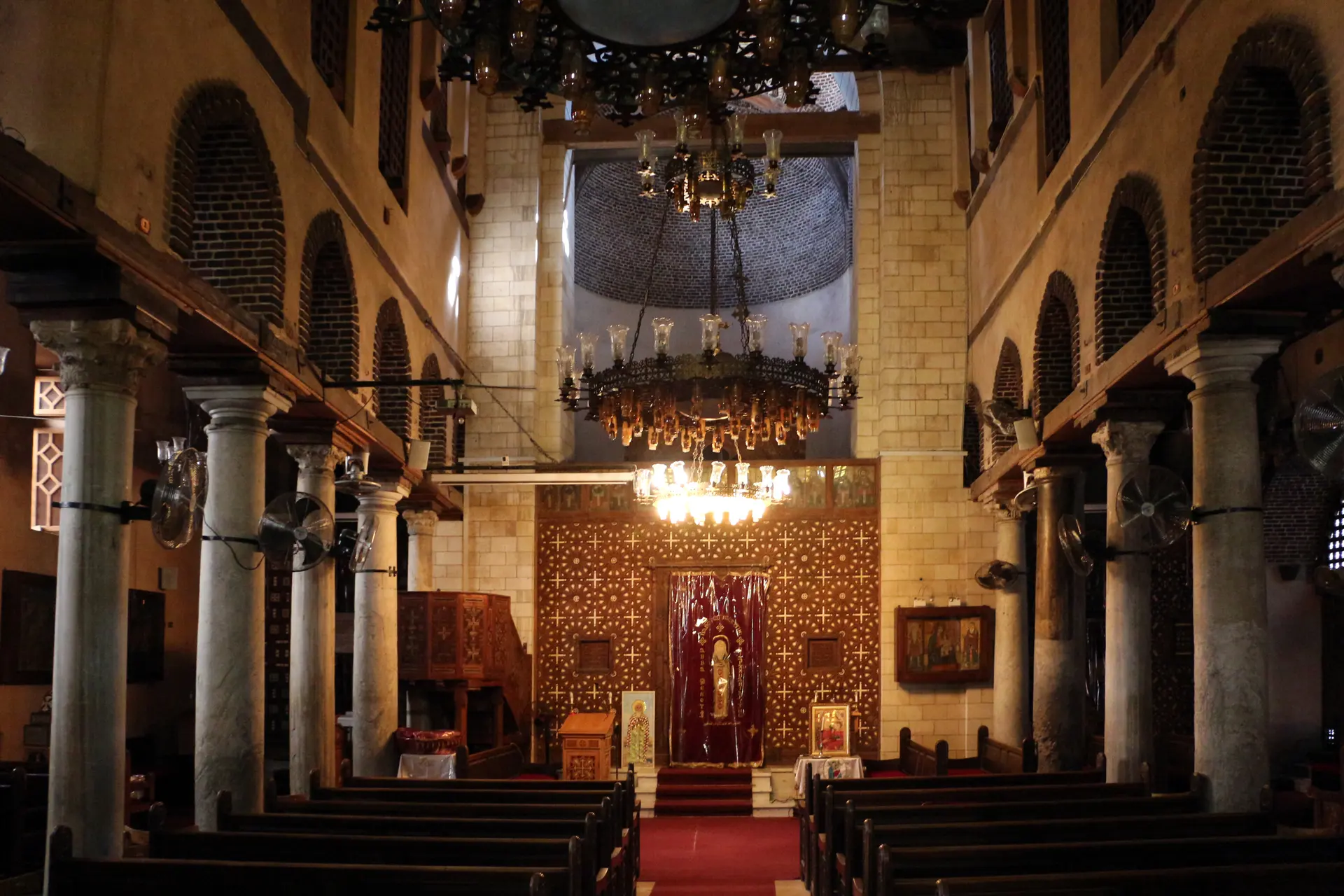
Inside, the basilica-style church opens into three sanctuaries, the central one dedicated to Saint Mark. Icons depicting the Holy Family's flight adorn the walls. The atmosphere is one of accumulated prayer. Generations of faithful have knelt here, lit candles here, sought the Virgin's intercession here. Their devotion has shaped the very air of the space.
The holy well offers a moment of physical encounter with tradition. To drink from waters blessed by the Holy Family's presence, to receive this baraka in your body, creates an experience that transcends intellectual understanding. The water becomes a sacrament of continuity, linking the pilgrim to the infant Christ who drank from this same source.
During the annual mawlid in August, the church transforms. Pilgrims gather, liturgies intensify, and the community celebrates its connection to Mary with particular fervor. At these times, the collective faith of the congregation creates an atmosphere of palpable devotion.
The church lies in Daqadus village, separated from Mit Ghamr only by the railway line. Visitors typically arrive by road from Cairo or other Delta cities. The church welcomes visitors, though this is primarily a parish serving local worshippers rather than a major pilgrimage destination. Dress modestly, as you are entering an active place of worship.
Context and lineage
According to Coptic tradition, the Holy Family fled from Bethlehem to Egypt to escape King Herod's Massacre of the Innocents. After passing through Mostorod, Belbeis, and Zagazig, they arrived at Daqadus. Here they rested for several days before crossing the Nile to Samannoud, where the local population received them with kindness and hospitality. The well from which they drank became blessed, and pilgrims continue to seek its baraka to this day.
The church belongs to the Coptic Orthodox Patriarchate of Alexandria, within the Diocese of Dakahlia. The site is recognized as part of the Holy Family Trail by both the Vatican (2017) and UNESCO (2022).
Pope Michael V
The 71st Coptic Patriarch (1145-1146 CE), born in Daqadus
Pope Cyril IV
The 'Father of Reform' (1853-1862 CE)
Muhammad Metwalli al-Sha'rawi
Islamic scholar (1911-1998 CE), born in Daqadus
Traditions and practice
The Divine Liturgy, following the Alexandrian Rite of Saint Basil or Saint Gregory, forms the center of worship life. Services are conducted in Coptic and Arabic, lasting two to three hours on Sundays and feast days. The annual mawlid of the Virgin Mary in August brings special services, processions, and communal celebration. The Feast of the Assumption (August 7-22), preceded by fifteen days of fasting, is observed with particular devotion.
Pilgrims visiting as part of the Holy Family Trail can receive water from the holy well blessed by the family's presence. Candles may be lit as prayers. The church participates in the broader Coptic liturgical calendar, celebrating all major feasts. Some visitors come specifically during the August festivities for the most intense spiritual atmosphere.
Visit on a Sunday morning to observe the Divine Liturgy and experience the parish in worship. Request water from the holy well from the church attendants. Light a candle in prayer. If possible, time your visit for the August mawlid to witness the community's celebration of their Marian heritage.
Coptic Orthodox Christianity
ActiveThe church holds profound significance within Coptic Christianity as a site where the Holy Family rested during their flight into Egypt. The village name derived from Theotokos demonstrates the community's ancient Christian identity. The church is part of the Holy Family Trail recognized by the Vatican and UNESCO.
Annual mawlid in August, Divine Liturgy in Coptic and Arabic, veneration of Holy Family icons, pilgrimage visits on the Holy Family Trail, receiving water from the blessed well.
Perspectives and open questions
Daqadus represents a point where biblical narrative and Egyptian geography converge, creating a site venerated by Coptic Christians and recognized by international religious authorities.
Scholarly perspective
Historians and Coptologists recognize Daqadus as a documented site on the Holy Family's traditional route through Egypt, with references dating to Abu Al-Makarim's 12th-century writings. The church's architectural evolution from ancient times through its 1881 reconstruction is documented. The etymological derivation of Dakados from Theotokos is accepted as evidence of the village's early Christian identity. The site is included in official Egyptian government and Vatican documentation of the Holy Family Trail.
Living and traditional perspectives
Within Coptic Orthodox tradition, the Holy Family's journey through Egypt fulfills the prophecy of Isaiah 19:1 and Hosea 11:1. Each site where they rested is considered specially blessed, and churches built on these locations are places of particular spiritual power. The name transformation from Theotokos to Daqadus represents the village's eternal dedication to Mary as the Mother of God.
Alternative interpretations
Some spiritual seekers view the Holy Family Trail as a sacred geography connecting sites blessed by the Virgin's presence. The holy wells along this route are considered to carry healing properties and spiritual baraka that transcends religious boundaries. The fact that Daqadus produced both a Coptic Pope and a renowned Islamic scholar suggests the location carries a blessing extending beyond any single tradition.
Open questions
The exact duration of the Holy Family's stay remains unspecified. The locations of the original 12th-century churches mentioned by Abu Al-Makarim are uncertain. The reason why Daqadus was chosen as a resting place is not recorded. The full extent of the holy well's history and any documented miracles remain incompletely preserved.
Plan your visit
Access and arrival
Daqadus lies adjacent to Mit Ghamr, separated only by the railway line. Mit Ghamr is accessible by train from Cairo on the Nile Delta line. From there, local transportation connects to Daqadus. By car from Cairo, approximately 100 km via the Cairo-Mansoura road through Benha.
Limited accommodations in Daqadus itself. Mit Ghamr offers basic options. Most visitors stay in Cairo or Mansoura and make day trips.
Respectful visit
Modest clothing covering shoulders and knees. Women traditionally cover their heads inside the church. Men wear long pants and shirts with sleeves.
Generally permitted outside services. Avoid flash photography near icons. Ask permission before photographing people.
Candles can be purchased and lit. Donations are appreciated but not required. There is no entrance fee.
{"No entry to the sanctuary area","Possible shoe removal","Silence during services","No eating or gum inside","Traditional menstruation restrictions may apply"}
The liturgy is lengthy, typically two to three hours. Visitors should be prepared to stand for extended periods, as many Coptic churches have no pews. Non-Orthodox Christians may attend but typically do not receive communion. Photography should be avoided during services.
Location
Map loads as you approach this section.
Pilgrim reflections
A portrait of encounter, not a score
Pilgrims describe what they felt, how present they could become, and whether the place would shape a journey. There are no stars and no ranking of traditions.
No reviewed reflections yet
The first pilgrims can help describe the character of being here.
Share a reflection
Available after an account-backed “Been there.” Every reflection is reviewed before publication.
Nearby sacred places
Explore other sacred places in the region. Proximity does not establish access or travel time; check each place’s guidance.

References
Sources consulted for this page. Source categories describe the publication, not a guarantee that every claim is verified. Traditional accounts and outside interpretations may differ.
- 01Dakados in the Writings of the Travelers and Historians — Holy Family in Egypt (Coptic Church project)officialOfficial Holy Family in Egypt project documentation with historical sources
- 02Dakados Churches and Famous Landmarks — Holy Family in Egypt (Coptic Church project)officialDetailed information about church architecture and history
- 03Daqadus - Wikidata — Wikidata contributorsofficialPrecise GPS coordinates
- 04The Holy Family in Egypt — Coptic Orthodox Diocese of Los AngelesspiritualOfficial Coptic Church source on Holy Family journey
- 05The Journey of the Holy Family — Egypt Ministry of Tourism and AntiquitiesofficialOfficial Egyptian government documentation
- 06Titles of the Holy Theotokos, Saint Mary — Coptic Orthodox Diocese of Los AngelesspiritualCoptic understanding of Theotokos title
- 07Daqadus - Wikipedia — Wikipedia contributorsacademicGeneral overview with coordinates and notable residents
- 08List of Coptic Orthodox churches in Egypt — Wikipedia contributorsacademicOfficial church listing confirming St. Mary Church in Daqadus
- 09Pope Michael V of Alexandria — Religion WikiacademicInformation on the Pope born in Daqadus
- 10Muhammad Metwalli al-Sha'rawi — Wikipedia contributorsacademicNotable Islamic scholar born in Daqadus
- 11Egypt's Holy Family Trail: A spiritual journey, heritage and renewal — PilgrimapsguideComprehensive pilgrimage route information
- 12What To Expect When Visiting Egypt's Historic Coptic Churches — Egypt Tour MagicguidePractical visitor information
Photo gallery
3 curated photos
Share a photo
Help visitors recognize Church of the Virgin Mary, Daqadus, Egypt. Every submission is reviewed before publication.