Church of Our Lady with the Golden Heart, Beauraing
A small Belgian village where five children saw the Virgin with the Golden Heart
Understand sacred places, explore living traditions, and learn how to engage respectfully with Pilgrim Map.
Access has not been verified. Check current local guidance before planning a visit.
Beauraing, Namur, Belgium
Read the sources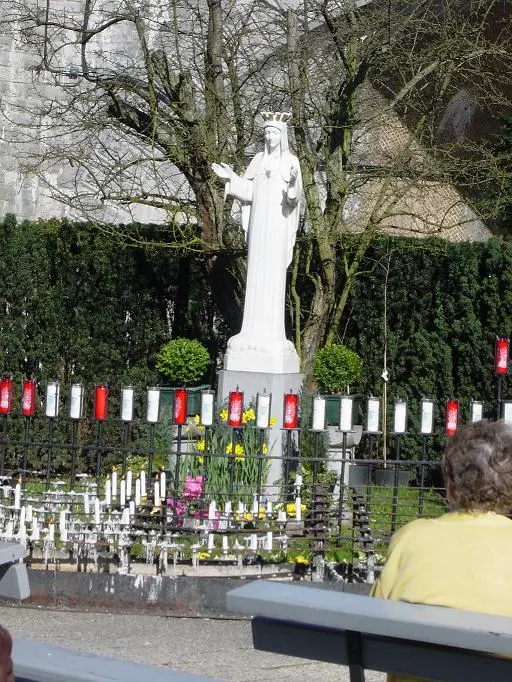
Image of Church of Our Lady with the Golden Heart, Beauraing. Image source · Public Domain
Visit essentials
A quick read before you go
- Duration
- Half a day for the apparition site, basilica, and a rosary.
- Access
- Beauraing is in Namur Province, southern Belgium, about 100 km southeast of Brussels.
Overview
In the southern Belgian village of Beauraing, a sanctuary has grown around a hawthorn tree where, between 29 November 1932 and 3 January 1933, five children reported thirty-three apparitions of the Virgin Mary. On 29 December they saw Mary's heart, golden and radiating, the sign that defines the shrine. By late December, thirty thousand people had gathered.
After seventeen years of investigation, the Bishop of Namur declared the apparitions worthy of belief on 2 July 1949 and approved two miraculous healings. Beauraing is often described as the 'simpler' Marian shrine: ordinary children, a small village, and messages centered on prayer and sacrifice rather than spectacle. A daily rosary at 6:30 PM, the precise hour of the apparitions, anchors the sanctuary's rhythm.
Why this place is sacred
Beauraing's thinness is not architectural. There is no grand basilica, no famous procession route, no spectacle of mass cures. The apparition site itself is unassuming: a hawthorn tree, an open-air chapel, an esplanade. What concentrates the place is the convergence of five witnesses and a single recurring sign — the Virgin appearing to ordinary children of a village school, eventually revealing a heart of gold.
The daily 6:30 PM rosary, held at the precise hour the apparitions began, gives the sanctuary a quiet liturgical pulse that pilgrims describe as more familial than ceremonial. The hospitality center for the sick, housed in the former convent buildings, adds another dimension: this is a shrine that has long oriented itself toward the suffering rather than the celebrated.
The site of the apparitions was the courtyard of a convent school of the Sisters of Christian Doctrine, a place of ordinary devotion and instruction. After 1932, it was preserved and progressively built up as a Marian sanctuary by the Diocese of Namur.
What began as an open-air vigil at the hawthorn tree has, over nine decades, developed into a complete sanctuary complex: an open-air chapel at the apparition site, a basilica for major liturgies, the international hospitality center for pilgrims who are ill or disabled, and a steady rhythm of daily Mass, confessions, and Eucharistic adoration. The 22 August international pilgrimage marks the annual peak.
Healing traditions
Apparition and intercession tradition
Beauraing's sanctuary preserves the account of five children who saw Mary in 1932–1933, including the vision of her golden heart. Devotion here centers on prayer, trust, and Mary's care for those who seek help. Pilgrims bring illness and family distress into that relationship. The official sources reviewed for this addition support the apparition and continuing prayer tradition, but not a specific named healing case.
Ways to participate
Pause at the apparition garden and make a short, personal prayer for the person or difficulty you have in mind. A candle or participation in a public service can give that intention a tangible form. Consult the sanctuary's pilgrimage information for organized visits and pastoral assistance; no special bodily sensation is required for the visit to have meaning.
These accounts describe religious traditions and reported experiences. They do not promise a cure or replace medical care.
Experience and orientation
Approaching Beauraing from the train station, a short walk through quiet residential streets brings pilgrims to the sanctuary esplanade. The hawthorn tree stands beside the open-air chapel; this is where the children first saw the Lady. The basilica and the older church both lie within a short walk. Most international visitors are struck by the smallness of everything: this is not Lourdes. There is no procession of stretchers, no chain of hotels, no commercial corridor.
Instead, the sanctuary breathes at the pace of a small Belgian village. The 6:30 PM rosary at the apparition site, held at the hour the apparitions began, gathers whoever is present — pilgrims, locals, a few sisters from the hospitality center. Evenings in winter, when the cold and the candlelight align with the apparition anniversaries between 29 November and 3 January, are often described as the most intimate time to visit.
The apparition site (hawthorn tree and open-air chapel), the basilica, and the hospitality center sit close together within easy walking distance. Free parking is available; the train station is a short walk away.
Context and lineage
On 29 November 1932, five children — Fernande Voisin (15), Gilberte Voisin (13), their brother Albert Voisin (11), and the sisters Andrée Degeimbre (14) and Gilberte Degeimbre (9) — were walking to collect Gilberte Voisin from her convent school when Albert reported seeing a luminous Lady dressed in white walking above the nearby railway bridge. Initial scoffing turned to shared vision; the apparitions continued for thirty-three occurrences over five weeks.
The Lady identified herself with the phrases 'I am the Immaculate Virgin' and 'I am the Mother of God, the Queen of Heaven,' and asked for prayer and sacrifice. On 29 December 1932 the children reported seeing a golden, radiating heart on the Virgin's breast — the iconographic sign that would define Beauraing devotion.
By the time of the final apparition on 3 January 1933, an estimated thirty thousand people had gathered in the village; witnesses reported seeing only the children fall to their knees in unison.
Roman Catholic Marian devotion in the Latin Rite tradition, administered by the Diocese of Namur. Beauraing belongs to the post-Lourdes wave of European apparition shrines and is paired in Belgian devotion with Banneux, whose own apparitions began in January 1933.
Fernande Voisin
Eldest of the five visionaries (age 15 at first apparition)
Gilberte Voisin
Voisin sister (age 13)
Albert Voisin
Voisin brother (age 11); reported the first sighting
Andrée Degeimbre
Degeimbre sister (age 14)
Gilberte Degeimbre
Youngest visionary (age 9)
Bishop André-Marie Charue of Namur
Issued the decree of 2 July 1949 declaring the apparitions worthy of belief
Traditions and practice
The annual feast of 22 August (Queenship of Mary) is the largest gathering, with international pilgrimage and processions on the esplanade. The anniversaries of the first apparition (29 November) and the final apparition with the revelation of the Golden Heart (3 January) anchor a quieter winter cycle. The daily rosary at the apparition site at 6:30 PM — the hour at which Mary first appeared — has become the sanctuary's signature devotion.
The Diocese of Namur maintains daily Mass in French and Dutch, with occasional liturgies in other languages during the international pilgrimage season. Eucharistic adoration is held regularly. The former convent has been repurposed as a hospitality center for pilgrims who are ill or disabled, with priority access during major feasts. Candlelight processions on the esplanade frame the principal evening liturgies.
Many pilgrims plan a visit around the 6:30 PM rosary at the apparition tree, allowing time before for quiet prayer at the open-air chapel and time after for a visit to the basilica. For a longer stay, the hospitality center offers group retreat accommodation; a weekend across an apparition anniversary (late November through early January) is widely recommended for its contemplative atmosphere.
Roman Catholicism
ActiveOne of two Church-approved Marian apparition sites in Belgium, with Banneux. Bishop André-Marie Charue of Namur declared the events 'worthy of belief' on 2 July 1949 after seventeen years of investigation, also approving two miraculous healings attributed to Our Lady of Beauraing.
Daily Mass, confessions, Eucharistic adoration, the 6:30 PM rosary at the apparition site (the hour of the original apparitions), candlelight processions on the esplanade, veneration at the hawthorn tree, and the international pilgrimage on 22 August.
Perspectives and open questions
Beauraing is held in different ways by different communities — as one of the earliest twentieth-century Church-approved apparitions, as an interwar Marian sign read against the gathering shadow of World War II, and as a quietly faithful village shrine whose signature is intimacy rather than spectacle.
Scholarly perspective
Historians of European Catholicism document Beauraing as part of an interwar wave of reported Marian apparitions — Beauraing 1932, Banneux 1933, Heede 1937 — that have been read in relation to the political and spiritual turbulence of the 1930s. The 1949 episcopal approval, after seventeen years of investigation, made Beauraing one of the earliest twentieth-century apparition cases formally recognized by the Church.
Living and traditional perspectives
Within Catholic devotion, Beauraing centers on Mary as Mother of God and Queen of Heaven. The 'golden heart' iconography is understood as a visible sign of her maternal love and intercession, drawing on a long Western tradition of Sacred Heart imagery and Immaculate Heart devotion.
Alternative interpretations
Some interpreters group the interwar apparitions as warnings preceding World War II. This is a devotional reading, not a Church-defined doctrine; the official approval addresses the credibility of the events themselves, not any specific eschatological interpretation.
Open questions
The Church approval declares the events 'worthy of belief' but does not require Catholics to hold the apparitions as articles of faith. The phenomenology — five children's synchronized falls, identical descriptions, the sustained intensity over five weeks — remains theologically interpreted rather than scientifically explained.
Plan your visit
Access and arrival
Beauraing is in Namur Province, southern Belgium, about 100 km southeast of Brussels. A train station within town connects to Brussels and Namur; the sanctuary is a short walk or local bus ride from the station. Free parking is available for those arriving by car.
The sanctuary's hospitality center accepts pilgrim groups (priority for the sick and disabled). Several small hotels and guesthouses serve the village; advance booking is essential for the August feast.
Respectful visit
Modest dress (shoulders and knees covered) for indoor liturgies. Comfortable walking shoes for the esplanade and outdoor stations. Layers for winter visits.
Permitted on the grounds and at the apparition site outside liturgies. Discreet inside the chapels and basilica; prohibited during Mass and Eucharistic adoration.
Candles are available at the apparition site. Donations are accepted via collection boxes for shrine upkeep and the care of the sick at the hospitality center.
Silence during liturgies and adoration. Respect for pilgrims in the hospitality center. No private access to areas reserved for residents of the center.
The sanctuary asks for silence during liturgies and adoration. Pilgrims should give space to those receiving care at the hospitality center, particularly during the international pilgrimage when access to the apparition site is regulated.
Current practical details
Address
Rue de l'Aubépine 14, 5570 Beauraing, Belgium
Hours, fees, and access can change — verify on the official source before you travel. Practical details last checked Jun 2026.
Location
Map loads as you approach this section.
Pilgrim reflections
A portrait of encounter, not a score
Pilgrims describe what they felt, how present they could become, and whether the place would shape a journey. There are no stars and no ranking of traditions.
No reviewed reflections yet
The first pilgrims can help describe the character of being here.
Share a reflection
Available after an account-backed “Been there.” Every reflection is reviewed before publication.
Nearby sacred places
Explore other sacred places in the region. Proximity does not establish access or travel time; check each place’s guidance.

Chevetogne Abbey
Chevetogne (Ciney), Chevetogne (Ciney), Namur, Belgium
16.8 km away

Maredsous Abbey and Basilica of Saint Benedict
Denée (Anhée), Denée (Anhée), Namur, Belgium
25.6 km away

Saint-Hubert Basilica
Saint-Hubert, Saint-Hubert, Luxembourg, Belgium
30.9 km away

Basilica of Saint Materne at Walcourt
Walcourt, Walcourt, Namur, Belgium
40.9 km away
References
Sources consulted for this page. Source categories describe the publication, not a guarantee that every claim is verified. Traditional accounts and outside interpretations may differ.
- 01Our Lady of Beauraing — Wikipedia — Wikipedia contributorsencyclopediaCore narrative: 33 apparitions, five children of Voisin and Degeimbre families, golden heart, 1949 episcopal approval.
- 02The 'Golden Heart' Apparition of Our Lady of Beauraing — National Catholic RegisternewsCatholic editorial source on apparition theology and recognition pathway.
- 03The Beauraing Sanctuaries — Office du tourisme de Beauraing — Office du tourisme de BeauraingofficialMunicipal tourism page on the sanctuary complex, the hawthorn tree, and esplanade.
- 04Who Is Our Lady of Beauraing — and What Is Her Connection to Alaska? — National Catholic RegisternewsBackground primer on the children, the messages, and global devotion (Anchorage cathedral connection).
- 05Beauraing: The Virgin with the Golden Heart — Marie de Nazareth — Marie de Nazareth Marian EncyclopediaspiritualConfirms 1943 decree authorizing public devotion and 2 July 1949 formal approval by Bishop of Namur.
- 06Sanctuary of Our Lady of Beauraing, Belgium — Catholic Shrine Basilica — Catholic Shrine BasilicaofficialApparition site logistics, hospitality center, daily Mass and 6:30pm rosary.
- 07The Virgin with the Golden Heart, Beauraing, Belgium, 1932-1933 — Divine Mysteries and MiraclesspiritualDetail on individual apparitions, named phrases ('I am the Immaculate Virgin'), 30,000 present on 3 January 1933.
- 08Guide to Our Lady of Beauraing: Pilgrimage and Meaning 2026 — Journeys of FaithguidePilgrim-facing visit guide, feast-day activities, devotional practices.
- 09Beauraing sanctuary — introductionofficialSupports the attributed account or visitor practice in the healing section; not evidence of clinical efficacy.
- 10Account of the apparitions — Beauraing sanctuaryofficialSupports the attributed account or visitor practice in the healing section; not evidence of clinical efficacy.
- 11Prepare a pilgrimage — Beauraing sanctuaryofficialSupports the attributed account or visitor practice in the healing section; not evidence of clinical efficacy.
Photo gallery
3 curated photos
Share a photo
Help visitors recognize Church of Our Lady with the Golden Heart, Beauraing. Every submission is reviewed before publication.