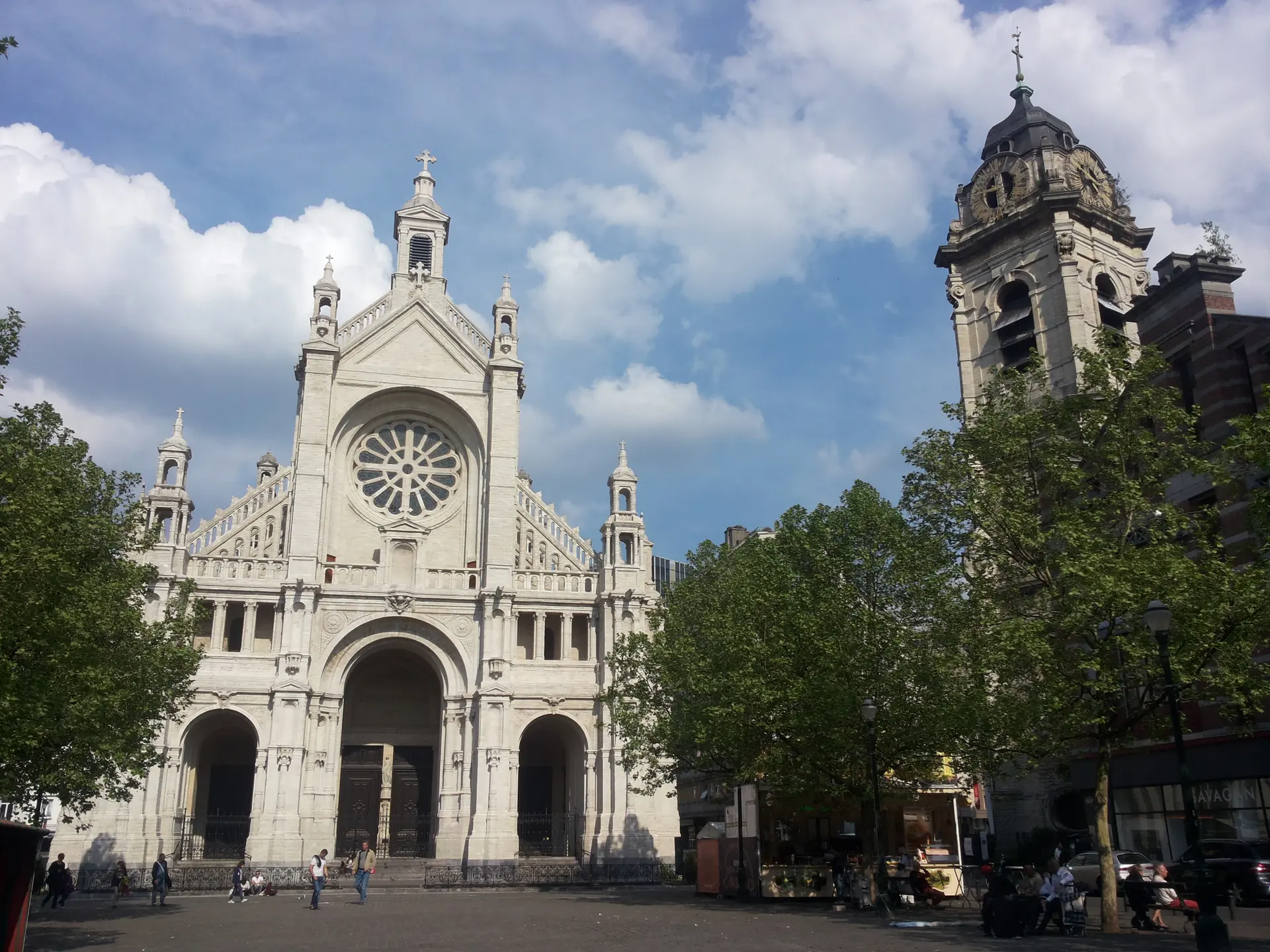
Church of St. Catherine with Black virgin of Brussel
Where a Black Virgin rose from the waters, and eight centuries of devotion persist
Understand sacred places, explore living traditions, and learn how to engage respectfully with Pilgrim Map.
Access has not been verified. Check current local guidance before planning a visit.
Brussels, Brussels-Capital, Belgium
Visit essentials
A quick read before you go
- Duration
- A meaningful visit requires at least thirty minutes: time to let the atmosphere settle, approach…
- Etiquette
- The Church of St.
Overview
The Black Virgin of St. Catherine has accumulated presence through more than five hundred years of attention in Brussels. Sailors threw her into the Senne in 1744, yet she floated on peat; she survived the old church's demolition for urban renewal and remained when its successor faced conversion to a market hall. Her present mid-nineteenth-century church, Joseph Poelaert's eclectic union of Gothic verticality and Renaissance openness, occupies Brussels' former main port basin, now the seafood-restaurant-lined Place Sainte-Catherine.
Inside, commercial noise gives way to tall-windowed light and worn stone. The roughly foot-tall figure is carved from stone darkened over time and holds the Christ child tenderly. Visitors report effects disproportionate to her size: sudden stillness, unexpected tears, and feeling seen by something ancient and patient.
Why this place is sacred
What makes a place thin? Often it is time. The first chapel dedicated to Saint Catherine leaned against Brussels' original city walls around 1201, a modest dependency of the parish of Molenbeek. When the city built new walls, the chapel found itself enclosed within Brussels proper, growing first into a Gothic church, then absorbing a Baroque tower, then giving way to the current building. Through each transformation, people continued to gather here for worship. Eight centuries of prayer leave traces.
But time alone does not explain the quality visitors describe. Black Madonnas carry their own charge. Throughout Europe, these dark-faced images of Mary attract devotion that runs deeper than ordinary Marian veneration. Scholars debate whether their blackness represents soot accumulation, original artistic intent, or symbolic connection to earth mysteries. Whatever the explanation, the phenomenological effect is consistent: Black Madonnas draw pilgrims who sense something primordial, something that predates doctrine.
The Brussels Black Virgin adds her own legend to this tradition. In 1744, sailors threw her into the Senne river, perhaps in anger or iconoclasm. Days later, neighborhood residents discovered her floating on a mass of peat, as if the waters refused to let her sink. This seemingly miraculous buoyancy transformed popular devotion. The statue was fished out and venerated with renewed intensity. She had been tested and had persisted.
The location itself contributes to the site's liminal quality. The church stands on what was once water: the port basin that served Brussels' trade for centuries. To build here was to claim the threshold between water and land, commerce and sanctuary. The medieval Black Tower still stands behind the church, a remnant of the thirteenth-century city walls. Past and present coexist here in a way that blurs temporal boundaries.
Visitors do not need to know this history to feel something shift when they enter. The effect arrives before explanation.
The original chapel served the growing population outside Brussels' first walls, providing spiritual care for fishermen, merchants, and workers in the harbor district. As the area developed, the church grew in importance, eventually becoming an independent parish. The Black Virgin appears to have arrived in the medieval period, though her exact origin remains uncertain. By the eighteenth century, she had become the focus of popular devotion that survived the site's physical transformations.
The church has been rebuilt twice: first in the Gothic style during the fourteenth and fifteenth centuries, then comprehensively by Joseph Poelaert between 1854 and 1874. Poelaert's design preserved the Italian Baroque tower from 1629-1664, the only remnant of the medieval church that Mayor Charles Buls later fought to save from demolition.
The twentieth and twenty-first centuries brought new challenges. As Belgian Catholicism declined, the parish struggled to sustain itself. In 2011, the church closed and faced conversion to a covered market. Public outcry and the intervention of the Fraternity of the Holy Apostles led to its reopening in 2014. The Black Virgin, which had been moved during the closure, was ceremonially reinstalled in January 2015.
This pattern of threat and survival mirrors the statue's own legend. Both church and Virgin have persisted through attempts at destruction or displacement. This narrative adds a layer to the visitor's experience: they are encountering something that has refused to disappear.
Experience and orientation
The contrast hits immediately upon entering. Place Sainte-Catherine bustles with restaurant terraces, shoppers, and the ambient noise of a European capital. Step through the doors and the soundscape changes. The scale of the interior creates a container for silence.
Light is the first thing most visitors notice. Tall windows filter the Brussels sky, creating an atmosphere that shifts with weather and time of day. On grey afternoons, the stone takes on a contemplative quality. When sun breaks through, particular corners illuminate unexpectedly.
The Black Virgin stands in a side chapel, smaller than photographs suggest. Perhaps a foot tall, her features worn soft by centuries. The Christ child rests in her arms with an intimacy that requires no doctrinal explanation. She is simply a mother holding her child, rendered in stone that has darkened over time until it seems to absorb light rather than reflect it.
Visitors report a range of responses. Some speak of peace, a settling of the nervous system that accompanies entry into a space designed for attention. Others describe something more active: tears that arrive without invitation, a feeling of being seen or recognized, the sense that something old and patient is present in the room. A few mention physical sensations: warmth, pressure in the chest, the quality of air that seems different near the statue.
These reports do not cluster along religious lines. Secular tourists express surprise at their own responses. Devoted Catholics feel their faith confirmed. Those with no particular belief system find themselves moved by something they cannot name.
The church's recent history adds emotional weight. Knowing that it nearly became a market, that the statue spent years in storage, that people organized to save both, creates a narrative of rescue that resonates with visitors' own experiences of survival and persistence.
St. Catherine rewards those who arrive with no agenda. The temptation in Brussels is to check the church off a list en route to the Grand Place or the Manneken Pis. Those who report meaningful encounters almost always describe lingering: sitting in one of the pews, letting the eyes adjust, allowing time to notice what arises.
Approach the Black Virgin as you would approach anyone you wished to know. Slowly, without demands. You need not be Catholic to stand before her; you need only be willing to be quiet. Notice what you feel in your body. Notice what thoughts surface. The statue has been receiving such attention for centuries. There is something to be said for adding your attention to the accumulated weight.
If you happen to visit during a service, remain at the back unless you intend to participate. The Mass is not performance but practice, and those present are engaged in something that matters to them. Even as an observer, you participate by virtue of your attention.
Context and lineage
The story begins in the margins. Around 1201, documents mention a chapel dedicated to Saint Catherine of Alexandria leaning against Brussels' first city walls. This modest structure served as a dependency of the parish of Molenbeek-Saint-Jean, catering to the spiritual needs of workers in the growing harbor district.
When Brussels built its second, larger ring of walls, the chapel found itself enclosed within the expanding city. It grew in status, eventually becoming an independent parish church. During the fourteenth and fifteenth centuries, a proper Gothic church with three naves rose on the site. Italian Baroque influence arrived in the seventeenth century with a new bell tower, completed between 1629 and 1664.
The Black Virgin enters the record without fanfare. Her exact date of creation remains disputed: sources variously cite the eleventh, fourteenth, or fifteenth century. She was carved from stone, perhaps originally painted, perhaps always dark. By the time she was thrown into the Senne in 1744, she had already accumulated centuries of devotion.
The story of her recovery transformed her from local veneration to legendary status. That she floated when she should have sunk, that she returned from the river to renewed honor, made her a figure of resilience. The faithful understood: this Virgin would not be easily lost.
For eight centuries, priests, parishioners, and pilgrims have maintained continuous worship at this site. The parish served fishermen and merchants during Brussels' years as a port city. When the harbor was filled in and the surrounding neighborhood gentrified, the character of the congregation shifted but did not disappear.
The twentieth century brought secularization and decline. By 2011, the parish could no longer sustain itself, and the archdiocese closed the church. The Fraternity of the Holy Apostles, a traditionalist Catholic community, took over the parish in 2014, reopening the church for worship. Though the Fraternity was dissolved in 2016, the parish continues, now under diocesan administration.
This succession of caretakers mirrors the Black Virgin's own passage through time: handed from one generation to the next, threatened, recovered, still present.
Saint Catherine of Alexandria
patron_saint
A fourth-century martyr traditionally depicted with a wheel, the instrument of her attempted execution. She was patroness of scholars, philosophers, and unmarried women. The church's dedication to her reflects medieval devotional patterns, though her historical existence is debated by scholars.
The Black Virgin of Brussels
sacred_object
A small stone statue of the Virgin Mary holding the Christ child, darkened over centuries. Her legendary recovery from the Senne river in 1744 made her a focus of popular devotion. She represents the tradition of Black Madonnas found throughout Europe, figures associated with deep spiritual power and transformative encounter.
Joseph Poelaert
historical
The architect who designed the current church building between 1854 and 1874. Poelaert is best known for the monumental Brussels Palace of Justice. His design for St. Catherine blends Gothic and Renaissance elements in the eclectic style characteristic of nineteenth-century Belgian architecture.
Charles Buls
historical
Mayor of Brussels from 1881 to 1899, known for his preservation efforts throughout the city. He successfully fought to save the Baroque bell tower from demolition in 1893, ensuring that this remnant of the medieval church would stand alongside Poelaert's new building.
Traditions and practice
Historical devotion to the Black Virgin likely included processions through the parish streets and special feasts on Marian holy days. Guild members, particularly fishermen and merchants who worked the nearby port, would have processed with the statue on significant occasions.
The statue's recovery from the Senne in 1744 would have occasioned particular celebration. Thanksgiving Masses, renewed offerings, and heightened attention to the Virgin's shrine followed such miraculous events in Catholic popular practice.
These communal expressions have largely faded with the decline of parish life and guild culture. What remains is individual devotion: believers approaching the statue with personal petitions, lighting candles, sitting in prayer.
The church offers daily and Sunday Masses in multiple languages, maintaining the liturgical rhythm that has defined this space for centuries. Confession is available daily for those who practice the sacrament. The Traditional Latin Mass has been offered here at various points, reflecting the church's recent association with traditionalist Catholic communities.
Veneration of the Black Virgin continues as an informal practice. Visitors approach her shrine, spend time in prayer or contemplation, and leave with whatever they came seeking. There is no structured pilgrimage program, no official devotional schedule. The practice is simple: come, be present, attend.
The church occasionally hosts classical music concerts, taking advantage of its excellent acoustics. These events, while not liturgical, offer another way to experience the sacred space.
If you come seeking encounter, consider arriving when the church is quiet, between scheduled services. The early morning hours, before tourist foot traffic begins, offer the most contemplative atmosphere.
Sit in a pew and let your nervous system settle. The shift from street noise to interior silence takes time to register fully. Notice the quality of light, the temperature of the air, the smell of old stone and candle wax.
When you approach the Black Virgin, do so slowly. There is no required prayer, no expected gesture. Simply stand before her and notice what arises. Some find it helpful to bring a question, something genuinely unsettled in their lives, and to hold it in her presence without demanding an answer.
If you wish, light a candle as an offering. The gesture is simple but anchoring: a small act of devotion that connects you to the countless others who have done the same.
Roman Catholicism
ActiveThe Church of St. Catherine has served as a Catholic parish since at least 1201, making it one of Brussels' oldest continuously used places of worship. The site embodies eight centuries of Catholic liturgical practice, sacramental life, and communal devotion. Through changes in architecture, neighborhood, and pastoral administration, the church has maintained its fundamental identity as a place where the Mass is celebrated and the faithful gather.
Daily and Sunday Masses form the core of parish life. Confession is available daily for those seeking the sacrament of reconciliation. The Traditional Latin Mass has been offered at various points, reflecting the parish's recent association with traditionalist communities. Baptisms, weddings, and funerals mark the passages of parishioners' lives. The liturgical year unfolds with its rhythm of feasts and fasts, Advent to Easter to Ordinary Time.
Marian Devotion and Black Madonna Veneration
ActiveThe Black Virgin of Brussels belongs to a European-wide phenomenon of dark-faced Madonna images that attract particular devotion. Black Madonnas are associated with miracles, healing, protection, and spiritual power that exceeds ordinary Marian veneration. The Brussels statue, with its legend of miraculous survival and recovery from the Senne, exemplifies this tradition. For devotees, she represents Mary in her most ancient and potent form.
Veneration of the Black Virgin involves personal prayer before the statue, petitions for intercession, lighting of candles, and quiet contemplation. Unlike larger pilgrimage shrines, St. Catherine offers no structured devotional program. The practice is intimate and individual: seeker and Virgin, presence and presence. Some visitors touch rosaries or religious objects to the shrine area (though not the statue itself) to carry a connection away with them.
Perspectives and open questions
The Church of St. Catherine and its Black Virgin invite multiple interpretations: historical, devotional, psychological, and archetypal. Honest engagement requires holding these perspectives together without forcing resolution. Each offers genuine insight; each has limitations.
Scholarly perspective
Art historians and scholars of material culture place the Black Virgin within the broader European tradition of dark-faced Madonnas. These figures appear in nearly every Catholic country, with particular concentrations in France, Spain, Poland, and Italy. The blackness may result from original pigmentation, candle soot accumulation over centuries, or darkening of the base material. No single explanation covers all cases.
The church building itself represents a significant example of nineteenth-century eclectic architecture, blending Gothic revival with Renaissance and Baroque elements. Poelaert's design reflects the historicist impulses of his era. The preserved Baroque tower offers a genuine artifact of seventeenth-century sacred architecture.
Historians emphasize the site's eight centuries of continuous use, documenting the shifts from harbor chapel to parish church to threatened landmark to reopened place of worship. This institutional continuity, whatever spiritual significance one attributes to it, represents a remarkable case of urban religious survival.
Living and traditional perspectives
Within Catholic tradition, the Black Virgin is venerated as an image of Mary, Mother of God. Her blackness, rather than requiring explanation, is simply accepted as part of her identity. Devotees approach her as they would any Marian shrine: with petitions, gratitude, and the expectation of maternal intercession.
The legend of her 1744 recovery from the Senne carries theological weight for believers. That she floated when she should have sunk demonstrates, in this view, divine protection and the genuineness of her sacred power. She is not merely a cultural artifact but a vessel of grace.
The church's recent near-closure and reopening fits within a narrative of providence: the faith was tested, and the faith prevailed. For traditional Catholics, continuing to worship here represents participation in a lineage of devotion that has outlasted every attempt at suppression.
Alternative interpretations
Alternative perspectives on Black Madonnas often locate them within a longer history than Christianity acknowledges. Some scholars of comparative religion suggest connections to pre-Christian goddess worship: Isis, Cybele, Diana, and other figures associated with earth, fertility, and the feminine principle. The blackness, in this reading, represents not soot or artistic choice but deliberate reference to earth mysteries and the dark matter from which creation emerges.
Others associate Black Madonnas with Mary Magdalene and suppressed currents of feminine wisdom within Christianity. The Brussels Black Virgin's emergence from water resonates, in this view, with archetypal themes of birth, baptism, and resurrection from the depths.
These interpretations lack direct historical evidence but address the question of why Black Madonnas attract devotion that runs deeper than ordinary Marian veneration. Something in the figure speaks to experiences that exceed conventional religious categories.
Open questions
Genuine uncertainties persist. The exact date of the Black Virgin's creation remains disputed: sources variously cite the eleventh, fourteenth, or fifteenth century. Whether her blackness is original or acquired cannot be definitively determined without invasive analysis that would damage the statue.
Why sailors threw her into the Senne in 1744 is not recorded. Iconoclasm, drunken malice, accident, or some now-lost grievance: the historical record is silent. The statue's recovery on floating peat, while celebrated as miraculous, also lacks independent documentation.
The site's possible pre-Christian sacred associations remain unexplored. Brussels' earliest settlement patterns and any rituals that preceded Christian chapels are lost to archaeology and oral tradition alike. Whether something about this particular location drew sacred attention before 1201 cannot be known.
Plan your visit
Access and arrival
Central Brussels offers lodging at all price points within walking distance of the church. The Place Sainte-Catherine itself is ringed with hotels and restaurants. For visitors seeking a more contemplative stay, various retreat centers and monasteries in the Brussels region offer hospitality, though none are immediately adjacent to the church.
Respectful visit
Dress modestly, as befitting a place of worship. Shoulders and knees should be covered. This is not strictly enforced, but it demonstrates respect for the tradition that has shaped this space. Casual attire is acceptable; beachwear is not.
Personal photography is generally permitted for non-commercial purposes. Use no flash, especially near the Black Virgin or during services. Be discreet and prioritize presence over documentation. Professional equipment and tripods require advance permission from the parish office.
Candles are available for purchase and may be lit as prayer offerings. Donations for church maintenance are appreciated but not required. There are no mandatory fees for visiting.
{"Maintain silence or speak quietly throughout your visit","Do not interrupt services or worshippers","No eating or drinking inside the church","Turn off mobile phones or set to silent","Do not touch the Black Virgin statue or other sacred objects","During communion, non-Catholics should remain seated"}
Avoid treating the church as merely a sightseeing stop. Those who rush in for photographs and rush out miss whatever the space has to offer. If you lack time for a meaningful visit, consider returning when you do.
Do not interrupt services or worshippers with questions, photography requests, or conversation. The church is still a place of active worship; those present may be engaged in prayer that matters deeply to them.
Be aware that the parish's recent history includes periods of closure and uncertainty. The current pastoral administration may differ from what earlier sources describe. Accept the church as you find it rather than expecting a particular experience.
Current practical details
Address
Pl. Sainte-Catherine 50, 1000 Bruxelles, Belgium
Phone
Hours
Hours, fees, and access can change — verify on the official source before you travel. Practical details last checked Jun 2026.
Location
Map loads as you approach this section.
Pilgrim reflections
A portrait of encounter, not a score
Pilgrims describe what they felt, how present they could become, and whether the place would shape a journey. There are no stars and no ranking of traditions.
No reviewed reflections yet
The first pilgrims can help describe the character of being here.
Share a reflection
Available after an account-backed “Been there.” Every reflection is reviewed before publication.
Nearby sacred places
Explore other sacred places in the region. Proximity does not establish access or travel time; check each place’s guidance.

Grimbergen Abbey and Saint Servatius Basilica
Grimbergen, Grimbergen, Flemish Brabant, Belgium
9.2 km away

Saint Martin Basilica, Halle
Halle, Flemish Brabant, Belgium
15.0 km away
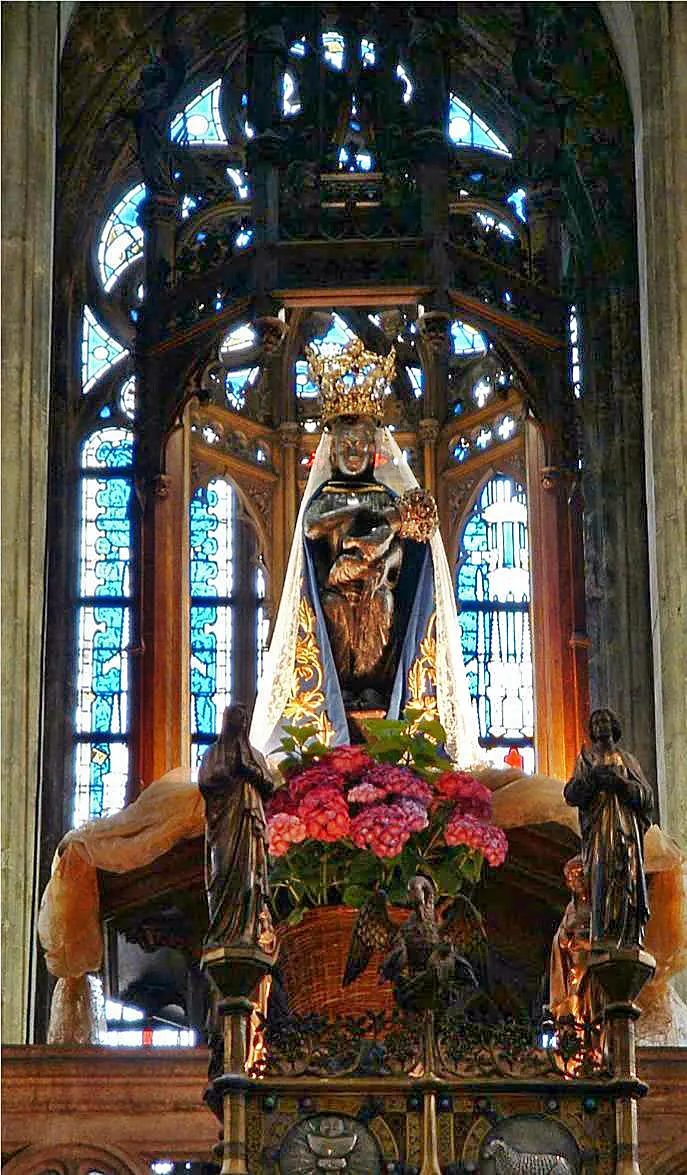
Our Lady the Black Virgin of Hal
Diegem, Flemish Brabant, Belgium
15.0 km away

Basilica of Our Lady of Hanswijk
Mechelen, Mechelen, Antwerp, Belgium
21.3 km away
Share a photo
Help visitors recognize Church of St. Catherine with Black virgin of Brussel. Every submission is reviewed before publication.