Basilica of Our Lady of Scherpenheuvel, Scherpenheuvel
Where pilgrims have circled a sacred oak for centuries, seeking Mary's healing presence
Understand sacred places, explore living traditions, and learn how to engage respectfully with Pilgrim Map.
Access has not been verified. Check current local guidance before planning a visit.
Scherpenheuvel-Zichem, Flemish Brabant, Belgium
Read the sources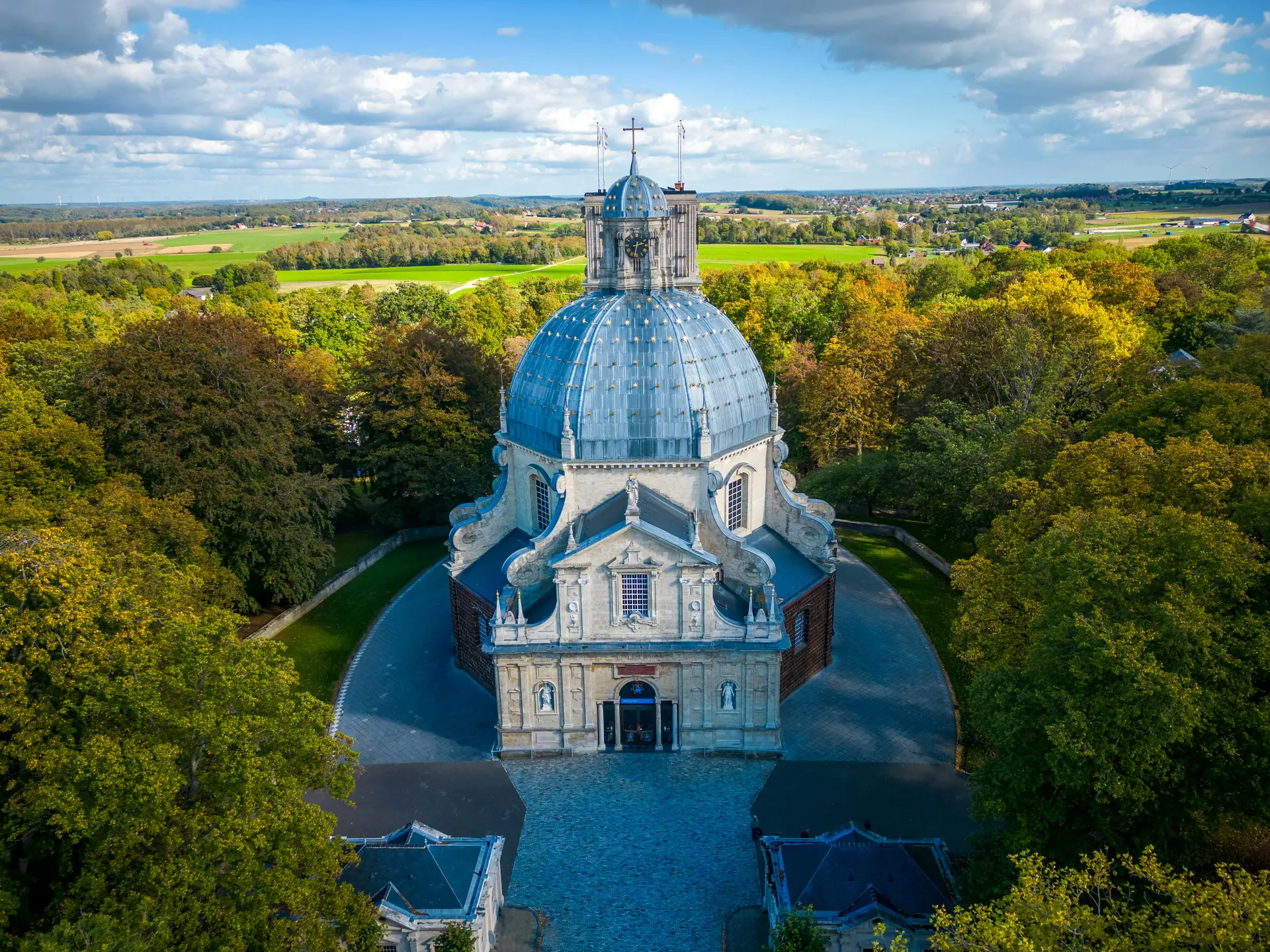
Image of Basilica of Our Lady of Scherpenheuvel, Scherpenheuvel. Image source · CC-BY-SA-4.0
Visit essentials
A quick read before you go
- Duration
- A meaningful visit to the basilica and Stations of the Cross requires 1-2 hours.
- Etiquette
- Scherpenheuvel is an active pilgrimage site receiving nearly a million visitors annually.
Overview
On a sharp hill in Flemish Brabant, pilgrims have walked prayerful circles for over five hundred years. Its Latin name, Mons Acutus, means Sharp Mountain. Before Christianity, a sacred oak stood here; when a statue of Mary appeared in it, the form of devotion changed while recognition of the place endured.
Nearly seven hundred miracles were recorded in the 17th century alone: a shepherd frozen when he tried to remove the statue, a Virgin reportedly weeping blood during the Low Countries' religious wars, and a plague said to lift after the statue passed through the streets.
The Baroque basilica commissioned by Archdukes Albert and Isabella crowns the hill. Its seven-sided dome evokes the seven pillars of wisdom and an enclosed garden symbolizing Mary's eternal purity. Above the high altar, the miraculous statue occupies the ground where the oak stood. Each November, thousands join the Kaarskensprocessie, the Candle Procession maintained since the plague year of 1629. Buses now arrive full, candles burn daily, and the circles continue as living devotion.
Sites inside
Why this place is sacred
The hill itself came first. Long before the statue appeared in the oak, this height in Flemish Brabant was recognized as set apart. The druidic peoples who inhabited these lands understood certain trees, certain elevations, as places where the veil between worlds wore thin. When Christianity arrived, the recognition persisted even as the language changed.
Sometime in the medieval period, a statue of the Virgin Mary appeared in the oak tree on the hill. The written record begins in the 13th century, but the devotion may be older still. Pilgrims came, walking three times around the tree while praying, and some were healed. Word spread. By the 1550s, floods of pilgrims were arriving at the oak tree, seeking whatever Mary might offer.
The miraculous events accumulated. Around 1500, according to tradition, a shepherd noticed the statue had fallen from the tree. When he tried to take it home, his feet became anchored to the ground. He could not move despite all attempts, remaining frozen until the owner placed the statue back in the oak. The story spread through the region, confirming what pilgrims already sensed.
In 1580, during the Dutch Protestant iconoclasm that swept the Low Countries, soldiers stole the original statue. But the devotion could not be stolen. A replacement was installed in 1587, and within years, new miracles were reported. In January 1603, the statue was said to weep bloody tears, Mary grieving the religious schism that divided neighbor from neighbor.
That same year, Archdukes Albert and Isabella made their first pilgrimage. Their architect, Wenceslas Cobergher, was commissioned to transform this site of popular devotion into a monument of Counter-Reformation faith. The heptagonal design he created was no accident. Seven sides for the seven pillars of wisdom. Seven columns supporting the dome for the House of Wisdom from Proverbs. The entire plan a Hortus Conclusus, an enclosed garden symbolizing Mary's eternal virginity. Every line of the building was theology made stone.
The high altar stands on the exact site of the original oak. The tree is gone, but the ground remembers. Pilgrims who walk the circles today trace paths worn by centuries of feet, adding their intentions to the accumulated weight of human longing.
The site's original sacred function predates documentation. The oak-crowned hill likely served as a place of druidic worship before Christianization. The Marian devotion that emerged in the medieval period transformed the site into a place where the faithful could seek Mary's intercession, particularly for healing. The Baroque basilica commissioned in 1607 served both spiritual and political purposes, asserting Catholic faith against Protestant iconoclasm while channeling popular devotion into institutional form.
From druidic sacred grove to medieval Marian shrine to Counter-Reformation monument, Scherpenheuvel has repeatedly transformed while maintaining its essential character as a place of pilgrimage and healing. The 17th century brought architectural grandeur and institutional support. The 20th century brought official recognition as a minor basilica in 1922. The 21st century brings a million pilgrims annually, many arriving by bus where their ancestors walked for days.
The practices have streamlined but not fundamentally changed. Pilgrims still circle the site three times while praying. The Kaarskensprocessie still winds through November streets. Those seeking Mary's help still light candles and make their petitions. The Baroque architecture frames an encounter whose essence predates the building itself.
Healing traditions
Marian pilgrimage and thanksgiving tradition
Scherpenheuvel's healing reputation grew around an image of Mary associated with an oak tree. Local heritage accounts describe the miracles attributed to that image and the pilgrimage that followed. Candles, blessings, and processions continue to express requests for protection and gratitude for help received. These sources establish a healing and intercession tradition; they do not identify a particular recovery that can responsibly be retold here.
Ways to participate
Bring an intention to the basilica, light a candle where permitted, or ask about a blessing. A slow walk along the processional route offers space for prayer between visits to the church. If attending the candle procession, follow the sanctuary's current instructions and choose a place where you can participate comfortably.
These accounts describe religious traditions and reported experiences. They do not promise a cure or replace medical care.
Experience and orientation
The first impression is often the dome. Stepping into the central space, the eye is drawn upward to a heaven of gilded stars against blue, hundreds of points of light suggesting a cosmos ordered and benevolent. The seven walls curve around you, the architectural geometry creating a sense of being held. Light enters through high windows, softened and diffused.
Visitors describe a quieting that begins almost immediately. The mental chatter that accompanies most tourism fades. Whether this reflects acoustics, the accumulated centuries of prayer, or something less explicable, the effect is consistent. People slow down. Voices drop. Cameras are put away.
The Theodoor van Loon altarpieces reward sustained attention. These are not merely decorative but contemplative objects, painted by an artist who spent time in Rome studying Caravaggio's use of light and darkness. The scenes from Mary's life glow from their alcoves, each panel an invitation to stop and stay.
Above the high altar, the miraculous statue looks down. This is the replacement installed in 1587, not the original stolen in 1580, but centuries of veneration have charged it with the weight of devotion. Pilgrims approach, make their petitions silently or aloud, and step back changed. Or unchanged. The encounter is not guaranteed, only offered.
The Kaarskensprocessie in early November draws those seeking the most intense collective experience. Thousands carry candles through the dark streets, a river of light flowing toward the basilica. The procession began in 1629 during a plague epidemic, when the statue was carried through Scherpenheuvel and the mortality rate dropped. Whether by divine intervention or coincidence, the tradition took hold and persists.
For those who participate, the experience is one of joining something larger than themselves, of adding their flame to centuries of flames.
De Grote Trek, the 57-kilometer pilgrimage walk from Antwerp each May, offers another kind of encounter. The journey takes all day, feet blistering on Belgian roads, the body's discomfort becoming a form of prayer. Those who complete it report that the final arrival at the basilica carries a weight that driving cannot replicate. The journey makes the destination.
Scherpenheuvel rewards those who approach it as pilgrims rather than tourists. The distinction is not about belief but about attention. A tourist comes to see; a pilgrim comes to encounter.
Consider arriving early, before the buses. The morning light through the dome windows creates a particular atmosphere. Sit in the central space and let the geometry work on you. You need not pray in any formal sense; simple receptivity is sufficient.
If you are able, walk the traditional three circles around the exterior of the basilica while holding a question or intention. The practice may feel strange at first, especially for those unaccustomed to devotional movement. Let it become a walking meditation, the repetition creating space for something to shift.
The Stations of the Cross in the surrounding park offer a contemplative walk for those who have time. The stations are not merely historical markers but invitations to pause, to consider suffering and redemption in whatever framework holds meaning for you.
If you visit during the Kaarskensprocessie, let yourself be carried by the collective. Hold your candle carefully. Move with the crowd. For one night, you are not a visitor but a participant in something that has been happening since 1629.
Context and lineage
The founding narrative centers on a shepherd and an oak tree. Around 1500, so the tradition holds, a shepherd noticed that the statue of Mary had fallen from the tree where pilgrims venerated it. Thinking to take it home, he reached down to pick it up. And found he could not move. His feet were anchored to the ground as if roots had grown through them. He struggled, called for help, prayed. Nothing worked.
Only when the statue's owner arrived and placed it back in the tree was the shepherd released, stumbling forward as if freed from invisible bonds.
The story spread through Brabant and beyond. Here was proof, the faithful said, that this place was chosen. Mary wished to remain on the sharp hill. Other miracles followed. Healings. Prayers answered. The fame of Onze-Lieve-Vrouw van Scherpenheuvel grew.
In January 1603, during the terrible years when Catholic and Protestant fought for the soul of the Netherlands, the statue was seen to weep. Not ordinary tears but blood, running down the Virgin's face as if she mourned the violence tearing her people apart. The weeping was witnessed by multiple people and reported to Church authorities. Whether natural phenomenon or supernatural sign, the effect was electric. Devotion intensified.
The Archdukes Albert and Isabella, Catholic rulers of the Spanish Netherlands, made their first pilgrimage later that year. What they found was a wooden chapel on a hill, packed with fervent worshippers, a locus of popular faith that the institutional Church had not created but could not ignore. They would return annually for the rest of their lives. And they would build.
The devotion at Scherpenheuvel belongs to the long tradition of Marian pilgrimage that has shaped Catholic Europe since the medieval period. Sites like Lourdes, Fatima, and Czestochowa share this character: places where Mary is understood to have made herself present in particular ways, drawing the faithful from far regions.
Within Belgium, Scherpenheuvel holds precedence as the primary national Marian shrine. The devotion predates the country itself, stretching back to when these lands were part of the Duchy of Brabant, then the Spanish Netherlands, then various political configurations until Belgian independence in 1830. Through all these changes, the pilgrims kept coming.
The basilica's architecture connects it to the broader Counter-Reformation project of using beauty and grandeur to reinforce Catholic faith. Churches throughout Catholic Europe were rebuilt or newly constructed in this period, deploying Baroque aesthetics as theology. Scherpenheuvel was among the first in the Low Countries to import Roman Baroque style, making it a deliberate statement of communion with Rome against Protestant austerity.
Archdukes Albert and Isabella
historical
Rulers of the Spanish Netherlands who championed Scherpenheuvel as a Counter-Reformation statement. They commissioned the basilica in 1607 and made annual pilgrimages beginning in 1603, lending royal prestige to popular devotion.
Wenceslas Cobergher
historical
Architect, painter, and polymath who designed the basilica and the surrounding seven-sided town plan. His design introduced Roman Baroque architecture to the Spanish Netherlands, using symbolic geometry to reinforce Marian doctrine.
Theodoor van Loon
historical
Flemish painter who created the altarpieces depicting scenes from Mary's life. His work, influenced by Caravaggio, brings dramatic use of light and shadow to the contemplative spaces of the basilica.
Our Lady of Scherpenheuvel
deity/saint
The Virgin Mary as venerated at this site. The miraculous statue, though a replacement for the original stolen in 1580, has been the focus of Marian devotion for over four centuries, associated with healings and answered prayers.
Traditions and practice
The oldest practice, predating the basilica itself, is walking three times around the sacred site while praying. Pilgrims circled the oak tree before any church existed; today they circle the basilica on the same path worn smooth by generations of feet. This circumambulation appears in many pilgrimage traditions worldwide, the walking itself becoming prayer, the repetition creating space for intention to deepen.
Foot pilgrimage to Scherpenheuvel was the norm for centuries. Families would walk for days from distant cities, the journey as significant as the arrival. Those who completed 25 or 50 foot pilgrimages over their lifetime received special blessings with the miraculous statue, recognition of devotion sustained over years.
The Kaarskensprocessie originated in 1629 during a plague epidemic. With mortality rising and medical options exhausted, the faithful asked permission to carry the statue through Scherpenheuvel's streets. The procession took place on a November evening, candles lighting the way. The mortality rate dropped noticeably afterward. Whether divine intervention, coincidence, or psychological effect, the tradition was established and continues on the first Sunday after All Saints each year.
Daily Mass services fill the liturgical calendar, drawing local parishioners and traveling pilgrims alike. The pilgrimage season runs from May 1 to the first week of November, when the site receives its heaviest traffic.
De Grote Trek, the 57-kilometer pilgrimage walk from Antwerp, began in 1931 and takes place on the first Sunday of May. Hundreds of pilgrims set out before dawn, walking through the day to arrive at Scherpenheuvel by evening. The modern tradition adapts ancient practice to contemporary schedules.
Blessing processions occur throughout the year for people, pets, animals, and even vehicles. These blessings, while less dramatic than the Candle Procession, maintain the sense that the sacred is available for everyday concerns, not reserved for crisis.
The Stations of the Cross in the surrounding park offer a contemplative practice accessible year-round. Fourteen stations mark the path, each inviting pause and reflection on Christ's final journey.
If you seek meaningful engagement rather than tourism, consider these possibilities.
Walk the three circles. This practice is open to anyone, regardless of belief. Hold a question or intention as you walk. Let the repetition do its work. You need not pray in any formal way; the walking itself is the practice.
If you visit during the Kaarskensprocessie, arrive early enough to secure a candle and a place in the procession. Let yourself become part of the river of light. The collective experience often moves people more than solitary contemplation.
For those able to commit a full day, consider walking at least the final leg from Diest or Aarschot rather than arriving by bus. The approach on foot changes the arrival. Your feet will know what your eyes cannot.
Light a candle at the shrine. The gesture is simple and requires no particular belief. Fire has accompanied human prayer since before recorded history. Let the flame carry whatever you cannot speak.
Roman Catholicism - Marian Devotion
ActiveScherpenheuvel is Belgium's most important Marian pilgrimage site and one of the major Marian shrines in the Low Countries. The devotion originated around a miraculous statue of the Virgin Mary placed in an oak tree, which became associated with healing miracles. Nearly 700 miracles were documented in the 17th century. The site was strongly promoted during the Counter-Reformation by Archdukes Albert and Isabella as a bastion of Catholic faith.
Pilgrimage on foot remains the traditional approach, though most visitors now arrive by vehicle. Walking three times around the basilica while praying continues the ancient practice of circumambulating the sacred oak. The Kaarskensprocessie (Candle Procession) on the Sunday after All Saints draws thousands for an evening of collective devotion. De Grote Trek, the 57-kilometer walk from Antwerp on the first Sunday of May, revives the foot pilgrimage tradition. Blessing processions for people, animals, and vehicles occur throughout the year. Daily Mass services anchor the liturgical rhythm.
Counter-Reformation Catholicism
ActiveThe basilica was built as a deliberate Counter-Reformation statement under the patronage of the Catholic Archdukes Albert and Isabella. The elaborate Baroque architecture and Marian iconography were designed to reinforce Catholic doctrine, particularly concerning Mary, in opposition to Protestant iconoclasm that had damaged the original shrine in 1580. The site demonstrates how ecclesiastical and state power collaborated to defend and promote Catholic faith through beauty and grandeur.
The Counter-Reformation dimension is expressed through the building itself rather than through specific practices. The architectural symbolism, the artwork, and the very existence of so grand a basilica on this site all proclaim Catholic truth claims. Contemporary visitors experience this through engagement with the space and its art rather than through distinct rituals.
Perspectives and open questions
Scherpenheuvel invites multiple readings, from the strictly devotional to the art historical to the anthropological. Each perspective illuminates something genuine about the site while leaving other dimensions in shadow. The basilica is large enough to hold them all.
Scholarly perspective
Art historians recognize Scherpenheuvel as the first church in the Spanish Netherlands built in Roman Baroque style with a central plan and monumental dome. Cobergher's design imported Counter-Reformation aesthetics from Rome, using architecture as a polemical tool against Protestant austerity. The heptagonal geometry is deliberately symbolic, representing the Hortus Conclusus (enclosed garden) of Marian doctrine and the House of Wisdom from Proverbs 9:1.
The site exemplifies how ecclesiastical and state power collaborated to channel popular devotion during the Counter-Reformation. The Archdukes' patronage transformed a grassroots pilgrimage site into an official monument, simultaneously legitimizing popular faith and bringing it under institutional control.
Theodoor van Loon's altarpieces, influenced by his study of Caravaggio in Rome, are considered among the finest Baroque paintings in the Low Countries. Their dramatic lighting and emotional intensity served the Counter-Reformation project of moving hearts through beauty rather than argument.
Living and traditional perspectives
For Belgian Catholics, Scherpenheuvel represents an unbroken chain of Marian intercession stretching back centuries. The miraculous statue is not merely a historical artifact but a continuing source of grace. The healings documented in the 17th century are understood as real divine interventions, and similar intercessions are believed to continue today.
The traditions of foot pilgrimage, the three circles, and the Candle Procession connect contemporary devotees to generations of faithful who walked the same paths with the same prayers. To participate is to join a community that spans centuries. The theology of the site emphasizes Mary as advocate and intercessor, able to bring human petitions before her divine Son.
The Counter-Reformation history, while acknowledged, is less important from this perspective than the ongoing relationship between the faithful and Our Lady of Scherpenheuvel. The building is a vessel for encounter; the encounter is what matters.
Alternative interpretations
Some interpreters emphasize the pre-Christian origins of the site, noting that the sacred oak on the hill predates Marian devotion by centuries and possibly millennia. From this perspective, Scherpenheuvel is a thin place whose power transcends any single religious tradition. Christianity did not create the sacredness here; it inherited and transformed it.
This reading does not contradict Catholic understanding but sits alongside it, suggesting that the land itself carries something that different traditions recognize and interpret through their own frameworks. The druidic grove, the Marian shrine, and the Baroque basilica are three expressions of the same fundamental recognition: this place is set apart.
Open questions
The exact origins of the Marian cult remain obscure. Written sources date only to the 13th century, despite traditions suggesting earlier veneration. The original statue stolen in 1580 was never recovered, and its origins are unknown.
What happened at the site before written records is largely conjecture. The claim of druidic worship, while plausible given the sacred oak tradition, cannot be verified. The site's pre-Christian history exists only as inference and local tradition.
The nature of the miracles reported, particularly the 1603 weeping statue, remains unexplained. Church authorities investigated and accepted the accounts; secular explanation remains elusive. Whether divine intervention, natural phenomenon, or collective imagination, the effect on believers and the subsequent history are matters of fact even if the cause is not.
Plan your visit
Access and arrival
Scherpenheuvel is a small town with limited accommodation options. Most visitors stay in nearby cities such as Leuven, Diest, or Brussels and travel to the site for day visits. For those wishing to stay overnight near the basilica, inquire locally about guesthouses. The pilgrimage season sees higher demand for accommodation, particularly around the Kaarskensprocessie and De Grote Trek.
Respectful visit
Dress modestly, as appropriate for a Catholic church. Shoulders and knees should be covered. Avoid clothing with prominent slogans or imagery that might be considered disrespectful in a religious context. During winter months, the basilica can be cold; layers are practical as well as appropriate.
Photography is permitted in most areas of the basilica, but should be practiced with sensitivity. Do not use flash. Do not photograph during services. Do not photograph other visitors without their consent, particularly those who are clearly engaged in prayer or devotion. The architecture and artwork are fair subjects; the faith of fellow visitors is not.
Votive candles are available for purchase and may be lit at designated areas. This is the primary form of offering at the site. Monetary donations support the maintenance of the basilica. There is no expectation that non-Catholic visitors will make offerings, but those who wish to participate in this form are welcome.
No food or drink inside the basilica. Respectful quiet is expected throughout the interior spaces. During the Kaarskensprocessie, follow the instructions of marshals organizing the procession. Certain areas may be restricted during special events or services.
Be aware that this is an active site of Catholic worship. Mass and other services take precedence over tourism. Check schedules before visiting if you wish to either attend or avoid services.
The Kaarskensprocessie draws enormous crowds. If you have mobility limitations or difficulty with crowds, consider visiting at another time. The procession involves hours of standing and walking in dense groups.
De Grote Trek is physically demanding. The 57-kilometer walk requires genuine preparation. Do not attempt it casually; many who start do not finish. If you wish to participate, train beforehand and bring appropriate footwear and supplies.
Current practical details
Address
Albertusplein 7, 3270 Scherpenheuvel-Zichem, Belgium
Phone
Hours
Hours, fees, and access can change — verify on the official source before you travel. Practical details last checked Jun 2026.
Location
Map loads as you approach this section.
Pilgrim reflections
A portrait of encounter, not a score
Pilgrims describe what they felt, how present they could become, and whether the place would shape a journey. There are no stars and no ranking of traditions.
No reviewed reflections yet
The first pilgrims can help describe the character of being here.
Share a reflection
Available after an account-backed “Been there.” Every reflection is reviewed before publication.
Nearby sacred places
Explore other sacred places in the region. Proximity does not establish access or travel time; check each place’s guidance.

Averbode Abbey
Averbode (Scherpenheuvel-Zichem), Averbode (Scherpenheuvel-Zichem), Flemish Brabant, Belgium
5.9 km away

Tongerlo Abbey
Tongerlo (Westerlo), Tongerlo (Westerlo), Antwerp, Belgium
14.8 km away

Park Abbey
Heverlee (Leuven), Heverlee (Leuven), Flemish Brabant, Belgium
22.3 km away

Basilica of Our Lady of Hanswijk
Mechelen, Mechelen, Antwerp, Belgium
34.8 km away
References
Sources consulted for this page. Source categories describe the publication, not a guarantee that every claim is verified. Traditional accounts and outside interpretations may differ.
- 01Basilica of Our Lady of Scherpenheuvel - WikipediaacademicPrimary encyclopedic source with comprehensive historical information
- 02Our Lady of Scherpenheuvel - MaryPagesspiritualDetailed Marian devotion information
- 03Basilica of Our Lady of Scherpenheuvel - Flemish Masters in SituofficialArt historical documentation of Van Loon paintings
- 04Wenceslas Cobergher - WikipediaacademicArchitectural and biographical information
- 05De Grote Trek Official WebsiteofficialOfficial source for annual pilgrimage walk
- 06Theodoor van Loon - WikipediaacademicArt historical context for basilica paintings
- 07The Catholic Travel Guide - ScherpenheuvelguidePractical visitor information
- 08Catholic Shrine Basilica - ScherpenheuvelspiritualAdditional historical details
- 09Visit Scherpenheuvel - Belgium Travel InfoguideVisitor logistics and practical information
- 10Religiana - Basiliek de ScherpenheuvelspiritualDetailed procession and tradition information
- 11Amazing Belgium - The Basilica of ScherpenheuvelguideOverview and visitor experience
- 12Pilgrimage destination Scherpenheuvel — municipal tourismofficialSupports the attributed account or visitor practice in the healing section; not evidence of clinical efficacy.
- 13Blessings and celebrations — sanctuaryofficialSupports the attributed account or visitor practice in the healing section; not evidence of clinical efficacy.
- 14Candle procession — sanctuaryofficialSupports the attributed account or visitor practice in the healing section; not evidence of clinical efficacy.
Photo gallery
3 curated photos
Share a photo
Help visitors recognize Basilica of Our Lady of Scherpenheuvel, Scherpenheuvel. Every submission is reviewed before publication.