Our Lady the Black Virgin of Hal
InsideSaint Martin Basilica, Halle
The 'invincible Virgin' of Brabant — a walnut Black Madonna housed in Halle's Saint Martin basilica
Understand sacred places, explore living traditions, and learn how to engage respectfully with Pilgrim Map.
Access has not been verified. Check current local guidance before planning a visit.
Diegem, Flemish Brabant, Belgium
Visit essentials
A quick read before you go
- Duration
- One to two hours for the basilica, treasury (guided tour only), and Trazegnies chapel.
- Access
- Halle is in Flemish Brabant, about 15 km southwest of Brussels.
Overview
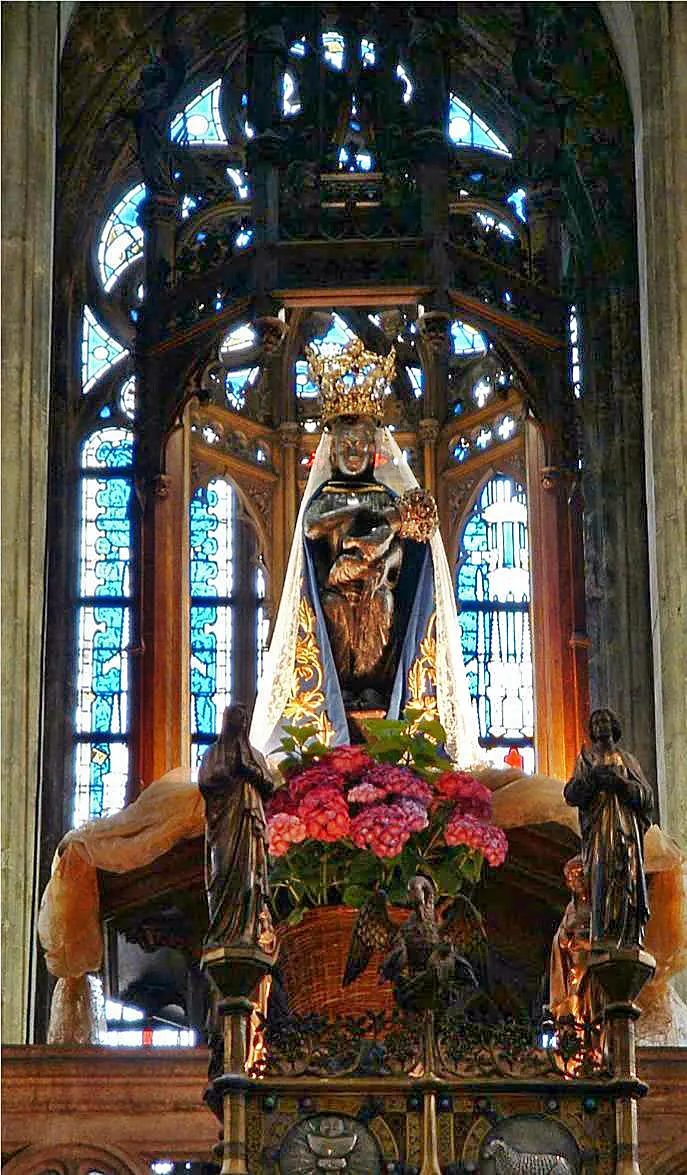
Halle is a small town in Flemish Brabant about fifteen kilometres south of Brussels, and the Sint-Martinusbasiliek — the basilica of Saint Martin — dominates its market square. Inside, on the high altar, stands a walnut statue of the Virgin and Child just over a metre tall, dark with age and ritual handling, crowned and veiled with pearls. The statue was given to Halle around 1267, traditionally by Countess Aleidis of Holland-Hainaut.
Her reputation rests on protection rather than apparition: during the 1489 attack on Halle by the troops of Philip of Cleves, some thirty cannonballs were fired into the town and the basilica; chronicles agree that none caused fatal damage, and the recovered cannonballs were chained in the church as ex-votos where most of them remain. A second deliverance came in 1580 when Calvinist iconoclasts attempted to destroy the statue; she was concealed, smuggled out, and returned safely after the storm.
In 1604 Justus Lipsius published Diva Virgo Hallensis, codifying her miracles for Latin readers across Counter-Reformation Europe. The Habsburgs and Spanish Habsburgs were lifelong devotees. Today she is venerated daily on her altar, and on Pentecost the Sjeúskes procession leads her through Halle in one of the most atmospheric Marian processions in Belgium.
Why this place is sacred
The basilica's thinness is built from layered evidence of intervention. Visitors arriving from the market square enter a Brabantine Gothic interior of long clerestory shadows, gilded altarpieces, and tomb monuments accumulated over seven centuries. The statue itself is smaller than most reproductions suggest — just over a metre — and her impact at close quarters in candlelight is more intimate than grand.
Around her hang the cannonballs of 1489, chained near the choir as material proof of the protection tradition; chronicles agree the balls were fired into the basilica during the siege without killing anyone, and the recovered iron has been displayed in the church ever since. The Trazegnies funerary chapel of 1466, with its alabaster retable, is one of the finest late-medieval ensembles in Belgium and frames the southern aisle.
Visitors commonly remark on the surprise of how small the statue is, on the visible chain of pilgrim badges and royal donations across the centuries, and on the quiet weekday afternoons when contemplation is easiest. On Pentecost the basilica unloads into the streets as the Sjeúskes procession leads the statue through Halle, accompanied by guilds, brass bands, and historical costumes — a procession the town has performed without serious interruption since the thirteenth century.
Construction of the Brabantine Gothic Sint-Martinusbasiliek began in 1341, replacing an earlier chapel that had received the walnut statue in 1267. The basilica was built as a Marian and parish church under the patronage of the dukes of Brabant; Marian devotion was the organising purpose from the outset.
The shrine's reputation as the 'Vierge invincible' was forged through two protection events: the 1489 cannonball miracle during the Brabant War of Succession and the 1580 Calvinist iconoclasm during which the statue was hidden and survived. Justus Lipsius's 1604 monograph Diva Virgo Hallensis carried her cult through Counter-Reformation Europe.
The basilica was raised to minor-basilica status by Pope Leo XIII in 1897; restorations in the late nineteenth and twentieth centuries confirmed the walnut substrate of the statue but did not definitively settle its original surface.
Experience and orientation
Most visitors arrive on the train from Brussels-Midi — twelve minutes — and walk five minutes from Halle station to the basilica. The market square frames the west front, and entering through the north portal brings you into the Brabantine Gothic nave. The high altar carries the statue, framed by a gilded sixteenth-century altarpiece; the lighting is dim enough that the dark walnut reads as almost black against the gilding.
Approach close — she is smaller than reproductions suggest, just over a metre — and the carved details of the pearled veil and the Christ Child's hand are visible at devotional distance. Chained cannonballs hang near the choir as material ex-votos of the 1489 miracle; the Trazegnies funerary chapel of 1466 with its alabaster retable opens off the south aisle and rewards a slow circuit.
The basilica's treasury (visited on guided tour) holds pilgrim badges from across medieval Europe, relics of the True Cross, and royal donations from the Habsburg and Spanish Habsburg courts. Pentecost Monday or the closest Sunday brings the Sjeúskes procession through the town; brass bands, guilds, and historical costumes accompany the statue along a route worn into the streets of Halle by seven hundred years of use.
Allow one to two hours for the basilica, treasury, and Trazegnies chapel. Half a day allows you to attend Mass, walk the procession route on Pentecost, or visit Halle's medieval centre. Tuesdays are traditional Marian devotion days; weekday afternoons outside the procession are best for contemplative time with the statue.
Context and lineage
Around 1267 a small walnut statue of the Virgin and Child, carved by an anonymous Brabantine master in the third quarter of the thirteenth century, was given to the chapel that preceded the present basilica. Tradition names Countess Aleidis of Holland-Hainaut, sister-in-law of the Duke of Brabant, as the donor; some sources instead name Matilda of Brabant. Construction of the Brabantine Gothic Sint-Martinusbasiliek began in 1341 and continued into the early fifteenth century.
During the 1489 Brabant War of Succession, troops of Philip of Cleves bombarded Halle; some thirty cannonballs were fired into the town and the basilica, and chronicles agree that none caused fatal damage. The recovered balls were chained in the church as ex-votos and most remain there.
In 1580 Calvinist forces sacked the town and attempted to destroy the statue; she was concealed, smuggled out, and returned safely after the storm — a Counter-Reformation symbol of Catholic resilience in the Low Countries. In 1604 Justus Lipsius published Diva Virgo Hallensis, carrying her miracle tradition into Latin reading circles across Europe.
The Halle shrine belongs to the Latin Church and is administered by the parish (Federatie Halle / Kerk in Halle) within the Archdiocese of Mechelen-Brussels. Patronage chains lead from the dukes of Brabant through the Burgundian dukes, the Habsburgs, the Spanish Habsburgs (Charles V, Albert and Isabella), and modern Belgian royal devotion.
Countess Aleidis of Holland-Hainaut
Traditionally credited with the gift of the walnut statue to Halle around 1267. Some sources instead name Matilda of Brabant; the documentary record is ambiguous.
Justus Lipsius
Flemish humanist and Counter-Reformation scholar whose Diva Virgo Hallensis (1604) compiled and codified the miracles of the Black Madonna of Halle for a Latin-reading European audience, cementing her place in seventeenth-century Marian devotion.
Archduke Albert and Archduchess Isabella
Spanish Habsburg sovereigns of the Low Countries whose personal devotion to the Black Virgin of Hal — including pilgrimages, votive gifts, and patronage of Lipsius's monograph — anchored the shrine within Counter-Reformation court culture.
Pope Leo XIII
Raised the church of Saint Martin in Halle to the status of minor basilica in 1897, formally recognising its place among the principal Marian shrines of Europe.
Traditions and practice
The Pentecost procession — known locally as the Sjeúskes — has run for more than seven centuries and remains the heart of Halle's devotional year. The statue is carried through the town accompanied by guilds, brass bands, and historical costumes along a route that has changed little over the centuries. Pilgrim badges from medieval Halle survive in collections across Europe and are visible evidence of long-distance pilgrimage from as far as Poland and Scotland.
Silver ex-votos — miniature limbs, hearts, and children — are commissioned through the parish office and left at the Madonna's altar as visible petitions and thanksgivings. The Octave of Halle in early September, around the Nativity of Mary, is the second major pilgrimage of the year; the Procession of the Trinity takes place in late spring.
Daily Masses are celebrated typically morning and evening, in Dutch and occasionally French. Tuesday Marian devotions are held at the statue's altar. Treasury visits — by guided tour only — examine the pilgrim badges, royal gifts, cannonballs, and relics of the True Cross. The basilica is open year-round; restoration scaffolding occasionally affects specific chapels and is announced on the basilica's website.
Approach the statue close enough to register her size — she is smaller than most reproductions imply — and notice the cannonballs near the choir before moving to the Trazegnies chapel. The Litany of Loreto recited at her altar is the traditional Marian devotion; a candle lit at the side stand is the simplest visible act. Weekday afternoons offer the most contemplative encounter; if you have time, return on Tuesday for the Marian devotions.
Roman Catholicism
ActiveHalle has been one of the principal Marian pilgrimage towns of the Low Countries since the late thirteenth century. Habsburg, Burgundian, and Spanish rulers — including Emperor Charles V and Archduke Albert and Isabella — were lifelong devotees. The basilica was made a minor basilica by Pope Leo XIII in 1897. The Black Madonna is credited with deflecting cannonballs during the 1489 Brabant Wars and again with surviving the 1580 Calvinist iconoclasm.
Daily Mass and votive Masses at the Black Madonna's altar; the annual Pentecost (Whitsun) procession through Halle — the Sjeúskes; lighting candles and offering silver ex-votos (miniature limbs, hearts, children); recitation of the Litany of Loreto and rosary before the statue; the Octave of Halle in early September; veneration of relics of the True Cross kept in the basilica's treasury.
Perspectives and open questions
The Black Virgin of Hal is read in three overlapping registers: scholarly art history that places her squarely within the Brabantine walnut Madonna tradition, traditional Catholic devotion that emphasises her protection of town and ruler, and a Black Madonna literature that sometimes reads her against the documentary record.
Scholarly perspective
The Black Virgin of Hal is a Brabantine walnut Madonna of the third quarter of the thirteenth century that became famous through the Burgundian-Habsburg orbit and the Counter-Reformation. Her 'blackness' is best explained by ageing of unpainted walnut combined with centuries of candle and lamp smoke; she belongs typologically to the northern European Black Madonnas rather than to the older Romanesque examples of southern France and the Mediterranean.
The 1489 cannonball miracle is well-attested in contemporaneous chronicles and ex-voto documentation; the iron balls themselves remain in the church.
Living and traditional perspectives
In Halle and across Flemish Brabant she is the 'Vierge invincible', the protectress whose intervention saved the town and persists in the chained cannonballs displayed in the church. Devotees emphasise miracles of protection — from siege, plague, fire, and modern threats — over private spiritual experiences. The Habsburg and Spanish Habsburg houses anchored her status as a Counter-Reformation Madonna of resistance.
Alternative interpretations
Some twentieth-century Black Madonna writers, including Ean Begg, read Halle within a broader thesis of pre-Christian dark-goddess survival. Mainstream scholarship rejects this reading for Halle specifically, given the documentary chain of custody from the 1267 gift onward and the clear stylistic placement of the statue within the Brabantine Gothic carving tradition.
Open questions
The original sculptor and patron of the statue remain unidentified. Whether the statue was originally polychromed, and to what colour, before darkening through age and ritual handling, has not been settled by twentieth-century restoration.
Plan your visit
Access and arrival
Halle is in Flemish Brabant, about 15 km southwest of Brussels. Frequent train services from Brussels-Midi (around 12 minutes) reach Halle station, a 5-minute walk from the basilica. Driving from Brussels takes 25–40 minutes depending on traffic; car parks are available near the Grote Markt. The basilica is fully walkable from the station; the precinct is largely accessible. Mobile signal in central Halle is reliable.
The basilica is housed in the Sint-Martinusbasiliek — Saint Martin's — and the Black Madonna lives on its high altar; orient yourself by the basilica's twin towers visible from the market square. Check the basilica website for restoration scaffolding, treasury tour times, and current procession schedule.
Halle is small but well-equipped with hotels and B&Bs. Most visitors stay in Brussels and travel by train, which is convenient given the twelve-minute connection. Book in advance for Pentecost weekend, when accommodation along the procession route is scarce.
Respectful visit
Modest church dress, covered shoulders and knees. Smarter dress is normal for the Pentecost procession.
Allowed in the basilica outside of liturgy; no flash near the statue and treasury items. Tripods and commercial photography require permission.
Candles at the Madonna's altar, monetary donations, written prayer intentions, and commissioned silver ex-votos through the parish office.
Silence in the choir and chapels. Do not touch the statue or cannonballs. Treasury access by guided tour only.
Pentecost Monday brings dense crowds along the procession route; arrive early if you want a position. Photography is allowed in the basilica outside of liturgy, but flash is not used near the statue and treasury items, and tripods and commercial photography require permission. Do not touch the statue or the cannonballs. Silence is observed in the choir and chapels.
Location
Map loads as you approach this section.
Pilgrim reflections
A portrait of encounter, not a score
Pilgrims describe what they felt, how present they could become, and whether the place would shape a journey. There are no stars and no ranking of traditions.
No reviewed reflections yet
The first pilgrims can help describe the character of being here.
Share a reflection
Available after an account-backed “Been there.” Every reflection is reviewed before publication.
Nearby sacred places
Explore other sacred places in the region. Proximity does not establish access or travel time; check each place’s guidance.

Saint Martin Basilica, Halle
Halle, Flemish Brabant, Belgium
0.0 km away
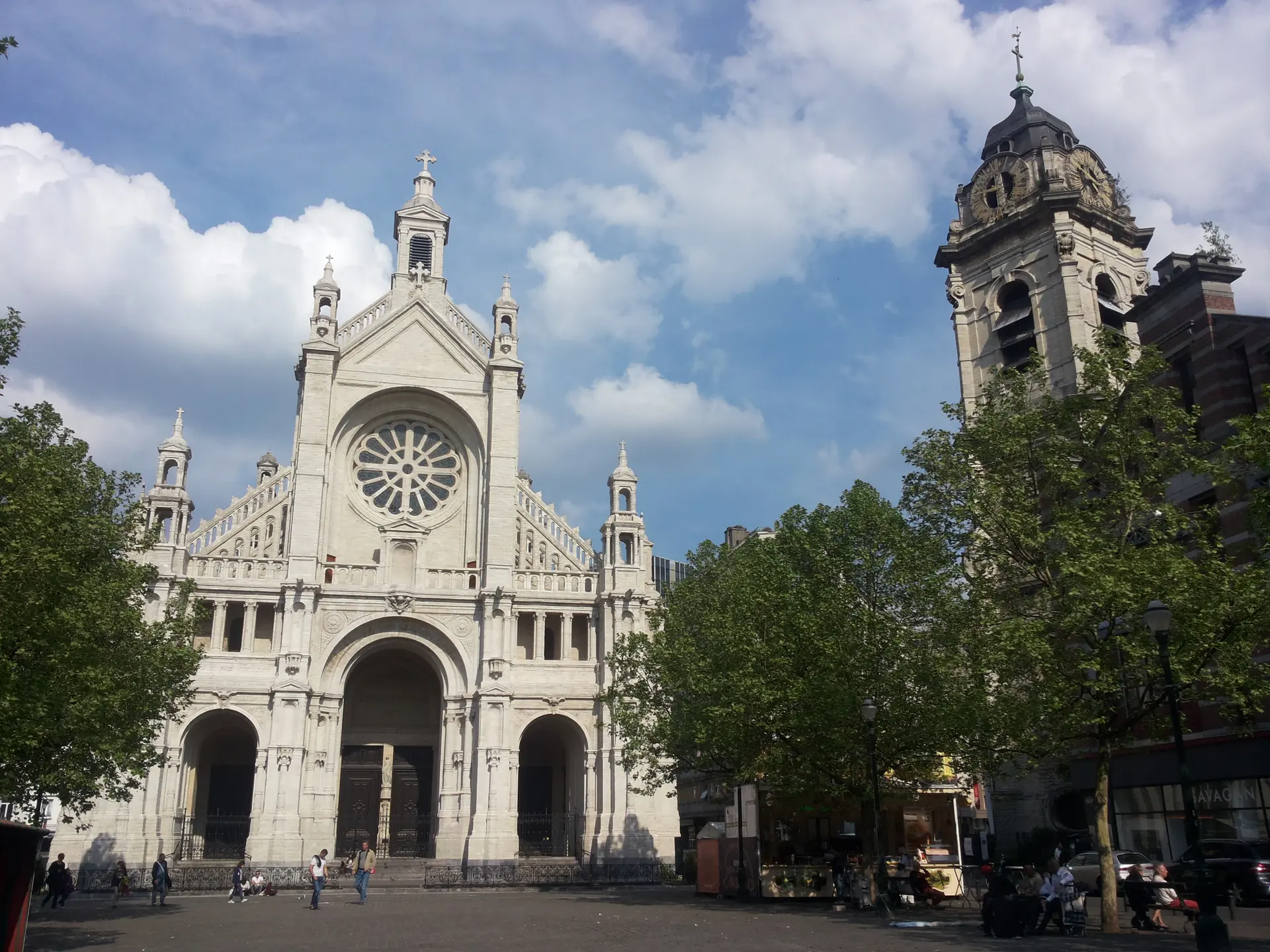
Church of St. Catherine with Black virgin of Brussel
Brussels, Brussels-Capital, Belgium
15.0 km away

Collegiate Church of Saint Gertrude
Nivelles, Nivelles, Walloon Brabant, Belgium
16.6 km away

Grimbergen Abbey and Saint Servatius Basilica
Grimbergen, Grimbergen, Flemish Brabant, Belgium
23.8 km away
Photo gallery
2 curated photos
Share a photo
Help visitors recognize Our Lady the Black Virgin of Hal. Every submission is reviewed before publication.