Chiesa di San Pietro della Ienca
A pope's mountain refuge where medieval stone meets the silence of Gran Sasso
Understand sacred places, explore living traditions, and learn how to engage respectfully with Pilgrim Map.
Access has not been verified. Check current local guidance before planning a visit.
San Pietro della Ienca, L'Aquila, Italy
Read the sources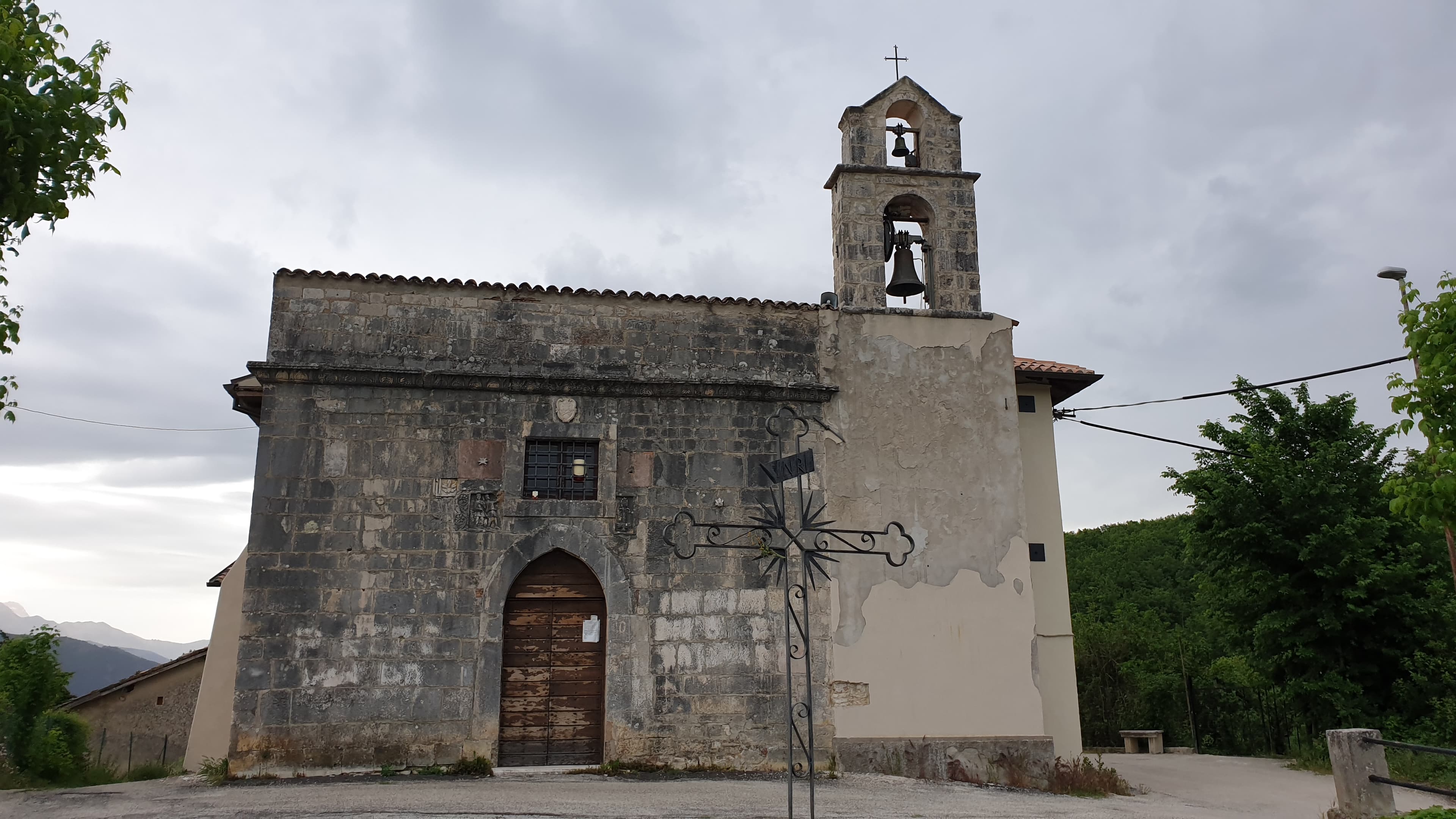
Image of Chiesa di San Pietro della Ienca. Image source · CC-BY-SA-4.0
Visit essentials
A quick read before you go
- Duration
- 1-2 hours for the sanctuary and hamlet; half-day if combining with hiking trails in the Gran…
- Access
- By car from L'Aquila via Assergi and Camarda on a mountain road.
Overview
San Pietro della Ienca occupies the threshold of a mountain hamlet abandoned by its original inhabitants and only partly reclaimed, roughly eleven hundred metres up the Gran Sasso's western slopes, where restored stone buildings overlook a valley shifting from cool morning light to late-afternoon ochre. The church is documented from Alexander III's 1178 papal bull.
The village prospered enough in the thirteenth century to be taxed at twice the rate of neighbouring Camarda, but L'Aquila drew residents away and both village and church lay ruined by the fifteenth century. Recovery began after the mountaineering pope Karol Wojtyla came to ski, hike, and pray in solitude, returning at least three times in the 1980s and 1990s.
His visits catalyzed restoration in 1995–1997, and on May 18, 2011, the church became the first European sanctuary dedicated to Saint John Paul II. A bronze statue shows him blessing beside a stone stele and fountain; memorabilia remain inside. Its intimacy suits individuals, small groups, and walkers arriving after an hour from Assergi, where mountain landscape, centuries of prayer, and one pope's devotion converge.
Why this place is sacred
The earliest reference to this church appears in a papal bull of 1178, where it is likely identified as San Pietro del Guasto. Later documents name it San Pietro de Fonte before the current name settled at the end of the thirteenth century.
The village's coat of arms carried two crossed keys of Saint Peter bound by a red band on a yellow field, mirroring the papal emblem and confirming the dedication to Peter the Apostle rather than the later Peter Celestine.
What remains today is probably a fragment of a larger monastic complex that once formed the heart of the settlement. The Romanesque lines of the church suggest the simplicity of a mountain religious house, built to endure winters at altitude rather than to impress visitors. Stone walls, a modest interior, a commanding position from which one looks down into the valley: these are the elements that survived the village's decline.
The thinness of this place deepened in the twentieth century through an improbable convergence. John Paul II, known as the theologian of the mountain, found in the Gran Sasso what he could not find in Vatican City: solitude sufficient for contemplative prayer. He came not as a visiting dignitary but as a man seeking silence. The mountains of Abruzzo, he suggested, were particularly stimulating both spiritually and physically.
His repeated visits through the 1980s and 1990s were sometimes official, sometimes private, always oriented toward that interior quiet.
The sanctuary designation of 2011 formalized what the pope's presence had already accomplished: the transformation of a forgotten medieval ruin into a living place of pilgrimage. The thinness here is not the dramatic thinness of ancient temples or sites of apparition.
It is the thinness of sustained attention, of a place where prayer has been offered across centuries by anonymous monastics and by one of the most recognizable spiritual leaders of the modern age, all of them drawn by the same mountain silence.
Medieval church, likely part of a monastic complex, serving the settlement of San Pietro della Ienca. First documented in 1178 in a papal bull of Alexander III.
Prosperous in the 13th century, ruined by the 15th century as L'Aquila drew away inhabitants. Rediscovered by Pope John Paul II in the 1980s. Restored 1995-1997. Erected as sanctuary dedicated to John Paul II on May 18, 2011.
Experience and orientation
The approach to San Pietro della Ienca is itself a form of preparation. Whether driving the mountain road from Assergi or walking the trail that climbs through changing vegetation for roughly an hour, the journey moves steadily away from the inhabited valley toward something more spare. The hamlet appears on its hillside, stone buildings restored to various degrees of completion, some impeccable, others still showing the centuries of abandonment.
The church holds a commanding position, a small building from which the eye travels down into the valley and across to the peaks of the Gran Sasso massif. The proportions are human rather than monumental. This is not a basilica designed to overwhelm but a mountain church designed to shelter prayer.
In the small piazza, the bronze statue of John Paul II stands with hand raised in blessing, a palm branch in his other hand. The stone stele and fountain complete the modest civic space. Inside the church, the Romanesque simplicity has been preserved through the restoration. Papal memorabilia remain as testimony to the visits that transformed this forgotten place into a sanctuary.
The atmosphere holds a quality that visitors consistently describe as peaceful, a word that in this context carries more weight than its common usage might suggest.
The experience deepens with time. Those who stay beyond the initial visit, who sit with the silence rather than photographing through it, report something closer to what John Paul II himself seems to have found here: a place where the altitude and the stone and the absence of distraction permit an interior settling. Late afternoon, when spring light paints the walls in tones of ochre and rose, is the hour most visitors identify as the sanctuary's finest.
The surrounding landscape extends the experience. Trails connect the hamlet to other points in the Gran Sasso National Park, and the Cammino Naturale dei Parchi long-distance route passes through, linking San Pietro della Ienca to a broader network of walking pilgrimage. For those who arrive on foot, the physical effort of the climb becomes inseparable from the spiritual arrival.
San Pietro della Ienca sits at approximately 1,100 meters altitude on the western slopes of the Gran Sasso massif, in the province of L'Aquila, Abruzzo. The hamlet lies between the villages of Assergi and Camarda, near the Gran Sasso tunnel entrance. The church occupies a hilltop position with panoramic views into the valley below.
Context and lineage
The earliest documentary evidence appears in a papal bull of Alexander III dated September 24, 1178, which mentions three churches in the valley. The church then called San Pietro del Guasto is believed to correspond to the present building. Later known as San Petrus de Fonte, it assumed its current name by the end of the thirteenth century.
The settlement participated in the founding of L'Aquila, receiving a location in the quarter of Santa Maria where it built the church of Saints Peter and Nicholas. In 1269 the village was taxed at double the rate of nearby Camarda, indicating considerable prosperity. But the gravitational pull of the new city drew inhabitants away, and by the fifteenth century the village stood in ruins.
The church belongs to the Roman Catholic tradition. Its medieval origins suggest monastic use, though the specific order is not documented. Its modern significance is entirely connected to the papacy of John Paul II and the subsequent designation as a sanctuary within the Archdiocese of L'Aquila.
Pope John Paul II (Karol Wojtyla)
Pontiff who adopted the site as his personal mountain retreat
Archbishop Giuseppe Molinari
Presided over the solemn ceremony erecting the church as a sanctuary
Pope Alexander III
Issued the 1178 papal bull containing the first known reference to the church
Traditions and practice
The church's medieval practices are undocumented. As part of a probable monastic complex, it would have hosted the regular round of liturgical prayer according to the customs of whichever order maintained it.
Mass is celebrated in the sanctuary, sometimes in both Italian and Polish in honor of the Polish pope's connection to the place. The feast of Saint John Paul II on October 22 draws pilgrims annually. The Cultural Association San Pietro della Ienca organizes the annual International Award La Stele della Ienca, which includes a Mass celebrated by the Cardinal Archbishop of L'Aquila. Torchlit processions mark certain commemorative occasions.
Arrive on foot from Assergi if weather and fitness permit; the one-hour uphill walk serves as preparation for the sanctuary. Spend time in the church with the papal memorabilia, then sit outside where the view opens toward the Gran Sasso peaks. If timing allows, attend Mass. Late afternoon offers the best light and deepest quiet.
Roman Catholicism
ActiveThe first European sanctuary dedicated to Saint John Paul II, established 2011. The pope's personal retreat for contemplative prayer in the mountains of Abruzzo during the 1980s and 1990s.
Mass, pilgrimage, veneration of papal memorabilia, annual feast day celebrations, La Stele della Ienca award ceremony
Perspectives and open questions
San Pietro della Ienca invites interpretation through multiple lenses: as a medieval monument, as a papal pilgrimage site, and as a place where mountain landscape and human devotion intersect.
Scholarly perspective
Historians document the church from 1178 and trace the settlement's participation in the founding of L'Aquila. The architectural remains suggest a Romanesque building that was likely part of a larger monastic complex. The modern significance is attributed entirely to the personal devotion of Pope John Paul II, whose visits catalyzed restoration and eventually sanctuary status.
Living and traditional perspectives
Within Catholic tradition, the sanctuary represents the continuation of a deep connection between mountain solitude and contemplative prayer. John Paul II's choice of this remote place echoes the impulse that drew early monastics to mountain hermitages across the Apennines. The sanctuary's designation affirms the sacredness not only of the building but of the landscape that drew a pope to prayer.
Alternative interpretations
Some visitors approach the site outside specifically Catholic frameworks, drawn by the mountain setting, the medieval stonework, and a more general sense of spiritual receptivity that they associate with high places and ancient structures. The Gran Sasso itself carries significance as one of Italy's most prominent mountain massifs, and the hamlet's position on its slopes resonates with traditions that associate altitude with spiritual proximity.
Open questions
The full history of the medieval monastic complex remains obscure. Archaeological investigation could reveal the extent of the original settlement and the identity of the religious order that maintained it. The reasons for the village's thirteenth-century prosperity and subsequent rapid decline also remain incompletely understood.
Plan your visit
Access and arrival
By car from L'Aquila via Assergi and Camarda on a mountain road. On foot from Assergi, approximately one hour uphill (1,900 meters distance, 160 meters elevation gain). Also a stop on the Cammino Naturale dei Parchi long-distance trail.
No accommodation in the hamlet itself. Assergi and L'Aquila (approximately 15 km) offer hotels and guest houses. Campo Imperatore has mountain refuges.
Respectful visit
Shoulders and knees covered, as standard for Catholic churches in Italy.
Photography is generally permitted in the hamlet and exterior. Inside the church, respectful photography without flash is likely acceptable, but visitors should defer to any posted guidelines or the preferences of those at prayer.
Candles and donations are accepted at the sanctuary.
Winter road conditions may prevent access | Seasonal opening hours apply | Silence during any liturgical celebration
The mountain road may be difficult or impassable in winter. Verify opening hours before visiting, as they vary seasonally. The hamlet has minimal facilities.
Current practical details
Address
SP86, 67100 San Pietro della Ienca AQ, Italy
Phone
Hours
Hours, fees, and access can change — verify on the official source before you travel. Practical details last checked Jun 2026.
Location
Map loads as you approach this section.
Pilgrim reflections
A portrait of encounter, not a score
Pilgrims describe what they felt, how present they could become, and whether the place would shape a journey. There are no stars and no ranking of traditions.
No reviewed reflections yet
The first pilgrims can help describe the character of being here.
Share a reflection
Available after an account-backed “Been there.” Every reflection is reviewed before publication.
Nearby sacred places
Explore other sacred places in the region. Proximity does not establish access or travel time; check each place’s guidance.



References
Sources consulted for this page. Source categories describe the publication, not a guarantee that every claim is verified. Traditional accounts and outside interpretations may differ.
- 01Santuario San Giovanni Paolo II official site — Santuario San Giovanni Paolo IIofficialOfficial sanctuary website
- 02Chiesa di San Francesco e Santuario di San Pietro della Ienca — Abruzzo TurismoSource contextOfficial regional tourism source
- 03Chiesa di San Pietro della Ienca - Wikipedia (Italian) — Wikipedia contributorsencyclopediaItalian Wikipedia article with historical documentation
- 04San Pietro della Ienca - In the Footsteps of John Paul II — Life in AbruzzoguideDetailed visitor account with historical and practical information
- 05Unexpected Abruzzo: A One-Day Itinerary Through Timeless Villages and the Sanctuary of San Pietro della Ienca — Viaggiando ItaliaguideTourism guide with visitor experience details
- 06San Pietro della Ienca - Cammino Naturale dei Parchi — Cammino Naturale dei ParchiSource contextPart of long-distance walking trail network
Share a photo
Help visitors recognize Chiesa di San Pietro della Ienca. Every submission is reviewed before publication.