Cattedrale di Santa Maria Assunta, Rieti
A cathedral at Italy's navel where popes canonized saints and crowned kings
Understand sacred places, explore living traditions, and learn how to engage respectfully with Pilgrim Map.
Access has not been verified. Check current local guidance before planning a visit.
Rieti, Rieti, Italy
Read the sources
Image of Cattedrale di Santa Maria Assunta, Rieti. Image source · CC-BY-SA-4.0
Visit essentials
A quick read before you go
- Duration
- 45 minutes to 1 hour for the cathedral, crypt, and baptistery
- Access
- Central Rieti, near Piazza Cesare Battisti.
Overview
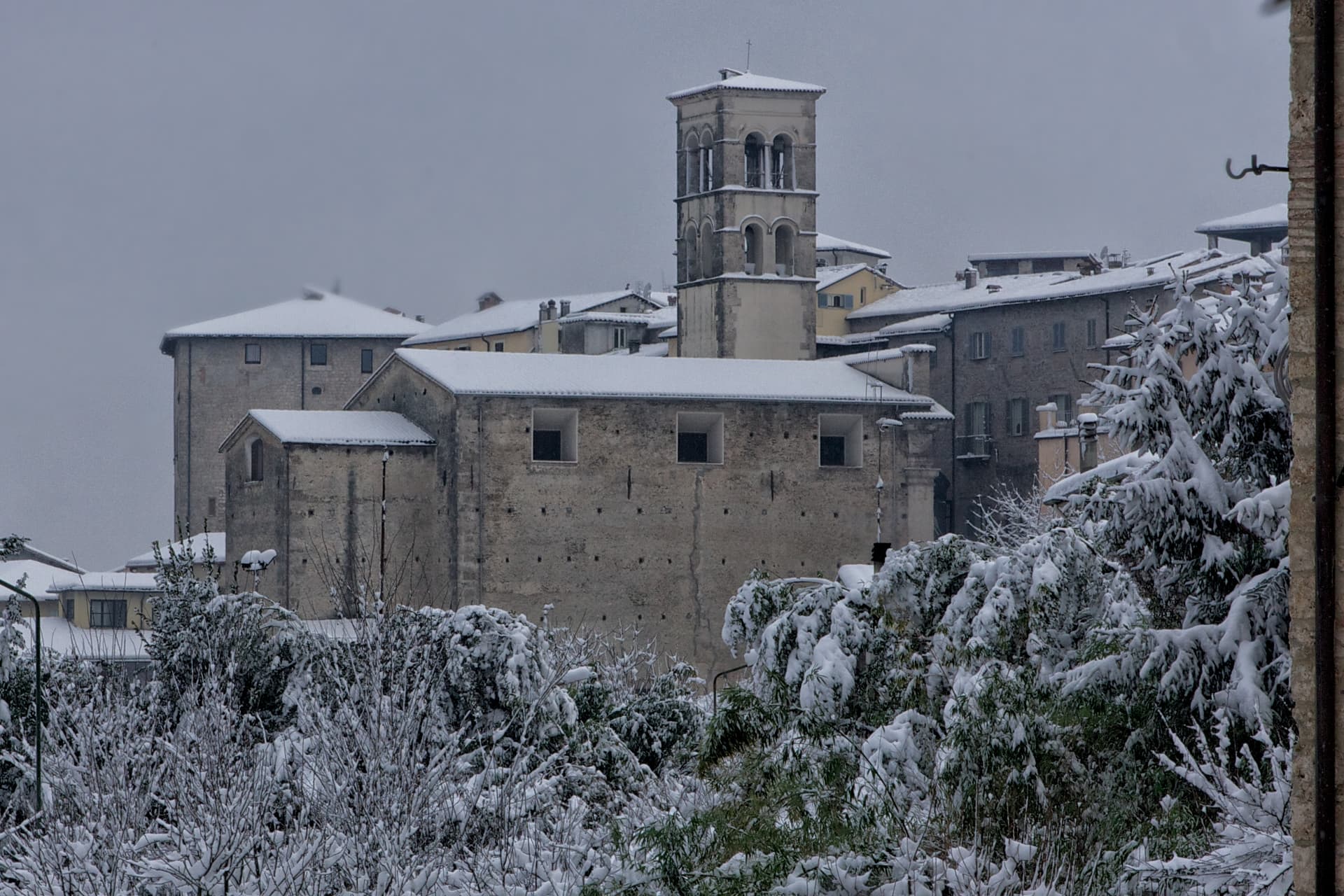
Rieti has been called the umbilicus Italiae, the navel of Italy. Whether or not the geographic claim is precise, the city's cathedral stands at a significant intersection of Christian history. Its Romanesque exterior, with hanging arches and splayed windows, contrasts with the Baroque interior; the crypt, its oldest surviving element, holds the spare gravity of Romanesque simplicity. The bell tower, completed in 1252, still marks the skyline.
Within these walls, Pope Gregory IX celebrated the canonization Mass of Saint Dominic on July 13, 1234, and Pope Nicholas IV crowned Charles II of Anjou as King on May 29, 1289. As mother church of the Diocese of Rieti, the cathedral is also a gateway to the Valle Santa: four Franciscan sanctuaries mark hills where Saint Francis wrote his Rule, created the first living nativity, and composed the Canticle of the Sun.
They radiate from the city center like the arms of a mystical cross, with the cathedral as their still point.
Why this place is sacred
The first documented act of sacredness at this site occurred in 598, when Pope Gregory the Great instructed Bishop Crisanto of Spoleto to deposit the relics of the martyrs Hermes, Hyacinth, and Maximus near the baptismal font of the Cathedral of Rieti. This act of placing martyrs' bones in the foundation of worship established a pattern that would deepen over fourteen centuries.
The thirteenth century was the cathedral's period of greatest historical significance. Rieti, positioned between Rome and the papal territories, frequently served as an alternative papal seat. The city's importance to the papacy brought extraordinary events within the cathedral's walls. The canonization of Saint Dominic by Pope Gregory IX on July 13, 1234, marked the formal recognition of the founder of the Order of Preachers in this very space.
The coronation of Charles II of Anjou by Pope Nicholas IV in 1289 added royal ceremony to the cathedral's accumulated gravity.
Beneath the Baroque interior that later centuries imposed, the Romanesque crypt preserves the atmosphere of the earlier building. Consecrated in 1157 by Bishop Dodone, the crypt carries the spare, grounded quality of medieval worship spaces: low ceilings, heavy columns, the sense of being enclosed by stone that has absorbed a millennium of prayer.
The cathedral's contemporary thinness is shaped by its position within the Valle Santa. Saint Francis of Assisi came to the Rieti valley repeatedly from 1209 onward, establishing four sanctuaries on the hills that surround the plain. At Fontecolombo he wrote the Franciscan Rule. At Greccio he created the first living nativity. The cathedral sits at the center of this Franciscan geography, the urban counterpart to the mountain hermitages, the place where the institutional Church and the radical Franciscan vision intersect.
Cathedral and mother church of the Diocese of Rieti, documented from at least 598 CE
Rebuilt from 1109 under Bishop Benincasa. Crypt consecrated 1157. Upper church consecrated 1225 by Pope Honorius III. Bell tower completed 1252. Interior modified to Baroque style in later centuries. Designated minor basilica and national monument.
Experience and orientation
The cathedral occupies a central position in Rieti's historic core, its bell tower visible above the surrounding medieval buildings. The Romanesque facade, with its upper decoration of hanging arches and three slightly splayed windows, prepares visitors for an earlier period than what the interior delivers.
Entering through the central portal, with its twelfth-century floral and zoomorphic carvings, the transition to the Baroque interior is immediate. The Latin cross plan opens into three naves separated by semicircular arches on rectangular pillars, surfaced in polychrome marble. The modification from Romanesque to Baroque is a familiar Italian cathedral story, representing centuries of evolving taste imposed on ancient bones.
The crypt rewards the descent. Corresponding to the most ancient surviving portion of the building, it carries the weight of the 1157 consecration. The Romanesque proportions, the heavy columns, the low ceiling create an atmosphere of concentrated age. Here, beneath the later additions, the cathedral's earliest centuries remain accessible.
The Baptistery of San Giovanni in Fonte, adjacent to the cathedral's southern side and connected by a fifteenth-century portico (1458), contains an elegant baptismal font from the same century. The baptistery itself dates from the fourteenth century and preserves a more intimate scale than the cathedral nave.
Outside, the bell tower stands as the most recognizably Romanesque element of the complex. Completed in 1252, its proportions are typical of central Italian campanili: square, rising in stages, pierced by windows that increase in number toward the summit. The view from its base takes in the roofscape of medieval Rieti and, beyond the city walls, the hills where the Franciscan sanctuaries sit in their oak forests.
The cathedral stands in the historic center of Rieti, in the Lazio region, approximately 80 km northeast of Rome. It faces the Piazza Cesare Battisti. The bell tower rises on the cathedral's north side. The baptistery adjoins to the south, connected by a covered portico.
Context and lineage
The earliest record of the cathedral appears in 598, when Pope Gregory the Great instructed the deposit of martyrs' relics near the baptismal font. The building that housed these relics was substantially rebuilt from 1109 under Bishop Benincasa. The crypt was consecrated in 1157, and the full cathedral was consecrated by Pope Honorius III on September 9, 1225, during a period when Rieti served frequently as an alternative papal seat.
The cathedral is the mother church of the Diocese of Rieti, one of the oldest dioceses in central Italy. Its relationship to the papacy, particularly in the thirteenth century, gives it a significance beyond its diocesan role. Its position at the center of the Valle Santa connects it to the Franciscan pilgrimage network.
Pope Gregory the Great
First documented papal involvement with the cathedral (598)
Bishop Benincasa
Initiated the reconstruction of the cathedral (1109)
Pope Honorius III
Consecrated the cathedral (1225)
Pope Gregory IX
Celebrated the canonization Mass of Saint Dominic here (1234)
Saint Dominic
Founder of the Dominican Order, canonized in this cathedral
Traditions and practice
Daily Mass and the Liturgy of the Hours have been celebrated here continuously for centuries. The cathedral has hosted papal liturgies, canonizations, and royal coronations.
Regular diocesan liturgical life continues. The cathedral serves as a reference point for pilgrims walking the Cammino di Francesco between the four Franciscan sanctuaries of the Valle Santa.
Begin in the crypt, the oldest and most atmospherically resonant space. Ascend to the main church to experience the Romanesque-to-Baroque transition. Visit the baptistery through the connecting portico. If timing allows, attend Mass. Consider the cathedral as the first stop before exploring the Franciscan sanctuaries radiating from the city.
Roman Catholicism
ActiveMother church of the Diocese of Rieti since at least the 6th century. Site of the canonization of Saint Dominic (1234). Minor basilica and national monument. Gateway to the Valle Santa.
Daily Mass, Liturgy of the Hours, diocesan celebrations, sacramental life
Perspectives and open questions
The Cathedral of Rieti invites reading as a palimpsest of architectural and historical layers, as a papal monument, and as the anchor point for the Franciscan geography of the Valle Santa.
Scholarly perspective
The cathedral is documented from 598 and was substantially rebuilt in the twelfth century. Its role as a papal seat in the thirteenth century is well-established in historical scholarship. The architectural evolution from Romanesque to Baroque is typical of central Italian cathedrals that have remained in continuous use.
Living and traditional perspectives
Within Catholic tradition, the cathedral's significance is threefold: as a diocesan mother church with fourteen centuries of continuous worship, as the site of the canonization of Saint Dominic, and as the center of the Valle Santa Franciscan pilgrimage landscape.
Alternative interpretations
Rieti's claimed status as the umbilicus Italiae, the geographic center of Italy, gives the cathedral a symbolic resonance beyond its ecclesiastical function. Some visitors perceive in this centrality a deeper significance, connecting the site to ideas of sacred geography and axis mundi.
Open questions
The pre-Romanesque cathedral beneath the current building remains largely unexplored archaeologically. The full extent of sixth- and seventh-century worship at this site is not known.
Plan your visit
Access and arrival
Central Rieti, near Piazza Cesare Battisti. Rieti is accessible by COTRAL bus from Rome Tiburtina station (approximately 1.5 hours). Limited train service. Car from Rome via the Via Salaria (approximately 80 km).
Hotels and guest houses in Rieti city center. Some Franciscan sanctuaries offer pilgrim accommodation.
Respectful visit
Modest dress: shoulders and knees covered.
Photography without flash generally permitted. No photography during services.
Candles available. Donations appreciated for maintenance.
Silence during liturgical celebrations | No flash photography | Crypt access may be restricted at certain times
Visiting hours for the crypt may vary. Check locally before planning.
Current practical details
Address
Piazza Cesare Battisti, 1, 02100 Rieti RI, Italy
Phone
Hours, fees, and access can change — verify on the official source before you travel. Practical details last checked Jun 2026.
Location
Map loads as you approach this section.
Pilgrim reflections
A portrait of encounter, not a score
Pilgrims describe what they felt, how present they could become, and whether the place would shape a journey. There are no stars and no ranking of traditions.
No reviewed reflections yet
The first pilgrims can help describe the character of being here.
Share a reflection
Available after an account-backed “Been there.” Every reflection is reviewed before publication.
Nearby sacred places
Explore other sacred places in the region. Proximity does not establish access or travel time; check each place’s guidance.


References
Sources consulted for this page. Source categories describe the publication, not a guarantee that every claim is verified. Traditional accounts and outside interpretations may differ.
- 01Cattedrale di Santa Maria Assunta - Italia.it — Italia.itSource contextOfficial Italian tourism portal
- 02CATHOLIC ENCYCLOPEDIA: Rieti — New AdventencyclopediaHistorical diocesan information
- 03Cattedrale di Santa Maria Assunta (Rieti) - Wikipedia (Italian) — Wikipedia contributorsencyclopediaComprehensive Italian Wikipedia article
- 04Rieti, Italy and its Cathedral — OnePeterFiveblogDetailed account with historical and architectural information
- 05Diocese of Rieti - Wikipedia — Wikipedia contributorsencyclopediaDiocesan history context
Share a photo
Help visitors recognize Cattedrale di Santa Maria Assunta, Rieti. Every submission is reviewed before publication.