Canterbury Cathedral
Where a martyr's blood consecrated the mother church of Anglican faith
Understand sacred places, explore living traditions, and learn how to engage respectfully with Pilgrim Map.
Access has not been verified. Check current local guidance before planning a visit.
Canterbury, England, United Kingdom
Read the sources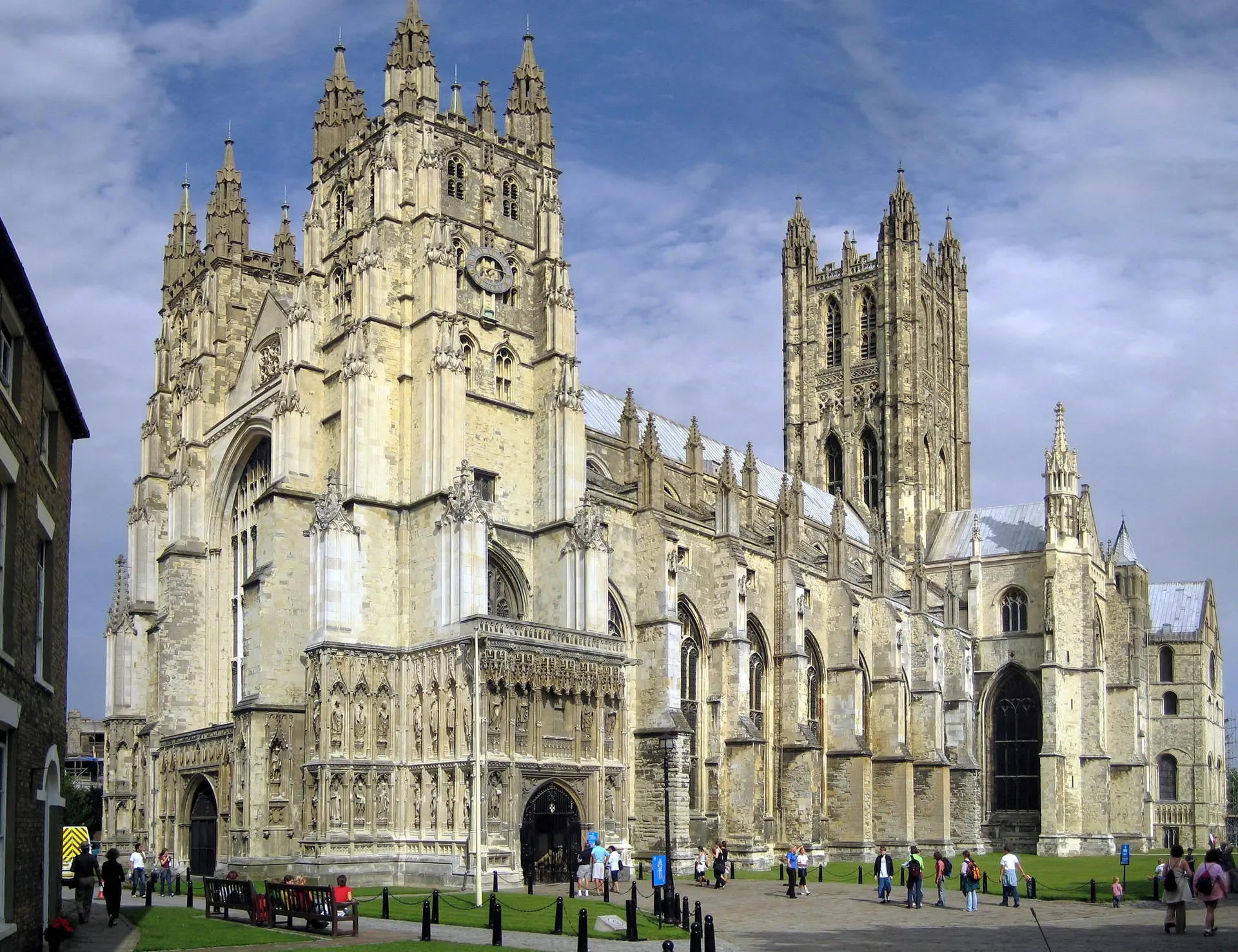
Image of Canterbury Cathedral. Image source · CC-BY-SA-4.0
Visit essentials
A quick read before you go
- Duration
- Two to three hours allows a thorough visit to the nave, crypt, Trinity Chapel, cloisters, and…
- Access
- Canterbury Cathedral is at CT1 2EH, in the centre of Canterbury, Kent.
Overview
Millions of pilgrims have crossed Canterbury Cathedral's threshold, from medieval penitents seeking Becket's intercession to modern walkers arriving from Winchester, and the history remains a living atmosphere rather than museum display. The Perpendicular nave rises in fan vaults above a low Norman crypt whose columns carry creatures from a pre-Gothic imagination.
In the northwest transept, stone floor and suspended steel mark the exact spot where Archbishop Thomas Becket was killed on the evening of 29 December 1170; the Altar of the Sword's Point is among England's most precisely located sacred sites.
Trinity Chapel, built in the late 12th and early 13th centuries for Becket's translated shrine, retains jewelled Miracle Windows recording healings ascribed to him soon after death. Henry VIII ordered the shrine destroyed in 1538; one candle marks its place. Founded by Saint Augustine in 597, Canterbury is the Church of England's institutional root and symbolic centre of an Anglican Communion of some 85 million Christians: both oldest and living heart of English Christianity.
Places within this site
Why this place is sacred
Few sites in England concentrate so much sacred weight in so defined a space. Canterbury Cathedral is not a ruin or a monument but a living building where daily choral services have continued for over fourteen centuries. The Norman crypt, among the largest and oldest surviving in England, preserves an atmosphere of profound antiquity that resists the interpretive apparatus of tourism.
The Altar of the Sword's Point in the northwest transept is perhaps the most emotionally immediate site in the entire building: a stone floor, a modern sculptural crown of thorns suspended above, and the knowledge — precise and documented — that here a man was killed for the claims of conscience against the claims of power. In Trinity Chapel, the Miracle Windows were made within living memory of the events they depict, their blues and reds still carrying medieval light.
The candle that marks the shrine's location functions as a thin-place anchor, drawing the attention of pilgrims arriving from across England and across the world to a specific, irreplaceable point of contact with the past.
Founded by Saint Augustine of Canterbury in 597 as a cathedral church for the first Archbishop of Canterbury, on the orders of Pope Gregory the Great, as the centre of his mission to convert the Anglo-Saxons. From its earliest years it served both as the administrative seat of the English church and as a centre of worship and community life for the surrounding city.
The cathedral has passed through several distinct identities: apostolic mission church (597 onwards); Benedictine cathedral priory (late 10th century to 1540); the supreme English pilgrimage destination, centred on Becket's shrine (1173–1538); a post-Reformation Church of England cathedral (1540 to present) with an active choral and pilgrimage ministry. The physical building preserves evidence of all these phases in its Norman undercroft, Gothic choir, medieval windows, and Perpendicular nave.
The suppression of the Benedictine community and destruction of Becket's shrine under Henry VIII represent the cathedral's most dramatic rupture; yet the building survived — almost uniquely among English monastic cathedrals — substantially intact.
Experience and orientation
The approach to Canterbury Cathedral from the west — along the high street, through the medieval Christ Church Gate — is itself a piece of ritual geography unchanged in its essentials since the 12th century. Pilgrims completing the Pilgrim's Way from Winchester arrive through the Westgate Towers and follow streets that their medieval predecessors knew.
The cathedral's exterior is a composite of Norman, Early Gothic, and Perpendicular periods, its silhouette dominated by the Bell Harry Tower, completed in 1505, whose fan-vaulted interior rewards anyone who pauses beneath it. Inside, the scale of the nave is arresting: long, high, and saturated with the cool grey-gold light of English stone.
The choir screen frames the approach to the eastern arm of the building, where the architecture changes register from the broad Perpendicular west to the tighter, more vertical Early English Gothic of the choir, rebuilt by William of Sens after the disastrous fire of 1174. Descending into the Norman crypt, the temperature drops; the carved capitals — monsters, foliage, ambiguous figures — belong to a visual vocabulary that preceded the Gothic.
Returning to ground level and moving east to Trinity Chapel, the Miracle Windows come into view: twelve windows of medieval glass, each panel narrating the healing of a specific supplicant at Becket's shrine, the colours dense and jewelled against English sky. Where the shrine stood, a single candle burns. The juxtaposition — elaborate medieval glass recording miracles above, bare stone and a single flame below — is a quietly charged act of sacred memory.
Enter through the southwest porch (main accessible entrance) or the Christ Church Gate from the Buttermarket. The nave is immediately to the east; the northwest transept and martyrdom site (Altar of the Sword's Point) are to the left. The choir screen leads through to the choir and high altar; Trinity Chapel with the shrine site and Miracle Windows is in the far east. The Norman crypt is accessed from the choir.
The cloisters and Chapter House are reached from the north side of the nave.
Context and lineage
In 597, Pope Gregory the Great sent Augustine and forty monks from Rome on a mission to convert the Anglo-Saxon kingdoms of Britain. Augustine landed in Kent and was received by King Æthelberht, whose Frankish queen Bertha was already a Christian who worshipped at the ancient Church of St Martin on the city's edge. Æthelberht converted, and Augustine was consecrated the first Archbishop of Canterbury, establishing his cathedral at the capital of the Kentish kingdom.
The building that Augustine founded has been continuously in use as a cathedral church ever since — making it the oldest occupied episcopal see in England. The Norman Conquest brought a wholesale rebuilding under Archbishop Lanfranc from 1070, and the choir was rebuilt again in the Gothic style after a catastrophic fire in 1174. That rebuilding, supervised by the French mason William of Sens and then William the Englishman, introduced French Gothic architecture to England for the first time.
Trinity Chapel was added specifically to receive the translated remains of Thomas Becket in 1220. The Perpendicular nave and Bell Harry Tower were completed in the 15th and early 16th centuries, giving the cathedral its present form.
Church of England, tracing direct institutional continuity from Augustine's mission of 597. The see of Canterbury has been occupied without interruption for over 1,400 years. The cathedral was a Benedictine cathedral priory from the late 10th century until the Dissolution in 1540. It is a UNESCO World Heritage Site (1988), inscribed as part of the three-site grouping with St Augustine's Abbey and St Martin's Church.
Saint Augustine of Canterbury
Founder; first Archbishop of Canterbury (d. c.604)
Saint Thomas Becket
Archbishop of Canterbury, martyr (c.1118–1170)
William of Sens
Master mason (active 1174–1178)
King Henry II
King of England (1154–1189)
Geoffrey Chaucer
Poet (c.1343–1400)
Traditions and practice
Medieval pilgrimage to Becket's shrine was among the most elaborately documented devotional practices in English history. Pilgrims arrived after journeys that could span weeks — from Winchester via the North Downs ridge, from London via Southwark and the Old Kent Road, or from the Continent. On arrival they sought proximity to the jewelled shrine in Trinity Chapel, touched it if permitted, and received absolution.
The iconic souvenir of the pilgrimage was the Canterbury ampulla — a small lead flask containing holy water mixed with Becket's blood, worn as a badge on the return journey. Monks William and Benedict recorded 703 miracles attributed to Becket between 1171 and 1177 alone, covering healings of blindness, leprosy, paralysis, and epilepsy. King Henry II's public penance in 1174 — the most powerful person in England submitting to be flogged in the crypt — demonstrated the shrine's singular authority.
The 50-year Jubilees of Becket's translation (beginning 1270) drew pilgrims numbering in the tens of thousands; in the Jubilee year of 1420, some 100,000 are recorded as having visited.
Daily services are open to all without charge: Morning Prayer at 7:30am, Eucharist at 8am, Choral Eucharist on Sundays at 11am, and Choral Evensong most days at 5:30pm. The Evensong — sung by the cathedral choir in the ancient choir stalls with the building largely emptied of tourists — is regarded by many visitors as the most atmospheric and accessible entry point into the cathedral's devotional life.
The cathedral actively welcomes pilgrims completing the Pilgrim's Way: credential stamps are available, and the pilgrimage office can arrange a brief blessing or welcome ceremony for arriving walkers. Candle lighting is available in designated chapels. The feast of Becket's martyrdom (29 December) and the feast of the translation of his relics (7 July) are major liturgical occasions that draw pilgrims specifically.
Arrive in the late afternoon when sightseeing crowds have thinned and the light through the Miracle Windows is richest. Attend Choral Evensong as a devotional rather than a touristic act — no ticket required, no commentary, only the choral office in a medieval space. Spend unhurried time at the Altar of the Sword's Point and at the shrine candle in Trinity Chapel.
If completing the Pilgrim's Way, visit the pilgrimage office to collect a credential stamp and receive the formal welcome offered to arriving pilgrims.
Church of England (Anglican)
ActiveCanterbury Cathedral is the mother church of the Church of England and the symbolic centre of the worldwide Anglican Communion of over 85 million Christians. The Archbishop of Canterbury — the most senior cleric in the Church of England and first among equals in the Anglican Communion — is enthroned here. Founded by Saint Augustine of Canterbury in 597 at the direction of Pope Gregory the Great, the see has been occupied continuously for over 1,400 years, making it the oldest occupied episcopal see in England.
Daily choral worship including Morning Prayer, Eucharist, and Evensong. Enthronement of successive Archbishops of Canterbury. Annual liturgical observances of the Becket feasts (29 December and 7 July). Active pilgrimage ministry welcoming arrivals on the Pilgrim's Way. Retreats, interfaith events, and educational outreach.
Roman Catholic and medieval pilgrimage
HistoricalFollowing Becket's martyrdom in 1170 and canonisation in 1173, Canterbury became the greatest pilgrimage destination in England and one of the foremost in Christendom. Pilgrims travelled from across England, Europe, and beyond to seek Becket's intercession at the jewelled shrine in Trinity Chapel. The pilgrimage drew tens of thousands annually; in the Jubilee year of 1420, approximately 100,000 pilgrims are recorded. Geoffrey Chaucer immortalised it in The Canterbury Tales. The shrine was destroyed in 1538 under Henry VIII; the Catholic pilgrimage cult formally ended at the Reformation.
Medieval pilgrims sought healing and absolution at Becket's shrine. 703 miracles were recorded in the years immediately after his death. Pilgrims collected the Canterbury ampulla — a lead badge containing water mixed with Becket's blood — as evidence of the completed pilgrimage. Royal penance: Henry II submitted to a public scourging at the cathedral in 1174.
Benedictine monastic
HistoricalCanterbury Cathedral was served by Benedictine monks as a cathedral priory from the re-founding under Archbishop Dunstan in the late 10th century until the Dissolution under Henry VIII in 1540. The monastic community managed the Becket pilgrimage, recorded the miracles, produced significant illuminated manuscripts, and were responsible for major phases of the building's architectural development.
The full monastic Divine Office, hospitality to pilgrims, manuscript production, administration of Becket's shrine, and the recording of miraculous healings by monks William and Benedict.
Perspectives and open questions
Canterbury Cathedral invites interpretation at multiple registers — architectural, devotional, political, and territorial — and different traditions have found different meanings in its layered history.
Scholarly perspective
Historians and architectural scholars regard Canterbury Cathedral as the most historically significant church in England and one of the most important in northern Europe. The Gothic choir, rebuilt after the 1174 fire under William of Sens, represents the introduction of French Gothic architecture to Britain — the pointed arches, ribbed vaulting, and new spatial logic that would define English ecclesiastical building for centuries.
The Miracle Windows in Trinity Chapel, made c.1213–1220, are considered the finest collection of early medieval stained glass in the United Kingdom and among the most important in Europe; their value as historical documents of 12th-century social and devotional life is as significant as their artistic status. The martyrdom and cult of Thomas Becket is exhaustively documented and is treated by historians as a defining episode in the long conflict between ecclesiastical and royal authority in medieval England.
The Pilgrim's Way itself is documented from at least the late 12th century, though scholarly debate continues about the extent to which its course reflects prehistoric trackways across the North Downs.
Living and traditional perspectives
The Church of England understands Canterbury Cathedral as the founding seat of its institutional identity, tracing direct continuity from Augustine's mission of 597. The Archbishop of Canterbury occupies a see that is held to descend without interruption from the first archbishop. Contemporary Anglican theology honours the memory of Thomas Becket while interpreting his witness within a post-Reformation framework that can hold both the Catholic and Reformed dimensions of the Church of England's history.
The feast of Saint Thomas Becket (29 December) remains in the Church of England's liturgical calendar, and the cathedral actively maintains a pilgrimage ministry that connects present-day walkers with the medieval tradition.
Alternative interpretations
Writers working in the earth mysteries and sacred landscape traditions have observed that the Pilgrim's Way follows ancient ridgeway alignments across the North Downs that predate Christianity by millennia, suggesting the route may participate in a sacred geography connecting Neolithic and Bronze Age sites across southern England. Canterbury itself lies within a landscape scattered with significant prehistoric monuments.
These interpretations remain speculative and are not supported by the archaeological evidence for the specific routes taken by medieval pilgrims, which are well documented; but they point to the possibility that some element of the route's hold on the imagination may antedate its Christian identity.
Open questions
The exact fate of Thomas Becket's physical remains after the shrine's destruction in 1538 is not known. Henry VIII's agents may have burned or scattered the bones; no contemporary account records their fate unambiguously. A set of bones discovered in the crypt in 1888 was proposed as Becket's but has never been definitively identified.
Whether any relics survive — including fragments said to have been dispersed to European cathedrals before the Reformation — remains an open question of both historical and devotional significance. The mystery sits at the centre of the cathedral's sacred life: the candle burns above bare stone, marking a presence that may be absence, or an absence that is still somehow presence.
Plan your visit
Access and arrival
Canterbury Cathedral is at CT1 2EH, in the centre of Canterbury, Kent. By train: Canterbury West station is approximately 56 minutes from London St Pancras on the High Speed 1 line; Canterbury East station is approximately 1 hour 20 minutes from London Victoria. Both stations are a short walk from the cathedral.
Walkers arriving on the Pilgrim's Way from Winchester approach from the west, entering the city via the Westgate Towers and proceeding along the high street to the Christ Church Gate. The main accessible entrance is via the southwest porch; a full accessibility map is available from the cathedral. Hearing loops are fitted throughout.
Canterbury city centre offers a wide range of accommodation from budget hostels to boutique hotels, all within walking distance of the cathedral. Several establishments have histories connected to the pilgrimage, including inns on the high street whose predecessors served medieval pilgrims. The cathedral itself does not offer accommodation, but the Canterbury Diocese maintains information on retreat and pilgrimage hospitality; the Franciscan friary on the route into the city has historically offered hospitality to pilgrims.
Booking in advance is advisable during peak summer months and around the Becket feast days.
Respectful visit
Modest dress is appreciated as a baseline courtesy; there are no formal restrictions on attire for sightseers, but visitors are reminded that the cathedral is a functioning church. Particularly during services, clothing that does not draw attention is appropriate.
Personal photography is permitted throughout the cathedral. Flash photography near the medieval stained glass or during services is not permitted. Commercial or publication photography requires prior permission from the cathedral; requests should be directed to the communications office.
Entry for worshipping at services is free; a voluntary donation is welcomed. Sightseeing admission is charged: adults £18, children free (up to two children per paying adult). Candle offerings are available in designated chapels within the cathedral.
Dogs are not permitted in the cathedral, with the exception of registered assistance animals. Some areas of the cathedral may be closed during major services, conservation work, or special events; checking the official website before visiting is recommended. Quiet and silence are requested in the designated prayer areas, particularly near the martyrdom site and the shrine candle.
Current practical details
Address
Cathedral House, 11 The Precincts, Canterbury CT1 2EH, UK
Phone
Hours
Hours, fees, and access can change — verify on the official source before you travel. Practical details last checked Jun 2026.
Location
Map loads as you approach this section.
Pilgrim reflections
A portrait of encounter, not a score
Pilgrims describe what they felt, how present they could become, and whether the place would shape a journey. There are no stars and no ranking of traditions.
No reviewed reflections yet
The first pilgrims can help describe the character of being here.
Share a reflection
Available after an account-backed “Been there.” Every reflection is reviewed before publication.
Nearby sacred places
Explore other sacred places in the region. Proximity does not establish access or travel time; check each place’s guidance.


References
Sources consulted for this page. Source categories describe the publication, not a guarantee that every claim is verified. Traditional accounts and outside interpretations may differ.
- 01Canterbury Cathedral — Wikipedia — Wikipedia contributorsacademicComprehensive overview of history, architecture, dedications, Thomas Becket connection, pilgrimage significance and UNESCO status. Cross-checked against primary sources.
- 02Our Story — Canterbury Cathedral — Canterbury CathedralofficialOfficial cathedral website detailing its history, founding by Augustine, Becket's martyrdom, and ongoing mission.
- 03Tickets and Opening Times — Canterbury Cathedral — Canterbury CathedralofficialOfficial visitor information: opening times, admission prices, accessibility.
- 04Canterbury Cathedral, St Augustine's Abbey, and St Martin's Church — UNESCO World Heritage Centre — UNESCO World Heritage CentreofficialOfficial UNESCO listing from 1988. Confirms outstanding universal value and the three-site heritage group.
- 05Thomas Becket — Wikipedia — Wikipedia contributorsacademicDetailed account of Becket's life, martyrdom on 29 December 1170, canonisation in 1173, and the development of his pilgrimage cult.
- 06Why Did They Move Thomas Becket's Bones? — British Museum — British MuseumofficialScholarly treatment of the 1220 translation of Becket's remains to the Trinity Chapel shrine and its eventual destruction by Henry VIII.
- 07Pilgrims' Way — Wikipedia — Wikipedia contributorsacademicOverview of the 214 km Winchester-to-Canterbury route, its prehistoric origins, medieval pilgrimage heyday, and modern long-distance walking use.
- 08The Pilgrims' Way — Winchester to Canterbury — British Pilgrimage Trust — British Pilgrimage TrustofficialContemporary authoritative pilgrimage body confirming the route and Canterbury's place as its terminus.
- 09Trinity Chapel — Wikipedia — Wikipedia contributorsacademicDetails on the construction of Trinity Chapel to house Becket's translated shrine in 1220 and its surviving medieval stained glass Miracle Windows.
- 10Canterbury Cathedral — Britannica — Encyclopaedia Britannica editorsacademicIndependent encyclopaedia entry confirming architectural history including Norman rebuild, Gothic choir, Perpendicular nave, and Bell Harry Tower.
- 11Chaucer — Learning Resources — Canterbury Cathedral — Canterbury Cathedral LearningofficialCathedral's own educational resource on Chaucer and the Canterbury Tales as a literary monument to the pilgrimage tradition.
- 12Visiting the Cathedral — The Becket Story — The Becket StorySource contextDedicated educational resource on visiting Becket's sites within the cathedral, including crypt, Trinity Chapel, and martyrdom point.
Photo gallery
3 curated photos
Share a photo
Help visitors recognize Canterbury Cathedral. Every submission is reviewed before publication.