Buddha Dhatu Jadi
A golden Theravada temple rising above the Chittagong Hill Tracts, housing a Buddha relic from Myanmar
Understand sacred places, explore living traditions, and learn how to engage respectfully with Pilgrim Map.
Access has not been verified. Check current local guidance before planning a visit.
Bandarban, Chattogram, Bangladesh
Read the sources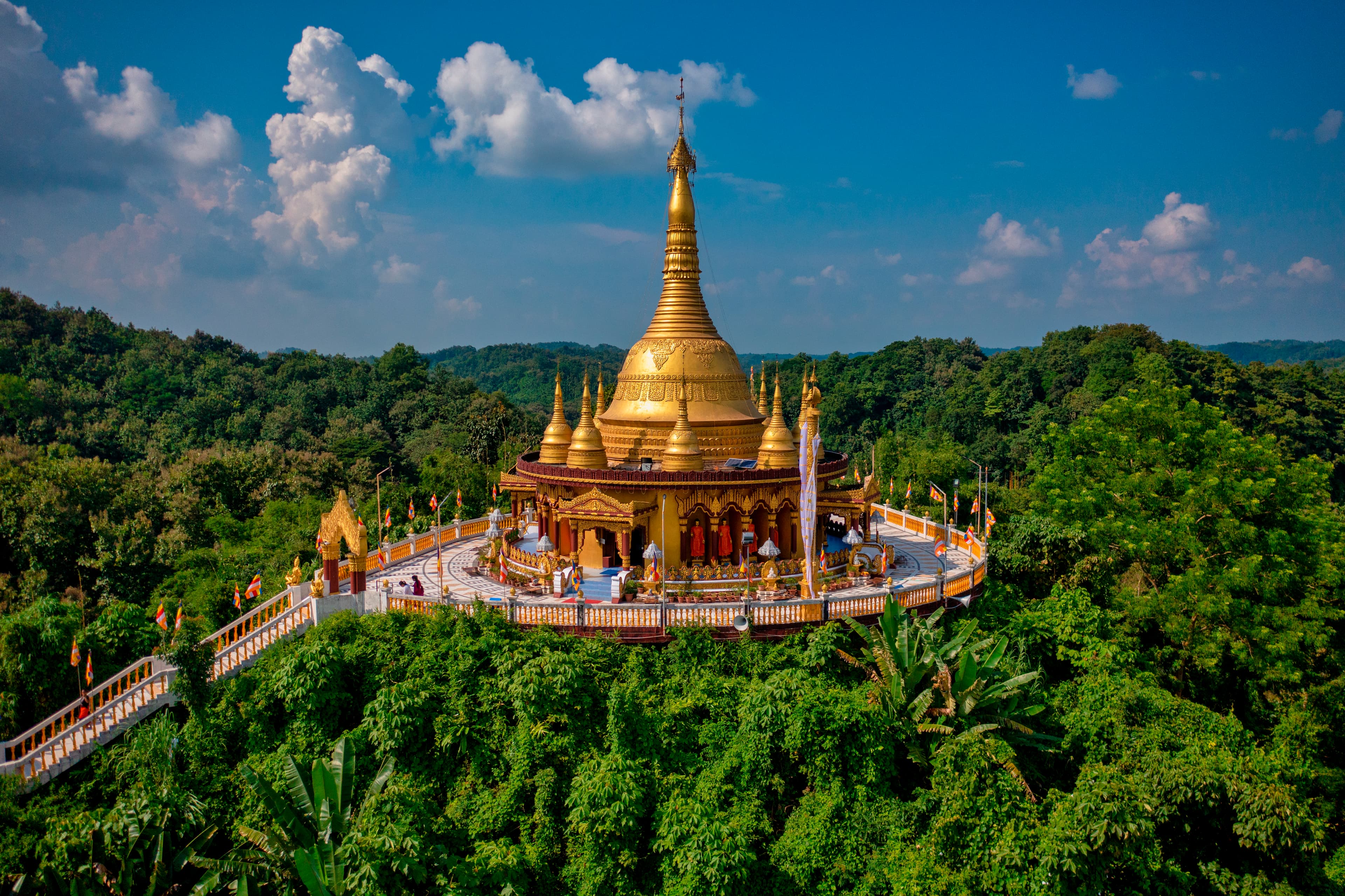
Image of Buddha Dhatu Jadi. Image source · CC-BY-SA-4.0
Visit essentials
A quick read before you go
- Duration
- 1 to 1.5 hours including stairway ascent and temple exploration.
- Access
- Located 4 km from Balaghata and 10 km from Bandarban city.
Overview
Buddha Dhatu Jadi's golden surfaces catch the afternoon light from a hilltop near Bandarban above the forested Chittagong Hill Tracts. Completed in 2000, the youngest of Bangladesh's major sacred sites houses an ancient dhatu: a physical relic of the Buddha received from Myanmar's State Sangha Maha Nayaka Committee in 1994.
Founder Ven. U Pannya Jota Mahathera is a Theravada monk of the royal Bohmong family, hereditary rulers of the southern Hill Tracts. Renouncing royal privilege to build a temple for his community made it both an individual renunciation and collective offering. Its Arakanese style acknowledges Marma origins across the Myanmar border.
An elegant hillside stairway prepares the transition from town to temple; within, Bangladesh's second-largest Buddha statue, a golden bell set on a dragon, and smaller statuary form a setting distinctly Theravada and specifically Marma for Hill Tracts practice.
Why this place is sacred
The hilltop placement is not merely scenic; it is theological. In Theravada Buddhism, the monastery traditionally sits apart from the settlement it serves — close enough for alms rounds, distant enough for contemplation. The sixty-metre hill that Buddha Dhatu Jadi occupies creates this separation naturally. The stairway ascent serves as a threshold, each step a small letting-go of the town below.
The relic introduces a different kind of thinness: temporal rather than spatial. A dhatu is understood in Theravada tradition as carrying the living presence of the Buddha. The fragment enshrined here traveled from Myanmar to Bangladesh, crossing a national border that the Marma people's cultural identity has always transcended. The relic connects this contemporary temple not only to the historical Buddha but to the network of relic shrines that span the Theravada world from Sri Lanka to Southeast Asia.
The golden surfaces catch and release light throughout the day, creating a temple that appears to glow from within. This luminosity is not accidental — it embodies the Buddhist understanding that awakening is, at its root, a matter of seeing clearly.
Founded in 1995-2000 by Ven. U Pannya Jota Mahathera to enshrine a Buddha relic and provide a center for Theravada practice among the Marma community of the Hill Tracts.
As a relatively young temple, its evolution has been one of growing significance as a pilgrimage destination for Theravada Buddhists in Bangladesh and as a cultural landmark of the Marma community.
Experience and orientation
The temple is reached by a stairway that climbs the hillside from the road. The ascent takes perhaps ten minutes, long enough to leave the sounds and concerns of the town behind. The vegetation thins, the air changes, and the golden temple emerges above the treeline.
At the top, the precinct opens into a space designed for quietness. The main temple building houses the second-largest Buddha statue in Bangladesh, seated in the posture of meditation. The golden surfaces create a warm, diffused light within the interior. Smaller statues and the golden dragon-mounted bell add visual detail without disrupting the overall atmosphere of composure.
The relic itself is enshrined within the temple — the dhatu that connects this hilltop to the historical Buddha. For Theravada practitioners, proximity to a relic is a form of proximity to the Buddha's presence. For others, the experience is simply one of extraordinary stillness, amplified by the hilltop isolation and the golden light.
The views from the temple grounds encompass the rolling hills of the Chittagong Hill Tracts — a landscape of forests and rivers that forms the homeland of the indigenous communities of southeastern Bangladesh.
Arrive before 5 PM to allow time for the stairway ascent. The limited visiting hours (5-7 PM) create a concentrated experience. Remove shoes and observe the dress code before entering. Allow the golden interior to settle your attention before focusing on the statue and the enshrined relic.
Context and lineage
In 1994, Ven. U Pannya Jota Mahathera received a Buddha relic from the State Sangha Maha Nayaka Committee of Myanmar. The monk, who had renounced his position in the Bohmong royal family to take ordination in 1991, began construction of a temple to house the relic in 1995. The temple was completed in 2000, built in the Arakanese architectural style that reflects the Marma community's cultural roots.
The temple connects the Marma community's Theravada practice to the broader Theravada world, particularly Myanmar's Buddhist institutions. The Bohmong royal family has historically served as patrons of Buddhist practice in the southern Hill Tracts.
Ven. U Pannya Jota Mahathera
Founder and chief priest. Member of the royal Bohmong family who became a Theravada monk in 1991.
Traditions and practice
The monastic community follows Theravada Vinaya rules — the monastic code that governs daily life in the oldest Buddhist tradition. Chanting, meditation, and study form the daily routine. The community gathers for major Theravada observances including Vesak, Kathina, and other liturgical events.
The temple serves as both a monastery and a community gathering place for the Marma people. It has become a significant cultural landmark and pilgrimage destination for Buddhists across Bangladesh.
Visit during the limited hours (5-7 PM) and allow the ascent to serve as preparation. If possible, time your visit with a major Buddhist observance. Sit quietly in the temple and let the golden light work on your attention.
Theravada Buddhism
ActiveThe largest Theravada Buddhist temple in Bangladesh, housing a genuine Buddha relic and the country's second-largest Buddha statue.
Daily monastic chanting, meditation, and study. Community gatherings for Vesak, Kathina, and other Theravada observances.
Perspectives and open questions
Buddha Dhatu Jadi represents a living tradition building its future while maintaining connections that span centuries and borders.
Scholarly perspective
The temple represents the continuation of Theravada Buddhism among the Marma people, an ethnic group of Arakanese origin who maintain their Buddhist identity as a minority within Bangladesh. The Bohmong family's patronage of Buddhist institutions continues a centuries-old tradition.
Living and traditional perspectives
For the Marma community, this is their spiritual center — a place where the Buddha's physical presence, in the form of the relic, anchors their practice to the source of their tradition.
Alternative interpretations
The temple's Arakanese architectural style creates a living bridge between Bangladesh and Myanmar, suggesting that Buddhist practice in this region exists within a spiritual geography that predates and transcends modern national boundaries.
Open questions
The specific provenance and age of the Buddha relic. The relationship between the Marma community's pre-Buddhist spiritual practices and their Theravada tradition.
Plan your visit
Access and arrival
Located 4 km from Balaghata and 10 km from Bandarban city. Accessible by auto-rickshaw or rented vehicle. Entry fee: 10 taka.
Hotels and guesthouses available in Bandarban town.
Respectful visit
No shorts permitted. Shoes must be removed in the temple precinct. Modest, conservative clothing is required.
Generally permitted but respectful of ceremonies. Do not photograph monks without permission.
Flowers, incense, and candles are traditional. Food offerings follow Theravada protocols.
No shorts or revealing clothing | Remove shoes in the temple precinct | Maintain silence | Do not disturb monks during meditation or prayer | Visiting hours: 5 PM - 7 PM only | Entry fee: 10 taka
The limited visiting hours (5-7 PM) require planning. The stairway climb is moderate but may challenge those with mobility issues. The Hill Tracts region may require travel permits for non-Bangladeshi visitors.
Current practical details
Address
Pulpara, Bandarban, Bangladesh
Hours
Hours, fees, and access can change — verify on the official source before you travel. Practical details last checked Jun 2026.
Location
Map loads as you approach this section.
Pilgrim reflections
A portrait of encounter, not a score
Pilgrims describe what they felt, how present they could become, and whether the place would shape a journey. There are no stars and no ranking of traditions.
No reviewed reflections yet
The first pilgrims can help describe the character of being here.
Share a reflection
Available after an account-backed “Been there.” Every reflection is reviewed before publication.
Nearby sacred places
Explore other sacred places in the region. Proximity does not establish access or travel time; check each place’s guidance.


References
Sources consulted for this page. Source categories describe the publication, not a guarantee that every claim is verified. Traditional accounts and outside interpretations may differ.
- 01The Buddha Dhatu Jadi - Beautiful Bangladesh — Government of BangladeshofficialOfficial government tourism information
- 02Buddha Dhatu Jadi - Wikipedia — Wikipedia contributorsencyclopediaOverview including founding, architecture, and relic history
- 03Buddha Dhatu Jadi - World Pilgrimage Guide — Sacred Sites / Martin GrayguidePilgrimage context and spiritual significance
- 04Buddha Dhatu Jadi - Bandarban Tours — Bandarban ToursguidePractical visitor information and etiquette details
- 05Buddha Dhatu Jadi - Buddha Images — Buddha-images.netguideVisual description of temple and statuary
- 06Buddha Dhatu Jadi - Tripadvisor — Tripadvisor reviewersguideVisitor reviews and practical experience reports
Photo gallery
3 curated photos
Pilgrim glossary
- Sangha
- The community of Buddhist practitioners, traditionally monks and nuns.
Share a photo
Help visitors recognize Buddha Dhatu Jadi. Every submission is reviewed before publication.