Bride's Mound
Where goddess and saint converge at Britain's oldest monastic site, hidden behind an industrial estate
Understand sacred places, explore living traditions, and learn how to engage respectfully with Pilgrim Map.
Access has not been verified. Check current local guidance before planning a visit.
Glastonbury, England, United Kingdom
Read the sourcesVisit essentials
A quick read before you go
- Duration
- Allow at least one hour total: fifteen to twenty minutes walking from central Glastonbury, time…
- Access
- The site is located behind Beckery Enterprise Park, west of central Glastonbury.
Overview
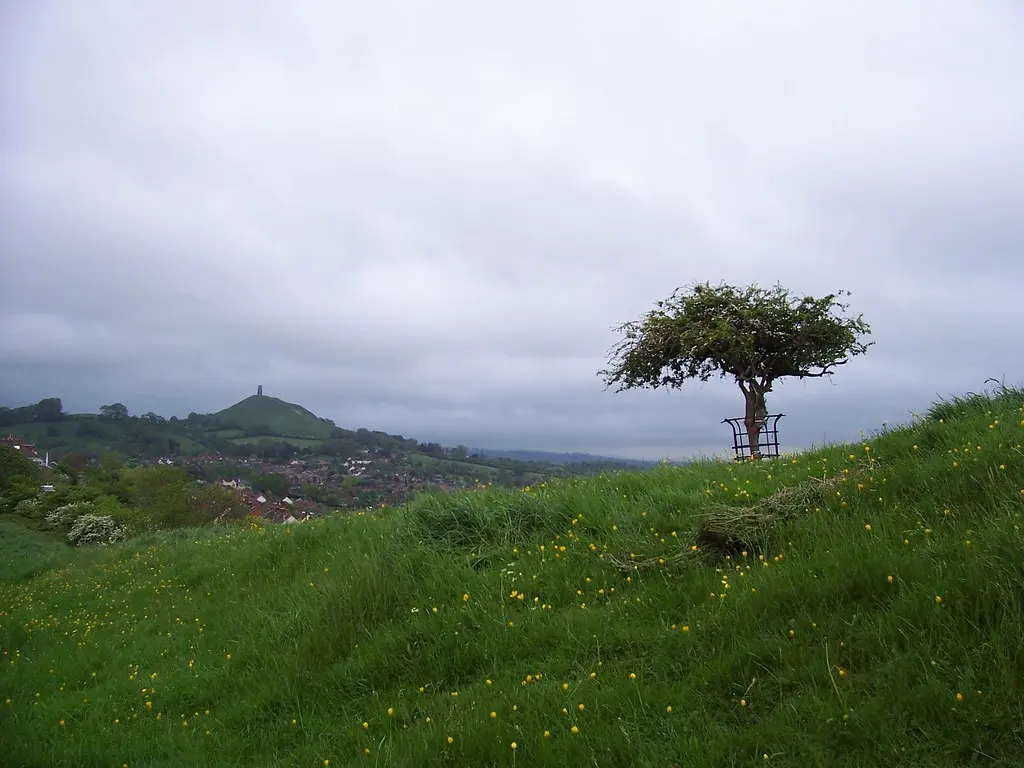
The journey to Bride's Mound is part of its meaning. No clear signs point the way. The path leads past warehouses, through or near a traveller site, to a field where a grass-covered mound rises perhaps thirty feet above the surrounding land. From its summit, the Tor appears in the east and Wearyall Hill to the south. Between them spreads the landscape that was once the watery approach to Avalon.
Archaeologists have excavated here three times—in 1887, 1967, and 2016. They found what the medieval chronicles described: chapels, a priest's house, and a cemetery. The burials date to the 5th century CE, making this the earliest documented Christian monastic site in Britain. The skeletons are predominantly male—monks who chose this place for their eternal rest fifteen hundred years ago.
But the mound's name points to something older. Bride is the Celtic goddess of fire and water, of poetry, smithcraft, and healing. She was the Guardian of Wells and Springs, the Keeper of the Flame. When Christianity came, she was not suppressed—she was transformed. Saint Brigid of Kildare inherited her attributes, her feast day, her perpetual flame. The two became one, or perhaps always were.
Medieval chroniclers record that Saint Brigid visited Glastonbury in 488 CE, staying at 'Beokery' and leaving relics behind—a spindle, a bell, weaving implements. So many Irish pilgrims came to honor her that the area became known as Little Ireland. Today, practitioners of goddess spirituality gather here each Imbolc to honor Brigid in her original form. The distinction between goddess and saint, at this particular place, seems less important than the continuity of devotion.
Why this place is sacred
The quality of Bride's Mound differs from Glastonbury's more famous sites. The Tor dominates the landscape; the Abbey commands attention through its ruins; Chalice Well is cultivated and serene. Bride's Mound offers none of these. It is small, overgrown, reached through industrial dereliction, and known mainly to those who seek it specifically.
This obscurity is part of its sacred quality. The effort required to find it creates intention. The contrast between industrial estate and ancient mound sharpens perception. By the time you stand at the summit, looking toward the Tor, you have already made a kind of pilgrimage—not the grand pilgrimage of the medieval church, but something more intimate.
The thinness here comes from accumulation. Beneath this grass lie the bones of 5th-century monks. A stone near the river marks where Bride's Well once flowed. The chapel that medieval pilgrims knew has returned to earth, but its outline remains in the archaeological record. The offerings left by contemporary visitors—ribbons, flowers, figurines—testify to continuing devotion.
For those who honor the goddess, this is Brigid's place in Glastonbury. For those who honor the saint, it is her stopping place on the journey from Ireland. For historians, it is the earliest documented monastic site in Britain. For seekers without specific allegiance, it offers something rarer: a place where multiple sacred traditions meet without conflict, where goddess became saint became goddess again, where the very uncertainty about origins allows space for encounter.
The site appears to have served as a monastic community and cemetery from the 5th century CE. A chapel dedicated to Mary Magdalene, later rededicated to Saint Brigid, served medieval pilgrims. Earlier purposes—if the goddess was venerated here before the monks came—cannot be established archaeologically.
The site has evolved from Romano-British monastic cemetery through Saxon and Norman chapels to Victorian excavation to twentieth-century neglect to contemporary revival. The name 'Bride's Mound' dates only from around 1967, when archaeologist Philip Rahtz conducted his excavation. Before that, the area was known simply as Beckery. The Friends of Bride's Mound, established in the early 2000s, have worked to restore access and maintain the site's sacred character.
Experience and orientation
The approach begins on the A39, heading west from central Glastonbury. The turning is not obvious. You pass the industrial estate, the old sheepskin factory site, the unexpected geometry of modern commerce. Then the path opens to a field.
The mound itself is modest—a grass-covered hillock perhaps thirty feet high, surrounded by meadow. A path has been mown around its base. Another path leads to a stone near the River Brue, marking where Bride's Well once flowed. Recent improvements have added a wheelchair-accessible gravel path to the summit.
Climbing the mound, you rise above the immediate surroundings. The Tor appears to the east, unmistakable. Wearyall Hill rises to the south, where Joseph of Arimathea's thorn still blooms. Between them stretches the landscape of the Somerset Levels—flat, vast, once the watery approach to what was then an island. You stand where monks stood fifteen hundred years ago, where pilgrims paused before entering Glastonbury proper.
Visitors often find offerings left by others—ribbons tied to vegetation, flowers placed at the summit, small figurines and tokens of devotion. The style of these offerings suggests goddess spirituality more than Christianity, but the impulse is ancient and ecumenical: to mark a place as sacred, to leave something of yourself.
The peace here is distinctive. Unlike the Tor with its crowds, unlike the Abbey with its interpretation panels, Bride's Mound offers only itself. The wildlife is abundant. The wind moves through grass. The industrial estate, visible from the summit, seems to belong to a different world entirely.
Bride's Mound is located west of central Glastonbury, behind Beckery Enterprise Park. From the High Street, walk west along the A39 for approximately fifteen minutes until you reach the industrial area. The path to the mound is not well signposted—GPS navigation is recommended. The mound rises from a large field, with the River Brue nearby. A stone marks the former location of Bride's Well.
Context and lineage
The origins of Bride's Mound are layered and contested. Archaeological evidence confirms a 5th-century monastic cemetery—Celtic Christians of the Romano-British period, whose bones still lie beneath the grass. By 670 CE, Saxon king Cenwealdh granted 'Beckery' to Glastonbury Abbey, suggesting the site's importance was already established.
Medieval chroniclers added narrative to archaeology. William of Malmesbury, writing around 1135, and John of Glastonbury, writing around 1400, recorded that Saint Brigid of Kildare visited Glastonbury in 488 CE. She stayed at Beokery, left behind her relics, and departed—but her presence remained. John of Glastonbury described a chapel with a healing opening in its southern wall.
But Brigid the saint inherited her attributes from Brigid the goddess—the triple goddess of fire and water, Guardian of Wells and Springs, Keeper of the Flame. Some see this as Christian absorption of pagan devotion. Others see continuity: the same presence, differently understood. The well on the mound, the fire ceremonies, the February 1st feast day—all predate Christianity and continued through it.
Arthurian legend added another layer. King Arthur, sleeping on Wearyall Hill, was told in a dream to visit the Mary Magdalene Chapel at Beckery. There he received a vision of the Virgin Mary and the Infant Jesus, who presented him with a crystal cross. He gave this to the Abbot of Glastonbury, who placed it above the High Altar.
The lineage of Bride's Mound moves from anonymous 5th-century monks through Saxon and Norman chapel builders to medieval chroniclers who recorded Brigid's visit to Victorian antiquarians who first excavated to twentieth-century archaeologists who established the site's significance to contemporary goddess practitioners and the Friends of Bride's Mound who tend the site today. Each generation has added meaning while the mound itself has endured.
Brigid (Goddess)
Celtic goddess of fire and water
The Celtic triple goddess of fire and water, poetry, smithcraft, and healing. Known as Guardian of Wells and Springs and Keeper of the Flame. Worshipped throughout Celtic Britain and Ireland. Her attributes passed to Saint Brigid of Kildare.
Saint Brigid of Kildare
Celtic saint, traditional visitor
According to medieval tradition, Brigid visited Glastonbury in 488 CE and stayed at Beckery, leaving behind relics. She founded the famous monastery at Kildare with its perpetual flame. Historians debate whether the saint was a historical figure who absorbed goddess attributes, or a Christian transformation of the goddess herself.
Philip Rahtz
Archaeologist
Conducted the 1967 excavation that revealed the chapel remains and approximately 50-60 skeletons. This excavation established the site's archaeological significance and led to its current name.
Wellesley Tudor Pole
Mystic, Glastonbury figure
In 1898, guided by dreams, he hid a sacred bowl—later called the Blue Bowl or Glastonbury Grail—in the well on Bride's Mound. It was found in 1906 by the Allen sisters, who had visited annually at Imbolc seeking the 'Holy Graal.'
Traditions and practice
Medieval pilgrims stopped at Beckery before entering Glastonbury proper, spending the night near Saint Brigid's chapel. Irish pilgrims came specifically to honor Brigid—enough that the area became known as Little Ireland. The chapel's healing opening, described by John of Glastonbury, would have drawn those seeking physical cure. Inside, Brigid's relics—spindle, bell, weaving implements—were displayed for veneration.
The traditions of the goddess, if they preceded Christianity here, are not documented. But the well on the mound, the fire associations, the February 1st feast connecting to Imbolc (the Celtic festival of spring's first stirrings)—these suggest continuity older than the written record.
The annual Imbolc pilgrimage, organized by the Glastonbury Goddess Temple, Friends of Bride's Mound, and unaffiliated practitioners, draws participants from across Britain. The route typically begins at the White Spring, proceeds through central Glastonbury, and concludes at the mound with ceremony. Traditional practices include making Bridie dolls (corn dolly figures representing Brigid) and Brigit crosses (four-armed crosses woven from rushes).
In 2006, a significant ceremony joined six sacred flames at the mound: fire from the sun, the Hiroshima peace flame, the children's flame, the Madonna Ministry flame, Bridie's flame from Lewis in the Hebrides, and Brigit's flame of Kildare—the perpetual flame rekindled in 1993 after its medieval extinguishing. Together they formed the Flame of Avalon, dedicated to Brigid.
The Friends of Bride's Mound organize volunteer work parties throughout the year, maintaining paths and vegetation. Their stewardship represents a contemporary practice of care for sacred land that transcends specific tradition.
If drawn to Bride's Mound, consider timing your visit for Imbolc—around February 1st—when you may encounter others honoring Brigid. At other times, the solitude itself becomes part of the experience. Walk the approach with intention, recognizing the journey as pilgrimage. At the mound, circumambulate if moved to do so—the circular path has been maintained for this purpose. Sit in silence at the summit.
Observe the views: Tor to the east, Wearyall Hill to the south, the Levels spreading in all directions.
If you wish to leave an offering, use natural materials only—flowers, biodegradable items, nothing that will persist as litter. Respect offerings left by others; do not disturb or remove them. The stone marking Bride's Well is near the river—some visitors walk there as part of their visit, acknowledging the water aspect of Brigid's dual nature.
Celtic Goddess (Brigid/Bride)
ActiveThe Celtic triple goddess of fire and water, poetry, smithcraft, and healing. Known as Guardian of Wells and Springs and Keeper of the Flame. She was 'simply too popular among the Celtic people to be forgotten or suppressed,' so the early Church redirected devotion toward Saint Brigid of Kildare, who inherited her attributes. Contemporary practitioners honor the original goddess here, particularly at Imbolc.
Annual Imbolc pilgrimage (February 1st) organized by the Glastonbury Goddess Temple and Friends of Bride's Mound. Participants gather at the White Spring, make Bridie dolls and Brigit crosses, and walk to the mound for ceremony. The 2006 Flame of Avalon ceremony joined six sacred flames including the rekindled Kildare flame. Year-round individual devotions include offerings at the summit.
Celtic Christianity (Saint Brigid)
HistoricalAccording to medieval tradition, Saint Brigid of Kildare visited Glastonbury in 488 CE and stayed at Beckery. She left behind relics—spindle, bell, weaving implements—displayed in the chapel for veneration. John of Glastonbury describes a healing opening in the southern wall. The site may be where Brigid received her monastic training before founding Kildare.
Medieval Irish pilgrims came in such numbers that the area became Little Ireland. The chapel served as a stopping place for pilgrims before entering Glastonbury proper. These practices ended with the Dissolution. No organized Christian devotion currently takes place at the site.
Arthurian Legend
HistoricalKing Arthur, sleeping on Wearyall Hill, was told in a dream to visit the Mary Magdalene Chapel at Beckery. There he received a vision of the Virgin Mary and Infant Jesus, who presented him with a crystal cross. This he gave to the Abbot of Glastonbury, who placed it above the High Altar. The legend connects Bride's Mound to Glastonbury's Arthurian mythology.
No active practices. The legend adds narrative depth to the site for those interested in Arthurian tradition.
Contemporary Stewardship
ActiveThe Friends of Bride's Mound have worked for years to restore and maintain this neglected site. In partnership with Somerset County Council, they are undertaking a multi-year redevelopment project continuing through 2026. This contemporary tradition of care for sacred land transcends specific religious affiliation.
Volunteer work parties maintain paths and vegetation. Fundraising supports site improvements including wheelchair-accessible paths. The organization hosts the annual Imbolc pilgrimage and welcomes monthly supporters. Their work ensures the site remains accessible for future seekers.
Perspectives and open questions
Bride's Mound invites multiple perspectives that need not conflict. Archaeologists document Britain's oldest monastic remains. Devotees of the goddess honor Brigid in her original form. Students of religion trace the transformation of goddess into saint. Seekers without allegiance find a place where traditions converge. Each perspective is valid for its purposes.
Scholarly perspective
Archaeological excavations (1887, 1967, 2016) establish the site as the oldest documented Christian monastic cemetery in Britain. The 2016 excavation, led by Richard Brunning of Southwest Heritage Trust, confirmed 5th-century dating for the burials—Romano-British Celtic Christians. Approximately 50-60 skeletons were recovered, predominantly male, consistent with a monastic community. A Saxon timber chapel (c. 700 CE) was replaced by a Norman stone chapel (c. 1000 CE, enlarged 1290).
The name 'Beckery' appears first in a 670 CE charter. Its derivation is disputed: either Old English 'Beocere' (bee-keepers island) or Gaelic 'Becc-Eriu' (Little Ireland). Saint Brigid's 488 CE visit is recorded only in medieval sources (William of Malmesbury c. 1135, John of Glastonbury c. 1400)—six to nine centuries after the supposed event—and cannot be historically verified. Claims of Neolithic use do not appear in published archaeological literature.
The current name 'Bride's Mound' dates only from around 1967, when Philip Rahtz's excavation drew attention to the site's Brigid associations.
Living and traditional perspectives
For those honoring the goddess Brigid, this is her place in Glastonbury—the site where her wells flowed, where her flame can be kindled, where the veil between her and her saintly transformation is thinnest. The Celtic triple goddess of fire and water, poetry, smithcraft, and healing, remains accessible here to those who seek her.
For those honoring Saint Brigid, the medieval tradition of her visit provides connection to one of Celtic Christianity's most beloved figures. The relics she left—spindle, bell, weaving implements—may be lost, but the land where she walked remains. Irish pilgrims came in such numbers that the area became known as Little Ireland.
Both perspectives recognize the same essential truth: this place has been sacred for at least fifteen hundred years, and probably longer. Whether that sacredness originates in goddess or saint matters less than its continuity.
Alternative interpretations
The site is understood by many as the western gateway to Avalon, one of the seven sacred isles that together comprise the mystical Glastonbury. The well on the mound was where Wellesley Tudor Pole, guided by dreams, hid the Blue Bowl in 1898—later found by the Allen sisters, who visited annually at Imbolc seeking the 'Holy Graal.'
Whether this bowl was the Grail, a sacred vessel of another kind, or simply a beautiful artifact, its discovery at this particular place added another layer to the mound's accumulated significance.
Some interpret the Brigid/Brigid syncretism as evidence of the early Church's strategy: unable to suppress goddess devotion, it redirected it toward a saint who inherited the goddess's attributes, feast day, and perpetual flame. Others see this not as strategy but as recognition—the Church acknowledging what was already sacred.
Open questions
Questions remain without answers. Whether Brigid was a historical figure who absorbed goddess attributes, or a Christian transformation of the goddess herself, scholars cannot determine. Whether the site was sacred before the 5th-century monks arrived—to the goddess, or to some other veneration—cannot be established archaeologically. What Brigid's relics were, where they went after the Dissolution, and whether the healing opening in the chapel wall was real or legend: all unknown. The mound keeps its secrets, as sacred places do.
Plan your visit
Access and arrival
The site is located behind Beckery Enterprise Park, west of central Glastonbury. From the High Street, walk west along the A39 past the industrial area. The path is not well signposted—GPS/Google Maps navigation to 'Bride's Mound Glastonbury' is recommended. Alternatively, take Bus 29, 37, 375, or 377 from Abbey Car Park to the Moorlands bus stop. The path passes through or near a traveller site; be respectful. A wheelchair-accessible gravel path to the summit has been added recently.
Respectful visit
No specific requirements. Sturdy waterproof footwear is strongly recommended—the path can be muddy in all seasons. Layered clothing for changeable weather.
Permitted throughout. The views from the summit are particularly striking. If others are present in ceremony, do not photograph them without permission.
Natural, biodegradable materials only. Flowers, herbs, grain, items that will return to earth. Do not attach permanent items to vegetation or leave plastic, glass, or synthetic materials. Respect offerings left by others—they are sacred to someone.
Do not dig or disturb the archaeological site. Do not remove offerings left by others. Take all litter with you. Be respectful passing through or near the traveller site. The site is freely accessible; no admission or permission is required.
The path to Bride's Mound is not well signposted. GPS navigation is recommended. The route passes through or near a traveller site—be respectful. The site is undergoing multi-year redevelopment (through 2026) and access may occasionally be affected. Check with Friends of Bride's Mound before visiting if access is important to your plans. The path can be muddy; sturdy footwear is advised.
Current practical details
Address
Glastonbury BA6 9QT, UK
Hours
Hours, fees, and access can change — verify on the official source before you travel. Practical details last checked Jun 2026.
Location
Map loads as you approach this section.
Pilgrim reflections
A portrait of encounter, not a score
Pilgrims describe what they felt, how present they could become, and whether the place would shape a journey. There are no stars and no ranking of traditions.
No reviewed reflections yet
The first pilgrims can help describe the character of being here.
Share a reflection
Available after an account-backed “Been there.” Every reflection is reviewed before publication.
Nearby sacred places
Explore other sacred places in the region. Proximity does not establish access or travel time; check each place’s guidance.
References
Sources consulted for this page. Source categories describe the publication, not a guarantee that every claim is verified. Traditional accounts and outside interpretations may differ.
- 01Beckery monastery and chapel - Avalon Marshes — Southwest Heritage TrustacademicOfficial archaeological project information
- 02Beckery - WikipediaSource contextGood overview with historical sources
- 03Friends of Bride's Mound — Friends of Bride's MoundSource contextLocal community organization maintaining the site
- 04Bride's Mound - Pilgrimage in Glastonbury — Unity Through DiversityspiritualMulti-faith pilgrimage perspective
- 05St. Bride's Mound: Oldest Monastic Ruins in England Exposed — Ancient OriginsnewsCoverage of 2016 excavation findings
- 06Bride's Mound, sacred to Christians and Pagans, set to receive renovations — The Wild Huntnews2023 news coverage of renovation project
- 07Bride's Day — the patron saint - and goddess - of The British Pilgrimage Trust — British Pilgrimage TrustspiritualContemporary pilgrimage organization perspective
Share a photo
Help visitors recognize Bride's Mound. Every submission is reviewed before publication.