Glastonbury Abbey
Where Britain's mythic king lies buried beneath the ruins of its wealthiest monastery
Understand sacred places, explore living traditions, and learn how to engage respectfully with Pilgrim Map.
Access has not been verified. Check current local guidance before planning a visit.
Glastonbury, England, United Kingdom
Read the sources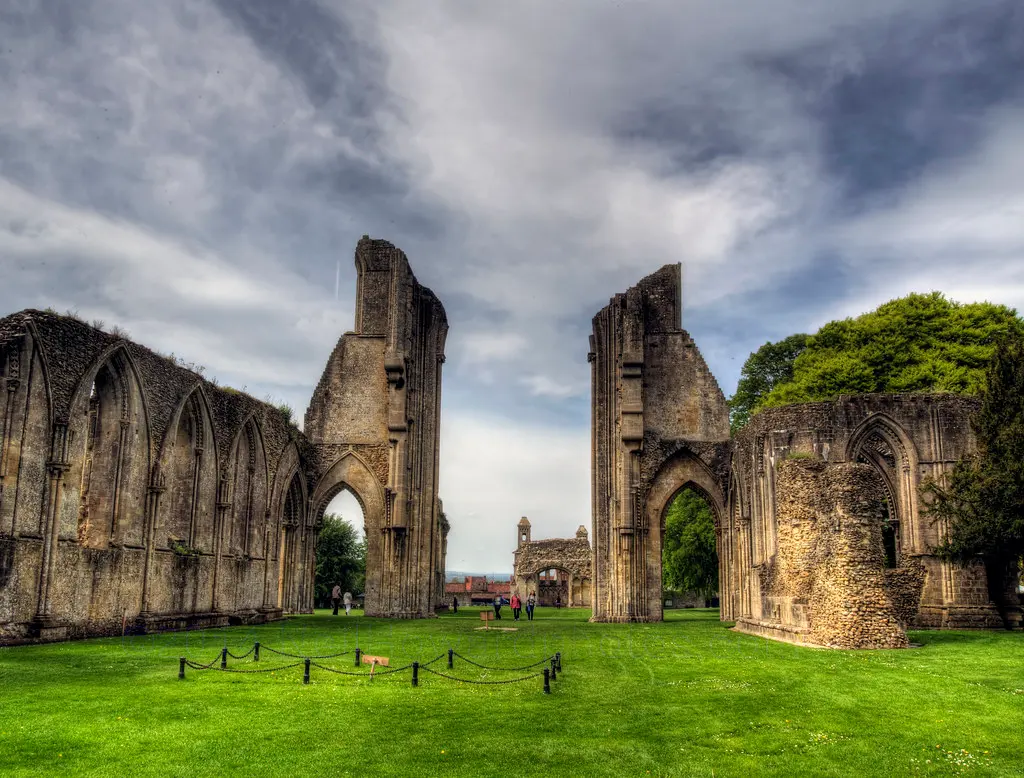
Visit essentials
A quick read before you go
- Duration
- Allow 1.5-2 hours for a thorough visit including the museum and a complete circuit of the…
- Access
- Located in central Glastonbury, the abbey entrance is a short walk from the High Street.
Overview
The scale of the ruins tells the story. Walls rise thirty feet and stop, their upper courses stripped away. The Lady Chapel's arches frame empty sky. Where the great abbey church once stood, visitors walk on grass between foundation stones that mark the crossing, the nave, the choir. This was one of the largest churches in England, and now it is an outline on the ground.
For medieval pilgrims, Glastonbury combined everything sacred: the tomb of King Arthur, the oldest church in Britain (allegedly founded by Joseph of Arimathea himself), a shrine to Our Lady that drew devotees from across Europe. When the monks needed funds after a devastating fire in 1184, they announced a miraculous discovery—the graves of Arthur and Guinevere, sixteen feet deep, with a lead cross proclaiming this as Avalon. Historians today view the discovery as almost certainly a forgery, but it worked.
Pilgrims came.
Then came the Dissolution. In 1539, Henry VIII's commissioners arrived. The last abbot, Richard Whiting, was dragged up Glastonbury Tor and hanged, drawn, and quartered for resisting. His head was mounted over the abbey gate. The library—described by contemporaries as containing unique early Christian documents—was scattered and largely lost. The buildings were stripped for lead and stone.
What remains is sacred in the way that ruins are sacred: as testimony to impermanence, as ground saturated with centuries of prayer, as the place where people still come seeking what the monks sought.
Why this place is sacred
Something happens in ruins that does not happen in intact buildings. The Abbey's broken walls create a permeability that functioning architecture prevents. Light enters from angles the medieval builders never intended. Rain falls on ground that was roofed for centuries. The boundary between inside and outside—fundamental to sacred architecture—has been abolished.
This creates its own form of liminality. Visitors walk where only monks once walked, stand in the choir where the offices were sung, pass through doorways that once marked transitions between zones of increasing sanctity. The thresholds remain even when the doors are gone. The sacred geography persists in the foundations.
The ruins also thin the boundary between present and past. The scale of what was lost is visible in every broken arch. The Lady Chapel, rapidly built after the 1184 fire, displays the finest early Gothic craftsmanship in England—and stops abruptly where the roof once was. The Abbot's Kitchen, miraculously intact, stands as witness to what all the other buildings might have been.
For many visitors, the very destruction becomes part of the sacred encounter. The Dissolution was violent—not just to buildings but to a way of life, to the monks who were expelled or executed, to the manuscripts that were scattered or burned. Walking these grounds means walking ground that remembers violence. Some find that history sharpens rather than diminishes the site's spiritual power.
The abbey was founded as a monastery following Benedictine rule. Its purpose was the opus Dei—the work of God—conducted through the daily offices of prayer from Matins through Compline. The monks lived, worked, and prayed together in community. They produced and preserved manuscripts in their renowned library. They offered hospitality to pilgrims who came seeking the Marian shrine, Arthur's tomb, and connection to the legendary earliest church in Britain.
Archaeological evidence confirms monastic presence from at least the 7th century, with earlier Roman and Saxon activity. The abbey grew wealthy through land grants from Saxon and Norman kings. By 1086, it was the richest monastery in England. A catastrophic fire in 1184 destroyed the Old Church—claimed as the wattle chapel Joseph of Arimathea had built—along with much of the monastery. The monks rebuilt rapidly and, within a few years, announced the discovery of Arthur's tomb.
By the 14th century, Glastonbury was the second wealthiest abbey in England, surpassed only by Westminster. The Dissolution in 1539 ended monastic life. The buildings were demolished for their materials. The site passed through private hands until the Church of England purchased it in 1908. Today it functions as a heritage site and visitor attraction, while remaining a place of pilgrimage for Christians who remember what was and what was lost.
Experience and orientation
The experience begins in the Abbey Yard, renovated in 2024 to welcome visitors. From here you enter the grounds, and the scale becomes immediately apparent. The Lady Chapel stands to your right—walls rising high, carved stonework still sharp after eight centuries, the finest early English Gothic in the country. But the roof is gone. You walk inside what was once inside, now open to air.
Beyond the Lady Chapel, the great abbey church is marked more by absence than presence. Low walls and foundation stones trace the outline of one of England's largest medieval churches. Signs indicate where the crossing stood, where the high altar rose, where the choir sang the offices. Now it is lawn and stone and imagination.
A marker indicates the site of Arthur's tomb—a rectangle on the ground where the black marble shrine once stood, where Edward I and Queen Eleanor knelt in 1278 to witness the opening of the royal graves. The bones are gone, scattered during the Dissolution. The marker remains.
The Abbot's Kitchen stands intact amid the destruction—a square medieval building with an octagonal roof, four great fireplaces, and the only complete monastic structure surviving at Glastonbury. It served as a Quaker meeting house after the Dissolution, which saved it from demolition. Standing inside, you understand what all the other buildings once were: the weight of stone, the engineering of vaulting, the solidity of medieval construction. Then you step outside and see, again, the ruins.
The museum, located in the gatehouse, houses artifacts from the abbey's history: medieval tiles, carved stone fragments, archaeological finds. A model shows the abbey as it appeared before dissolution—the scale is staggering, the loss made visible.
Many visitors come specifically for pilgrimage. The annual Catholic pilgrimage in summer draws thousands. But the grounds are open to anyone who wishes to walk them contemplatively, to sit in what was once the nave and think about what prayer meant to the monks who chanted here for a thousand years.
Enter through the Abbey Yard and begin at the Lady Chapel—it offers the most complete sense of medieval architecture. Walk the outline of the great church slowly, reading the markers that identify significant locations. Spend time at Arthur's tomb site. Visit the Abbot's Kitchen to understand what survived, then return to the ruins with that knowledge. The museum provides context that enriches the experience. If costumed guides are offering tours, join one—their interpretation brings the abbey to life.
Context and lineage
The abbey's origin story exists in layers, each contested. The legendary account claims Joseph of Arimathea founded a church here in AD 63, just thirty years after Christ's crucifixion. In this telling, Joseph brought the Holy Grail to Britain and built a wattle chapel that became the 'Old Church' the monks revered. Archaeological evidence does not support a 1st-century foundation; the earliest confirmed Christian presence dates to the 7th century.
The Arthurian layer was added in 1191, when monks announced they had discovered Arthur's grave—a massive oak coffin containing two skeletons, with a lead cross identifying the male as 'the famous King Arthur' buried 'in the Isle of Avalon.' Historians view this as almost certainly a medieval creation, likely motivated by the urgent need for pilgrimage revenue after the 1184 fire destroyed much of the monastery.
Whether forgery or genuine discovery, it worked: Glastonbury became Avalon, and pilgrims came to venerate Britain's legendary king.
The historical foundation is less romantic but still remarkable. Saxon charters from the late 7th century document land grants to the monastery. Archaeological excavation has revealed glass production workshops from around AD 700—among the earliest in Saxon England—and evidence of Roman activity predating the monastery entirely. Whatever legendary accretions attached to it, Glastonbury was genuinely one of England's oldest and most important monastic foundations.
The abbey's spiritual lineage flows through Benedictine monasticism—the Rule of St. Benedict governed daily life for centuries. But Glastonbury also claimed a more ancient lineage: direct connection to the apostolic era through Joseph of Arimathea. This claim placed Glastonbury's foundation before Canterbury, before Rome's mission to England, before any other British church. Whether historically accurate or medieval invention, this lineage shaped the abbey's identity and prestige.
Today the Church of England maintains the site, continuing Anglican connection to the pre-Reformation church.
Joseph of Arimathea
mythological
According to medieval legend, Joseph was the wealthy follower of Jesus who provided the tomb for Christ's burial. He is said to have traveled to Britain in AD 63, bringing the Holy Grail and founding the first church at Glastonbury. The legend has no historical support but was significant enough that England claimed precedence at the Council of Constance based on Glastonbury's apostolic foundation.
King Arthur
mythological
The legendary British king whose 'grave' was discovered by Glastonbury monks in 1191. Whether Arthur was a historical figure remains debated; that the grave discovery was a medieval creation is generally accepted by historians. Nevertheless, the identification of Glastonbury as Avalon persists in popular imagination.
Dunstan
historical
Abbot of Glastonbury from 940 to 956, later Archbishop of Canterbury and a saint. Dunstan significantly enlarged the monastery and reformed its monastic discipline. His abbacy represents Glastonbury's historical importance as distinct from its legendary associations.
Richard Whiting
historical
The last Abbot of Glastonbury, executed on Glastonbury Tor on November 15, 1539, for resisting the Dissolution. He had initially signed the Act of Supremacy making Henry VIII head of the church, but refused to surrender the abbey's treasures. His execution was brutal—hanged, drawn, and quartered, his head mounted over the abbey gate. He was beatified in 1895 as a martyr.
Traditions and practice
The monks lived according to the Rule of St. Benedict. Their day was structured around the eight canonical hours: Matins in the darkness before dawn, Lauds at daybreak, Prime, Terce, Sext, None through the day, Vespers in evening, Compline before sleep. Between offices, they worked—in the scriptorium producing and copying manuscripts, in the fields that sustained the community, in hospitality to the pilgrims who arrived seeking the Marian shrine or Arthur's tomb.
The library was renowned. When Henry VIII's antiquary John Leland visited shortly before the Dissolution, he described unique early Christian documents and ancient histories of England. What survived the Dissolution is fragmentary; what was lost cannot be recovered.
Pilgrimage to the abbey followed medieval patterns: devotion at the shrine of Our Lady, veneration of Arthur's black marble tomb, contact with the Holy Thorn that grew from Joseph's staff. Indulgences were granted. Miracles were reported. Kings came—Edward I witnessed the opening of Arthur's tomb in 1278.
The annual Catholic pilgrimage to Glastonbury resumed in 1895 and continues each summer, drawing thousands of participants to the abbey grounds. The pilgrimage commemorates the martyrdom of Abbot Whiting and his monks and maintains continuity with medieval devotion to Our Lady of Glastonbury.
The Church of England, which owns the site, maintains it as sacred ground while operating it as a visitor attraction. Costumed Living History interpreters offer tours that bring monastic life to vivid reality. The museum provides archaeological and historical context. Anglican services occur at adjacent St. John's Church rather than at the ruins.
Many visitors come for personal pilgrimage rather than organized events. The grounds are spacious enough for contemplative walking, for sitting in the ruins of the nave, for quiet reflection on what prayer meant to those who practiced it here across a millennium.
If contemplation draws you, find a spot in what was once the nave. Sit. Let the silence gather. The monks chanted here for a thousand years; their silence is still here too.
If you are Christian, consider timing your visit to coincide with the annual pilgrimage. If you prefer solitude, weekday mornings outside school holidays offer the quietest experience.
Medieval Christianity/Benedictine
HistoricalGlastonbury was one of the oldest and wealthiest Benedictine monasteries in England. By the Domesday survey of 1086, it was the richest monastery in the country. It was home to the 'Old Church' (vetusta ecclesia), claimed as the earliest Christian foundation in Britain and a major pilgrimage destination. The monks maintained one of England's great libraries and followed Benedictine rule for a thousand years until the Dissolution.
The monastic day revolved around the eight canonical hours—Matins, Lauds, Prime, Terce, Sext, None, Vespers, Compline—chanted in the great abbey church. Between offices, monks worked in the scriptorium, the fields, and hospitality to pilgrims. The shrine of Our Lady drew devotees from across Europe. The library produced and preserved manuscripts including, according to contemporaries, unique early Christian documents.
Joseph of Arimathea/Early Christianity
HistoricalMedieval legend claimed Joseph of Arimathea founded the first church in Britain at Glastonbury in AD 63, bringing the Holy Grail with him. This tradition placed Glastonbury's Christian foundation before Canterbury, before Rome's mission, before any other British church. At the Council of Constance (1414-1418), England claimed precedence among nations based on Glastonbury's apostolic antiquity.
The 'Old Church'—the wattle chapel Joseph allegedly built—was venerated as the most sacred structure at Glastonbury until the 1184 fire destroyed it. The Holy Thorn on Wearyall Hill, said to have sprouted from Joseph's staff, became an object of pilgrimage. Cuttings from that tree still grow in the abbey grounds.
Arthurian/Avalon
HistoricalIn 1191, monks announced they had discovered the graves of King Arthur and Queen Guinevere, establishing Glastonbury as the legendary Avalon. A lead cross identified 'the famous King Arthur' buried 'in the Isle of Avalon.' The remains were reinterred in a black marble tomb before the high altar in 1278, witnessed by King Edward I. This association with Britain's mythic king made Glastonbury a site of national as well as religious significance.
Medieval pilgrims venerated Arthur's tomb, which became a major draw alongside the Marian shrine. Kings and nobles visited. The association with Avalon connected the abbey to the cycle of Arthurian romance that dominated medieval literature. The tomb was destroyed during the Dissolution; a marker now indicates its site.
Contemporary Christian Pilgrimage
ActiveCatholic pilgrimage to Glastonbury resumed in 1895, the same year Abbot Whiting and his monks were beatified as martyrs. The annual summer pilgrimage has continued since, with interruptions. In 1965, twenty thousand Catholics participated in a pilgrimage held in the abbey grounds for the first time in four hundred years. The site represents both pre-Reformation Catholic England and the blood of those who died resisting the Reformation.
The annual pilgrimage, organized by the Shrine of Our Lady of Glastonbury, brings thousands to the abbey grounds each summer. Mass is celebrated. Devotion to Our Lady of Glastonbury continues the medieval tradition. The martyrdom of Abbot Whiting is commemorated. Anglican services occur at nearby St. John's Church, maintaining Protestant Christian presence at the site.
Perspectives and open questions
Glastonbury Abbey sits at the intersection of history, legend, and faith. Scholarly and spiritual perspectives diverge significantly on what the site means—historians emphasize medieval literary creation while believers maintain spiritual truth. Understanding the abbey requires holding these perspectives in productive tension.
Scholarly perspective
Archaeological research, particularly the University of Reading's analysis of 1904-1979 excavations, confirms monastic presence from the 7th century with earlier Roman and Saxon activity. The abbey's historical significance is substantial—it was one of England's oldest and wealthiest monasteries, with genuine importance in the development of English Christianity.
However, historians generally view the site's famous legends as medieval creations. The Joseph of Arimathea story emerged in 12th-century literary sources; there is no earlier evidence connecting him to Glastonbury. The 1191 discovery of Arthur's tomb is almost certainly a forgery, likely motivated by the urgent need for pilgrimage revenue after the 1184 fire. The lead cross identifying the grave has stylistic features inconsistent with the supposed 6th-century burial.
This does not diminish the abbey's importance—the legends themselves are historically significant as evidence of medieval mentality and the power of sacred narrative. But scholarly consensus distinguishes between what can be documented and what was believed.
Living and traditional perspectives
Christian tradition, particularly Catholic, understands Glastonbury as hallowed ground regardless of what can be historically verified. The prayers of a thousand years have consecrated this place. The blood of martyrs—Abbot Whiting and his monks—sanctifies it further.
For believers in the Joseph legend, the absence of archaeological proof does not disprove the tradition. Absence of evidence is not evidence of absence. The earliest churches would have been simple structures leaving minimal archaeological trace. The tradition connecting Glastonbury to Christ's disciples through Joseph represents a precious link to apostolic Christianity.
The Arthurian connection carries different significance: less about literal historical fact than about Britain's Christian identity and the way sacred legend shapes a people's understanding of themselves.
Alternative interpretations
New Age and alternative spirituality communities understand Glastonbury as one of Earth's primary energy centers—the heart chakra of the planet in some systems. From this perspective, the abbey is one node in a sacred landscape that includes the Tor, the springs, and ley lines connecting Glastonbury to other power sites.
Some interpret the Dissolution as spiritual suppression—the deliberate destruction not just of monasteries but of an older, earth-based spirituality that Christianity had partially absorbed. The ruins become evidence of what was lost when the Reformation severed England from its mystical past.
The Arthurian legends are sometimes taken more literally in these circles, with Arthur understood as a genuine historical figure connected to pre-Christian sacred traditions that the monks Christianized but could not entirely suppress.
Open questions
What happened at this site before the Saxon monastery remains partially obscure. Roman activity is documented but not fully understood. Whether any genuine tradition connects the site to the earliest centuries of British Christianity—whether any kernel of historical reality underlies the Joseph legend—cannot be determined with current evidence.
The fate of the abbey's library represents an irrecoverable loss. John Leland, visiting just before the Dissolution, described unique early Christian documents. What survived is fragmentary. What was lost—what those manuscripts might have told us about early British Christianity—we will never know.
The exact circumstances of the Arthur tomb discovery remain debated. Was it pure fabrication? Did the monks find genuinely ancient remains and misidentify them? Did they believe their own discovery? The truth of that day in 1191 died with those who dug the grave.
Plan your visit
Access and arrival
Located in central Glastonbury, the abbey entrance is a short walk from the High Street. The 2024-renovated Abbey Yard provides visitor welcome with café, shop, and orientation. Wheelchair accessible throughout the grounds except the Lady Chapel crypt (viewable from above). Under 16s enter free with a paying adult. Dogs welcome on leads.
Glastonbury town offers numerous accommodations ranging from B&Bs to hotels, many catering to spiritual seekers. The town is compact and walkable. No accommodations exist within the abbey grounds.
Respectful visit
No specific dress code. Comfortable walking shoes are recommended as the grounds are extensive and surfaces vary. In wet weather, paths can be slippery.
Photography and video are permitted throughout the site for personal use.
Purchases from the museum shop support the abbey's preservation. Donations are welcomed. The annual pilgrimage typically includes opportunities for religious offerings within that context.
Do not climb on the ruins or remove any materials from the site. The structures are protected as a Grade I listed building and Scheduled Ancient Monument. Dogs must remain on leads. The Lady Chapel crypt is inaccessible to wheelchair users but can be viewed from the bridge above.
This is an archaeological site as much as a sacred one. The ruins are fragile—do not climb on walls or remove anything. Dogs are welcome but must be leashed. The Lady Chapel crypt is inaccessible to wheelchair users, though it can be viewed from above. Check the website for current opening hours and any special events that might affect your visit.
Current practical details
Address
Magdalene St, Glastonbury BA6 9EL, UK
Phone
Hours
Hours, fees, and access can change — verify on the official source before you travel. Practical details last checked Jun 2026.
Location
Map loads as you approach this section.
Pilgrim reflections
A portrait of encounter, not a score
Pilgrims describe what they felt, how present they could become, and whether the place would shape a journey. There are no stars and no ranking of traditions.
No reviewed reflections yet
The first pilgrims can help describe the character of being here.
Share a reflection
Available after an account-backed “Been there.” Every reflection is reviewed before publication.
Nearby sacred places
Explore other sacred places in the region. Proximity does not establish access or travel time; check each place’s guidance.

References
Sources consulted for this page. Source categories describe the publication, not a guarantee that every claim is verified. Traditional accounts and outside interpretations may differ.
- 01Glastonbury Abbey Official Website — Glastonbury AbbeyofficialPrimary visitor information source
- 02Glastonbury Abbey Archaeology - University of Reading — University of ReadingacademicAcademic research project analyzing 1908-1979 excavations
- 03Glastonbury Abbey - Historic England — Historic EnglandofficialOfficial Grade I listing
- 04Legends of Glastonbury Abbey - Archaeology Magazine — Archaeology MagazineacademicAcademic archaeology publication
- 05Glastonbury: Abbey - British History Online — Victoria County HistoryacademicAuthoritative historical reference
- 06The Annual Pilgrimage - Shrine of Our Lady of Glastonbury — Catholic pilgrimage organizationofficialSource for contemporary Catholic pilgrimage
- 07Glastonbury: archaeology is revealing new truths about the origins of British Christianity — The ConversationacademicAcademic article on recent archaeological findings
- 08Glastonbury Abbey - WikipediaSource contextGood overview with citations
Share a photo
Help visitors recognize Glastonbury Abbey. Every submission is reviewed before publication.