Black Madonna of Naples
InsideBasilica of Our Lady of Mount Carmel
Where Naples finds its Black Mother, who has heard eight centuries of prayers
Understand sacred places, explore living traditions, and learn how to engage respectfully with Pilgrim Map.
Access has not been verified. Check current local guidance before planning a visit.
Naples, Naples, Italy
Read the sources
Visit essentials
A quick read before you go
- Duration
- A basic visit to view the icon and church can be accomplished in thirty to sixty minutes.
- Etiquette
- The Basilica del Carmine Maggiore is an active place of Catholic worship.
Overview
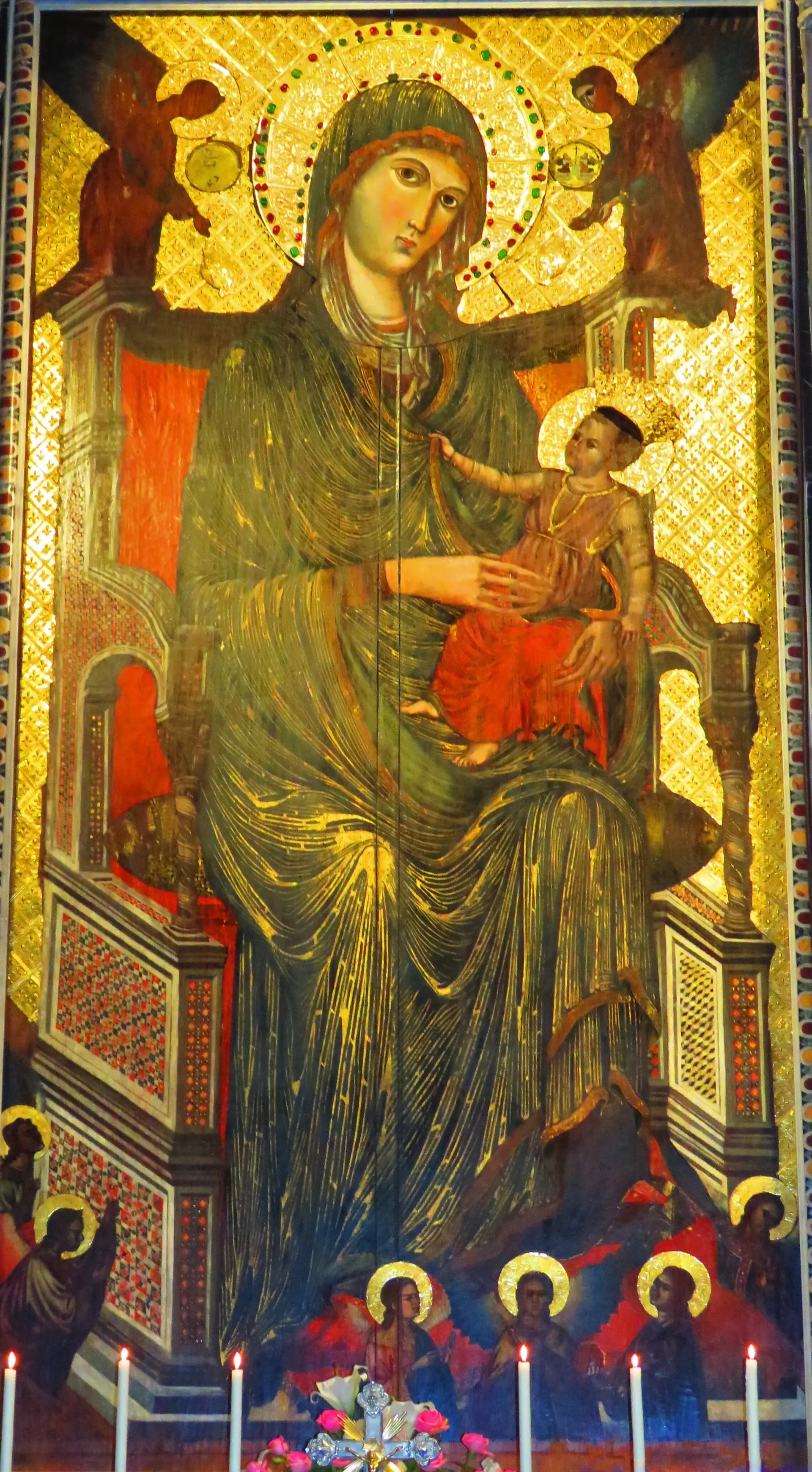
The Madonna Bruna belongs to Neapolitans across class and generation, from fishermen and aristocrats to families who invoked her through plagues, eruptions, and wars. Carmelite tradition says monks fleeing Islamic invasion carried their order's oldest venerated image from the Holy Land in the thirteenth century; centuries of votive-candle soot gave La Bruna her dark skin.
Her Basilica del Carmine Maggiore stands at Piazza Mercato, where Conradin, last of the Hohenstaufen dynasty, was beheaded in 1268 and Masaniello led his 1647 revolution before being assassinated on the Madonna's feast day. Each July 16th, a three-day festival culminates in fireworks that appear to engulf the bell tower. The Madonna's image rises above the simulated flames, which die away in a repeated enactment of the city's protection.
Why this place is sacred
Why do certain images of Mary take on lives their makers never intended? The Madonna Bruna offers no simple answer, but several currents converge in her dark face.
The icon belongs to the Eleousa or Tenderness type, showing Mary holding the Christ Child against her cheek in intimate embrace. Byzantine iconographers developed this form to convey divine love made visible, the incarnate God receiving his mother's tenderness. According to Carmelite tradition, Saint Luke the Evangelist painted the original, though art historians date the Naples icon to the thirteenth century.
The attribution matters less than what it signals: this is understood as an image of apostolic origin, bearing the authority of eyewitness.
The Carmelite connection links Naples to Mount Carmel itself, the mountain where Elijah confronted the prophets of Baal, where centuries later hermits gathered to live in contemplation. When they fled the Holy Land, they carried not just an icon but a lineage reaching back to the Hebrew prophets. Something of that antiquity adheres to the Madonna Bruna.
Black Madonnas appear throughout Europe, and scholars have long noted their association with sites of pre-Christian worship, with earth goddesses and chthonic powers. The Madonna Bruna was originally kept in a crypt, associated with death and the underworld, with guidance through darkness. Whether this reflects absorbed pagan tradition or simply the practical needs of earlier eras, the resonance persists. She is the Black Mother, the one who descends into the depths.
Perhaps most powerfully, eight centuries of prayer have saturated this site. Generation after generation of Neapolitans have brought their sorrows here, lit their candles, whispered their petitions. Whatever one believes about the mechanics of the sacred, this accumulation of human intention is itself a kind of power. The veil thins where people have thinned it.
The Carmelite friars who settled in Naples in the thirteenth century brought with them the practices of their order: contemplation, devotion to Mary, and the liturgical life. The church they built at Piazza Mercato served these functions while also providing a locus of veneration for the icon they carried from the Holy Land.
When Elisabeth of Bavaria, mother of the executed Conradin, patronized the church in her grief, she added another layer of intention: memorial, sanctuary, a place to hold loss.
The devotion has deepened rather than faded over the centuries. The 1439 siege brought the legend of the miraculous crucifix, whose head turned to avoid a cannonball. The year 1500 saw the icon carried to Rome, where it reportedly worked such miracles that the Pope sent it home lest it overshadow Saint Peter. The Brown Scapular devotion, originating with Saint Simon Stock's vision in 1251, found a natural home here, promising protection to those who wear it.
The Incendio del Campanile, the burning of the bell tower, emerged as the festival's climax, though its exact origins remain debated. Some trace it to suppressed mock battles between Christians and Moors; others suggest connections to older fire festivals. Whatever the source, the spectacle has become inseparable from Neapolitan identity. The Madonna who extinguishes the flames is the city's assurance that she remains vigilant, that protection continues.
Experience and orientation
Entering the basilica on an ordinary morning, you step from the noise of Naples into something older. The church's Baroque interior, rebuilt after various disasters, holds the accumulated weight of centuries. Light falls from high windows onto worn stone. The faithful—often elderly women, but also young families, workers on their way somewhere else—move about their devotions with the ease of people at home.
Above the high altar, the Madonna Bruna watches. The icon's dark face, the product of centuries of candle smoke, gives her a gravity that lighter images lack. She holds the Christ Child against her cheek, both of them gazing out, present and absent at once. To sit before her in the relative quiet of midday is to understand something of what draws people here. This is not a museum piece but a presence, addressed and implored, trusted through generations.
The miraculous crucifix, missing its crown of thorns since the 1439 siege, hangs beneath the main arch. According to tradition, Christ's wooden head turned to avoid the Aragonese cannonball, causing the crown to fall. The story matters less than its telling: even the inanimate responds here, even wood protects the faithful.
The July festival transforms everything. For three days, Piazza Mercato fills with the faithful, with vendors and performers, with the smells of festival food and the sounds of Neapolitan devotion. Processions carry the Madonna through streets that have known her for centuries. On the night of July 15th, the crowds gather for the Incendio del Campanile. When the fireworks engulf the bell tower in simulated flames, the darkness, the noise, the press of bodies create a kind of collective trance.
Then the Madonna's image rises, the flames die, and something releases. Whatever else this is, it is not passive spectatorship. It is participation in a story the city tells itself about itself.
How you approach this site matters. If you come as an observer of quaint folk religion, you will find exactly that and miss what makes it alive. If you come as a pilgrim, even a questioning one, you may find more than you expected.
Consider sitting with the icon in silence before trying to understand it. Let the Neapolitan faithful move around you with their practiced devotions. Notice what arises when you stop analyzing and simply attend. The Madonna Bruna has witnessed generations of seekers; she is not in a hurry.
If you visit during the July festival, surrender to it. The crowds, the heat, the intensity are not obstacles to experience but its medium. This is devotion as Neapolitans practice it: embodied, communal, unapologetically emotional. You cannot participate at a distance.
Context and lineage
The Carmelites trace their lineage to Mount Carmel, where the prophet Elijah confronted the priests of Baal and where, centuries later, hermits gathered to live in contemplation near the cave associated with Elijah. When Islamic invasions made the Holy Land dangerous for Christian communities, these monks fled westward. According to Carmelite tradition, they brought with them the oldest image their order venerated, an icon of Mary and Child believed painted by Saint Luke the Evangelist.
They arrived in Naples sometime in the thirteenth century, settling near Piazza Mercato at the edge of the city. The market square was a place of commerce and public gathering, but it would soon become a place of execution as well. In 1268, Conradin, the last of the Hohenstaufen line that had ruled the Holy Roman Empire, was beheaded here after his failed attempt to reclaim the crown of Sicily.
His mother, Elisabeth of Bavaria, took the church under her patronage in her grief, helping establish it as a place where memory could be held.
The icon found its home here, and Neapolitans made it their own. She became Mamma d'o Carmene, the Black Mama of Carmine. Where the Carmelites brought contemplative devotion, the people of Naples added their own fervor: processions and festivals, passionate prayers for healing and protection, the intimate trust of children in their mother.
The Carmelite presence in Naples has continued unbroken from the thirteenth century. Through plagues and wars, eruptions of Vesuvius and political upheavals, the friars have maintained the liturgical life and cared for the icon. The devotion itself has passed from generation to generation of Neapolitans, not as something imposed by the institutional church but as living tradition carried by families and neighborhoods. Grandmothers teach granddaughters the prayers; fathers bring sons to the July festival.
The lineage is both monastic and popular, formal and intimate.
Mary
deity
The Virgin Mary, depicted in the Byzantine Eleousa (Tenderness) style, holding the Christ Child against her cheek. Her dark skin, from which she takes the name 'La Bruna,' results from centuries of votive candle smoke. For Neapolitans, she is not a distant heavenly figure but an intimate protectress, addressed as mother.
Elijah
prophet
The Hebrew prophet associated with Mount Carmel, where the Carmelite order originated. The Carmelites see themselves as Elijah's spiritual descendants, and their devotion to Mary connects to his prophetic tradition.
Conradin
historical
The last of the Hohenstaufen dynasty, executed in Piazza Mercato in 1268 at age sixteen. His death marked the end of an imperial line and added layers of martyrdom and grief to the site. His mother Elisabeth's patronage of the church ensured his memory would be held here.
Masaniello
historical
The fisherman who led Naples' revolt against Spanish taxation in 1647. He was assassinated near the basilica on July 16th, the Feast of Our Lady of Mount Carmel. His body was first thrown in a ditch, then recovered and honored with a grand funeral as the revolt's martyr. The church holds this memory too.
Traditions and practice
The Carmelite scapular devotion has been central to the Madonna Bruna's veneration since the thirteenth century. According to tradition, the Virgin Mary appeared to Saint Simon Stock in 1251, presenting him with the brown scapular and promising protection to those who wear it: 'Whoever dies wearing this scapular shall not suffer eternal fire.' The Sabbatine Privilege, associated with a later apparition, promised early release from Purgatory.
These promises, controversial to some theologians, gave the devotion urgent practical meaning for the faithful.
The icon itself was historically kept in a crypt, associating the Madonna with death and underworld passage, with guidance through darkness to light. Mass healings were documented in 1500, when the icon was taken to Rome and then returned amid signs and wonders. The faithful have brought their sick and suffering here for centuries, trusting in the Madonna's intercession.
The basilica maintains a full liturgical life. Daily masses are offered, and the faithful gather throughout the day for private prayer and veneration. Votive candles burn before the icon as they have for centuries, each flame representing a petition or thanks.
The Brown Scapular remains available to the faithful. Those wishing to be enrolled in the scapular devotion may receive it from the Carmelite priests, taking on its obligations and promises. The scapular is worn as a sign of Mary's protection and a commitment to daily prayer.
The annual feast, July 13th through 16th, is the devotion's climax. Special masses are celebrated. The Madonna's image is dressed in jewels and processed through the streets. On the night of July 15th, the Incendio del Campanile transforms the neighborhood: the bell tower appears to catch fire from spectacular pyrotechnics, the crowd holds its breath in the darkness and flames, and then the Madonna's illuminated image rises to 'extinguish' the fire.
The city is saved again, as it has been saved each year in living memory.
Those coming to the basilica outside the festival period can participate in several ways. Attending mass, even without receiving communion if you are not Catholic, allows you to witness the liturgical context in which the icon lives. Lighting a candle before the Madonna and spending time in silent prayer or contemplation creates personal encounter. Observing the Neapolitan faithful at their devotions teaches something no guidebook can convey.
If the Brown Scapular speaks to you, inquire about enrollment. This traditional practice offers ongoing connection to the Madonna's protection beyond a single visit.
During the July festival, full participation means surrendering to the experience: joining the processions, staying for the Incendio del Campanile despite the heat and crowds, letting the communal devotion carry you.
Roman Catholicism (Carmelite Marian Devotion)
ActiveThe Madonna Bruna is understood as the oldest image of Mary venerated by the Carmelite Order, brought to Naples from the Holy Land in the thirteenth century. The icon depicts Mary in the Byzantine Eleousa or Tenderness style, holding the Christ Child against her cheek. For Carmelites, she connects the order to its origins on Mount Carmel, to the prophet Elijah, and to the contemplative tradition that flows from that mountain. For Neapolitans, she is Mamma d'o Carmene, the Black Mother who protects and intercedes, who has heard the city's prayers through centuries of suffering.
Daily masses are celebrated in the basilica. The faithful venerate the icon above the high altar, light votive candles, and offer prayers for healing and protection. The Brown Scapular devotion, associated with the 1251 vision of Saint Simon Stock, remains central: those enrolled wear the scapular as a sign of Mary's protection and commit to daily prayer. The annual feast, July 13-16, includes special masses, processions with the icon dressed in jewels, and the climactic Incendio del Campanile on the night of July 15th.
Perspectives and open questions
The Madonna Bruna invites several ways of seeing, each revealing something the others miss. Scholarly analysis illuminates the icon's artistic origins and the devotion's historical development. Traditional Catholic teaching situates her within Marian theology and Carmelite spirituality. Alternative interpretations connect her to older goddess traditions. An honest encounter holds these perspectives without forcing resolution.
Scholarly perspective
Art historical analysis dates the icon to the first half of the thirteenth century, making it contemporary with the Carmelites' arrival in Naples rather than a Byzantine original brought from the Holy Land. The attribution to Saint Luke, common among venerated Marian icons, is legendary rather than historical. The icon's dark coloring results from centuries of candle smoke and accumulated varnish, not original pigmentation.
Historians have studied the church's location at Piazza Mercato as a site of political and social significance. The execution of Conradin, the Masaniello revolt, and the patterns of popular religion have all received scholarly attention. The Incendio del Campanile appears to have evolved from earlier traditions, possibly including suppressed mock battles between Christians and Moors, though documentation is incomplete.
The bell tower itself, at 75 meters the tallest church campanile in Naples, has been studied as an architectural achievement. Completed in 1631 by Fra Giuseppe Nuvolo, its distinctive majolica-tiled spire contributes to Naples' skyline.
Living and traditional perspectives
For Neapolitan Catholics and Carmelites, the Madonna Bruna is not an art historical object but a living presence. She is the Mother of God, available to her children, who has protected Naples through centuries of suffering. The miracles attributed to her, from the mass healings of 1500 to countless private answered prayers, confirm her intercessory power.
The Brown Scapular devotion offers tangible connection to her protection. According to traditional teaching, those who wear the scapular and meet the conditions of the Sabbatine Privilege receive Mary's promise of salvation and early release from Purgatory. This is not superstition but theology lived in practice, the bond between heaven and earth made visible in brown cloth.
The Incendio del Campanile, whatever its historical origins, enacts the fundamental truth of Marian devotion: Mary protects. The flames that threaten the city are extinguished by her intervention. Year after year, the story repeats. Year after year, she is faithful.
Alternative interpretations
Scholars of Black Madonnas have traced patterns across Europe connecting dark-skinned Marian images with sites of pre-Christian goddess worship, with earth mothers and chthonic powers. The Madonna Bruna's early location in a crypt, her association with death and the underworld, her patronage by the poor and marginalized, all fit this pattern. From this perspective, she may represent the absorption of older divine feminine traditions into Christian form.
The connection to lottery predictions, documented in Neapolitan folklore, echoes goddess associations with fate and fortune. The July festival's fire spectacle may preserve elements of pre-Christian fire festivals, reframed as Marian miracle. These interpretations do not negate Catholic understanding but suggest layers of meaning beneath the official theology.
Some esoteric practitioners understand Black Madonnas as initiatory figures, guides through psychological or spiritual underworld journeys. The Madonna Bruna's darkness becomes not accident of candle smoke but symbol of the depths she illuminates.
Open questions
Genuine mysteries persist around the Madonna Bruna. What was the original appearance of the icon before centuries of candle smoke darkened it? Was there an earlier, genuinely Byzantine icon brought from the Holy Land that was later replaced? The exact origins of the Incendio del Campanile tradition remain unclear. What pre-Christian traditions at this site or at Mount Carmel itself may have shaped the devotion?
The question of why Black Madonnas so often became associated with the poor and with lottery predictions has not been fully answered. The relationship between official Carmelite theology and popular Neapolitan practice, with all its unofficial elaborations, invites further investigation.
Perhaps most fundamentally: what accounts for the devotion's persistence and intensity after eight centuries? Scholarly categories explain some of this, but something escapes the categories. The Madonna Bruna remains, in the end, a mystery that has not yielded to explanation.
Plan your visit
Access and arrival
Naples offers abundant lodging at all price points, from historic center hotels to budget options near Piazza Garibaldi. For immersion in the neighborhood atmosphere, seek lodging in the Centro Storico or near the port. During the July festival, book accommodations well in advance, as the event draws devotees from across southern Italy.
Respectful visit
Dress modestly, as you would for any Catholic church. Shoulders and knees should be covered. This is Naples in July, so light fabrics are practical, but respect the space.
Photography is generally permitted when services are not in progress. Use no flash, which can disturb both the atmosphere and the artwork. Be discreet and never photograph individual worshippers without explicit permission. Consider whether you truly need photographs, or whether simply being present would serve you better.
Donations are appreciated and support the church's maintenance and ministry. Votive candles may be purchased and lit as offerings. These small flames join centuries of accumulated light before the Madonna.
Tourist activities pause during religious services. During the July festival, religious celebrations take absolute precedence over visitor convenience. Parts of the church may be inaccessible during preparations or ceremonies. Accept these limitations as part of encountering a living tradition.
Remember that this is a living church, not a museum. Devotees are here for prayer, not to be observed as curiosities. Let your presence be unobtrusive during masses and private devotions. During the July festival, be aware that the crowds can be intense; those uncomfortable with press of bodies and sensory overwhelm may find quieter times more suitable.
Current practical details
Address
Piazza del Carmine, 2, 80142 Napoli NA, Italy
Phone
Hours
Hours, fees, and access can change — verify on the official source before you travel. Practical details last checked Jun 2026.
Location
Map loads as you approach this section.
Pilgrim reflections
A portrait of encounter, not a score
Pilgrims describe what they felt, how present they could become, and whether the place would shape a journey. There are no stars and no ranking of traditions.
No reviewed reflections yet
The first pilgrims can help describe the character of being here.
Share a reflection
Available after an account-backed “Been there.” Every reflection is reviewed before publication.
Nearby sacred places
Explore other sacred places in the region. Proximity does not establish access or travel time; check each place’s guidance.

Basilica of Our Lady of Mount Carmel
Naples, Naples, Italy
0.0 km away

Santa Maria del Parto a Mergellina
Naples, Italy
4.6 km away

Pontifical Shrine of Our Lady of the Rosary of Pompeii
Pompei, Pompei, Campania, Italy
22.6 km away
Madonna di Montevergine (Mamma Schiavona)
Mercogliano, Avellino, Italy
40.0 km away
References
Sources consulted for this page. Source categories describe the publication, not a guarantee that every claim is verified. Traditional accounts and outside interpretations may differ.
- 01What is 'La Bruna'? — Our Lady of Mercy Lay CarmelitesofficialCarmelite Order's official perspective
- 02The Carmine Maggiore Bell Tower: An Inclusive and Sustainable Restoration Experience — MDPI Sustainability JournalacademicArchitectural and historical details of bell tower
- 03Santa Maria del Carmine, Naples — Wikipedia contributorsencyclopediaComprehensive historical overview with references
- 04The Black Madonna of Naples — Interfaith Mary PageSource contextDetailed spiritual and historical context
- 05Italian traditions: The feast of Our Lady of Carmine in Naples — We The ItaliansspiritualFestival and cultural traditions
- 06Mamma d'o Carmene! — Napoli UnpluggedspiritualLocal perspective on devotion
- 07Our Lady of Naples — Roman Catholic SaintsSource contextCarmelite and scapular traditions
- 08Basilica Sanctuary of Santa Maria del Carmine Maggiore — Tour NaplesguidePractical visitor information
- 09July 16, 2025: Feast of the Madonna del Carmine in Naples — Associazione FontevecchiaspiritualFestival history and contemporary celebration
Share a photo
Help visitors recognize Black Madonna of Naples. Every submission is reviewed before publication.