Basilica of Our Lady of Mount Carmel
Where Carmelite devotion to the Madonna Bruna has sustained Naples through eight centuries
Understand sacred places, explore living traditions, and learn how to engage respectfully with Pilgrim Map.
Access has not been verified. Check current local guidance before planning a visit.
Naples, Naples, Italy

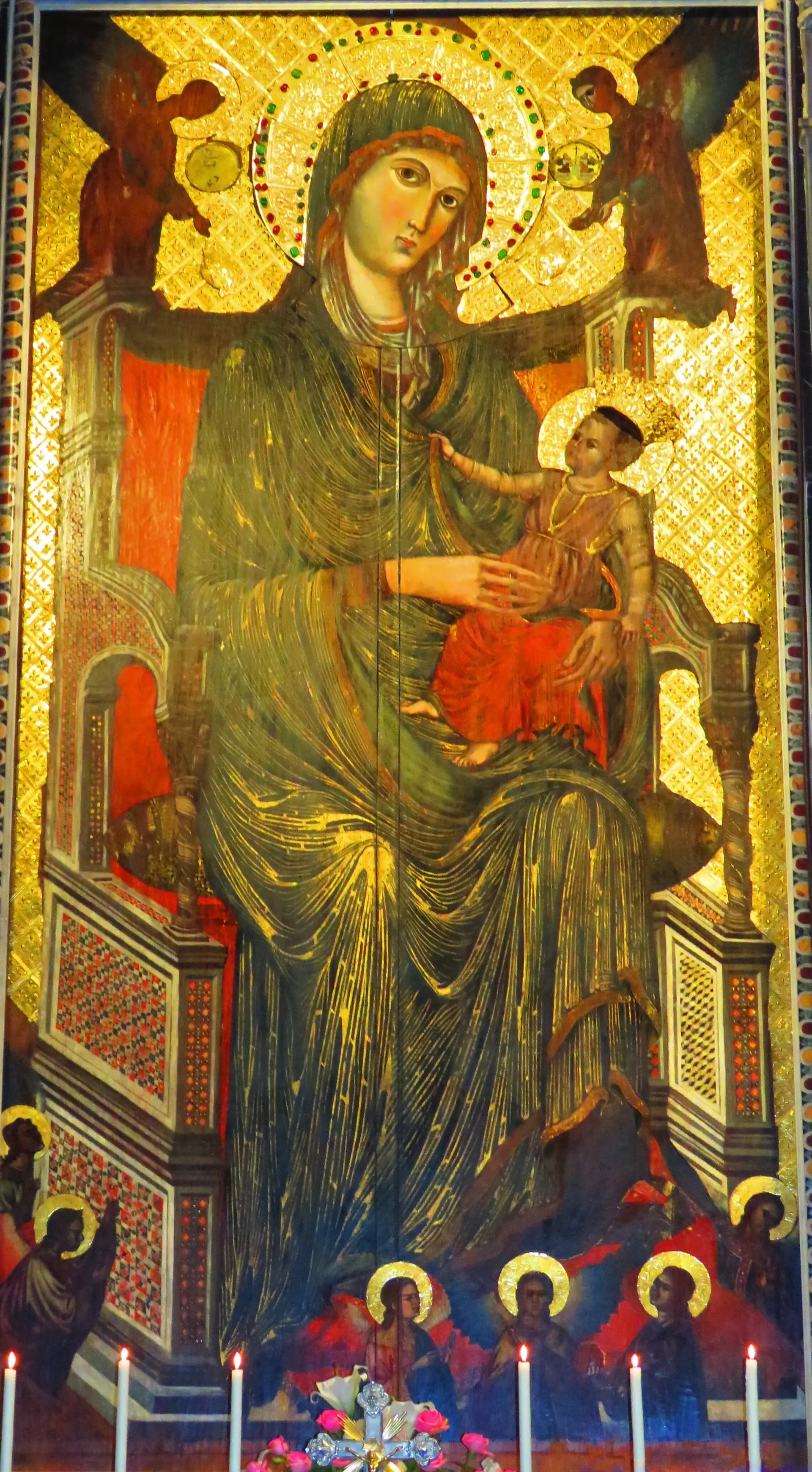
Image of Basilica of Our Lady of Mount Carmel. Image source · CC-BY-SA-4.0
Visit essentials
A quick read before you go
- Duration
- A contemplative visit takes 30 minutes to an hour.
- Etiquette
- The Basilica of Santa Maria del Carmine Maggiore is an active place of worship where appropriate…
Overview
The Basilica of Santa Maria del Carmine Maggiore is both monument and home, sustaining a living bond between Naples and the Madonna Bruna. The Carmelites came from Mount Carmel, where Elijah heard God's still small voice and Christian hermits practiced contemplation from the earliest centuries. Displaced from the Holy Land by Muslim conquest, they brought an icon of the Virgin traditionally attributed to Saint Luke.
Neapolitans gather each Wednesday for La Bruna devotions and each July for the feast of Our Lady of Mount Carmel. During the Incendio del Campanile, fireworks appear to set the 75-meter bell tower ablaze until the Madonna's raised image seems to extinguish the flames. She remains Mamma d'o Carmene, Mother of Carmine.
The Baroque interior reflects centuries of royal and popular patronage. Its crucifix has a tilted head and missing crown of thorns from a 1439 event in which, according to witnesses, Christ moved to avoid a cannonball. The sanctuary also holds the tomb of Conradin, the last Hohenstaufen, executed at sixteen in the piazza outside.
Sites inside
Why this place is sacred
The Carmelites did not choose this site by chance. Arriving in Naples after fleeing Mount Carmel, they established their church near Piazza del Mercato, the commercial and social heart of the city. For centuries, this was where Naples gathered to trade, to celebrate, and sometimes to die. Conradin of Swabia was executed here in 1268. Masaniello launched his revolt here in 1647. The Madonna has watched it all.
In Carmelite spirituality, the Virgin Mary holds special significance as the first and perfect contemplative, the one who pondered all things in her heart. The order's name derives from Mount Carmel, where Elijah experienced God not in wind or earthquake or fire but in the still small voice of silence. When the Carmelites brought the Madonna Bruna to Naples, they brought this contemplative tradition with them, embedding it in a city known for passion rather than stillness.
The result is a distinctive thinness: the quiet interiority of Carmelite prayer meeting the urgent, emotional faith of Neapolitan popular devotion. People come to La Bruna with problems that cannot wait for contemplation. They come with sick children and failing businesses, with broken hearts and desperate hopes. And according to centuries of testimony, she answers.
The icon itself carries mystery. Traditionally attributed to Saint Luke, who according to legend painted the Virgin from life, the Madonna Bruna shows Mary with dark skin holding the Christ child. Whether this darkness reflects age, original pigmentation, or symbolic meaning remains debated. What is clear is that Neapolitans have never cared about the explanation. They care about the relationship.
The church's other thin places reinforce the central devotion. The crucifix that moved to avoid a cannonball in 1439 still hangs with its tilted head, its crown of thorns forever fallen. The cannonball itself rests in the crypt, physical evidence of the miraculous. The tomb of Conradin adds the weight of tragedy, a reminder that this ground has witnessed history's turning points.
The Carmelite friars who fled Mount Carmel in the 13th century sought to recreate in Naples what they had known in the Holy Land: a life of contemplative prayer centered on Mary. For many years they kept the Madonna Bruna in a grotto beneath the church, as if trying to replicate the rocky caves of their original mountain home.
The church that grew above this grotto became both monastery and sanctuary, a place where the Carmelite charism of interior prayer could be practiced and the Madonna could receive the devotion of all who came.
From contemplative monastery to popular sanctuary, the Carmine has evolved while maintaining its essential character. The original Gothic structure gave way to Baroque renovation in the 17th and 18th centuries, as earthquake damage and changing taste prompted reconstruction. The bell tower was rebuilt by Giuseppe Nuvolo with its distinctive onion dome. The interior was transformed by Nicola Tagliacozzi Canale into the theatrical space of stucco and polychrome marble visitors encounter today.
Yet through these changes, the devotion to the Madonna Bruna has only deepened. The 1500 healing procession to Rome, the 1875 papal coronation of the icon, the annual festa that has become one of Naples' defining celebrations: each generation has added its layer to the relationship between city and Madonna. Today the adjacent monastery has become a shelter for the needy, continuing the Carmelite commitment to charity while the church remains a living place of worship.
Experience and orientation
The first thing many visitors notice is the light. The Baroque interior of the Carmine plays with illumination in ways both subtle and dramatic, drawing the eye toward the high altar where the Madonna Bruna presides. The icon itself is not large, but it commands the space. Mary's dark face is tender, her eyes meeting yours with a directness that can feel like recognition.
Neapolitans relate to this Madonna with an intimacy that can startle outsiders. They speak to her as to a mother, not in the formal language of liturgy but in the urgent dialect of the streets. Prayers offered here are not abstract petitions but specific requests, accompanied by the weight of generations who have asked and received.
The church holds other encounters. The crucifix with its tilted head invites contemplation of a moment when, according to witnesses, the boundary between wood and flesh, image and reality, dissolved. Whether or not visitors accept the miracle, the crucifix's unusual posture raises questions that linger. The tomb of Conradin offers a different kind of encounter, with history's cruelty and the church's role as final witness.
Those who visit on an ordinary day find a church that breathes with daily devotion. Those who come on a Wednesday experience the special intensity of the Madonna Bruna devotions. But those who witness the July 16 festa encounter something beyond categories: the entire neighborhood gathered in the piazza, fireworks cascading from the 75-meter bell tower, flames appearing to consume the structure, and then the moment when the Madonna's image is raised and the fire subsides.
The crowd shouts Viva la Madonna del Carmine! with a passion that can move even skeptics.
The Carmine rewards those who come as seekers rather than tourists. This is not a museum of religious art, though art abounds. It is a living place of worship where your presence is welcomed but not required.
Consider timing your visit for a Wednesday devotion to experience the church at its most alive. If you come on an ordinary morning, sit in the nave and let the space work. The Madonna Bruna has watched over this city for eight centuries; a few minutes of silence in her presence is not time wasted.
Before leaving, notice the crucifix with its tilted head. Notice the tomb of Conradin, a teenager executed in the piazza you just crossed. Notice the Neapolitans who enter, cross themselves, and speak to the Madonna as if she were family. This is what devotion looks like when it is not performance but relationship.
Context and lineage
When Muslim armies conquered the Holy Land, they shattered a world. Among those displaced were the hermits of Mount Carmel, descendants of a community that traced its origins to the prophet Elijah himself. According to tradition, these men had lived in contemplation on the sacred mountain since the earliest Christian centuries, developing a spirituality centered on silence and Marian devotion.
Gathering their most precious possession, an icon of the Virgin and Child said to have been painted by Saint Luke the Evangelist, the hermits fled westward. The journey from Mount Carmel to Naples may have taken years; accounts vary on exact dates. What is certain is that by the 13th century, Carmelite friars had established themselves near the Piazza del Mercato, building a church to house their icon and continue their contemplative life.
For many years, according to tradition, they kept the Madonna Bruna in a grotto beneath the sanctuary, as if trying to recreate the caves of their mountain home. When they eventually brought her into the light of the church above, she became not just the Carmelites' icon but Naples' own: Mamma d'o Carmene, the mother who watches over a city that has known invasion, plague, earthquake, and revolution.
From the hermits of Mount Carmel to the friars who built this church, from the medieval monastery to the Baroque basilica, from royal patronage to popular devotion, the lineage of the Carmine spans nearly a millennium. The Carmelite order has maintained continuous presence, adapting its ministry as the city around it changed.
Today the friars no longer fill a large monastery; the adjacent building now serves as a shelter for the needy. But the church remains fully active, with daily masses and weekly devotions. The July festa draws crowds that rival any in the Carmelite world. The relationship between Naples and its Madonna continues, passed from generation to generation, mother to child.
The Madonna Bruna
deity
The dark-faced icon of the Virgin and Child traditionally attributed to Saint Luke. Carried from Mount Carmel by fleeing Carmelites, she has been the object of Neapolitan devotion for eight centuries. The Vatican crowned her image in 1875.
Saint Simon Stock
historical / visionary
Prior General of the Carmelite Order to whom the Virgin Mary appeared on July 16, 1251, giving him the Brown Scapular with promises of protection and salvation. His feast day is the occasion for the Carmine's annual festa.
Conradin of Swabia
historical
The last Hohenstaufen, executed at sixteen in Piazza del Mercato in 1268 after his failed bid to reclaim his grandfather Frederick II's kingdom. His tomb in the church makes the Carmine a site of historical memory as well as devotion.
Masaniello
historical
Fisherman who led the 1647 revolt against Spanish taxation. He used the Carmine as his headquarters, and was killed in the adjacent monastery. His terracotta statue in the church commemorates a figure who remains deeply ambiguous in Neapolitan memory.
Traditions and practice
The Carmelite order developed a spirituality centered on contemplation and Marian devotion, practices that continue at the Carmine today. The Brown Scapular, given by the Virgin to Saint Simon Stock in 1251, remains a central devotional object, worn by Catholics worldwide as a sign of Mary's protection and a commitment to Carmelite spirituality.
Historical practices at this church included keeping the Madonna Bruna in a grotto to recreate the Mount Carmel environment, royal processions of the icon to Rome, and elaborate ceremonies during times of crisis when Naples turned to its Madonna for protection. The 1500 healing procession, when the sick were reportedly cured as light fell upon the icon, established a pattern of miraculous expectation that continues.
Daily masses are celebrated at 7:00, 8:30, 10:00, and 11:00 on weekdays, with an additional noon mass on Wednesdays. Sunday masses add an 11:30 and 13:00 celebration. The Wednesday devotions to La Bruna draw particular participation, combining special liturgy with a commitment to works of charity.
The annual Festa del Carmine, celebrated July 15-16, is the devotional peak. The evening of July 15 builds toward the Incendio del Campanile at 10:00 PM, when fireworks make the bell tower appear to burn. The climax comes when the image of the Madonna is raised and the flames subside, a theatrical enactment of Mary's protective power that reduces the crowd to tears and shouts of Viva la Madonna del Carmine!
The Carmelite ministry extends beyond the church to the shelter in the former monastery, where the needy receive care. This continuity between worship and charity reflects the Carmelite understanding that contemplation must bear fruit in action.
If you come seeking engagement rather than observation, consider these invitations. Attend a weekday mass to experience the rhythm of daily worship that has continued here for centuries. Time your visit for a Wednesday to participate in the devotions to La Bruna that draw the most fervent faithful.
Spend time in silence before the Madonna Bruna. You need not share the faith of those around you to benefit from quiet attention to an image that has received eight centuries of prayers. Notice her dark face, her tender posture, the weight of devotion that surrounds her.
If possible, witness the July 16 festa. Nothing else in European Christianity quite resembles the Incendio del Campanile, when fire and faith meet in a drama that is both spectacle and genuine prayer.
Roman Catholicism / Carmelite Order
ActiveThe Basilica of Santa Maria del Carmine Maggiore is one of the most important Carmelite churches outside the Holy Land. Founded by friars who fled Mount Carmel during the Crusades, it preserves the direct spiritual lineage from the original hermits of the sacred mountain. The Madonna Bruna icon, traditionally attributed to Saint Luke, represents one of the most venerated Marian images in Naples. The church embodies the Carmelite charism of contemplative prayer and Marian devotion, adapted over centuries to serve both the friars and the city that surrounds them.
Daily masses continue the rhythm of worship that has characterized this place since its founding. Wednesday devotions to La Bruna draw particularly fervent participation, combining special liturgy with commitment to works of charity. The annual Festa del Carmine (July 15-16), culminating in the Incendio del Campanile, celebrates the feast of Our Lady of Mount Carmel with a drama of fire and rescue that enacts Mary's protective power. The Brown Scapular devotion, deriving from the Virgin's apparition to Saint Simon Stock, remains central to Carmelite spirituality worldwide.
Perspectives and open questions
The Basilica of Santa Maria del Carmine Maggiore holds meaning differently for scholars, for Carmelite tradition, for Neapolitan popular faith, and for those who seek alternative spiritual interpretations. Each perspective offers genuine insight; none fully encompasses what this place is.
Scholarly perspective
Art historians recognize the Carmine as a significant example of Neapolitan Baroque architecture, with works by major artists including Mattia Preti, Francesco Solimena, and Francesco De Mura. The 75-meter bell tower, rebuilt by Giuseppe Nuvolo with its distinctive majolica-covered onion dome, is the tallest in Naples and architecturally distinctive. The facade by Giovanni del Gaizo represents late 18th-century Neapolitan ecclesiastical design.
Scholars of Marian devotion study the Madonna Bruna as one of the most important Black Madonna icons in Italy, noting the persistence of its cult across social classes and centuries. The icon's attribution to Saint Luke belongs to a widespread medieval tradition attributing various Marian images to the evangelist, a claim scholars treat as pious legend rather than historical fact. The July festa has attracted anthropological study as an example of southern Italian popular religion.
Historians value the Carmine for its connections to major events: Conradin's execution, Masaniello's revolt, the broader narrative of Neapolitan political and social history. The church's survival through earthquakes, rebuilding, and political transformation makes it a continuous witness to the city's experience.
Living and traditional perspectives
For Carmelites, this basilica preserves the direct spiritual lineage from Mount Carmel, where the prophet Elijah heard God in the still small voice and where Christian hermits began their contemplative life. The Madonna Bruna is not merely an artwork but the presence of Mary that has accompanied the order from the Holy Land to Naples and continues to receive the prayers of the faithful.
The Brown Scapular given to Saint Simon Stock represents Mary's promise of protection and salvation: whoever dies wearing this garment will not suffer eternal fire. The July 16 feast celebrates this gift and the ongoing relationship between the Carmelite order and its patroness.
For Neapolitan popular faith, the Madonna Bruna is Mamma d'o Carmene, a maternal protector who has watched over the city through every crisis. The relationship is personal and immediate. People speak to her, argue with her, plead with her, and thank her as they would a human mother. The Incendio del Campanile dramatizes what Neapolitans already know: that fire threatens, but Mary protects.
Alternative interpretations
Some visitors are drawn to the Madonna Bruna as a Black Madonna, connecting her to ancient goddess traditions that may predate Christianity. The icon's dark complexion has invited associations with earth-mother archetypes, mystery traditions, and esoteric interpretations of feminine divinity. In this reading, the passionate devotion of Neapolitan women to the Madonna Bruna continues an ancient relationship with the sacred feminine that Christianity absorbed but could not eliminate.
The church's location at Piazza del Mercato, a historical center of commerce and public life, places it at what some would call an energetic nexus of the city. The weight of history here, from Conradin's execution to Masaniello's revolt, adds layers of intensity that sensitive visitors may perceive.
Open questions
Genuine mysteries persist. What is the true origin and date of the Madonna Bruna icon? Is the current image the same one brought from Mount Carmel, or has it been replaced or restored beyond recognition? The attribution to Saint Luke places it among dozens of images with the same claim, but this tells us more about medieval piety than historical fact.
What occurred during the crucifix miracle of 1439? How did Christ's head come to tilt and the crown of thorns to fall? The cannonball preserved in the crypt is physical evidence of something, but what exactly happened defies easy verification.
What rituals did the Carmelites perform when they kept the Madonna in a grotto beneath the church? Why was the icon eventually brought into the light above? The answers may be lost with the friars who made these decisions centuries ago.
Plan your visit
Access and arrival
Numerous hotels and guesthouses throughout central Naples. For proximity to the Carmine, lodging near Piazza Garibaldi offers convenience to the train station and a short walk to the church. Those seeking a more atmospheric stay might choose the Spaccanapoli district, the ancient heart of the city.
Respectful visit
Modest dress is expected as a sign of respect. Shoulders and knees should be covered. Hats are typically removed by men upon entering. These standards reflect not arbitrary rules but recognition that you are entering a sacred space.
Non-commercial photography is generally permitted without flash. During masses and devotional services, put cameras away and be present. The Madonna Bruna has been photographed millions of times; she does not need another image nearly as much as you need a few minutes of undistracted attention to her.
Donations are appreciated and support the church's ongoing ministry, including the shelter for the needy. Candles may be lit before various images. If you wish to make a specific intention known, the traditional practice is to light a candle and pray.
The church closes to tourists during mass times. Access to certain areas may be restricted. The July festa brings special considerations, with crowds that require patience and awareness. The neighborhood around the Carmine, while improving, requires normal urban caution.
This is an active place of worship, not a museum. Visitors are welcome but should not treat the church as primarily a sightseeing destination. Mass times are for worship, not photography. The Wednesday devotions are particularly intense; join respectfully or observe from the margins.
The July festa draws enormous crowds and requires patience and good humor. The neighborhood around the Carmine has historically been rough; exercise normal urban awareness, particularly at night.
Current practical details
Address
Piazza del Carmine, 2, 80142 Napoli NA, Italy
Phone
Hours
Hours, fees, and access can change — verify on the official source before you travel. Practical details last checked Jun 2026.
Location
Map loads as you approach this section.
Pilgrim reflections
A portrait of encounter, not a score
Pilgrims describe what they felt, how present they could become, and whether the place would shape a journey. There are no stars and no ranking of traditions.
No reviewed reflections yet
The first pilgrims can help describe the character of being here.
Share a reflection
Available after an account-backed “Been there.” Every reflection is reviewed before publication.
Nearby sacred places
Explore other sacred places in the region. Proximity does not establish access or travel time; check each place’s guidance.


Share a photo
Help visitors recognize Basilica of Our Lady of Mount Carmel. Every submission is reviewed before publication.