Assos
Where Aristotle thought at the edge of the Aegean world
Understand sacred places, explore living traditions, and learn how to engage respectfully with Pilgrim Map.
Access has not been verified. Check current local guidance before planning a visit.
Çanakkale, Turkey
Read the sources
Visit essentials
A quick read before you go
- Duration
- Half-day for the acropolis ruins (temple, agora, theater, walls, necropolis).
- Access
- Located in Behramkale village, 17 km south of Ayvacık in Çanakkale Province.
Overview
Assos rises from the Çanakkale coast on a basalt hill dropping to the Aegean on three sides and facing visible Lesbos across the distance between worlds. Seventh-century BCE Methymnian Greek colonists deliberately chose a defensible height, harbour, and open water separating them from older Anatolian cultures. At the summit, six restored grey-andesite columns of Athena's temple mark the only Archaic Doric temple built in Anatolia.
Three thousand kilometres from the Doric heartland, it declared a Greek rather than Persian, Aegean rather than inland identity, making Athena's civic protection architectural as well as religious. Invited by ruler Hermias in 348 BCE, Aristotle came from Athens for three years, founded an academy, and formed natural observations, student conversations, and scientific habits later expressed in his zoological treatises. He also married Hermias's niece Pythias, making Assos personal as well as intellectual.
Saint Paul later walked from Alexandria Troas to meet his ship, as Acts 20:13–14 records. Today visitors move between active excavation, living village, ancient acropolis, and a working harbour where boats still arrive.
Why this place is sacred
What marks Assos as a thin place is partly architectural, partly geographical, and partly historical accident.
The hill itself does the primary work. At 235 meters, the acropolis commands views in every direction — the Aegean below, Lesbos visible across the water, Mount Ida rising to the south in the distance. Mount Ida was, in ancient Homeric geography, the seat of Zeus watching the Trojan War. Standing at the temple of Athena at Assos, you look toward the mountain of the gods while standing inside a house of a goddess.
The spatial relationship had meaning that the builders could not have failed to register.
The Doric temple adds another layer. Doric order was the architectural language of mainland Greece, of the Peloponnese, of Magna Graecia — brought to Anatolia once, here, as a statement of who these colonists believed themselves to be. The sculptured metopes surviving in Istanbul and the Louvre show sphinxes, lions, and centaurs — Eastern and Greek imagery combined, suggesting a community negotiating its position between two worlds. The sacred space itself embodied that negotiation.
Aristotle's presence shifts the register from religious to philosophical — but in the ancient world, the distinction was less firm than it later became. The academy he founded operated in the shadow of the temple, in a city organized around divine protection. His zoological observations here — of marine life in the sheltered Aegean waters, of the natural world visible from this elevated position — became foundational.
The place contributed specific content to the history of thought, not just a backdrop to it.
For later Christian pilgrims tracing the Pauline route, Assos was a named stopping point in Acts — not a miracle site, but a place of passage on a journey that transformed the ancient world.
Assos was founded as a Greek colonial city with Athena as civic protector. The hilltop temple served simultaneously as fortification, divine sanctuary, and declaration of Hellenic identity in an Anatolian landscape.
From an active civic and religious center under Greek, Pergamene, and Roman rule, through Byzantine occupation and Ottoman resettlement at the harbor, to its current state as an active excavation site and heritage destination. The philosophical significance of the Aristotelian connection was never entirely forgotten — the 1881 American excavations were partly motivated by this association — and it now forms a primary draw alongside the architectural heritage.
Experience and orientation
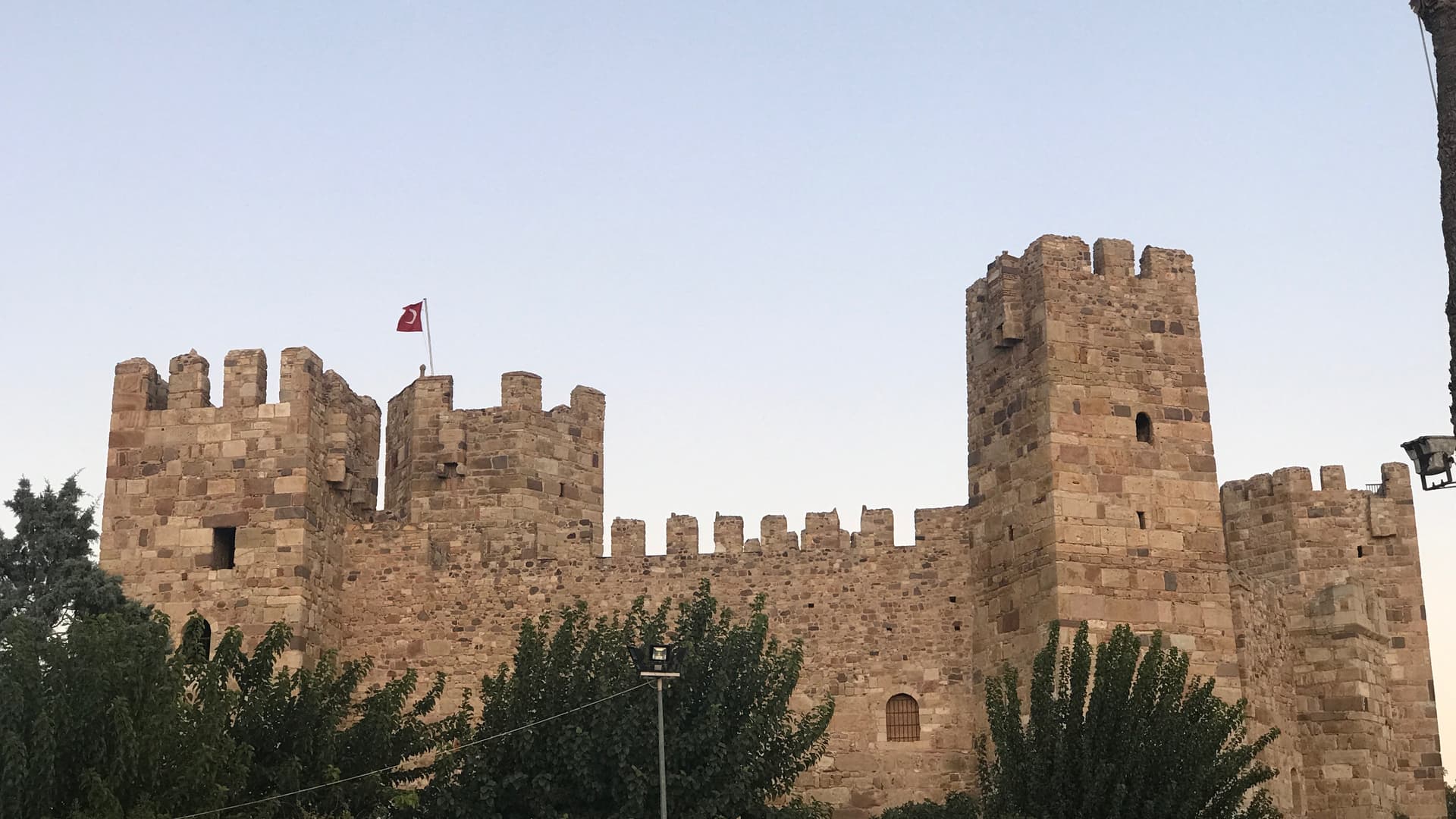
The approach to Assos from the village of Behramkale begins on the road winding upward from the harbor, through stone houses and past an Ottoman mosque that marks the medieval presence in this layered site. The acropolis gate appears ahead — monumental, its stones fitting together without mortar, the walls extending along the ridge in both directions. The 4th-century BCE defensive circuit, three kilometers long with towers reaching fourteen meters, is among the best-preserved in the Aegean world.
Walk it and the hill's military logic becomes immediate.
The Temple of Athena occupies the highest point. Several columns have been re-erected, enough to give the proportions of the structure — lower and heavier than Parthenon-period temples, with a compressed Doric ratio that reads as archaic even to an uninstructed eye. The stone is grey-green andesite, locally quarried, and in certain light it takes on a quality that makes the columns appear to grow from the hill rather than stand on it. Below on three sides, the sea.
To the south on clear days, Mount Ida.
The agora, bouleuterion, and theater lie on the slope below — spread across the terraced hillside in a configuration that required walking to understand. The theater's orientation faces north toward the sea rather than the conventional orientation toward the orchestra — an unusual choice that kept the view in sight even during performances.
The West Necropolis deserves more time than most visitors give it. The Archaic Street — flanked by monumental tomb structures, sarcophagi, and family tomb enclosures — runs along the ridge west of the city. The funerary sculptures and sarcophagi known as Assos sarcophagi, carved from local limestone, were believed in antiquity to dissolve corpses rapidly — a quality that gave the name sarkophagos (flesh-eater) to a class of stone coffin.
Several of the finest examples were removed to Istanbul and Boston in the 19th century; what remains still communicates scale and civic seriousness about the treatment of the dead.
The harbor, fifteen minutes' walk below, is a different world: boats, a waterfront of restaurants, the Ottoman caravanserai stones repurposed into a seawall. The juxtaposition is not jarring — it is clarifying. Assos has always been both hilltop sanctuary and working port.
Begin at the acropolis gate and work your way across the hilltop from east to west — temple, agora, theater, then along the city walls toward the necropolis. Return downhill through the village to the harbor for the afternoon. The direction gives you the best light on the temple columns in the morning and places the necropolis, which benefits from slower attention, in the middle of the day.
Context and lineage
The city was founded by colonists from Methymna on Lesbos — Greeks looking across the narrow water and claiming the opposite shore. The volcanic hill was the obvious choice: defensible, commanding, with a natural harbor below. The founding followed the standard pattern of Greek colonization, with the establishment of a patron deity — Athena — and the eventual construction of her temple on the highest point.
The Temple of Athena was built around 530 BCE, making it contemporary with the temple at Corfu and the early temples on Aegina. The choice of Doric order in Anatolia, where Ionic was standard, was a deliberate reference back to the colonists' mainland heritage — a statement of cultural identity at the literal edge of the Greek world.
The sculptural program of the metopes combined Greek mythological scenes (centauromachy, symposium imagery) with Eastern iconographic elements (sphinxes, lions), reflecting Assos's position at the intersection of cultural worlds.
In the 4th century BCE, Assos passed to Hermias of Atarneus, a former slave who had studied under Plato and became ruler of a small kingdom centered on Assos and Atarneus. His invitation to Aristotle in 348 BCE, following Plato's death, was an act of philosophical patronage that brought one of antiquity's most consequential minds to this specific hilltop for three years.
Aristotle founded a school, began systematic biological observations (aided by the rich marine environment), and married Pythias, Hermias's niece, before leaving for Mytilene in 345 BCE. Hermias was later captured and executed by the Persians; Aristotle wrote an ode to his memory.
The city came under Pergamene control in 241 BCE, during which period the agora, bouleuterion, and much of the urban infrastructure was regularized. Roman rule followed in 133 BCE. The apostle Paul passed through in the mid-first century CE, walking from Alexandria Troas while his companions sailed ahead — a deliberate choice recorded without explanation in Acts 20:13–14, whose quiet particularity has long attracted scholars of Pauline geography.
Methymnian Greek colonial foundation (7th century BCE) → independent polis under Cleobulus and other civic leaders → brief Persian control → Hermias of Atarneus's kingdom (mid-4th century BCE) → Macedonian and then Pergamene control (241 BCE) → Roman province of Asia (133 BCE) → Byzantine settlement → Ottoman-period village at the harbor (Behramkale) → modern Turkish municipality with ongoing excavation.
Aristotle (384–322 BCE)
Philosopher and naturalist
Hermias of Atarneus
Ruler and philosophical patron
Saint Paul
Apostle
J.T. Clarke, F.H. Bacon, R. Koldewey
Excavators
Prof. Dr. Nurettin Arslan
Current excavation director
Traditions and practice
The primary traditional practice at Assos was the civic cult of Athena Polias — temple sacrifices, festivals honoring the city's divine protector, and the use of the hilltop sanctuary as the symbolic center of public life. The necropolis supported elaborate funerary rites; the Assos sarcophagi indicate sophisticated beliefs about the treatment and dissolution of the dead body.
Aristotle's academy, while not a religious practice in the modern sense, operated within a framework in which philosophy and piety were not sharply distinguished.
Assos is on Turkey's UNESCO tentative list (2017) and under continuous excavation by Çanakkale Onsekiz Mart University. Academic visits, archaeological fieldwork, and heritage tourism are the primary contemporary activities at the site. Some visitors trace the Pauline route through Turkey, stopping at Assos as part of a Christian pilgrimage itinerary.
Stand at the temple columns in the morning and face seaward. The view takes in the Aegean, Lesbos, and on clear days the outline of mountains on the Greek islands further south. This is the view Aristotle would have seen daily. The quality of observation — of paying attention to what is actually there — that he practiced in Assos can be practiced again in the same place.
Walk the city walls. The 3 km circuit is largely intact and the experience of the defensive architecture — how height translates into protection, how sight lines were calculated — is tactile and immediate. The walls are best in early morning or late afternoon when the light is low.
Give the necropolis an hour. Walk the Archaic Street slowly. The monumental tomb enclosures, the sarcophagi, the temenos walls marking family burial precincts — these are among the best-preserved ancient funerary spaces in Turkey. The scale and care invested in the necropolis reflect a civic seriousness about ancestral continuity that still communicates.
Descend to the harbor at the end of the day. Eat at the waterfront. The transition from the ancient ruins above to the living harbor below completes the site's particular layering.
Ancient Greek — Worship of Athena Polias
HistoricalAssos was organized around its Temple of Athena from its founding. Athena as Polias — Athena of the City — served as divine protector and civic identity simultaneously. The Doric temple, built c. 530 BCE, was the only one of its order in Anatolia and represented a conscious assertion of Greek cultural identity at the boundary of the Hellenic world. The sculptured metopes combined Greek mythological subjects with Eastern iconographic elements, reflecting Assos's position at the intersection of Aegean and Anatolian cultural worlds.
Civic sacrifices to Athena; seasonal festivals; the acropolis as the center of public religious life and the symbolic guarantee of the city's safety.
Aristotelian Philosophical Academy
HistoricalAristotle's three-year residence at Assos (348–345 BCE) established one of the earliest philosophical academies outside Athens. In the shadow of the Temple of Athena and amid the ecological richness of the Aegean coastline, Aristotle began the systematic biological and zoological observations that would shape his scientific corpus. His marriage to Pythias and his close relationship with Hermias gave the stay personal depth alongside the intellectual one. Assos holds a documented place in the formation of Western scientific method.
Philosophical inquiry and debate; systematic observation of marine and terrestrial life; the exchange of students and ideas that Hermias's patronage made possible.
Archaeological and Heritage Scholarship
ActiveExcavations at Assos began in 1881 with the first American Archaeological Institute expedition and have continued with Turkish teams since 1981. The site has been on Turkey's UNESCO World Heritage Tentative List since 2017. Current work under Çanakkale Onsekiz Mart University continues to uncover domestic, funerary, and harbor architecture. Assos is an active research site as well as a heritage destination.
Ongoing systematic excavation; laboratory analysis of finds; publication and heritage tourism development; conservation of the temple columns, city walls, and necropolis structures.
Perspectives and open questions
Assos is understood differently depending on which thread of its history a visitor follows: as a site of architectural history (the Archaic Doric temple), as a site of intellectual history (Aristotle's academy), or as a site of spiritual passage (Paul's deliberate walk). These perspectives are not mutually exclusive — the place held all three simultaneously.
Scholarly perspective
Scholars of ancient architecture regard the Temple of Athena at Assos as a significant outlier — the only Archaic Doric temple in Anatolia, contemporary with the earliest Doric temples on the Greek mainland, and notable for metopes that combine Greek and Eastern iconographic elements. The temple provided evidence used in early debates about the diffusion of Doric order and the role of colonial contexts in architectural innovation.
The city walls, among the best-preserved Hellenistic defensive circuits in the Aegean, are studied as examples of systematic military engineering. The West Necropolis and its Assos sarcophagi contributed directly to the coinage of the word 'sarcophagus' in Latin medical and architectural literature.
Living and traditional perspectives
Within the ancient Greek religious imagination, Assos was a city under Athena's special care — the goddess as civic identity, not merely as war deity. The Methymnian colonists' choice to build in Doric rather than Ionic style, despite being an Aegean colonial community, reflects the particular character of this founding: a community asserting Greek identity at the boundary of the Hellenic world.
For the philosophical tradition, Aristotle's three years here were not incidental but constitutive — the natural richness of the site, the access to marine life, the intellectual atmosphere Hermias created, all entered into the formation of his method.
Alternative interpretations
Some visitors to Assos come specifically to walk where Paul walked — following the Acts itinerary through Turkey as a form of Christian pilgrimage. The mention of Assos in Acts 20:13–14 is brief and unexplained: Paul chose to walk from Alexandria Troas while his companions sailed, and they met him at Assos before continuing. The deliberateness of the choice to walk suggests a quality of personal intention that Pauline pilgrims find significant.
Others experience the hill as part of the broader sacred geography of the Troad — a region in which Mount Ida (Zeus's seat in the Iliad), the site of Troy, and numerous ancient sanctuaries create a landscape saturated with mythological memory.
Open questions
Whether Assos corresponds to the Hittite 'Assuwa' or the Homeric 'Pedasos' remains unconfirmed — the ancient layers beneath the Greek city have not been fully excavated. The precise location of Aristotle's academy — where he taught, where he observed, where he lived — is unknown.
The full sculptural program of the Temple of Athena cannot be reconstructed from what survives; fragments in Boston and Istanbul give only a partial picture of how the temple appeared to those who approached it from the sea.
Plan your visit
Access and arrival
Located in Behramkale village, 17 km south of Ayvacık in Çanakkale Province. From Ayvacık: dolmuş minibus (approximately 15 minutes) or taxi. From Çanakkale: bus or dolmuş to Ayvacık, then connection to Behramkale. From Istanbul: approximately 5 hours by bus to Çanakkale, then onward connection. Paid entry to the acropolis site; village and harbor are free. Mobile phone signal is generally available in the village and harbor; may be unreliable on the upper acropolis.
Nearest hospital is in Ayvacık (17 km) or Çanakkale (approximately 90 km). No specific booking required for individual visits; guided tours can be arranged locally.
The harbor village of Behramkale has several small hotels and guesthouses, primarily operating spring through autumn. Booking ahead is advisable in July and August. Additional accommodation options are available in Ayvacık (17 km). No accommodation on the acropolis site itself.
Respectful visit
No specific requirements. Practical footwear is important given the uneven ancient paving and the elevation change between acropolis and harbor.
Permitted throughout the open site. No restrictions on personal photography.
None traditional or expected. The site has no active religious function.
Stay on marked paths, particularly in the necropolis. Do not climb on walls or architectural elements. Active excavation zones may be marked off — respect all barriers. Do not remove stones, pottery fragments, or any archaeological material.
Active excavation zones may be closed without notice; respect barriers and do not enter restricted areas. Stay on marked paths in the necropolis to avoid disturbing fragile surfaces. The path between the acropolis and harbor involves significant elevation change on uneven ground — wear appropriate footwear.
Location
Map loads as you approach this section.
Pilgrim reflections
A portrait of encounter, not a score
Pilgrims describe what they felt, how present they could become, and whether the place would shape a journey. There are no stars and no ranking of traditions.
No reviewed reflections yet
The first pilgrims can help describe the character of being here.
Share a reflection
Available after an account-backed “Been there.” Every reflection is reviewed before publication.
Nearby sacred places
Explore other sacred places in the region. Proximity does not establish access or travel time; check each place’s guidance.


References
Sources consulted for this page. Source categories describe the publication, not a guarantee that every claim is verified. Traditional accounts and outside interpretations may differ.
- 01Assos – Wikipedia — Wikipedia contributorsencyclopediaComprehensive historical and archaeological overview
- 02Archaeological Site of Assos – UNESCO World Heritage Centre (Tentative List) — UNESCOofficialOfficial UNESCO tentative list entry (2017); justification of Outstanding Universal Value
- 03Çanakkale Assos Archaeological Site | Turkish Museums — Turkish MuseumsofficialOfficial Turkish ministry museum portal listing
- 04Assos | Turkish Archaeological News — Turkish Archaeological NewsacademicOngoing excavation updates and archaeological detail
- 05New Hope for a Forgotten City – Archaeology Magazine — Archaeology MagazineacademicScholarly assessment of excavation history and significance
- 06Assos – History and Facts | History Hit — History HitSource contextAccessible historical summary
- 07Assos Ancient City | ArticHaeology — ArticHaeologyacademicDetailed archaeological description
- 08The Goddess Rising at the Summit of Assos: Temple of Athena | Travelertopia — TravelertopiaguideSacred significance of the Temple of Athena at Assos
- 09Assos (Behramkale), Turkey – Turkey Travel Planner — Turkey Travel PlannerguidePractical visitor information and access
Share a photo
Help visitors recognize Assos. Every submission is reviewed before publication.