Alatri acropoli
Where massive stones align with solstice sunrises, encoding cosmic knowledge in cyclopean walls
Understand sacred places, explore living traditions, and learn how to engage respectfully with Pilgrim Map.
Access has not been verified. Check current local guidance before planning a visit.
Alatri, Frosinone, Italy
Read the sources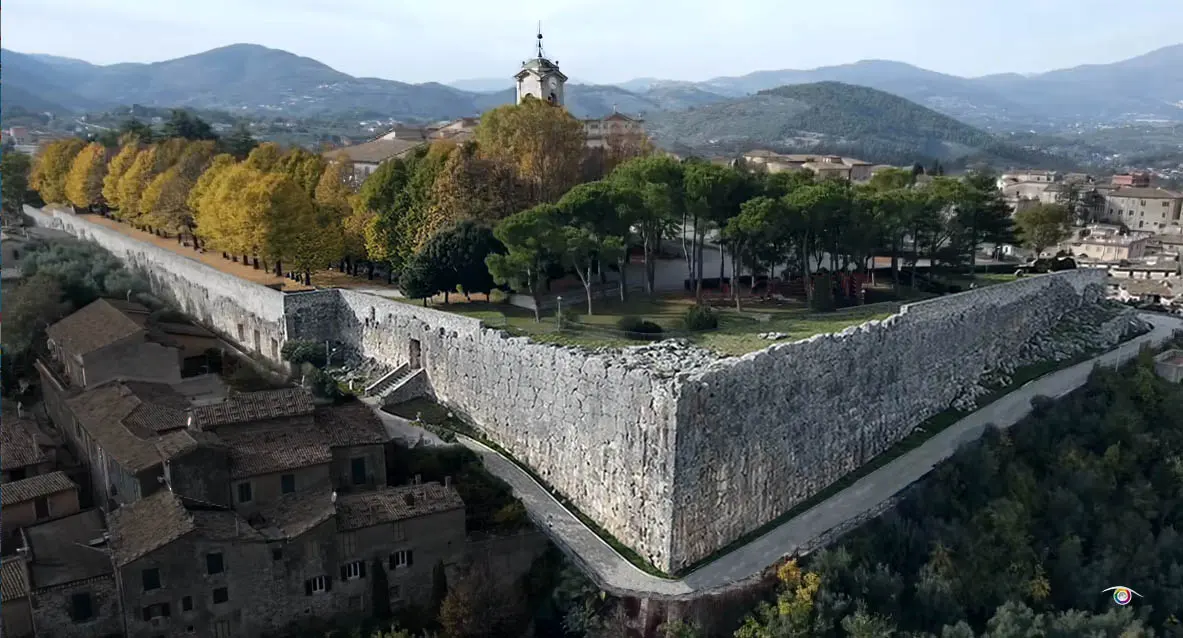
Image of Alatri acropoli. Image source · CC-BY-SA-4.0
Visit essentials
A quick read before you go
- Duration
- Two to three hours allows thorough exploration of the acropolis, including the walls, gates,…
- Access
- By car from Rome, follow the A1 motorway south, exiting toward Frosinone and continuing to…
Overview
Alatri’s massive irregular limestone blocks fit so precisely that a knife blade cannot pass between them. No mortar binds them; their weight and exact cutting have held for more than two millennia. Greeks encountering similar walls at Mycenae and Tiryns called the technique cyclopean, believing only mythic one-eyed giants could move such stones. Rising up to fifteen metres and extending more than two kilometres around the hilltop acropolis, Alatri’s circuit is Lazio’s best-preserved example of polygonal masonry.
Its geometry adds another puzzle. The walls align with sunrise at the summer solstice and sunset at the winter solstice, while the acropolis’s distinctive trapezoid appears to mirror Gemini as seen in the ancient sky. Whether deliberate or coincidental remains unresolved, but the alignments suggest a sophisticated knowledge of the heavens that challenges assumptions about prehistoric capabilities.
Why this place is sacred
The Acropolis of Alatri stands as a place where different orders of time seem to intersect. The massive stones themselves embody deep time—limestone formed from ancient seas, shaped by hands whose methods remain partially mysterious. The astronomical alignments connect the walls to cyclical time, marking the turning points of the solar year. And the layering of temples beneath churches speaks to the persistence of sacred recognition across cultural and religious transformation.
The Saturnian founding legend gives this layering its mythic charge: by tradition the site belongs to the golden age, that primordial era when Saturn ruled and the earth gave its fruits without labor, and the hilltop has never ceased to be recognized as sacred even as the names and forms of worship have changed.
The precision of the stonework contributes to the site's numinous quality. To confront the gates of Alatri is to confront an engineering achievement that seems to exceed what should have been possible with the technology of the 7th century BCE. This encounter with the inexplicable—with construction that approaches the limits of what we can explain—opens a space for wonder that rational analysis cannot entirely close.
The astronomical alignments deepen this sense of mystery. To stand within walls that may mirror a constellation and that frame the solstice sunrise is to occupy a space designed to be in conversation with the cosmos. The builders, whoever they were, appear to have conceived of architecture not merely as shelter or fortification but as a means of connecting earth to sky.
The acropolis served as the spiritual and political center of the Hernician people. Temples dedicated to Saturn and possibly other deities stood within its walls. The astronomical alignments suggest the site was designed with ceremonial significance related to solstices and equinoxes, possibly for agricultural or religious calendar purposes.
Following the Roman conquest in 306 BCE, Roman religion absorbed Hernician practices. The Temple of Saturn and other shrines eventually gave way to Christian churches, with Alatri Cathedral built directly atop the ancient sacred precinct, and the 5th-century Church of Santa Maria Maggiore continuing this pattern of sacred continuity. St. Benedict visited the local monastic community in 528 CE, connecting the site to the roots of Western monasticism.
Experience and orientation
Approaching Alatri, the first impression is of stone upon stone rising against the sky. The walls emerge from the hill as if they were a natural extension of the rock beneath, their massive blocks weathered to gray and ochre tones that blend with the surrounding landscape. Unlike ruins that speak primarily of the past, these walls remain functionally intact—still enclosing, still defining, still commanding the hilltop they have held for over two thousand years.
The Porta Maggiore draws the eye immediately. This gate on the southern side of the walls opens through a massive lintel, a single stone estimated to weigh twenty-seven tons, resting atop jambs that frame an opening nearly five meters high. A nineteenth-century staircase now leads up to the threshold, but the gate itself belongs to an age when the method of lifting such a stone into place remains difficult to fully explain.
Passing through the gates and into the acropolis, the atmosphere shifts. The medieval cathedral occupies the highest ground, but the ancient walls continue to frame the space, creating a bounded precinct that feels both intimate and connected to vast scales of time. From the ramparts, the view extends across the Cosa River valley to distant hills, and on clear mornings the light rises through precisely the orientation that the builders marked out nearly three thousand years ago.
The Civic Archaeological Museum in Palazzo Gottifredo offers context for what the eyes take in. Artifacts recovered from the area—tools, ceramics, ritual objects—help populate the imagination with the Hernici who once walked within these walls. But even with scholarly apparatus, the essential experience at Alatri remains one of confrontation with stone that should not, by conventional reasoning, be possible to position with such precision using ancient tools.
The acropolis occupies the highest point of the modern town. Two main gates provide access: the Porta Maggiore on the southern side and the Porta Minore to the northeast. The cathedral sits atop the ancient temple site at the center. The outer circuit of walls, over two kilometers long, encompasses the broader ancient city and can be walked for comprehensive views of the construction technique.
Context and lineage
The origins of Alatri reach back before recorded history. The Greek geographer Strabo recorded that the town was founded in 1830 BCE, though this date belongs to tradition rather than confirmed archaeology. What is certain is that by the 7th century BCE, the Hernici had established their acropolis here, raising walls of such sophistication that they rival the famous cyclopean constructions of Mycenaean Greece.
Roman tradition attributed a divine origin to the site. Saturn, the god of time, agriculture, and the golden age, was said to have founded five towns in Latium, all characterized by cyclopean walls: Alatri, Anagni, Arpino, Atina, and Ferentino. This mythology connected the builders not to human ingenuity alone but to the benevolent reign of a god associated with abundance and cosmic order.
The Hernici themselves were an Italic people who formed a confederation with three neighboring cities around 550 BCE, creating a defensive alliance against common enemies including the Volsci and Samnites. Alatri served as a center of this confederation, and the acropolis functioned as both political and spiritual heart. When Rome absorbed the city in 306 BCE, the temples and traditions did not disappear immediately but were gradually integrated into Roman practice before eventually giving way to Christianity.
The sacred history of the site flows from Hernician temples through Roman religion to Christianity. Alatri Cathedral now stands where the Temple of Saturn once rose, and the Church of Santa Maria Maggiore occupies the ground of a temple to Venus. This pattern of building new sanctuaries atop old ones suggests continuous recognition of the site's sacred significance across fundamental shifts in religious understanding.
Giuseppe Lugli
Archaeologist
Giuseppe Capone
Local historian
St. Benedict
Founder of Western monasticism
Traditions and practice
The Hernici who built the acropolis established temples on the hilltop, including a sanctuary dedicated to Saturn. Archaeological evidence suggests foundation deposit rituals—the burial of sacred objects at the moment of a building's founding—were practiced here. The astronomical alignments built into the walls imply that the solstices and equinoxes held ceremonial significance, though the specific rituals performed at these turning points of the year remain unknown.
Saturn was venerated throughout the region as a god of time, agriculture, abundance, and periodic renewal. The Saturnalia, celebrated in December, was the most prominent festival associated with Saturn worship. During this period, normal social rules were suspended, gifts were exchanged, and communities celebrated the return of the light after the winter solstice.
When Christianity arrived, the sacred precinct was transformed but not abandoned. The Church of Santa Maria Maggiore was built in the 5th century directly over a temple to Venus, and Alatri Cathedral rose atop the site of the Temple of Saturn. Early monasticism flourished here; St. Benedict visited the local monastic community in 528 CE, just a year before founding the famous monastery at Monte Cassino.
Catholic worship continues at Alatri Cathedral, maintaining the site's unbroken history as a place of spiritual practice. Good Friday features a historical commemoration of the Passion of Christ. The AntiquAlatri antique market, held on the third Sunday of each month, brings regular community gatherings to the historic center, though this is a cultural rather than religious event.
Modern visitors engage with Alatri primarily through contemplative exploration of the walls and gates. Those interested in the astronomical alignments may wish to time a visit to one of the solstices (see best times) to observe the corresponding sunrise or sunset. Walking the full circuit of the outer walls allows appreciation of the construction technique from multiple angles. The cathedral welcomes visitors outside of services for quiet reflection.
Hernician Religion
HistoricalThe Hernici, an ancient Italic people, constructed the acropolis around the 7th-6th century BCE as their spiritual and political center. They established temples within the walls, including sanctuaries that would later be identified with Roman gods. The astronomical alignments built into the walls suggest their religion included recognition of solstices and equinoxes as sacred time markers.
Temple worship, foundation deposit rituals (burial of sacred objects at building foundations), and likely ceremonial observation of astronomical events. The specific forms of Hernician practice remain largely unknown, visible only through archaeological traces and later Roman reinterpretation.
Saturn Worship
HistoricalSaturn was said to have founded the five Saturnian towns of Latium, including Alatri. A temple to Saturn occupied the highest point of the acropolis, where the cathedral now stands. Saturn was venerated as the god of time, agriculture, abundance, and periodic renewal, associated with the golden age and the turning of the year.
Temple worship and seasonal festivals, particularly Saturnalia in December, a time of gift-giving, role reversal, and celebration of the returning light following the winter solstice. The alignment of the acropolis walls with the winter solstice sunset may have been connected to Saturn's association with time and renewal.
Roman Catholicism
ActiveChristianity arrived in Alatri by the 5th century, when the Church of Santa Maria Maggiore was built over a temple to Venus. Alatri Cathedral rose atop the site of the Temple of Saturn, continuing the pattern of recognizing the hilltop as sacred while transforming the nature of worship. Early monasticism flourished here, with St. Benedict visiting in 528 CE.
Regular Catholic worship continues at the cathedral. Good Friday features a historical commemoration of the Passion of Christ. The site's connection to early monasticism and St. Benedict's visit links it to the roots of the Benedictine tradition that shaped Western spirituality.
Perspectives and open questions
Understanding the Acropolis of Alatri requires holding multiple perspectives in creative tension: the archaeological evidence for its construction, the mythological traditions that attributed divine origins, the astronomical alignments discovered in recent decades, and the mysteries that remain unresolved.
Scholarly perspective
Archaeologists classify the walls of Alatri as exemplary of third manner polygonal opus in Giuseppe Lugli's system—the most sophisticated technique, characterized by perfectly interlocked geometric stones shaped to fit one another without mortar. The dating of the walls remains contested. Some researchers attribute them to the Hernici in the 7th-6th century BCE, while others place their construction in the Roman Republican period following the conquest of 306 BCE.
The astronomical alignments first proposed by local historian Giuseppe Capone in 1982 have been confirmed by subsequent research, including studies published in peer-reviewed journals, though debate continues about whether these alignments were intentional or coincidental.
Living and traditional perspectives
Roman tradition held that Saturn founded the five towns of Latium characterized by cyclopean walls, connecting Alatri to the god of time, agriculture, and the golden age. The Hernici who built these walls were an Italic people whose religious practices predated Roman influence.
When Rome absorbed the region, the temples were integrated into Roman worship rather than destroyed, and the eventual replacement of Saturn's temple by a Christian cathedral continued the pattern of recognizing the site as sacred while transforming the worship conducted there.
Alternative interpretations
Some researchers emphasize the astronomical alignments as evidence of sophisticated knowledge that exceeds conventional understanding of prehistoric capabilities, reading the acropolis-to-Gemini correspondence as a deliberate earthly mirror of the heavens. The precision of the stonework leads some to question whether the construction techniques have been fully understood.
Open questions
Significant questions remain open. The precise dating of the walls continues to divide scholarly opinion. How builders without modern technology achieved such precise fitting of massive stones remains partially unexplained. Whether the astronomical alignments were intentional or coincidental cannot be definitively resolved. The specific religious practices of the Hernici beyond temple construction remain largely unknown, recoverable only through archaeological fragments and later Roman interpretations.
Plan your visit
Access and arrival
By car from Rome, follow the A1 motorway south, exiting toward Frosinone and continuing to Alatri (approximately 90 km total). Train service reaches Frosinone and Anagni, with bus connections to Alatri. Parking is available in the lower town, with a steep walk up to the acropolis.
The town of Alatri offers modest hotels and bed-and-breakfast accommodations. Frosinone, the provincial capital, provides more options. Rome is within day-trip range for those basing themselves in the capital.
Respectful visit
No specific dress code applies to the archaeological areas. Modest dress is appropriate when visiting the cathedral—shoulders and knees covered as is customary in Italian churches.
Photography is permitted throughout the town and at the walls. Standard restrictions may apply within the cathedral; flash photography during services would be inappropriate.
Not applicable at the archaeological site. Those attending mass at the cathedral may participate in the collection as is customary.
Do not climb on the ancient walls. Respect services at the cathedral by keeping quiet and refraining from photography during worship.
The archaeological site requires no special permissions, but the cathedral is an active place of worship and should be approached with appropriate respect during services.
Current practical details
Address
03011 Alatri, Province of Frosinone, Italy
Hours, fees, and access can change — verify on the official source before you travel. Practical details last checked Jun 2026.
Location
Map loads as you approach this section.
Pilgrim reflections
A portrait of encounter, not a score
Pilgrims describe what they felt, how present they could become, and whether the place would shape a journey. There are no stars and no ranking of traditions.
No reviewed reflections yet
The first pilgrims can help describe the character of being here.
Share a reflection
Available after an account-backed “Been there.” Every reflection is reviewed before publication.
Nearby sacred places
Explore other sacred places in the region. Proximity does not establish access or travel time; check each place’s guidance.



References
Sources consulted for this page. Source categories describe the publication, not a guarantee that every claim is verified. Traditional accounts and outside interpretations may differ.
- 01Alatri | Ancient City, Roman Ruins, Medieval Walls — BritannicaencyclopediaAuthoritative general reference
- 02Acropolis of Alatri - Astronomical Heritage — UNESCO Astronomical HeritageacademicDetailed astronomical alignment analysis
- 03The Acropolis of Alatri: Architecture and Astronomy — ResearchGateacademicPeer-reviewed archaeoastronomy study
- 04Alatri - Wikipedia — Wikipedia contributorsencyclopediaGood overview with archaeological detail
- 05Megalithic Walls at Alatri - The Ancient Connection — The Ancient ConnectionSource contextDetailed megalithic architecture analysis
- 06The Cyclopean Problem: Who Built Italy's Astounding Ancient Walls? — Ancient OriginsspiritualOverview of cyclopean walls debate
- 07History of Alatri — Italy This WayguideHistorical background with visitor context
- 08Templars, Miracles, and Cyclopean Walls: What Makes Alatri One of Italy's Most Fascinating Towns? — Wine DharmaguideOverview of town's spiritual heritage
Share a photo
Help visitors recognize Alatri acropoli. Every submission is reviewed before publication.