Monastero di Santa Scolastica
The oldest Benedictine monastery in the world, with three cloisters and the first Italian printing press
Understand sacred places, explore living traditions, and learn how to engage respectfully with Pilgrim Map.
Access has not been verified. Check current local guidance before planning a visit.
Subiaco, Rome, Italy
Read the sources
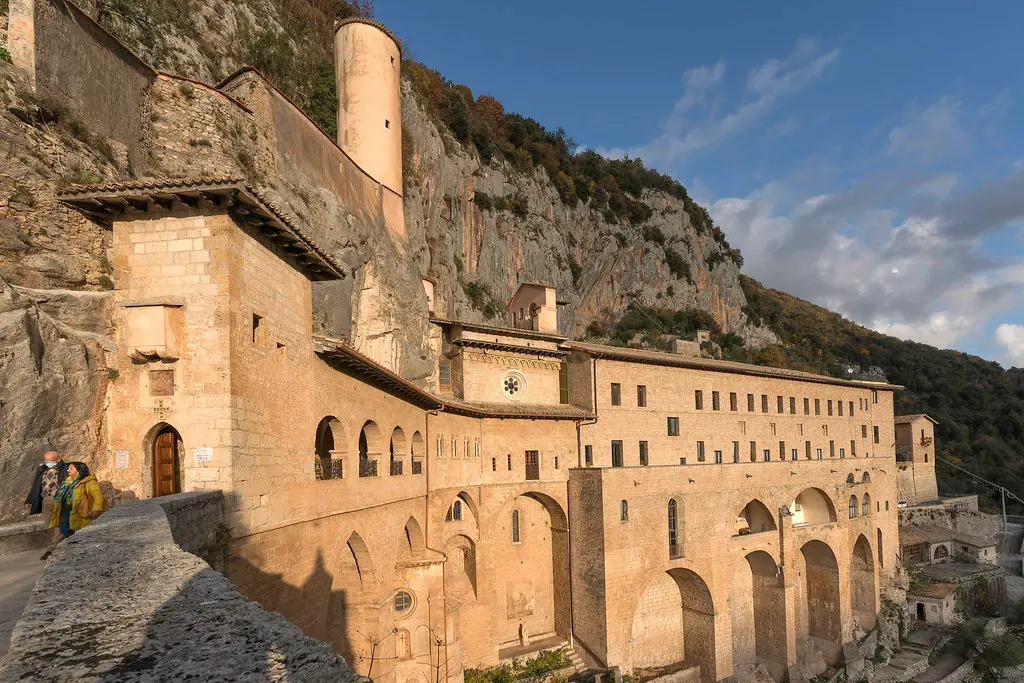
Image of Monastero di Santa Scolastica. Image source · CC-BY-SA-4.0
Visit essentials
A quick read before you go
- Duration
- 1-1.5 hours for the guided tour.
- Access
- Approximately 74 km east of Rome.
Overview
Saint Benedict founded thirteen monasteries in the Aniene valley at Subiaco before leaving for Monte Cassino. Twelve are gone; Santa Scolastica, named for his twin sister, remains. Saracens destroyed it twice in the ninth century, and it was rebuilt each time, passing through cultural flowering and decline. Its great medieval library was joined in 1465 by the first Italian printing press, where German clerics Arnold Pannartz and Conrad Sweynheym introduced moveable type to the peninsula.
The layered complex begins beneath the portal's Benedictine motto Ora et Labora, pray and work. Three successive cloisters lead backward through time: the calm, proportional Renaissance Cloister of the sixteenth century; the more angular, aspiring Gothic Cloister of the fourteenth century; and the small but spectacular Cosmatesque Cloister of the thirteenth century, with intricate marble work and frescoed symbols of the four Evangelists. The progression reaches toward Romanesque roots.
The 1052 bell tower is the earliest surviving constructed element, while the eighteenth-century neoclassical church is the most recent major intervention.
Monks still live here, pray the hours Benedict ordained, welcome guests in the foresteria, and maintain a library holding four hundred handwritten volumes and more than two hundred incunabula. The world's oldest Benedictine monastery is not a museum but a community living the same Rule in the same valley for fifteen hundred years.
Why this place is sacred
There is a particular quality to places that have endured what should have destroyed them. The Saracens came twice, in 828-829 and 876-877, and left ruins. Each time, the community returned and rebuilt. This pattern of destruction and restoration, shared with Monte Cassino and many other European monasteries, produces a form of thinness born not from unbroken continuity but from persistence through catastrophe.
The three cloisters embody this persistence in architectural form. The Cosmatesque Cloister, built by Abbot Lando around 1200, is the innermost and oldest, its intricate marble inlay work representing a craft tradition that connected medieval Roman workshops to Byzantine and Islamic decorative arts. The small scale of this cloister intensifies its beauty; the colored marbles seem to concentrate the light. The Gothic Cloister of the fourteenth century introduces pointed arches and a different spatial rhythm.
The Renaissance Cloister of the sixteenth century opens the proportions further, achieving the balanced calm that characterizes its period.
To walk through these three spaces in sequence is to experience eight hundred years of European architecture within a single monastic compound. Each cloister served the same function, providing a meditative ambulatory for monks living under the same Rule, yet each expressed that function through the aesthetic language of its time. The persistence of use through changing style is itself a lesson in what endures and what passes.
The printing press of 1465 adds another dimension to the monastery's thinness. When Pannartz and Sweynheym set up their press here, they were introducing to Italy a technology that would transform Western civilization. The first books they printed included works by Lactantius and Donatus, foundational texts of classical learning reproduced through a revolutionary medium.
That this revolution occurred within a Benedictine monastery was not accidental: the monastic tradition of manuscript preservation and production provided the context in which printing could take root.
The library that survives, with its four hundred handwritten volumes, thousands of parchments, and over two hundred incunabula, represents the material inheritance of a community that has valued the written word since Benedict himself commanded his monks to read. The thinness of Santa Scolastica is, in part, the thinness of accumulated knowledge: the sense that these walls contain not only prayer but the intellectual labor of centuries.
Benedictine monastery founded by Saint Benedict c. 520 AD as one of thirteen communities in the Aniene valley
Twice destroyed by Saracens (9th century), rebuilt each time. Romanesque church consecrated 980. Bell tower 1052. Cosmatesque cloister c. 1200. Gothic cloister 14th century. First Italian printing press 1465. Renaissance cloister 16th century. Church rebuilt 18th century. Active monastery today.
Experience and orientation
The approach to Santa Scolastica follows the road from Subiaco that also leads to the Sacro Speco above. The monastery appears on the mountainside, less dramatically positioned than the cliff-clinging Sacro Speco but more substantial, more clearly an institution designed for communal life rather than solitary prayer.
The entrance portal bearing Ora et Labora sets the tone. The free guided tour begins in the Renaissance Cloister, the most recent of the three, a space of balanced arcades and quiet proportions. The guide, typically a monk or staff member, introduces the monastery's history in this setting of sixteenth-century calm.
The Gothic Cloister follows, its pointed arches and different spatial rhythm marking the transition to an earlier period. The atmosphere shifts subtly; the proportions are more vertical, the feeling more aspiring. The fourteenth century expresses itself differently from the sixteenth, and the body registers the difference before the mind names it.
The Cosmatesque Cloister is the emotional center of the visit. Small in size, it is spectacular in execution. The marble inlay work, the colored stone patterns, the frescoes of Evangelist symbols create a concentrated beauty that visitors consistently describe as the highlight. Built around 1200, this cloister represents a craft tradition that connected medieval Rome to Constantinople and the Islamic world, a tradition of geometric precision and material splendor that achieves something close to the effect of music in stone.
The bell tower, dating to 1052, provides a vertical counterpart to the horizontal progression of the cloisters. The church, rebuilt in the eighteenth century in neoclassical style, represents the most recent layer of the architectural palimpsest. It does not have the medieval atmosphere of the cloisters but carries its own dignity.
The printing press site and the library, when accessible, add intellectual weight to the visit. To stand where the first Italian printed books were produced is to encounter a moment that changed the world, a moment that occurred within the same walls where monks had been copying manuscripts by hand for a millennium.
The foresteria (guest house) offers the possibility of staying overnight, participating more fully in the monastery's rhythm. Guests who attend the Divine Office hear the same psalms that Benedict assigned to each hour, sung in the same valley where he first prescribed them.
The Monastery of Santa Scolastica sits on the slopes above Subiaco in the Aniene valley, Province of Rome, Lazio. It is approximately 1 km below the Sacro Speco on the same mountain road. The monastery faces the valley with its entrance portal.
Context and lineage
Benedict of Nursia, after his three years as a hermit in the cave that would become the Sacro Speco, founded thirteen monastic communities in the Aniene valley. The community that would become Santa Scolastica was among them. Named for Benedict's twin sister Scholastica, herself a monastic who established a women's community nearby, the monastery became the principal foundation in the valley.
When Benedict departed for Monte Cassino, the Subiaco communities continued, but over the following centuries all but Santa Scolastica were destroyed or abandoned. The monastery became the repository of Benedict's Subiaco legacy.
Benedictine Order. Territorial abbey. The oldest Benedictine monastery in the world. The sole survivor of Benedict's thirteen Subiaco foundations. Connected to the broader Benedictine network that includes Monte Cassino, Cluny, and thousands of foundations worldwide.
Saint Benedict of Nursia
Founder of the monastery c. 520 AD
Saint Scholastica
Benedict's twin sister, for whom the monastery is named; founder of women's Benedictine monasticism
Abbot Lando
Built the Cosmatesque cloister (c. 1200)
Arnold Pannartz and Conrad Sweynheym
German clerics who established the first Italian printing press at the monastery
Pope Benedict VII
Consecrated the Romanesque church on December 4, 980
Traditions and practice
The Benedictine Divine Office has been prayed here since the sixth century. The community follows the Rule of Saint Benedict, maintaining the balance of prayer, study, and manual labor (Ora et Labora) that has characterized Benedictine life for fifteen centuries.
The monks maintain the full liturgical schedule. Free guided tours are offered to visitors. The foresteria welcomes guests seeking retreat. The library continues to preserve and catalogue its collection of manuscripts and early printed books. The monastery produces and sells devotional items.
Begin with the guided tour through the three cloisters, allowing the backward passage through architectural time to work on you. If the library is accessible, ask about the incunabula from the first printing press. Consider staying overnight in the foresteria to experience the rhythm of the Divine Office. Combine with a visit to the Sacro Speco, 1 km up the road; together, the two sites tell the complete story of Benedict's Subiaco years.
Roman Catholicism - Benedictine
ActiveThe oldest Benedictine monastery in the world. Only survivor of Benedict's thirteen Subiaco foundations. Home to the first Italian printing press (1465). Library with 400 manuscripts and 200+ incunabula.
Full Benedictine Divine Office, monastic hospitality (foresteria), guided visits, library preservation, community life under the Rule of Saint Benedict
Perspectives and open questions
Santa Scolastica invites interpretation as the origin point of Western monasticism, as an architectural timeline spanning eight centuries, and as a place where the monastic tradition of preserving and producing texts culminated in the introduction of printing to Italy.
Scholarly perspective
The monastery's foundation by Benedict in the early sixth century is established through the testimony of Pope Gregory the Great's Dialogues. Its survival as the sole remaining Subiaco monastery has been documented through centuries of destruction and rebuilding. The Cosmatesque cloister is recognized as an exceptional example of the tradition. The 1465 printing press is a well-documented milestone in the history of Western printing.
Living and traditional perspectives
Within the Benedictine tradition, Santa Scolastica holds a unique place as the oldest surviving monastery of the order. Its persistence through destruction embodies the Benedictine charism of stabilitas, the commitment to remain in one place through whatever comes. The naming for Scholastica honors the female dimension of Benedict's vision.
Alternative interpretations
The three cloisters, experienced in reverse chronological order, create what some visitors describe as a journey backward through time, a descent into the sources of Western spiritual and intellectual culture. The printing press connection links the monastic tradition of manuscript preservation to the technological revolution that would eventually create the modern information age.
Open questions
The fate of manuscripts and artworks lost during the Saracen destructions remains unknown. The library's full collection continues to yield discoveries. The history of the twelve destroyed Subiaco monasteries is only partially documented.
Plan your visit
Access and arrival
Approximately 74 km east of Rome. Bus: COTRAL from Rome Ponte Mammolo (approximately 1.5 hours). Car: Via Sublacense or A24 motorway. The monastery is on the road from Subiaco to the Sacro Speco, approximately 1 km below the Sacro Speco.
The monastery operates a foresteria (guest house) offering rooms for retreat and hospitality. Contact: foresteria-subiaco.com. Hotels and guest houses in Subiaco town.
Respectful visit
Shoulders and knees covered. Dress code enforced at entry.
Generally permitted in the cloisters during guided tours. Restrictions may apply in the church and library. Check with your guide.
Donations appreciated. Monastery shop purchases support the community.
Dress code enforced | Guided tour required for most areas | Monastic enclosure areas not accessible | Silence and reverent behavior expected
The guided tour is necessary for most areas. Arrive with appropriate dress (shoulders and knees covered). Check tour times locally, as they may vary seasonally.
Current practical details
Address
Piazzale Santa Scolastica, 1, 00028 Subiaco RM, Italy
Phone
Hours
Hours, fees, and access can change — verify on the official source before you travel. Practical details last checked Jun 2026.
Location
Map loads as you approach this section.
Pilgrim reflections
A portrait of encounter, not a score
Pilgrims describe what they felt, how present they could become, and whether the place would shape a journey. There are no stars and no ranking of traditions.
No reviewed reflections yet
The first pilgrims can help describe the character of being here.
Share a reflection
Available after an account-backed “Been there.” Every reflection is reviewed before publication.
Nearby sacred places
Explore other sacred places in the region. Proximity does not establish access or travel time; check each place’s guidance.


References
Sources consulted for this page. Source categories describe the publication, not a guarantee that every claim is verified. Traditional accounts and outside interpretations may differ.
- 01Monastery of Santa Scolastica, Subiaco - Italia.it — Italia.itSource contextOfficial Italian tourism portal
- 02Monastery of Santa Scolastica - Regional Directorate of Lazio's Museums — Italian Ministry of CultureofficialOfficial museum/heritage listing
- 03Abbey of Saint Scholastica, Subiaco - Wikipedia — Wikipedia contributorsencyclopediaDetailed article with comprehensive history
- 04St Scholastica Abbey - Pilgrimaps — PilgrimapsSource contextPilgrimage-focused guide
Share a photo
Help visitors recognize Monastero di Santa Scolastica. Every submission is reviewed before publication.