Sacro Speco di San Benedetto
The cliff-side cave where Western monasticism was born, painted with extraordinary frescoes
Understand sacred places, explore living traditions, and learn how to engage respectfully with Pilgrim Map.
Access has not been verified. Check current local guidance before planning a visit.
Subiaco, Rome, Italy
Read the sources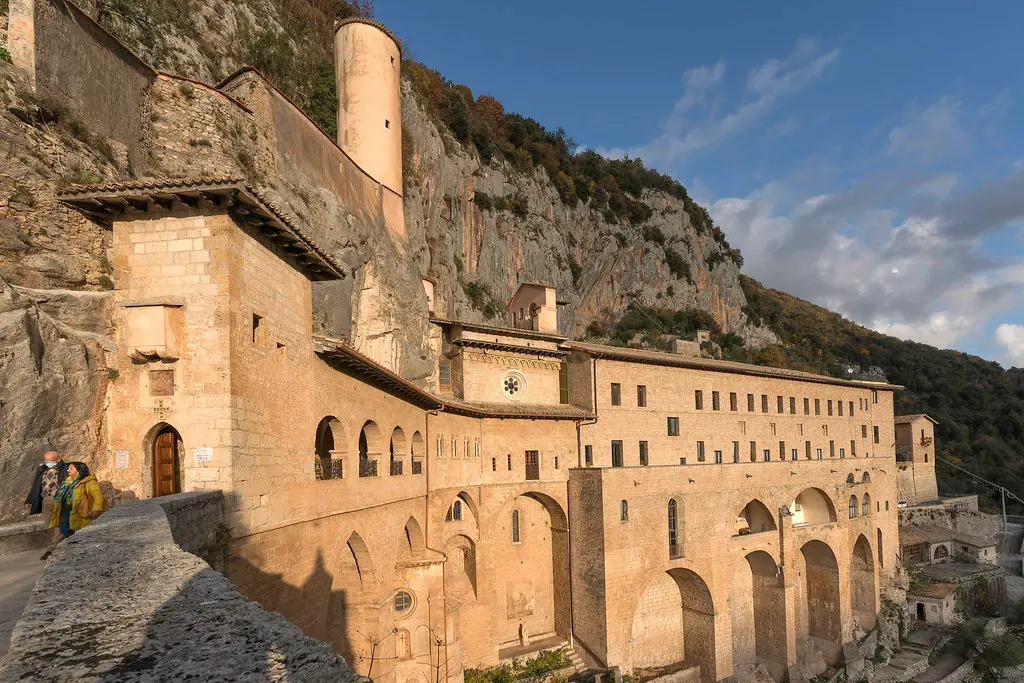
Image of Sacro Speco di San Benedetto. Image source
Visit essentials
A quick read before you go
- Duration
- 1.5-2.5 hours for a thorough visit
- Access
- Subiaco is approximately 74 km east of Rome.
Overview
At the Sacro Speco, architecture and natural rock become indistinguishable around the cliff cave that seeded Western monasticism and a sanctuary bearing some of central Italy's most significant medieval frescoes.
Benedict of Nursia arrived around 500 AD, a young man from a good family who had abandoned his studies in Rome, repelled by the moral decay he witnessed. He withdrew into a cave on Mount Taleo, where the monk Romanus lowered bread to him by rope. Three years of solitary prayer and ascetic practice formed the spiritual maturity from which Benedict founded thirteen monastic communities along the Aniene valley.
He later moved to Monte Cassino and wrote the Rule that has governed monastic life for fifteen centuries, but its impulse and charism formed here.
The sanctuary began taking its present form in the eleventh century. Its rooms and passages cling to the cliff, carved from and built against living rock. Thirteenth- and fourteenth-century fresco cycles depict Christ, the Virgin, and Saint Benedict in a skillful union of Roman and Byzantine elements.
The oldest existing portrait of Saint Francis of Assisi was painted during or shortly after his 1223 Subiaco visit. Because it shows him without the stigmata, scholars suggest it predates the 1224 event on La Verna. The image connects Benedictine and Franciscan traditions in a place both held holy.
The Sacro Speco remains an active Benedictine monastery. Monks still pray in Benedict's cave, while visitors ascend through spaces where stone, paint, and fifteen centuries of devotion merge.
Why this place is sacred
Pope Gregory the Great, writing his Dialogues in the late sixth century, provided the earliest account of Benedict's time in the cave. The narrative he preserved, of the young man lowered by Romanus's rope to the hidden cave, of the three years of solitary prayer, of the temptations overcome and the spiritual clarity achieved, has shaped the way Christians understand the relationship between solitude and wisdom for fifteen centuries.
The cave itself is small and rough, as caves are. It offers shelter from weather but none of the comforts that a young Roman aristocrat might have expected. Benedict's choice to remain here for three years was an act of radical withdrawal, following the model of the Desert Fathers whom he admired. Through this withdrawal, he found something he could not find in society: a silence deep enough for God to be heard.
What emerged from the cave was not merely a man who had prayed, but a man who had discovered how to build a way of life around prayer. The monastic communities Benedict founded in the Aniene valley were experiments in sustained communal devotion, balancing solitude and community, prayer and labor, silence and speech. When he codified these experiments in his Rule at Monte Cassino, he was drawing on everything the cave had taught him.
The monastery built into the cliff honours this origin by making the rock itself part of the sacred architecture. Walls emerge from stone faces. Ceilings are cave roofs. The boundary between the natural and the constructed dissolves, creating spaces that feel simultaneously created and discovered, as if the monastery were always latent in the mountain and the builders merely uncovered it.
The frescoes that cover these spaces add another dimension. Painted primarily in the thirteenth and fourteenth centuries by artists of the Roman school and the Sienese tradition, they surround the visitor with the life of Benedict, the life of Christ, and the life of the Virgin. The quality of execution and the state of preservation are exceptional.
In the dim light of the cliff-side chambers, the painted figures seem to emerge from the stone with the same organic quality as the architecture itself.
The portrait of Saint Francis, painted without stigmata during or shortly after his 1223 visit, provides a single point where two of the greatest spiritual traditions of Western Christianity intersect. Benedict and Francis, the monk and the friar, the rule-giver and the rule-receiver (Francis had come to Subiaco from writing his own Rule at Fontecolombo): their traditions converge in this painted image on a cave wall.
Hermit's cave where Benedict of Nursia spent three years in prayer (c. 500 AD), forming the spiritual foundations of Western monasticism
From hermit's cave to pilgrimage site (6th century onward). Artistic evidence from the 8th century. Current architectural complex from the 11th century. Major fresco campaigns in the 13th-14th centuries. Continuous Benedictine monastic presence.
Experience and orientation
The approach to the Sacro Speco involves ascent, both literal and spiritual. From Subiaco, the road climbs Mount Taleo, passing the Monastery of Santa Scolastica below before reaching the cliff where the Sacro Speco clings to the rock face like a swallow's nest. The first impression is of a building that is as much geological as architectural, its walls emerging from the cliff as if the mountain had grown them.
Entering the complex, visitors begin a descent through interconnected chambers that penetrate deeper into the rock. The experience has been described as a spiritual crescendo, though the word implies an increasing loudness where what actually increases is depth, intensity, and intimacy.
The frescoes begin almost immediately. In the upper church, cycles depicting the life of Christ and the life of the Virgin cover walls and ceilings. The painting is of exceptional quality, the work of Roman school and Sienese artists of the thirteenth and fourteenth centuries, and the preservation is remarkable for works that have endured seven hundred years in a damp cliff-side environment.
Descending further, visitors encounter the frescoes depicting the life of Saint Benedict, drawn from Pope Gregory the Great's Dialogues: the young student leaving Rome, the hermit in the cave, the miracles that attracted disciples, the founding of the monastic communities. These images surround the visitor in the very spaces where the events they depict occurred or where they were first remembered.
The cave itself, when reached, is the emotional and spiritual culmination. It is a natural cavity in the rock, modified by centuries of devotion but retaining its essential character: a rough, enclosed space where a young man chose to live alone with his prayer. A statue of Benedict marks the traditional location of his habitation. The stone walls are smooth where centuries of pilgrims have touched them.
The portrait of Saint Francis, encountered along the way, stops many visitors in their tracks. It shows Francis as a young man, without halo, without stigmata, dressed simply, his face intelligent and alive. This is not the sanctified icon of later art but something closer to a record of a living presence.
The sanctuary shop near the exit offers products made by the monks: medicinal spirits, honey, and devotional objects. Vending machines provide refreshments. The transition from the sacred depths of the cave to these practical amenities is itself a form of the Benedictine balance between contemplation and daily life.
The Sacro Speco is built into the cliff face of Mount Taleo, approximately 2 km from the town of Subiaco in the Province of Rome, Lazio. The monastery perches above the Aniene Valley. The Monastery of Santa Scolastica sits approximately 1 km down the road.
Context and lineage
Around 500 AD, Benedict of Nursia abandoned his studies in Rome, repelled by the moral corruption he encountered. He retreated to a cave on Mount Taleo above the Aniene River near Subiaco. The monk Romanus, who lived in a nearby monastery, supplied Benedict with bread, lowering it on a rope to the hidden cave.
For three years Benedict lived as a hermit, following the example of the Desert Fathers, developing through prayer and ascetic practice the spiritual depth that would enable him to found monastic communities. His reputation eventually drew disciples, and Benedict established thirteen monasteries in the Aniene valley before departing for Monte Cassino, where he would write the Rule that has governed Benedictine life for fifteen centuries.
Benedictine Order. The Sacro Speco and the adjacent Monastery of Santa Scolastica represent the origin point of Western monasticism. Every Benedictine, Cistercian, Trappist, and Camaldolese monastery in the world traces its spiritual lineage through these foundations.
Saint Benedict of Nursia
Hermit who lived in the cave c. 500 AD; founder of Western monasticism
Romanus
Monk who sustained Benedict in the cave by lowering bread on a rope
Pope Gregory the Great
Wrote the Dialogues containing the primary account of Benedict's life at Subiaco
Saint Francis of Assisi
Visited Subiaco in 1223; his oldest known portrait was painted here
Traditions and practice
The Benedictine Divine Office, as codified in Benedict's Rule, has been prayed in or near this cave since the sixth century. The eight canonical hours structure the monks' day.
The monks maintain the full liturgical schedule. Guided visits are available in Italian, English, French, German, and Spanish, either requested on site or booked in advance through Dom Maurizio O.S.B. The sanctuary shop sells monastic products. Weddings may be celebrated in the upper church.
Arrive early in the morning session for the quietest conditions. Allow the descent through the frescoed chambers to work on you gradually rather than rushing to the cave. Pause with each fresco cycle. When you reach the cave, sit if possible. The portrait of Saint Francis deserves careful attention. Combine with a visit to the Monastery of Santa Scolastica, 1 km down the road.
Roman Catholicism - Benedictine
ActiveThe cave where Saint Benedict formed the spiritual foundations of Western monasticism through three years of hermit prayer (c. 500 AD). Origin point of the Benedictine tradition. Contains the oldest portrait of Saint Francis of Assisi.
Full Benedictine Divine Office, Mass, monastic hospitality, guided visits, sanctuary shop
Perspectives and open questions
The Sacro Speco invites interpretation as the origin point of Western monasticism, as an extraordinary fusion of architecture and landscape, and as one of the most significant medieval fresco sites in central Italy.
Scholarly perspective
The identification of the cave with Benedict's hermitage is supported by Pope Gregory the Great's sixth-century Dialogues, the earliest major source for Benedict's life. The frescoes are considered among the most significant examples of 13th-14th century painting in the Roman school tradition. The portrait of Saint Francis is accepted by art historians as the oldest known representation.
Living and traditional perspectives
Within Benedictine tradition, the Sacro Speco is the origin point: the place where the charism that would shape Western civilization was formed through solitary prayer. The cave holds a significance analogous to the burning bush in Exodus, the place where a divine call was received and a mission began.
Alternative interpretations
The cave-cliff-water configuration of the Sacro Speco resonates with universal patterns of sacred landscape. Cave sites as places of spiritual transformation appear across cultures, from the Paleolithic to the present. The Sacro Speco can be read as a particularly striking example of a human universal: the instinct to seek spiritual depth in geological depth.
Open questions
The full extent of Benedict's activities at Subiaco remains partially obscure. The identity of several fresco artists is unknown. The relationship between the Roman villa ruins near the cave and Benedict's hermitage invites further archaeological investigation.
Plan your visit
Access and arrival
Subiaco is approximately 74 km east of Rome. Bus: COTRAL from Rome Ponte Mammolo station (approximately 1.5 hours). Car: Via Sublacense or A24 motorway. From Subiaco town: road ascending Mount Taleo, approximately 2 km. The Monastery of Santa Scolastica is 1 km below on the same road.
Foresteria (guest house) at the Monastery of Santa Scolastica. Hotels and guest houses in Subiaco town.
Respectful visit
Modest dress: shoulders and knees covered.
Photography without flash permitted. Flash photography and video recording are strictly forbidden. No tripods.
Candles and donations accepted. Sanctuary shop purchases support the community.
No flash photography or video recording | No tripods | Upper church closed during liturgical celebrations | Monastic enclosure areas not accessible | Silence and reverent behavior throughout
The complex involves stairs and uneven surfaces. Some passages are narrow. Flash photography is forbidden and risks damaging the frescoes. The upper church closes during liturgical celebrations.
Current practical details
Address
Via S. Benedetto, snc, 00028 Subiaco RM, Italy
Phone
Hours
Hours, fees, and access can change — verify on the official source before you travel. Practical details last checked Jun 2026.
Location
Map loads as you approach this section.
Pilgrim reflections
A portrait of encounter, not a score
Pilgrims describe what they felt, how present they could become, and whether the place would shape a journey. There are no stars and no ranking of traditions.
No reviewed reflections yet
The first pilgrims can help describe the character of being here.
Share a reflection
Available after an account-backed “Been there.” Every reflection is reviewed before publication.
Nearby sacred places
Explore other sacred places in the region. Proximity does not establish access or travel time; check each place’s guidance.



References
Sources consulted for this page. Source categories describe the publication, not a guarantee that every claim is verified. Traditional accounts and outside interpretations may differ.
- 01Monastery - Monastero di San Benedetto a Subiaco — Monastero di San Benedetto a SubiacoofficialOfficial monastery website
- 02Shrine of the Sacred Cave of St. Benedict - Italia.it — Italia.itSource contextOfficial Italian tourism portal
- 03Sacro Speco - Britannica — BritannicaSource contextEncyclopedia entry
- 04Information - Monastero di San Benedetto a Subiaco — Monastero di San Benedetto a SubiacoofficialOfficial visitor information including hours and contacts
- 05Sacro Speco di San Benedetto - Atlas Obscura — Atlas ObscuraguideDetailed visitor-oriented account
- 06Sacro Speco of Subiaco - Pilgrimaps — PilgrimapsSource contextPilgrimage-focused detailed guide
Share a photo
Help visitors recognize Sacro Speco di San Benedetto. Every submission is reviewed before publication.