Ħal Saflieni Hypogeum
An entire world of sacred architecture carved by hand into the living rock, six thousand years underground
Malta
Plan this visit
Practical context before you go
Approximately one hour (guided tour). Allow additional time for the journey from Valletta and, ideally, a companion visit to the Tarxien Temples 1 km away.
Located at Triq Ic-Cimiterju, Paola (Raħal Ġdid), Malta, approximately 4 km south of Valletta. Bus routes from Valletta: 82, 85 (alight at Paola). Taxi from Valletta approximately 10–15 minutes. Tickets must be pre-booked via heritagemalta.mt. Standard admission approximately €35 (pre-booked); last-minute tickets €50 from Fort St. Elmo, Valletta, available the day before. Maximum 80 visitors per day.
A site of exceptional fragility where conservation rules are non-negotiable and the atmosphere warrants correspondingly serious attention.
At a glance
- Coordinates
- 35.8697, 14.5067
- Type
- Underground Sanctuary
- Suggested duration
- Approximately one hour (guided tour). Allow additional time for the journey from Valletta and, ideally, a companion visit to the Tarxien Temples 1 km away.
- Access
- Located at Triq Ic-Cimiterju, Paola (Raħal Ġdid), Malta, approximately 4 km south of Valletta. Bus routes from Valletta: 82, 85 (alight at Paola). Taxi from Valletta approximately 10–15 minutes. Tickets must be pre-booked via heritagemalta.mt. Standard admission approximately €35 (pre-booked); last-minute tickets €50 from Fort St. Elmo, Valletta, available the day before. Maximum 80 visitors per day.
Pilgrim tips
- Flat, closed-toe shoes are required without exception; high heels, sandals, and flip-flops are prohibited for conservation and safety reasons on uneven underground surfaces. Comfortable layered clothing is advisable — underground temperature is 18–20°C year-round.
- Photography and filming are absolutely prohibited inside the Hypogeum. This rule is strictly enforced and cannot be waived. The red ochre paintings and microclimate are at genuine conservation risk from light sources and humidity changes.
- Children under six not admitted. Photography and filming strictly and absolutely prohibited inside — this is a conservation necessity, not a formality. No sandals, high heels, or flip-flops. Arrive fifteen minutes before your tour. Last-minute tickets (€50) are available the day before from Fort St. Elmo and other Heritage Malta sites, but pre-booking months in advance is strongly recommended.
Overview
The Ħal Saflieni Hypogeum is the only prehistoric underground temple in the world: three superimposed levels of chambers, halls, and passages carved by hand into soft limestone beneath what is now a residential suburb of Malta, used for over 1,500 years as sanctuary, necropolis, and — in the Oracle Room — a space whose acoustic properties appear to have been engineered to alter the human nervous system. The remains of approximately 7,000 people were found here. Only 80 visitors are admitted each day.
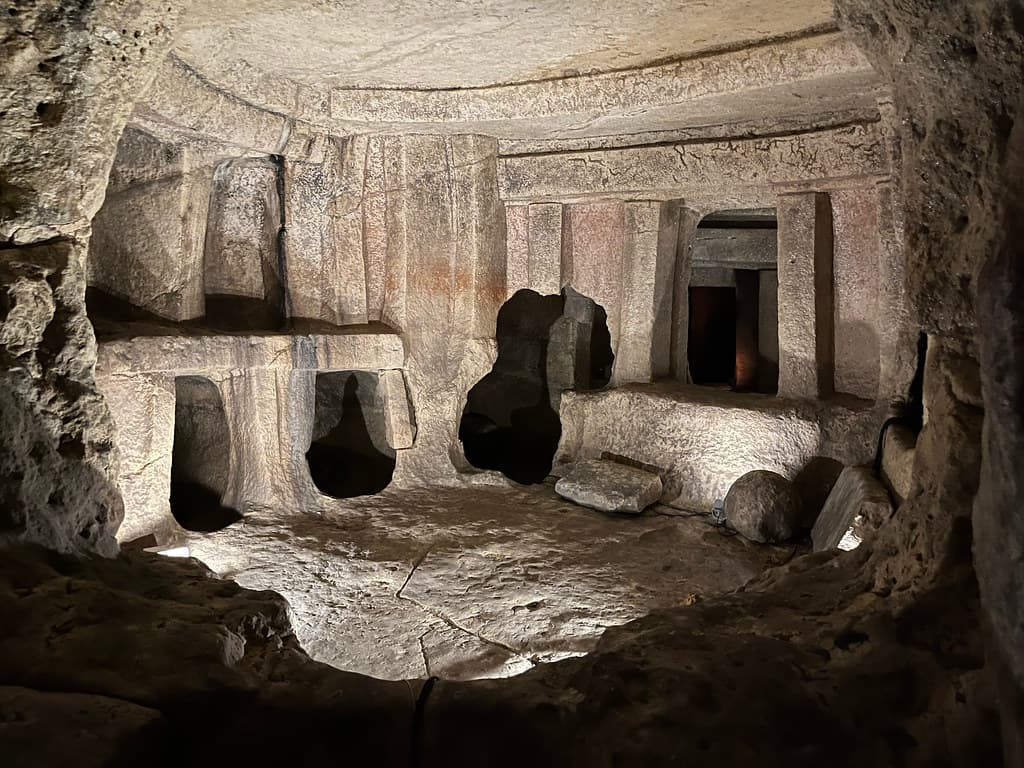
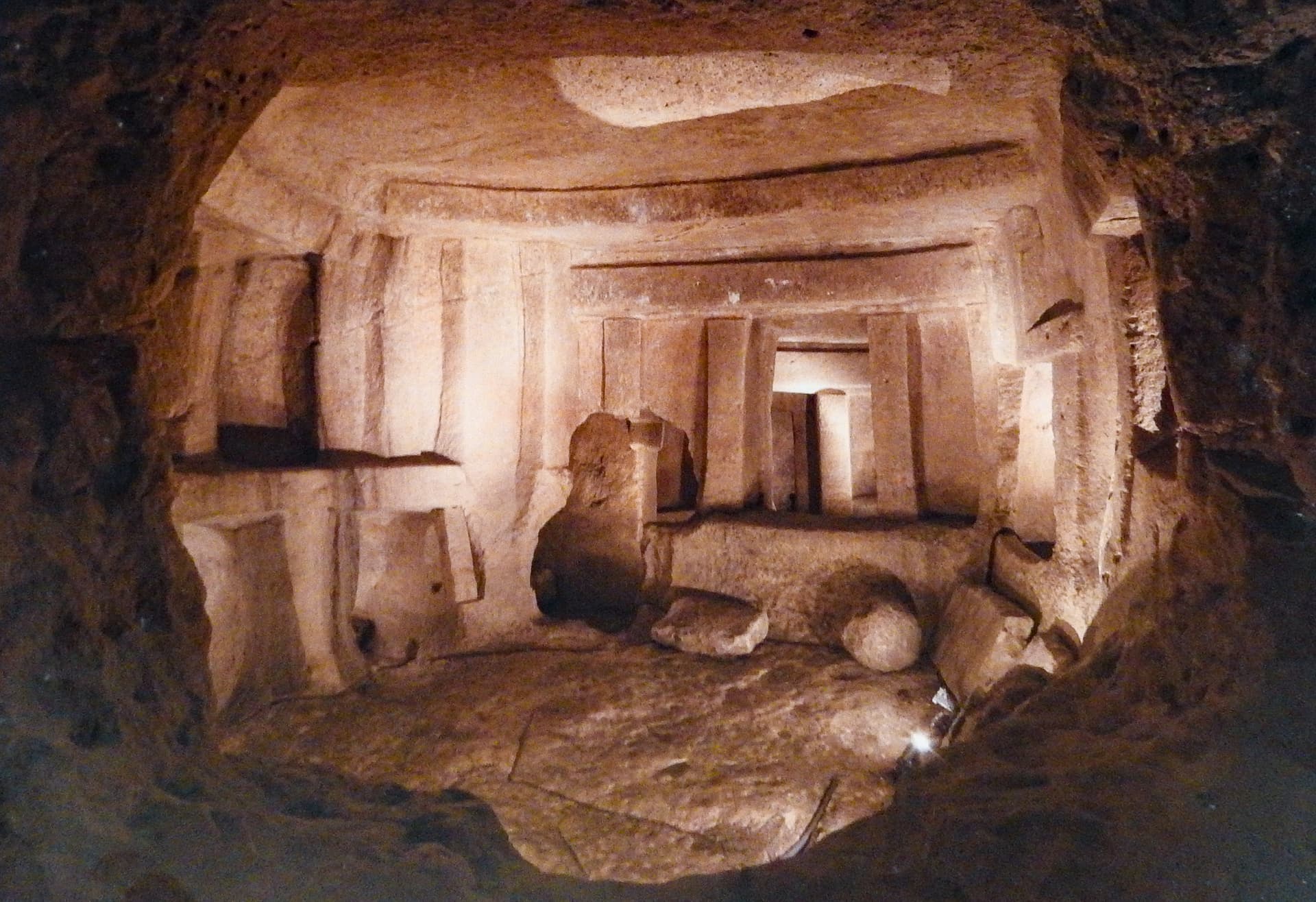
In 1902, construction workers in Paola fell through a ceiling they did not know was there. Below them was the Ħal Saflieni Hypogeum: an entirely subterranean complex of chambers and corridors carved into globigerina limestone beginning around 4000 BC and used continuously for at least 1,500 years. The builders did not discover a cave and modify it. They carved the entire structure from solid rock, shaping halls and doorways that deliberately mimic the above-ground megalithic temples in form — as if they were building an underworld mirror of the world above.
Three levels descend from the surface. The upper level is the oldest, with rock-cut chambers dating to around 4000 BC. The middle level contains the most architecturally sophisticated spaces: the Main Hall, the Oracle Room, the Holy of Holies. The lower level, excavated deeper into the limestone to around 3000–2500 BC, served primarily as the necropolis, where the remains of approximately 7,000 individuals were deposited over centuries.
The Oracle Room is perhaps the most scientifically provocative space in the Hypogeum. Its resonance frequency of approximately 110 Hz — produced when a voice is pitched at the right register — fills the entire underground complex with sound in a way that researchers in archaeoacoustics have documented as deliberate engineering. Modern neuroscience notes that low-frequency sound in the 110 Hz range correlates with heightened activity in the right hemisphere and suppression of rational-analytical processing, a shift associated with intuitive, emotional, or meditative states. Whether the Neolithic builders understood this effect in explicit terms is unknowable. That they produced it is not in doubt.
On the walls of several chambers, red ochre paintings survive — spirals and geometric forms that are the oldest known paintings in Malta. They were applied with care, in a darkness that their makers brought their own light to, in a space 7,000 people would eventually be brought to rest in. The Hypogeum is not an archaeological curiosity. It is one of the most concentrated expressions of human sacred ambition anywhere on Earth.
Context and lineage
There is no surviving mythology from the Hypogeum's builders — no oral tradition, no inscription. What the builders left instead are the chambers themselves, the ochre paintings, and the bones of 7,000 people. The site gives its name to the Saflieni phase of Maltese prehistory. Modern Maltese regard it as the most mysterious of all the island's prehistoric monuments.
The discovery in 1902 was accidental: construction workers preparing for a new housing development fell through the ceiling of the uppermost level. The property owner attempted to conceal the discovery, reportedly using some of the chambers for storage, before Father Emanuel Magri of the Malta Museum was brought in to excavate in 1903. Magri worked the site until 1907, when he died in a missionary expedition — and his excavation notes were lost with him. Sir Temi Zammit took over in 1907 and excavated through 1911, producing the published record on which all subsequent scholarship rests.
The Hypogeum belongs to the Saflieni phase of Maltese prehistory (c. 3300–2500 BC), with upper levels predating the Saflieni phase to c. 4000 BC. It is the only prehistoric underground temple in the world, earning its own UNESCO inscription (#130, 1980), separate from the Megalithic Temples cluster (#132). The same culture that built the above-ground temples built this — the Hypogeum is their subterranean theology made physical.
Why this place is sacred
The thinness of the Hypogeum is architectural, acoustic, and archaeological simultaneously. The builders carved a world underground to mirror the world above — but inverted, enclosed, removed from sky and sun, oriented toward what lies beneath living ground. This inversion is not a decorative choice. In the cosmologies of many ancient peoples, the underworld was where the dead resided and where the sacred dimension of existence was most concentrated. Building downward was a theological act.
The Oracle Room's acoustic properties intensify this quality to a degree that is still physically accessible to visitors today. A voice spoken at approximately 110 Hz in that chamber does not stay where it was produced. It fills the complex. The chest-resonance effect is involuntary and immediate. You do not need to believe in ancient mysticism to feel this; it is a physical phenomenon. The question of whether this effect was incidental or was engineered into the space by builders who understood their limestone and their geometry is increasingly answered by archaeoacoustic research: the geometry appears deliberate.
The 7,000 individuals deposited here over more than 1,500 years add a layer of weight that the acoustic phenomena alone cannot account for. This was a place where the living came to do something with and for the dead — to speak to them, to honour them, to seek guidance from them, or perhaps simply to place them as close as possible to whatever the sacred dimension of existence was understood to be. Standing in the Hypogeum, even as a 21st-century visitor in a timed group, is to stand where 7,000 deaths were received and held.
Dual function as sanctuary and necropolis; the Oracle Room suggests ritual use involving sound and possibly induced altered states. Whether these were healing ceremonies, ancestral consultation, initiation rites, or divination practices is unknown. The red ochre paintings suggest a sophisticated symbolic or cosmological programme.
Uppermost level carved c. 4000 BC. Middle and lower levels extended through the Saflieni phase (3300–2500 BC). Abandoned around 2500 BC with the collapse of the Maltese temple-building culture. Site of the name-giving 'Saflieni phase' of Maltese prehistory. Accidentally discovered 1902. Excavated by Father Emanuel Magri 1903–1907 (notes lost at his death). Major excavation by Sir Temi Zammit 1907–1911. UNESCO inscription 1980 (standalone #130, separate from the Megalithic Temples inscription #132). Closed for conservation 1992–2000. Managed by Heritage Malta; maximum 80 visitors/day.
Traditions and practice
The Hypogeum was used for the interment of the dead — approximately 7,000 individuals over more than 1,500 years — and for ritual practices whose nature is suggested by the Oracle Room's acoustic engineering, the red ochre paintings, and deposits of small figurines and objects. Whether the Oracle Room served ancestral consultation, healing ceremonies, initiation rites, or divination is not determined by the archaeological record. The ochre pigment deposits suggest ritual application of colour was itself a practice. The 'Sleeping Lady' figurine found at the site — now in the National Museum of Archaeology, Valletta — depicts a recumbent female figure that some researchers connect to incubation: the ritual practice of sleeping in a sacred space to receive dreams or visions.
Heritage Malta manages tightly controlled public tours (maximum 80 visitors per day). Archaeoacoustic researchers conduct periodic specialist visits. No active religious or spiritual practice is observed at the site.
The experience the Hypogeum makes available is not one that can be actively shaped by the visitor — the group tour format and strict guide protocol ensure that. What you can bring to it is the quality of attention. Before your visit, read enough about the Oracle Room's acoustic properties that you know what to listen for when the guide demonstrates the effect. Wear layers — the underground temperature is constant but markedly cooler than Maltese summer air, and sudden cold is distracting. When you enter the Oracle Room, stand in the centre of the space if the group position allows it, and listen not just to the frequency demonstration but to the baseline silence of the chamber between sound events: this is the silence 7,000 people were brought into. Let the time of the tour — approximately one hour — pass without checking a device or noting facts for later. The Hypogeum is one of the places on Earth where presence rather than documentation is the appropriate response.
Neolithic Mortuary and Ritual Culture
HistoricalThe Hypogeum served as both sacred sanctuary and necropolis for over 1,500 years, housing the remains of approximately 7,000 individuals. The Oracle Room's acoustic properties and the red ochre paintings suggest sophisticated ritual involving sound and symbol.
Interment of the dead; ritual use of the Oracle Room (suspected chanting, sound resonance ceremonies); ochre painting as symbolic or cosmological programme
Archaeological and Archaeoacoustic Research
ActiveThe Hypogeum is a major site for archaeoacoustic research globally; its Oracle Room resonance at 110 Hz matches similar prehistoric chambers worldwide and suggests deliberate acoustic engineering.
Controlled research visits by acousticians, archaeologists, and conservation scientists
Experience and perspectives
The Hypogeum experience is unlike any other sacred site visit in Europe. You descend below ground level into a space that has been sealed from daylight for 6,000 years. The temperature drops immediately — the underground chambers maintain a constant 18–20°C, cool against Maltese summer air, and the humidity is closely regulated to preserve the red ochre paintings and the carved surfaces. The transition from street-level Paola to the interior of the Hypogeum takes approximately thirty seconds of staircase, and that transition is the most compressed shift in register available to any visitor to Malta.
Groups are limited to approximately ten people, each guided by a Heritage Malta guide. You cannot explore independently. The guide's pace and path are fixed. This is a constraint that is also a gift: you are not scanning a vast site and deciding where to look. Each chamber is presented to your attention in turn.
In the Main Hall, orient yourself to the scale: the ceiling height, the doorways carved to human scale, the progression of spaces. The carved architecture deliberately echoes the above-ground temples — you are in an underground translation of the same sacred grammar. Notice the smoothness of the limestone walls, shaped by tools of antler and flint over generations.
The Oracle Room is the chamber to give your full attention. Your guide will likely demonstrate the acoustic effect: a voice at the right low frequency — a male baritone, approximately — fills the room and travels through the complex in a way that is physically arresting. The resonance you feel is in your sternum and your skull, not just your ears. This is the 110 Hz phenomenon that archaeoacoustic researchers have measured and that appears in stone chambers from Newgrange to Çatalhöyük. Stand still and let it pass through you. This is the closest available approximation of what the Oracle Room was built to produce.
The lower level, where the 7,000 were interred, carries a different quality — heavier, less architecturally elaborate, oriented toward containment rather than ceremony. The red ochre paintings on the walls of the middle level are visible in several chambers; look for the spirals and geometric forms applied in pigment that has survived 6,000 years of darkness.
Photography is strictly prohibited — this is not negotiable or enforceable by charm. The microclimate that preserves the paintings and surfaces is genuinely at risk from light sources, humidity from camera bodies, and breath. The prohibition is an act of care for something genuinely irreplaceable.
Maximum 80 visitors per day in groups of approximately ten. Pre-booking months in advance is standard; last-minute tickets are available the day before from Fort St. Elmo (€50). No photography or filming inside under any circumstances. Children under six are not admitted. Flat, closed shoes are required — no sandals, high heels, or flip-flops. The tour lasts approximately one hour.
The Hypogeum sits at the intersection of academic archaeoacoustics, mainstream prehistoric archaeology, Maltese national identity, and a broader global conversation about the deliberate manipulation of altered states in ancient sacred contexts.
UNESCO describes the Hypogeum as 'one of the outstanding examples of prehistoric art and architecture in the world.' Mainstream archaeology accepts it as a mortuary complex and sanctuary of exceptional preservation. The acoustic properties of the Oracle Room are increasingly recognised as deliberately engineered — archaeoacoustic studies have documented double resonance peaks at approximately 70 Hz and 114 Hz, with the dominant effect at around 110 Hz. A 2020 arXiv preprint (not yet fully peer-reviewed) argues the complex's geometry appears tuned to these frequencies. The discovery of approximately 7,000 individuals suggests the site served a very large population over a very long period.
No living tradition is directly connected to the Hypogeum. Maltese regard it with pride and considerable awe as the most mysterious of the island's prehistoric monuments — the one that resists easy interpretation more than any other.
The Hypogeum is widely discussed in alternative archaeology. Theories include use by a now-extinct race with elongated skulls (a misreading of evidence — the skulls found show cranial deformation consistent with deliberate modification of living individuals, not a separate species); connections to Atlantis mythology; and the deliberate induction of shamanic or trance states via acoustic resonance at 110 Hz. The last of these is the most academically credible and is supported by the published archaeoacoustic research. The 'Sleeping Lady' figurine has been interpreted as evidence of incubation ritual — the practice of ritual sleep in a sacred space to receive healing or prophetic dreams — which is documented in later Mediterranean traditions (Greek Asklepieia, Egyptian temples of Serapis).
The precise beliefs of the builders; the full iconographic programme of the red ochre paintings; whether the Oracle Room was used for ancestor communication, healing, initiation, divination, or some category of experience for which no modern analogue survives; what happened to the upper portions of carved objects found incomplete; why the temple culture vanished around 2500 BC; whether the 7,000 individuals represent the full social range of the population or a selected category (priests, healers, high-status individuals).
Visit planning
Located at Triq Ic-Cimiterju, Paola (Raħal Ġdid), Malta, approximately 4 km south of Valletta. Bus routes from Valletta: 82, 85 (alight at Paola). Taxi from Valletta approximately 10–15 minutes. Tickets must be pre-booked via heritagemalta.mt. Standard admission approximately €35 (pre-booked); last-minute tickets €50 from Fort St. Elmo, Valletta, available the day before. Maximum 80 visitors per day.
No accommodation in Paola itself. Valletta (4 km) offers the widest range of options and is the most convenient base for the Hypogeum and Tarxien combined. Sliema and St Julian's are also within easy range.
A site of exceptional fragility where conservation rules are non-negotiable and the atmosphere warrants correspondingly serious attention.
Flat, closed-toe shoes are required without exception; high heels, sandals, and flip-flops are prohibited for conservation and safety reasons on uneven underground surfaces. Comfortable layered clothing is advisable — underground temperature is 18–20°C year-round.
Photography and filming are absolutely prohibited inside the Hypogeum. This rule is strictly enforced and cannot be waived. The red ochre paintings and microclimate are at genuine conservation risk from light sources and humidity changes.
Not applicable.
Children under six not admitted. Arrive fifteen minutes before your scheduled tour. Follow guide instructions at all times. Do not touch any surface, wall, or carving. The tour cannot be paused for individual photography or extended examination of specific chambers.
Nearby sacred places
Sacred places within a half-day’s reach. Pilgrims often visit them together: walk one, stay for the other.

References
Sources consulted when researching this page. Independent verification by readers is welcome.
- 01Ħal Saflieni Hypogeum - Wikipedia — Wikipedia contributorshigh-reliability
- 02Ħal Saflieni Hypogeum - UNESCO World Heritage Centre — UNESCOhigh-reliability
- 03Ħal Saflieni Hypogeum - Heritage Malta — Heritage Maltahigh-reliability
- 04Malta's Hypogeum Reopens to the Public - Smithsonian Magazine — Smithsonian Magazinehigh-reliability
- 05Great Excavations: Zammit at the Ħal-Saflieni Hypogeum - World Archaeology — World Archaeologyhigh-reliability
- 06Archaeoacoustic Analysis of the Ħal Saflieni Hypogeum in Malta — SB Research Group
- 07The Frequency Spectrum and Geometry of the Hal Saflieni Hypogeum Appear Tuned - arXiv — arXiv preprint
- 08The unique Ħal Saflieni Hypogeum underground temple in Paola (Malta) - Malta Uncovered — Malta Uncovered
- 09Ħal Saflieni Hypogeum Malta: Tickets, Tours & Visitor Guide - Take Me To Europe Tours — Take Me To Europe Tours
Key questions
What pilgrims usually ask
- Why is Ħal Saflieni Hypogeum considered sacred?
- The world's only prehistoric underground temple, carved by hand into Maltese limestone 6,000 years ago. UNESCO site. Only 80 visitors daily — book months ahead.
- What should I wear at Ħal Saflieni Hypogeum?
- Flat, closed-toe shoes are required without exception; high heels, sandals, and flip-flops are prohibited for conservation and safety reasons on uneven underground surfaces. Comfortable layered clothing is advisable — underground temperature is 18–20°C year-round.
- Can I take photos at Ħal Saflieni Hypogeum?
- Photography and filming are absolutely prohibited inside the Hypogeum. This rule is strictly enforced and cannot be waived. The red ochre paintings and microclimate are at genuine conservation risk from light sources and humidity changes.
- How long should I spend at Ħal Saflieni Hypogeum?
- Approximately one hour (guided tour). Allow additional time for the journey from Valletta and, ideally, a companion visit to the Tarxien Temples 1 km away.
- How do you visit Ħal Saflieni Hypogeum?
- Located at Triq Ic-Cimiterju, Paola (Raħal Ġdid), Malta, approximately 4 km south of Valletta. Bus routes from Valletta: 82, 85 (alight at Paola). Taxi from Valletta approximately 10–15 minutes. Tickets must be pre-booked via heritagemalta.mt. Standard admission approximately €35 (pre-booked); last-minute tickets €50 from Fort St. Elmo, Valletta, available the day before. Maximum 80 visitors per day.
- What offerings are appropriate at Ħal Saflieni Hypogeum?
- Not applicable.
- What etiquette should visitors follow at Ħal Saflieni Hypogeum?
- A site of exceptional fragility where conservation rules are non-negotiable and the atmosphere warrants correspondingly serious attention.
- What is the history of Ħal Saflieni Hypogeum?
- There is no surviving mythology from the Hypogeum's builders — no oral tradition, no inscription. What the builders left instead are the chambers themselves, the ochre paintings, and the bones of 7,000 people. The site gives its name to the Saflieni phase of Maltese prehistory. Modern Maltese regard it as the most mysterious of all the island's prehistoric monuments. The discovery in 1902 was accidental: construction workers preparing for a new housing development fell through the ceiling of the uppermost level. The property owner attempted to conceal the discovery, reportedly using some of the chambers for storage, before Father Emanuel Magri of the Malta Museum was brought in to excavate in 1903. Magri worked the site until 1907, when he died in a missionary expedition — and his excavation notes were lost with him. Sir Temi Zammit took over in 1907 and excavated through 1911, producing the published record on which all subsequent scholarship rests.