Áhkká
A glacier-crowned massif named after the Sami mother goddess, rising above Arctic wilderness
Understand sacred places, explore living traditions, and learn how to engage respectfully with Pilgrim Map.
Access has not been verified. Check current local guidance before planning a visit.
Jokkmokks kommun, Norrbotten, Sweden
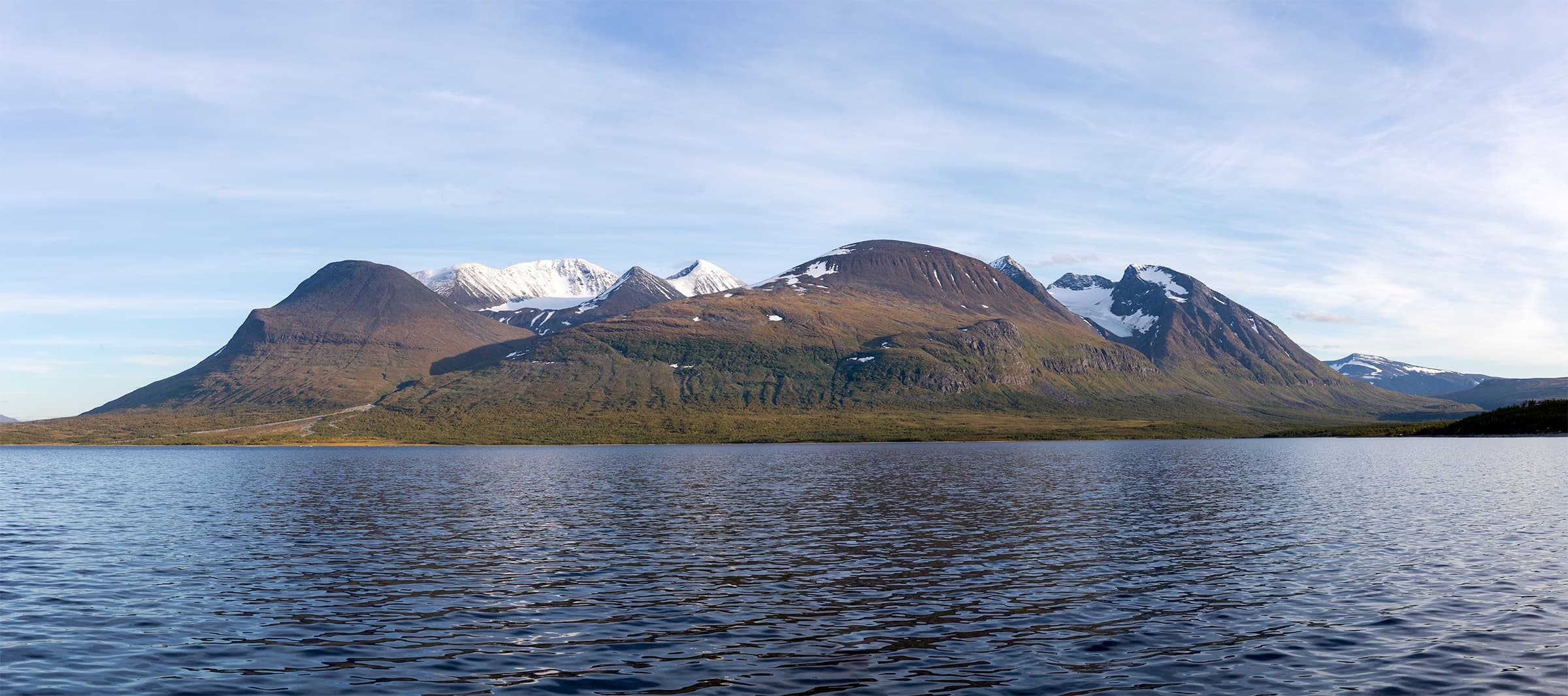
Image of Áhkká. Image source · CC-BY-SA-4.0
Visit essentials
A quick read before you go
- Duration
- Minimum two to three days for approach and basic exploration.
- Access
- Gallivare is the nearest town with rail and domestic air connections.
Overview
Ahkka rises from the shores of Lake Akkajaure in the heart of Swedish Lapland, twelve peaks crowned with ten glaciers, the highest summit reaching 2,015 metres above sea level. The Sami people named this massif after Mattarahkka, the origin woman of their spiritual tradition, the goddess of fertility and childbirth from whom all human life descends. The mountain bearing her name is the physical expression of divine feminine power in the Arctic landscape.
The massif possesses the greatest vertical drop in Sweden, 1,563 metres from summit to lake surface, a scale that overwhelms human proportion. The glaciers that drape the upper peaks are remnants of ancient ice, their slow movement measured in centuries. From below, the twelve peaks present a skyline of such complexity that the mountain appears to shift and rearrange itself as you move through the surrounding valleys.
Its remoteness is the mountain's threshold, a natural boundary ensuring any encounter with the goddess mountain is preceded by commitment and physical expenditure.
Why this place is sacred
The thinness at Ahkka operates through scale, remoteness, and the weight of a name. To approach a mountain identified with Mattarahkka herself is to approach a named presence, and the metaphorical crossing of Lake Akkajaure ensures that arrival is never casual: it is a passage from the world of roads and engines into a landscape where movement is governed by the body's capacity and the terrain's willingness.
When Ahkka finally reveals itself, the effect is cumulative. The twelve peaks do not present themselves at once. They emerge as you move through the surrounding landscape, each new vantage offering a different arrangement of summit, glacier, and ridge. The mountain is too large and too complex to be apprehended in a single view. It must be walked around, observed from multiple positions, encountered through time rather than in an instant.
The glaciers contribute a dimension of deep time. These ice formations are thousands of years old, their surfaces scored by centuries of movement. They connect the present visitor to a geological past that dwarfs human history. The Sami have been here for millennia, but the glaciers were here before the Sami, and the mountain was here before the glaciers. To stand beneath Ahkka is to occupy a point in a temporal scale that renders human concerns very small.
The Sami reindeer herders who move through these valleys maintain a living relationship with this landscape that predates written records. Their presence is not touristic but existential: they live within the sacred landscape as participants, not observers. For the visitor, encountering reindeer herding in the shadow of the goddess mountain offers a glimpse of what it means to inhabit a world where the sacred is not separated from the daily, where work and worship occupy the same ground.
A sacred mountain in Sami indigenous tradition, named after the mother goddess Mattarahkka and revered as a place where the divine feminine is present in the landscape. The mountain has been a significant feature of the Sami spiritual world for millennia.
The mountain's sacred significance predates recorded history. The surrounding area gained formal protection in the twentieth century, though hydroelectric development significantly altered the landscape in the same period. Through these changes the mountain has remained sacred to the Sami people and continues to command deep respect within Sami communities.
Experience and orientation
Reaching Ahkka begins with the journey to Ritsem, the small settlement that serves as the gateway to Stora Sjofallet National Park. From Gallivare, the nearest town with rail connections and a domestic airport, the drive or bus ride to Ritsem takes approximately three and a half hours, passing through increasingly remote landscape as the boreal forest gives way to mountain terrain.
At Ritsem, the STF mountain station provides accommodation, a cafe, and supplies. This is the last outpost of conventional comfort. From here, a daily ferry crosses Lake Akkajaure in summer, carrying hikers to the trailheads on the far shore. The crossing takes roughly forty-five minutes, and the view of Ahkka growing larger across the water is the journey's first sustained encounter with the massif.
Beyond the ferry landing, travel is on foot. The Akkastugorna mountain hut, with thirty beds, sits at the base of the massif and serves as a staging point for those attempting the summit or exploring the surrounding glacial landscape. The hut is basic but provides shelter and a gathering place for those drawn to the mountain.
Climbing Stortoppen, the highest peak, requires mountaineering experience and glacier travel equipment including crampons, ice axe, and rope. This is not a walking summit but a genuine alpine ascent. Those without mountaineering skills can still approach the massif on foot, hiking through the valleys and along the lake shores to experience the mountain's scale from below.
The experience of Ahkka is defined by the disproportion between human and geological scale. Standing at the base of the massif, the twelve peaks rising above, the glaciers catching and releasing light, the landscape stretching in every direction without a road or building in sight, the visitor encounters a world that has not been arranged for human convenience. The mountain exists on its own terms.
The Naturum Laponia visitor center, located at the eastern end of the national park, provides context on the World Heritage Site's natural and cultural values. Visiting the center before or after approaching Ahkka deepens the understanding of how the Sami relationship with this landscape has shaped its protection and meaning.
The midnight sun period from late May through mid-July offers extended light for travel and observation, though the mountain generates its own weather regardless of the calendar.
Ahkka is located in Stora Sjofallet/Stuor Muorkke National Park, Gallivare Municipality, Norrbotten County. Access via Ritsem, approximately 3.5 hours by car or bus from Gallivare. Ferry across Lake Akkajaure operates daily in summer.
Context and lineage
In Sami spiritual tradition, Mattarahkka is the origin woman, the mother goddess responsible for fertility and the continuation of life. She is the first of the Ahkka goddesses, accompanied by her three daughters: Sarahkka, who assists in childbirth; Juoksahkka, who determines gender; and Uksahkka, guardian of the threshold. The naming of this immense glacier-crowned massif after the mother goddess reflects the Sami understanding of landscape as alive with divine presence.
The mountain is not dedicated to the goddess in the way a temple might be. It is the goddess, her presence made manifest in twelve peaks, ten glaciers, and the weather that forms around them.
The Sami relationship with Ahkka belongs to a broader tradition of sacred mountains in Sapmi, the Sami homeland spanning northern Scandinavia. Mountains serve as dwelling places of gods and spirits, thresholds between the earthly and spiritual worlds. Sieidi, natural objects of stone or wood unshaped by human hands, serve as offering sites where gifts of meat, antler, and metal were made to ensure prosperity in hunting and herding.
Whether specific sieidi exist on Ahkka itself is not publicly documented, reflecting the sacred-private nature of some Sami spiritual knowledge.
Ahkka belongs to the Sami tradition of sacred mountains within Sapmi, the indigenous homeland spanning northern Scandinavia and the Kola Peninsula. The mountain stands within the Laponian Area UNESCO World Heritage Site, inscribed in 1996 for both natural and cultural values, the cultural designation specifically recognizing the Sami reindeer herding tradition as a living cultural landscape. Stora Sjofallet National Park was established in 1909, one of Sweden's first national parks.
The broader Laponian Area includes Sarek, Padjelanta, and Muddus/Muttos national parks, forming one of the largest protected wilderness areas in Europe.
Mattarahkka (Maderakka)
Sami mother goddess, origin woman and goddess of fertility, after whom the mountain is named
Sarahkka, Juoksahkka, and Uksahkka
Three daughters of Mattarahkka, governing childbirth, gender, and the threshold of life
Traditions and practice
The Sami tradition of sacred mountain worship at Ahkka includes offerings at sieidi, prayers to Mattarahkka and her daughters for fertility and prosperity, and the shamanic practice of noaidi, in which sacred mountains served as points of connection between the earthly and spiritual worlds through drumming and trance. The specific rituals conducted at Ahkka are not fully documented in public sources, reflecting the sacred-private character of some Sami spiritual knowledge.
Reindeer herding, which follows seasonal migration patterns through the mountain landscape, represents both an economic practice and a form of spiritual engagement with the sacred landscape.
The Sami maintain spiritual reverence for Ahkka as a sacred mountain. Active reindeer herding continues in the surrounding landscape, following seasonal patterns that have shaped the relationship between people and mountain for millennia. The mountain is visited by hikers and mountaineers, particularly during the summer months. The Naturum Laponia visitor center provides interpretation of the World Heritage Site's natural and cultural values.
Approach Ahkka with the awareness that you are entering a sacred landscape. Treat the journey itself as preparation, allowing the increasing remoteness to quiet the expectations you carry from the road.
When the mountain comes into view, pause. The twelve peaks and ten glaciers present a complexity that rewards sustained attention rather than quick appraisal. Let the mountain's scale register gradually rather than attempting to comprehend it in a single glance.
If you encounter reindeer or reindeer herders, give them wide berth. Their presence in this landscape is not incidental but constitutive. They belong here in a way that visitors do not, and observing their passage through the sacred landscape offers more than any interpretive panel.
Before leaving, sit in a place where the mountain fills your field of vision and spend time with the knowledge of whom it is named for. Whatever your own tradition, the Sami recognition of the divine feminine in this landscape invites a quality of attention that transcends cultural boundaries.
Sami Mother Goddess Tradition (Mattarahkka)
ActiveThe mountain's name directly references the Sami mother goddess Mattarahkka, the origin woman responsible for fertility, childbirth, and the continuation of life. Mattarahkka was among the most important deities in the Sami spiritual worldview, accompanied by her three daughters Sarahkka, Juoksahkka, and Uksahkka. The naming of this immense glacier-crowned massif after the mother goddess reflects the Sami understanding of landscape as alive with divine presence, where the natural world embodies rather than merely symbolizes the sacred.
Traditional Sami worship included offerings at sieidi, prayers for fertility and prosperity, and shamanic rituals connecting sacred mountains to the spirit world through drumming and trance. The specific practices conducted at Ahkka are not fully documented in public sources. The broader tradition of mountain reverence and offering at sacred natural features is well-established in Sami culture.
Sami Reindeer Herding Cultural Landscape
ActiveAhkka stands within the Laponian Area UNESCO World Heritage Site, designated for both natural and cultural values, the cultural recognition specifically acknowledging the Sami reindeer herding tradition as a living cultural landscape. The seasonal migration of reindeer herds through the mountain valleys surrounding Ahkka connects the physical landscape to the spiritual and cultural identity of the Sami people in a practice that has continued for millennia.
Seasonal movement of reindeer herds through the mountain landscape following natural pasture patterns maintained for millennia. Winter grazing in lower forests, spring calving in transitional areas, summer grazing in mountain pastures. This rhythm is governed by the same natural cycles that determine the mountain's accessibility and character through the year.
Perspectives and open questions
Ahkka invites reflection on the relationship between landscape and the sacred, between indigenous spiritual traditions and the protection of wilderness, and between the human desire to reach summits and the humility required by genuine remoteness.
Scholarly perspective
Geographers and geologists recognize Ahkka as one of Sweden's most impressive mountain massifs, notable for twelve peaks, ten glaciers, and the greatest vertical drop in the country. Cultural researchers and anthropologists recognize the mountain's deep significance in Sami spiritual tradition, connected to the mother goddess Mattarahkka. The Laponian Area's UNESCO World Heritage designation formally acknowledges both natural values and the living Sami cultural landscape, making it one of the few mixed natural-cultural heritage sites in Northern Europe.
Living and traditional perspectives
In Sami cosmology, the landscape is alive with spiritual presence, mountains and lakes serving as dwelling places of gods and thresholds between the earthly and spiritual worlds. Ahkka embodies this understanding at its most powerful: not merely dedicated to the divine feminine but the divine feminine made geological.
Seen through this lens, the Sami relationship with the mountain is part of a broader spiritual ecology in which the health of human, animal, and spirit communities are understood as interconnected and interdependent.
Alternative interpretations
Some spiritual seekers view Ahkka as one of the world's great goddess mountains, comparable to other sacred peaks in indigenous traditions globally. The twelve peaks are sometimes interpreted as reflecting cosmic numerical symbolism. The extreme remoteness and physical demands of reaching the mountain are understood as inherent qualities of a site that requires genuine commitment and intention to approach.
Open questions
The specific rituals and ceremonies traditionally conducted at Ahkka by the Sami people are not fully documented in public sources, reflecting the sacred-private nature of some Sami spiritual knowledge. Whether specific sieidi exist on or near the mountain is not publicly known. The full depth of the Sami spiritual relationship with Ahkka, including oral traditions, songs, and stories that may not have been shared with outsiders, remains within Sami communities.
The impact of early twentieth-century hydroelectric development on the sacred landscape surrounding Ahkka is an ongoing concern within Sami advocacy.
Plan your visit
Access and arrival
Gallivare is the nearest town with rail and domestic air connections. Bus or car from Gallivare to Ritsem takes approximately 3.5 hours. Daily ferry across Lake Akkajaure from Ritsem operates during summer. STF Ritsem provides accommodation, cafe, and supplies. Akkastugorna mountain hut (30 beds) at the base of Ahkka. No road access to the mountain itself. No admission charge for the national park.
STF Ritsem mountain station (beds, cafe, supplies). Akkastugorna mountain hut (30 beds, unstaffed). Gallivare offers hotels and guesthouses. Jokkmokk, further south, provides additional accommodation and serves as the cultural center of Swedish Sami life.
Respectful visit
Full mountain gear required. Waterproof and windproof layers, insulated clothing, sturdy mountain boots. For summit attempts: glacier travel equipment including crampons, ice axe, rope, and harness. The Arctic weather demands preparation for conditions ranging from summer warmth to winter-like cold on the same day.
Landscape photography is permitted throughout the national park. Be sensitive about photographing Sami cultural activities, reindeer herding operations, or any identified sacred features without permission. If in doubt, do not photograph.
Do not leave objects at the mountain or at natural features. Well-intentioned offerings create litter in a protected landscape.
National park regulations apply throughout, prohibiting disturbance of plants, animals, or geological features; practice strict leave-no-trace principles and pack out all waste including food scraps. Do not disturb reindeer or herding operations. Summit attempts require mountaineering experience and appropriate equipment. Register your route at Ritsem or the Akkastugorna hut. The mountain is within the Laponian Area UNESCO World Heritage Site and is protected under both Swedish national park law and World Heritage conservation standards.
Ahkka is a serious Arctic mountain. Weather changes rapidly and can become life-threatening. Summit attempts require mountaineering experience and proper equipment. The area has no mobile phone coverage in many locations. Register your route with the mountain station. Do not approach during conditions of poor visibility or high wind.
Current practical details
Address
Áhkká, 982 99 Gällivare, Sweden
Hours, fees, and access can change — verify on the official source before you travel. Practical details last checked Jun 2026.
Location
Map loads as you approach this section.
Pilgrim reflections
A portrait of encounter, not a score
Pilgrims describe what they felt, how present they could become, and whether the place would shape a journey. There are no stars and no ranking of traditions.
No reviewed reflections yet
The first pilgrims can help describe the character of being here.
Share a reflection
Available after an account-backed “Been there.” Every reflection is reviewed before publication.
Nearby sacred places
Explore other sacred places in the region. Proximity does not establish access or travel time; check each place’s guidance.

Trondenes Church
Trondenes / Harstad, Trondenes / Harstad, Troms, Norway
143.1 km away

Mt. Sanna, Finland
Enontekiö, Lapland, Finland
214.1 km away

Atoklimpen Sacred Sami Landscape
Storuman Municipality, Storuman Municipality, Västerbotten County, Sweden
245.1 km away

Seitapahta
Muonio, Muonio, Lapland, Finland
282.0 km away
Photo gallery
3 curated photos
Share a photo
Help visitors recognize Áhkká. Every submission is reviewed before publication.