The Rock Carvings of Alta
Seven thousand years of Arctic spirituality carved into stone at the edge of the known world
Understand sacred places, explore living traditions, and learn how to engage respectfully with Pilgrim Map.
Access has not been verified. Check current local guidance before planning a visit.
Alta, Finnmark, Norway
Read the sources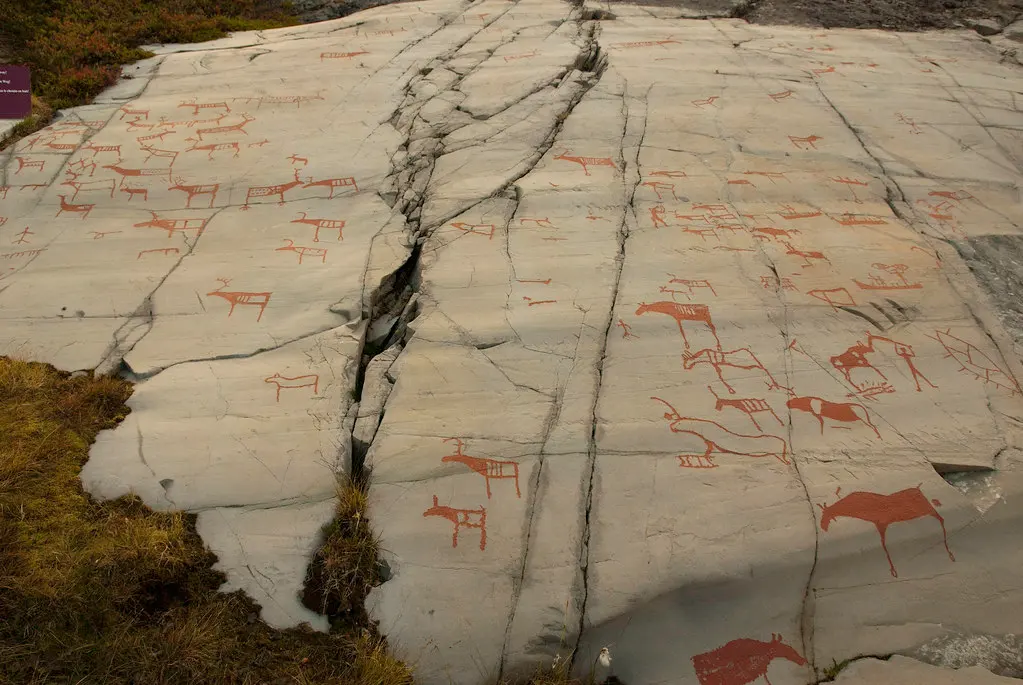
Image of The Rock Carvings of Alta. Image source
Visit essentials
A quick read before you go
- Duration
- Two and a half to three hours for the longer boardwalk route with unhurried attention to the…
- Access
- The site is located at Hjemmeluft, approximately five kilometres from Alta town centre in Troms…
Overview
Something drew people back to this place for five thousand years. Not settlers building a city, not farmers working the same soil, but hunter-gatherers who moved with the seasons yet returned, again and again, to the rock surfaces at the head of the Alta Fjord to carve images into stone. The oldest figures date to around 4200 BCE.
The most recent may have been made as late as 500 BCE, though some scholars extend the tradition to the first century of the common era.
What accumulated over those millennia is staggering in both scale and specificity. More than six thousand individual figures span forty-five sites across five distinct areas. Reindeer move in herds. Bears are surrounded by hunters in formations that appear ceremonial rather than practical. Boats carry passengers across stone seas. Human figures dance, process, and transform into animal shapes. Fences and enclosures suggest large-scale cooperative hunts. Geometric patterns intersperse among the figurative images, their meaning now opaque.
The carvings were inscribed by communities that many scholars identify as the direct ancestors of the modern Sami people. The parallels between the imagery at Alta and the symbolic traditions of historical Sami shamanism are extensive and well documented. Bear ceremonies, shape-shifting between human and animal forms, a three-world cosmology of sky, earth, and underworld — these themes appear in the rock art and recur in Sami spiritual practice thousands of years later.
The continuity is remarkable, though not all scholars accept a direct ancestral line.
Inscribed on the UNESCO World Heritage List in 1985, the Rock Carvings of Alta remain Norway's only prehistoric World Heritage Site. The carvings are managed by Alta Museum, which provides boardwalk access to the largest concentration at Hjemmeluft and indoor exhibitions when snow covers the outdoor panels.
Why this place is sacred
What makes a place thin is not always visible. At Alta, what is visible — more than six thousand figures carved into bedrock — is itself evidence of something deeper: the recognition, sustained across nearly five thousand years, that this place permitted communication between the seen and unseen worlds.
The fjord head where the carvings concentrate occupies a natural threshold. Land meets sea. Fresh water enters salt. In summer, the sun refuses to set; in winter, it refuses to rise. These are not metaphors for liminality but literal conditions of it. The Arctic light transforms the landscape on cycles both daily and annual, creating a place where the ordinary rules of darkness and daylight do not hold.
For communities attuned to the rhythms of animal migration, tidal movement, and seasonal extremity, such a place would have carried inherent significance.
The rock surfaces themselves served as interfaces. Scholars of circumpolar rock art have proposed that for the makers of these images, the rock face was not a blank canvas but a membrane between worlds. To carve an image into stone was to make contact with what lay behind or beneath the surface — the spirit world, the realm of animal masters, the domain of the dead.
The act of carving was itself a ritual act, not merely a record of one.
The density of imagery reinforces this quality. At Hjemmeluft alone, more than three thousand figures crowd the rock surfaces. Walking the boardwalk path among them, you move through millennia of accumulated spiritual expression. Each figure represents an act of intention, a moment when a human hand pressed a quartzite chisel against stone and struck. Multiplied by thousands over thousands of years, this accumulation creates a palimpsest of sacred engagement with no parallel in northern Europe.
The tidal quality of the site adds another layer. As post-glacial land uplift raised the coastline over millennia, the waterline retreated, exposing new rock surfaces that the carvers followed downslope. The oldest carvings sit highest on the hillside; the youngest are closest to the present shoreline. To walk from the oldest to the newest is to walk forward through time, descending toward the water that once lapped at the feet of the carvers.
This geological movement gives the site a built-in chronological architecture that visitors can physically traverse.
The rock surfaces at Alta served as sacred sites where hunter-gatherer communities enacted their relationship with the spirit world over nearly five millennia. Archaeological consensus holds that the carvings document a rich cosmology in which humans, animals, and spirits existed in an interconnected web of relationships. The imagery suggests the sites functioned as places of ritual gathering, possibly seasonal, where communities came together for ceremonies related to hunting, bear veneration, communal celebration, and shamanic practice.
The specific rituals performed remain a matter of scholarly interpretation, but the sustained investment of effort across thousands of years indicates profound and enduring significance.
The tradition evolved across roughly five thousand years, from approximately 4200 BCE to 500 BCE or later. Professor Knut Helskog of the University of Tromso developed a chronological framework dividing the carvings into phases based on shoreline dating, as post-glacial land uplift progressively exposed new rock surfaces at lower elevations. Early phases feature predominantly naturalistic animals and hunting scenes. Later phases introduce more complex compositions including boats, geometric patterns, and what appear to be ceremonial or mythological scenes.
The shift from purely figurative to increasingly symbolic imagery may reflect changes in spiritual practice, social organisation, or both. After active carving ceased, the sites appear to have been gradually forgotten until their rediscovery in 1973. The establishment of Alta Museum in 1991 and UNESCO inscription in 1985 transformed the carvings from forgotten archaeology into one of Norway's most significant cultural heritage destinations.
Experience and orientation
The experience begins inside Alta Museum, where indoor exhibitions provide context for what you are about to encounter. Loose boulders bearing carvings and red ochre paintings are displayed alongside interpretive material on the cultures that created them. Exhibitions on Sami and Kven heritage situate the rock art within the broader cultural landscape of northern Norway. This preparation matters; without context, the outdoor carvings risk appearing as marks on stone rather than the sophisticated spiritual record they represent.
From the museum, two boardwalk routes lead among the carvings. The shorter loop covers 1.2 kilometres and takes approximately thirty minutes. The longer route extends to three kilometres and requires about ninety minutes. Both follow wooden walkways that keep visitors off the fragile rock surfaces while providing close views of the carved panels. Information boards along the routes identify and interpret key figures and compositions.
The carvings themselves demand patience. Many are subtle, their pecked outlines shallow against the dark stone. The red paint applied to highlight them — a practice begun in the 1970s and maintained since — makes figures visible that might otherwise escape notice. Bears emerge from the rock. Reindeer process in lines. Boats carry crews across frozen stone seas. Human figures dance, hunt, and undergo transformations that blur the boundary between person and animal.
Certain panels reward extended contemplation. The large bear-hunting scenes, where groups of humans surround bears in formations that look more ceremonial than practical, convey something of the reverence these communities felt for the bear. Scholars have drawn parallels to the documented Sami bear ceremony, in which a killed bear was treated with elaborate ritual respect, and the imagery at Alta suggests this tradition may reach back thousands of years before it entered the historical record.
The boardwalk descent follows the chronological sequence created by land uplift. At the top, where the oldest carvings were made closest to the ancient shoreline, the figures tend toward naturalistic animal depictions. As you descend toward the present fjord, the imagery grows more complex and symbolic. Boats appear. Geometric forms multiply. The shift is gradual but perceptible, a visible record of how spiritual expression evolved over millennia.
The setting amplifies everything. The Alta Fjord opens to the north, its waters reflecting the Arctic sky. In summer, the midnight sun bathes the carvings in continuous, shadowless light that flattens perspective and dissolves the ordinary sense of time passing. In the transitional months of May and September, low-angle light creates shadows that bring the carved lines into sharp relief.
The combination of ancient imagery, Arctic landscape, and extreme seasonal light creates conditions that visitors consistently describe as profoundly moving, though the precise quality of the experience varies with each person and each visit.
Alta Museum and the Hjemmeluft rock art site are located approximately five kilometres from Alta town centre in Troms og Finnmark county. The museum is accessible by car, with free parking, by bus from Alta centre, or by bicycle. Audio guides are available in multiple languages and provide detailed interpretation of the carvings along the boardwalk routes. Pre-booked personal guides can be arranged through the museum.
The shorter boardwalk loop is accessible to those with moderate mobility; sections of the longer route involve inclines. Visitors arriving by Hurtigruten coastal steamer or at Alta Airport can reach the museum within fifteen minutes by taxi.
Context and lineage
The Rock Carvings of Alta have no founding narrative in the conventional sense. They were not created by a single act of establishment but accumulated over roughly five thousand years through the repeated return of hunter-gatherer communities to the same rock surfaces at the head of the Alta Fjord. The earliest carvings, positioned highest on the hillside near the ancient shoreline, date to approximately 4200 BCE.
As the land rose through post-glacial isostatic rebound, exposing new rock surfaces at progressively lower elevations, the carvers followed the retreating waterline downslope. This geological process gave the tradition its chronological architecture: the oldest figures sit highest, the youngest lowest, creating a record that can be read in the landscape itself.
The communities who made these carvings were adapted to Arctic conditions, subsisting through hunting, fishing, and gathering in a landscape of extremes. Reindeer, elk, bears, marine mammals, and fish provided sustenance, and all appear prominently in the carvings. The sites appear to have functioned as periodic gathering places, possibly seasonal, where dispersed communities came together for purposes that were simultaneously practical, social, and spiritual.
The sheer volume of carvings — more than six thousand figures across forty-five sites — indicates that whatever drew people here was compelling enough to sustain the tradition across nearly two hundred generations.
The lineage connecting the prehistoric carvers of Alta to the present is complex and partially contested. Many scholars identify the carving communities as the direct ancestors of the modern Sami people, an indigenous Finno-Ugric population whose traditional territory spans northern Scandinavia, Finland, and the Kola Peninsula.
The evidence for this connection is substantial: the imagery in the Alta carvings parallels the symbolic traditions found on historical Sami noaidi drums; bear ceremony scenes correspond to documented Sami bear rituals; and the three-world cosmology visible in the carvings — sky, earth, and underworld — matches the Sami cosmological framework.
However, some scholars caution that the relationship is more complex than direct descent, noting that the carving communities may represent a broader pre-Sami Arctic population from which the Sami eventually emerged.
The Sami maintain a living cultural connection to the broader Finnmark landscape, though no continuous oral tradition specifically explains the Alta carvings. The rock art sites are situated within a region that the Sami understand as their ancestral homeland, and the museum presents Sami cultural heritage alongside the archaeological material. The Norwegian government has recognised Sami rights and cultural significance through the Sami Parliament and various legal frameworks.
In this sense, the lineage is not entirely broken — the descendants of those who may have made these carvings still inhabit the region and maintain spiritual traditions that echo the imagery on the rock.
The prehistoric carvers of Alta
Knut Helskog
Jan Magne Gjerde
Alta Museum / World Heritage Rock Art Centre
Traditions and practice
The carvings constitute the primary evidence for the ritual practices that once animated these sites. Scholars interpret multiple categories of spiritual activity from the imagery. Bear ceremonies appear throughout the chronological sequence: groups of humans surround bears in formations that suggest ritualised hunts with spiritual dimensions, paralleling the documented Sami bear ceremony in which a killed bear was treated with elaborate respect and its spirit returned to its origin.
Communal processions and dances are depicted in lines of coordinated human figures, suggesting organised ceremonial gatherings. Some human figures appear to transform between human and animal forms, a concept central to Sami shamanism in which the noaidi could send their spirit in animal form to other worlds. Reindeer drive scenes with fence enclosures suggest large-scale cooperative hunts that likely involved ritual preparation and thanksgiving.
Maritime scenes with boats and sea creatures point to ceremonies related to the exploitation of marine resources. Some figures appear to hold instruments that researchers have compared to the Sami runebommen, or shamanic drum, though this interpretation remains debated.
The sites appear to have served as periodic gathering places where multiple communities came together for purposes that were simultaneously practical and spiritual. The five-thousand-year duration of the carving tradition suggests that whatever rituals were performed here were compelling enough to draw people back across nearly two hundred generations.
The site today functions as a heritage and educational destination rather than a place of active spiritual practice. Alta Museum hosts exhibitions, guided tours, educational programmes, and cultural events. The museum also presents Sami and Kven cultural heritage alongside the rock art, acknowledging the living cultural connections to the archaeological record. The Sami people maintain spiritual traditions in the broader region, though these are not practised at the rock art sites themselves.
Begin inside the museum, where the exhibitions provide essential context. The indoor carvings and paintings on loose boulders allow close study of technique and imagery before encountering the outdoor panels.
On the boardwalk, resist the impulse to move quickly. The longer three-kilometre route rewards unhurried attention. At each major panel, pause and look before reading the interpretation board. Let the images register on their own terms before receiving explanation. The figures were carved to be encountered directly, not through the mediation of text.
Attend to the bear scenes with particular care. These are not simple hunting depictions. Notice the formations of the human figures around the bears — ceremonial rather than tactical. Notice the bear tracks, represented as dots, that some scholars interpret as tracing the spiritual passage of the bear. Consider that for the communities who made these images, the bear was not merely an animal but a being of immense spiritual significance, a mediator between worlds.
As you descend from the oldest to the most recent carvings, notice how the imagery changes. Early panels feature naturalistic animals; later panels grow more complex and symbolic. This shift marks not mere stylistic evolution but a transformation in how these communities understood and expressed their relationship with the sacred.
The fjord itself is part of the experience. Pause where the boardwalk offers views north over the water. The carvers worked with this view before them. The interplay of rock, sea, and sky was the context in which every figure was made.
If you visit under the midnight sun, allow the continuous light to alter your sense of time. The absence of darkness dissolves ordinary temporal boundaries — an appropriate state in which to contemplate images that span five thousand years. If you visit in the transitional months, low-angle light creates shadows that bring the carved lines into sharper relief than midday illumination allows.
Prehistoric Arctic Hunter-Gatherer Spirituality
HistoricalThe Rock Carvings of Alta represent the largest concentration of rock art made by hunter-gatherers in northern Europe, spanning approximately five thousand years. The carvings provide an unparalleled window into the cosmology, spiritual life, and ritual practices of Arctic prehistoric communities. The imagery reflects a worldview in which the boundaries between human, animal, and spirit worlds were permeable, and the rock art sites appear to have been sacred meeting places where communities gathered for ritual purposes over millennia.
The carvings depict a wide range of activities interpreted as having spiritual dimensions: hunting scenes that evidence suggests represent sympathetic magic or ritual preparation for hunts; processions and dancing scenes suggesting communal ceremonies; bear worship scenes indicating a bear cult; figures interpreted as shamans or ritual specialists; and scenes showing boats, fishing, and reindeer herding with possible cosmological significance. The rock art sites may have functioned as liminal places where communication between the human world and spirit worlds was understood to be possible.
Proto-Sami Shamanism
HistoricalMany scholars identify the Alta rock carvings as evidence of the early development of Sami spiritual traditions, including shamanic practices. Significant parallels exist between the imagery at Alta and the symbolic landscapes depicted on Sami noaidi drums from the historical period. These parallels suggest a continuity of spiritual concepts spanning thousands of years. The carvings may document the earliest expressions of what later became formalised Sami shamanic practice, though the direct ancestral connection is not universally accepted among scholars.
Scholars have identified possible depictions of shamans or ritual specialists among the human figures in the carvings. Some figures appear to show shape-shifting between human and animal forms, a concept central to later Sami shamanism. Bear ceremony scenes parallel documented Sami bear rituals. Some figures appear to hold instruments resembling the runebommen, the shamanic drum, though this interpretation remains debated. The three-world cosmology visible in the carvings corresponds to the Sami cosmological framework of upper, middle, and lower worlds.
Bear Worship / Bear Cult
HistoricalBears feature prominently throughout the Alta rock carvings across multiple chronological phases, indicating sustained veneration spanning thousands of years. Bears are depicted not only as hunted animals but in positions suggesting worship or cult significance. The bear appears to have held a status far above that of ordinary prey, paralleling the bear cult documented among many circumpolar peoples including the Sami, Finns, and various Siberian groups.
The carvings depict elaborate bear-hunting scenes that appear ritualistic rather than practical, with groups of humans surrounding bears in ceremonial formations. Bear tracks, represented as dots, appear in multiple panels, suggesting that the tracking and pursuit of bears held spiritual as well as practical significance. The prominence of bears across the full chronological span of the carvings suggests that bear veneration was one of the most enduring elements of the spiritual tradition practised at Alta.
Archaeological Research and Conservation
ActiveSince the carvings were first discovered in 1973, the Alta rock art has been the subject of sustained archaeological investigation and conservation effort. The work of researchers including Knut Helskog, Jan Magne Gjerde, and others has transformed understanding of the carvings from scattered images into a coherent five-thousand-year sequence of spiritual and cultural expression. Conservation programmes protect the fragile rock surfaces from weathering, biological growth, and visitor impact.
Active research continues to refine the dating, distribution, and interpretation of the carvings. Shoreline dating methodology provides the chronological framework. Documentation using modern imaging techniques including photogrammetry and 3D scanning supplements earlier records. Conservation work includes monitoring weathering patterns, managing biological growth on rock surfaces, and maintaining the boardwalk infrastructure that protects the carvings from foot traffic. Alta Museum hosts educational programmes, guided tours, and exhibitions that make the research accessible to the public.
Perspectives and open questions
The Rock Carvings of Alta resist singular interpretation. For five thousand years, people carved images into these rock surfaces, and across that span, the meaning of the act almost certainly shifted, evolved, and transformed. What we encounter today is the accumulated residue of millennia of spiritual expression, compressed into stone panels that we read through our own contemporary frameworks. Scholarly, indigenous, and alternative perspectives each illuminate different facets of this legacy, and none claims to exhaust its meaning.
Scholarly perspective
Archaeological consensus recognises the Alta rock carvings as the largest and most important concentration of hunter-gatherer rock art in northern Europe, created between approximately 4200 and 500 BCE by communities adapted to Arctic conditions. The chronological framework developed by Professor Knut Helskog, based on shoreline dating that correlates carving elevation with post-glacial land uplift, provides the foundational structure for all subsequent analysis.
Jan Magne Gjerde's 2024 study in the Oxford Journal of Archaeology refined the spatiotemporal distribution of figures across the sites.
The imagery is broadly understood to document a rich material and spiritual culture encompassing hunting, fishing, boat construction, communal ceremony, and ritual practice. Evidence suggests the carvings have spiritual and cosmological dimensions, with scenes interpreted as depicting bear worship, shamanic transformation, communal procession, and the management of relations between human and animal worlds.
A 2022 essay in the Norwegian Archaeological Review cautions against assuming all rock art is necessarily ritual, symbolic, or religious, arguing that some images may document practical activities without spiritual overlay. This debate remains active and productive.
The connection to ancestral Sami culture is supported by significant parallels between the Alta imagery and the symbolic traditions found on historical Sami noaidi drums, though not all scholars accept a direct ancestral line. The question of whether the carving communities represent proto-Sami populations specifically or a broader pre-Sami Arctic population remains unresolved.
Living and traditional perspectives
The Sami people, as the indigenous people of northern Scandinavia, maintain a cultural and spiritual relationship with the broader landscape in which the Alta rock carvings are situated. While no continuous oral tradition specifically explains the carvings, the parallels between the carved imagery and historical Sami shamanic practices are extensively documented. The noaidi drum symbolism, bear ceremonies, shape-shifting between human and animal forms, and three-world cosmology all find expression in both the rock art and historical Sami practice.
The Sami concept of sacred landscape, in which certain places, rocks, and natural features possess inherent spiritual power, provides a cultural framework through which the carvings can be understood as marking spiritually significant locations. The rock surfaces may have functioned as what the Sami call sieidi — natural features recognised as dwelling places of spiritual forces. In this understanding, the act of carving was not mere documentation but active engagement with the spiritual properties of the place.
The bear worship scenes deserve particular attention from this perspective. The documented Sami bear ceremony, guovsságaslegat, treated the killed bear with elaborate ritual respect, including feasting, singing, and the careful return of the bear's bones to facilitate its rebirth. The Alta carvings depict scenes that scholars interpret as early expressions of this same tradition, suggesting a continuity of sacred relationship with the bear spanning thousands of years.
Alternative interpretations
Some interpretations situate the Alta carvings within a broader framework of circumpolar shamanic tradition, connecting Arctic peoples across Eurasia and potentially the Americas. The imagery of human-animal transformation, spirit journeys, and cosmic layering is compared with similar motifs in Siberian, Central Asian, and North American indigenous rock art, suggesting shared roots in ancient shamanic practice that may predate the divergence of these populations.
Other perspectives emphasise possible astronomical or calendrical functions of the art, noting that the extreme seasonal light of the Arctic — continuous daylight in summer, continuous darkness in winter — would have made celestial observation and seasonal reckoning central concerns. Specific solstice or equinox alignments at the Alta sites have not been conclusively demonstrated, however, and this interpretation remains speculative.
The idea that the rock surfaces functioned as membranes between worlds — that the act of carving was itself a form of spiritual contact with what lay behind the stone — draws on ethnographic parallels with other rock art traditions worldwide. In this framework, the carvings are not representations of spirits but points of contact with them.
Open questions
The Rock Carvings of Alta hold substantial mysteries that may never be resolved. The precise meaning of many individual panels and figure groupings remains debated — were they narrative, symbolic, instructional, or some combination that does not map onto modern categories. The reason why this specific location at the head of the Alta Fjord was chosen for such extensive and long-lasting rock art activity over five thousand years has not been satisfactorily explained.
The relationship between the rock carvings at the four petroglyph sites and the rock paintings at Transfarelvdalen within the same cultural tradition is unclear — did they serve different purposes, or were they different expressions of the same practice.
The identity and social role of the carvers themselves remain unknown. Were they specialist ritual practitioners — the shamans whose descendants would become the Sami noaidi — or were they community members participating in collective ceremonies. The significance of the geometric patterns and abstract shapes interspersed among the figurative imagery has not been satisfactorily explained. Whether the oldest known depiction of a trapping fence in the carvings represents actual hunting technology or carries additional cosmological significance remains debated.
And the extent to which the rock art tradition changed meaning over its five-thousand-year span — whether later carvers understood the images created by their predecessors, or whether meaning was continually reinvented — is a question that the stone cannot answer.
Plan your visit
Access and arrival
The site is located at Hjemmeluft, approximately five kilometres from Alta town centre in Troms og Finnmark county, northern Norway, at coordinates 69 degrees 56 minutes north, 23 degrees 11 minutes east. Alta Airport receives flights from Oslo and Tromso. The Hurtigruten coastal steamer calls at Alta. The E6 highway passes through the town. Local buses connect the town centre to the museum site. Free parking is available.
The museum building is wheelchair accessible, and adapted sections of the boardwalk are available, though the full outdoor route involves some inclines.
Alta offers a range of accommodation from hotels to guesthouses and camping. The town is well-equipped as a tourist base for exploring Finnmark. Northern Lights tourism has expanded accommodation options significantly in recent years. The museum cafe provides refreshments with views over the fjord.
Respectful visit
No specific dress code applies. Warm, layered clothing and sturdy waterproof footwear are strongly recommended. Even in summer, temperatures at this latitude can be cool, and wind off the fjord adds chill. Rain gear should be carried regardless of the forecast. The boardwalk surfaces can be slippery when wet.
Photography of the rock carvings is permitted throughout the outdoor boardwalk routes and inside the museum. The red paint highlighting the carvings makes them visible in photographs where unpainted figures would be difficult to capture. Tripods and professional equipment can be used on the boardwalks. Low-angle light in spring and autumn produces the most dramatic images, as shadows accentuate the carved lines.
This is a heritage and museum site. Leaving offerings is not appropriate and would compromise the protected environment. Any items left on or near the rock surfaces would be removed by conservation staff.
Visitors must stay on the designated wooden boardwalks at all times. Do not touch, scratch, chalk, or attempt to make rubbings of the carvings. Do not walk on the exposed rock surfaces. Do not remove any material from the site. Follow all posted signage and instructions from museum staff. The outdoor carvings are closed when under snow cover, typically November through April.
The carvings are extremely fragile and irreplaceable. Stay on the designated boardwalks at all times. Do not touch, trace, or make rubbings of the carvings. Do not walk on the exposed rock surfaces. The red paint highlighting the figures is a conservation choice maintained by the museum; it is not original to the carvings. The outdoor carvings are accessible only during the snow-free season, approximately May to October.
Weather in northern Norway can change rapidly; dress in layers and be prepared for wind, rain, or sudden temperature drops even in summer.
Current practical details
Address
Altaveien 19, 9512 Alta, Norway
Phone
Hours
Hours, fees, and access can change — verify on the official source before you travel. Practical details last checked Jun 2026.
Location
Map loads as you approach this section.
Pilgrim reflections
A portrait of encounter, not a score
Pilgrims describe what they felt, how present they could become, and whether the place would shape a journey. There are no stars and no ranking of traditions.
No reviewed reflections yet
The first pilgrims can help describe the character of being here.
Share a reflection
Available after an account-backed “Been there.” Every reflection is reviewed before publication.
Nearby sacred places
Explore other sacred places in the region. Proximity does not establish access or travel time; check each place’s guidance.

Mt. Sanna, Finland
Enontekiö, Lapland, Finland
135.0 km away

Pielpajärvi Wilderness Church
Inari, Inari, Lapland, Finland
189.1 km away

Ukonsaari Island
Inari, Lapland, Finland
195.5 km away

Ceavccageađge / Mortensnes Cultural Heritage Site
Mortensnes / Nesseby, Mortensnes / Nesseby, Finnmark, Norway
223.1 km away
References
Sources consulted for this page. Source categories describe the publication, not a guarantee that every claim is verified. Traditional accounts and outside interpretations may differ.
- 01Rock Art of Alta - UNESCO World Heritage Centre — UNESCO World Heritage CentreofficialOfficial UNESCO listing with Outstanding Universal Value statement, criteria (iii), integrity, authenticity, protection and management details
- 02The Rock Art of Alta - Alta Museum — Alta Museum / World Heritage Rock Art CentreofficialOfficial museum website with visitor information, research summaries, and site descriptions
- 03Rock art in Alta - Riksantikvaren (Norwegian Directorate for Cultural Heritage) — RiksantikvarenofficialOfficial Norwegian heritage authority page covering protection, management, and cultural significance
- 04World Heritage Rock Art Centre - Alta Museum - Bradshaw Foundation — Bradshaw FoundationacademicRock art research foundation with detailed chronological and cultural analysis
- 05FREQUENCY, PHASES AND CHRONOLOGY OF ROCK ART: SPATIOTEMPORAL STUDIES OF THE ALTA ROCK CARVINGS — Jan Magne Gjerdeacademic2024 peer-reviewed article in Oxford Journal of Archaeology on dating and chronological phases
- 06Always Ritual, Symbolic and Religious? An Essay on the Alta Rock Art and the Archaeological Quest for Meaning — Norwegian Archaeological Review (Tandfonline)academic2022 peer-reviewed essay challenging purely ritual interpretations of the Alta rock art
- 07Sámi Shamanism, Cosmology and Art as Systems of Embedded Knowledge — University of LaplandacademicAcademic thesis drawing parallels between prehistoric rock art (including Alta) and Sámi noaidi drum imagery
- 08Liminality, Rock Art and the Sami Sacred Landscape — ResearchGateacademicAcademic paper on the relationship between rock art sites and Sámi sacred landscapes
- 09Rock carvings at Alta - Wikipedia — Wikipedia contributorsencyclopediaComprehensive English-language article with referenced dating, imagery descriptions, Sámi connections, and site details
- 10Decoding the Stone Age: The Enduring Enigma of Norway's Alta Rock Art — History ToolsSource contextDetailed interpretive article covering shamanic connections, bear worship, hunting magic, and scholarly debates
- 11Rock art: World Heritage in Alta - Visit Alta — Visit AltaofficialOfficial regional tourism site with visitor information and historical overview
- 12The 7000 year old rock carvings of Alta fjord - Visit Northern Norway — Visit Northern Norway (nordnorge.com)officialRegional tourism article with historical overview, visitor tips, and cultural context
- 13Alta Museum - World Heritage Rock Art Centre - Visit Norway — Visit NorwayofficialNational tourism board listing with practical visitor information
- 14Rock Art of Alta, Norway - Google Arts & Culture — Google Arts & Culture / UNESCOacademicDigital exhibition with high-quality imagery and contextual information
- 15Amazing Alta Museum Rock Carvings in Norway — Gone with the Gastons (Paula Gaston)guideFirst-person visitor account with photographs and practical tips
Share a photo
Help visitors recognize The Rock Carvings of Alta. Every submission is reviewed before publication.