Abbazia di Montecassino
Where Benedict wrote the Rule, and where Europe later tried to erase it
Understand sacred places, explore living traditions, and learn how to engage respectfully with Pilgrim Map.
Access has not been verified. Check current local guidance before planning a visit.
Cassino, Frosinone, Italy
Read the sources
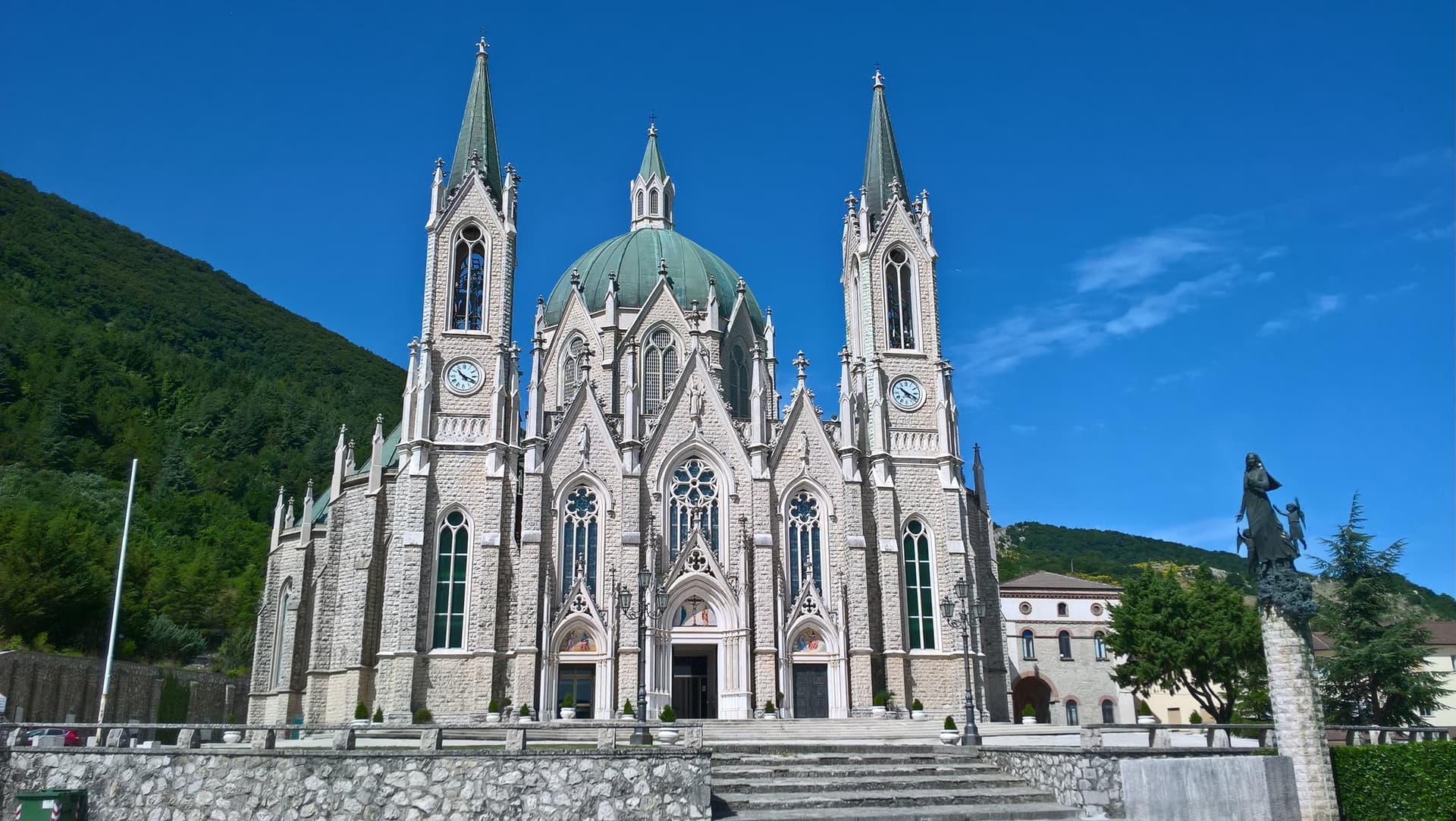
Image of Abbazia di Montecassino. Image source
Visit essentials
A quick read before you go
- Duration
- A focused visit to the basilica and cloisters takes roughly 1-1.5 hours; visitors wishing to…
- Access
- Atop Monte Cassino above the town of Cassino in southern Lazio, roughly midway between Rome and…
Overview
Montecassino gathers Benedictine origins, pilgrimage, and wartime memory on one hilltop. Around 529 CE, Benedict of Nursia founded a community here and wrote the Rule that shaped Western monastic life for the next millennium and a half. He and his twin sister Scholastica lie together beneath the basilica's high altar, toward which the rebuilt complex still turns, while a small resident community climbs to choir several times daily and sustains the founding intent despite repeated losses of stone.
The Cammino di San Benedetto reaches this tomb after beginning at Benedict's traditional birthplace in Norcia and passing through his youthful hermitage at Subiaco, mirroring the course of his life. The present abbey is the Italian state-and-Church-led reconstruction, completed in 1964 after almost total destruction in February 1944; that history is integral to the site and its museum, not an afterthought.
Why this place is sacred
For Benedictines, this hilltop is not simply historic but originary: the place where a man who had already tried and abandoned the hermit's life at Subiaco gathered a community, wrote a Rule balancing prayer, work, and stability, and in doing so gave Western monasticism its most durable template.
The tomb of Benedict and Scholastica beneath the high altar functions, within the Benedictine tradition, as the community's most sacred point of continuity — treated as unbroken in spiritual identity despite the building above it having been physically destroyed and rebuilt more than once across fifteen centuries, by Lombards in the sixth century, Saracens in the ninth, earthquake in the fourteenth, and Allied bombing in the twentieth.
That last destruction is not separable, at this site, from how sacredness is experienced here now. The abbey's rebuilding and its 1964 reconsecration by Pope Paul VI, under the motto Succisa Virescit — cut down, it grows again — transformed the hilltop into something more than a restored monument: a working symbol, understood by the Church and widely echoed in visitor and pilgrim accounts, of resurrection and reconciliation layered onto the sixth-century original.
Visitors and pilgrims frequently describe the site's power as arising from the juxtaposition of profound peace — the commanding hilltop position, the liturgical rhythm, the tomb itself — with the visible and remembered scars of catastrophic violence nearby.
The full history of that violence belongs to the abbey's twentieth-century chapter rather than to this account of why the site is sacred; what matters here is that the two qualities, peace and memory of loss, are not experienced separately by most who come.
Before Benedict's arrival, this hilltop held, according to the earliest biography of him written by Gregory the Great, a temple of Apollo and its associated grove. Benedict is said to have destroyed the altar and grove and raised oratories to Saint Martin and Saint John the Baptist before founding the monastery proper — a direct act of replacing one sacred use of the hill with another, rather than building on ground with no prior significance.
The monastery Benedict founded around 529 did not survive intact: Lombards destroyed it around 570, and it stood empty for roughly a century and a half before Petronax of Brescia refounded it around 718 with support from Pope Gregory II and the Lombard Duke Romuald II of Benevento. A medieval golden age under Abbot Desiderius, from 1058 to 1087, produced the celebrated scriptorium whose surviving output — around 1,200 codices — still anchors the abbey's library.
The building that Desiderius and his successors shaped stood, with further repairs across the centuries, until February 1944, when Allied bombing reduced it to rubble. The present structure, rebuilt by the Italian state and the Church, was reconsecrated in October 1964.
Experience and orientation
The climb up from Cassino town resolves, at the top, into a hilltop wide enough to hold both a monastery and a view that makes clear why this position mattered to anyone who has ever wanted to control the valley beneath it.
The basilica interior, on first encounter, does not read as a reconstruction — the craftsmanship absorbed the loss rather than displaying it, which is itself part of what several visitor accounts describe as unsettling in a useful way, a reminder that what looks intact was, within living memory, rubble.
The tomb of Benedict and Scholastica sits beneath the high altar, the point pilgrims arriving via the Cammino di San Benedetto treat as their actual destination rather than the building around it. Visitors describe a quality of arrival here distinct from the abbey's museum sections, which document the 1944 destruction directly and shift the visit's register from contemplative to historical.
Many extend the day to the Polish War Cemetery just below the summit, and the combination — monastery, museum, cemetery, all visible from roughly the same vantage — produces, in aggregate visitor accounts, a mood of reflection on destruction, survival, and reconciliation that neither element alone fully accounts for.
The church closes to sightseeing during Mass, though not to worshippers, and several visitors note that catching one of the daily liturgies, some sung with Gregorian chant, gives the basilica a different character than a self-guided walk-through does — the building doing, briefly, what it was rebuilt to keep doing.
Visit the basilica and tomb before the museum, so the site's older meaning has a chance to register before the twentieth-century history reframes it. If your schedule allows, attend a Mass or one of the sung offices rather than only touring independently. Afterward, walk down to the Polish War Cemetery — the short distance and the change in mood between the two sites is part of what the hilltop is asking of visitors.
If you are completing the Cammino di San Benedetto, treat the tomb as the walk's actual endpoint and have your credenziale ready to complete there.
Context and lineage
Benedict of Nursia arrived at Monte Cassino around 529 CE after years spent first at Subiaco, where he had lived as a hermit in a cave before gathering roughly a dozen monasteries of followers around him.
According to Gregory the Great's Dialogues, the primary early account of Benedict's life, he found the hilltop occupied by a temple of Apollo and its sacred grove, destroyed the altar, and founded oratories to Saint Martin and Saint John the Baptist before establishing the monastery proper.
It was here that Benedict composed the Rule of Saint Benedict, seventy-three chapters organizing monastic spiritual and administrative life around the discipline of ora et labora, prayer and work — a text that would become the most influential monastic rule in the Western Church and remains followed by Benedictine communities today.
Benedict died at Monte Cassino, by most accounts around 547 CE, and was buried beside his twin sister Scholastica in a shared tomb that the basilica's high altar still marks.
The monastery did not survive as a single continuous building. Lombards destroyed it around 570; it lay effectively abandoned for roughly a century and a half until Petronax of Brescia refounded it around 718, with the support of Pope Gregory II and the Lombard Duke Romuald II of Benevento. A medieval golden age followed under Abbot Desiderius, 1058 to 1087, whose scriptorium produced work in the distinctive Cassinese Beneventan script and left a surviving library of around 1,200 codices.
The most severe destruction in the abbey's history came in the twentieth century. During the Second World War, German forces held defensive lines across the mountainous terrain around Monte Cassino as part of the Gustav Line, and Allied commanders came to believe, incorrectly, that German troops were using the abbey itself as an observation post — the Germans had in fact agreed to leave it unoccupied, though they dug in among the ruins afterward.
On February 15, 1944, 142 B-17 bombers together with medium bombers dropped roughly 1,150 tons of ordnance on the abbey, reducing it to rubble and killing an estimated 230 civilians who had taken shelter there; the exact civilian toll is an estimate rather than a verified count.
The broader Battle of Monte Cassino stretched across four phases from January to May 1944, involving American, British, New Zealand, Indian, French, and Polish forces among others, with total Allied and German casualties estimated variously across sources, commonly cited in ranges from roughly 55,000 to over 100,000 depending on which phases and nationalities are counted.
The Polish II Corps, under General Władysław Anders, finally took the ruined hilltop on May 18, 1944, at a cost the corps's own records place at 923 killed, 345 missing, and roughly 3,000 wounded in the final assault alone.
Reconstruction began soon after the war and was overseen by the Italian state and the Church over the following two decades. Pope Paul VI reconsecrated the rebuilt basilica on October 25, 1964, and in the same visit proclaimed Benedict Patron Saint of Europe through the apostolic letter Pacis Nuntius.
The rebuilt abbey carries the Latin motto Succisa Virescit, 'cut down, it grows again,' a phrase the Church and subsequent commentary have consistently read as tying the destruction and the rebuilding into a single continuous statement about the site's resilience, rather than two separate stories.
Montecassino's custodianship has never fully broken, even when its buildings have: Benedict's original community, the refounding under Petronax in 718, Abbot Desiderius's medieval flourishing, and the post-1944 reconstruction all represent the same institution reasserting itself after disruption rather than a new foundation replacing an old one.
The abbey today holds the status of a territorial abbey, subject directly to the Holy See rather than to a diocesan bishop, and a small resident community of monks belonging to the Sublacensis-Cassinese Benedictine Congregation continues the Liturgy of the Hours and daily Mass.
The abbey also functions as the terminus of the modern Cammino di San Benedetto, linking its ancient monastic lineage to a contemporary pilgrimage practice that did not exist in its current form until the twentieth and twenty-first centuries.
Saint Benedict of Nursia
founder
Founded the monastery at Monte Cassino around 529 CE and composed the Rule of Saint Benedict here. Entombed with his twin sister Scholastica beneath the basilica's high altar. Declared Patron Saint of Europe by Pope Paul VI in 1964.
Saint Scholastica
co-venerated saint
Benedict's twin sister, buried beside him in the shared tomb beneath the high altar; venerated jointly with him at Montecassino.
Abbot Desiderius
abbot
Led the abbey through a medieval golden age from 1058 to 1087, during which its scriptorium produced the manuscript tradition, in the Cassinese Beneventan script, that anchors the abbey's surviving library of roughly 1,200 codices.
General Władysław Anders
military commander
Commander of the Polish II Corps, which captured the ruins of Monte Cassino on May 18, 1944, at heavy cost. His ashes were interred at the adjacent Polish war cemetery in 1970.
Pope Paul VI
reconsecrator
Reconsecrated the rebuilt basilica on October 25, 1964, and in the same visit proclaimed Benedict Patron Saint of Europe via the apostolic letter Pacis Nuntius.
Traditions and practice
Historically, the abbey followed the full monastic horarium prescribed in the Rule of St. Benedict, from Vigils through Compline, alongside seasonal liturgical feasts, most notably the feast of Saint Benedict on July 11, and March 21 in some traditional calendars, and the feast of Saint Scholastica on February 10.
The present community, belonging to the Sublacensis-Cassinese Benedictine Congregation, continues to celebrate the Liturgy of the Hours and daily Mass, some with Gregorian chant, and maintains the shrine of Saints Benedict and Scholastica. The abbey also hosts annual commemorations around the February 15 anniversary of the 1944 bombing and around May 18, marking the end of the battle for the hilltop.
If you are completing the Cammino di San Benedetto, arrive with enough time before your credenziale needs stamping to sit at the tomb without rushing — this is the walk's actual destination, not a formality on the way out. Attend a public Mass or Office if the schedule allows; the building does something different when it is being used for its intended purpose rather than only toured.
Pair the abbey visit with a walk down to the Polish War Cemetery on the same day rather than treating them as separate trips.
Roman Catholic Benedictine monasticism
ActiveMontecassino is the mother house of the Benedictine Order — the site where Benedict of Nursia founded his community around 529 CE and composed the Rule of Saint Benedict, the foundational text of Western monasticism. For Benedictines worldwide, it is the spiritual point of origin of their charism of prayer, work, study, and hospitality. Benedict and his twin sister Scholastica are entombed beneath the basilica's main altar. In 1964, Pope Paul VI reconsecrated the rebuilt basilica and proclaimed Benedict the Patron Saint of Europe, extending the abbey's significance beyond monastic circles as a symbol of European Christian civilization and post-war reconciliation.
Daily Liturgy of the Hours and communal prayer; celebration of Mass, including services with Gregorian chant; lectio divina and monastic study; hospitality toward pilgrims and retreatants; care of the shrine tomb of Saints Benedict and Scholastica.
Perspectives and open questions
Montecassino asks visitors to hold two well-documented histories at once — the founding of Western monasticism and one of the twentieth century's most debated military campaigns — without letting either one simplify the other.
Scholarly perspective
Historians agree Benedict of Nursia founded the monastery at Monte Cassino around 529 and that it was there he composed the Rule that became the template for Western monasticism; the abbey's medieval golden age under Abbot Desiderius in the eleventh century is well documented through its surviving scriptorium output.
Military historians are in consensus that the February 15, 1944 bombing, based on the subsequently disputed and largely discredited belief that German forces occupied the abbey itself, destroyed a building the Germans had in fact left unoccupied under an agreed protected-zone arrangement, though German troops did dig in among the ruins afterward.
The battle as a whole is treated in official military histories as one of the costliest and most controversial Allied campaigns of the Italian theater, notable both for its human cost and for the intense debate it triggered over the destruction of cultural heritage in war.
Living and traditional perspectives
Within the Benedictine tradition, Montecassino is regarded as the sacred wellspring of the Order, and the tomb of Benedict and Scholastica beneath the high altar is treated as the community's most sacred point of pilgrimage and continuity, unbroken in spiritual identity despite repeated physical destructions across fifteen centuries.
Open questions
Some specifics remain genuinely uncertain or disputed by historians rather than mysterious in a numinous sense: the exact year of Benedict's death, commonly given as around 543 or 547; precise total casualty figures for the multi-phase Battle of Monte Cassino, which vary by source and by which national forces and time periods are included; and the exact civilian death toll from the February 1944 bombing, commonly cited near 230 but not drawn from a verified census.
Plan your visit
Access and arrival
Atop Monte Cassino above the town of Cassino in southern Lazio, roughly midway between Rome and Naples. Best reached by car via the Cassino exit off the A1 autostrada, then a winding roughly 8 km ascent to the abbey, with parking available at the summit. Travelers arriving by train at Cassino station can take one of a limited number of daily buses up to the abbey, or a taxi.
Cassino town, at the base of the hill, has a range of hotels serving both pilgrims and WWII heritage visitors; those completing the full Cammino di San Benedetto typically end their walk here before returning by train or bus.
Respectful visit
Modest dress is required, as in any active Catholic church: no shorts, miniskirts, or sleeveless tops for either gender.
General photography of the exterior, cloisters, and basilica interior is typically permitted for personal use outside active services; flash and photography during Mass or other liturgical services should be avoided out of respect for worshippers.
No specific offering ritual is documented beyond the customary donation box and candle offerings typical of Catholic pilgrimage churches; the museum has a separate paid entry.
No eating or drinking on the grounds; no pets permitted; visitors should speak quietly throughout, particularly given the site's dual identity as a place of worship and a war memorial.
The church is closed to sightseeing during Mass, though worshippers are welcome; plan a museum visit around, rather than during, service times. The exact current number of resident monks fluctuates year to year and should be treated as approximate rather than fixed.
Current practical details
Address
Monte Cassino, 03043 Cassino, Province of Frosinone, Italy
Hours, fees, and access can change — verify on the official source before you travel. Practical details last checked Jun 2026.
Location
Map loads as you approach this section.
Pilgrim reflections
A portrait of encounter, not a score
Pilgrims describe what they felt, how present they could become, and whether the place would shape a journey. There are no stars and no ranking of traditions.
No reviewed reflections yet
The first pilgrims can help describe the character of being here.
Share a reflection
Available after an account-backed “Been there.” Every reflection is reviewed before publication.
Nearby sacred places
Explore other sacred places in the region. Proximity does not establish access or travel time; check each place’s guidance.


References
Sources consulted for this page. Source categories describe the publication, not a guarantee that every claim is verified. Traditional accounts and outside interpretations may differ.
- 01Monte Cassino — Wikipedia — Wikipedia contributorsacademicFounding by Benedict of Nursia c. 529; Lombard sack c. 570; refounding by Petronax c. 718; 11th-12th century golden age under Desiderius.
- 02Monte Cassino Territorial Abbey — Wikipedia — Wikipedia contributorsacademicEcclesiastical status, territorial abbacy structure, reconsecration history.
- 03Battle of Monte Cassino — Wikipedia — Wikipedia contributorsacademicOverview of the four-month, four-phase battle (Jan-May 1944); multinational Allied forces (US, British, New Zealand, Indian, French, Polish); scale of casualties.
- 04The Destruction of Monte Cassino, 1944 — The National WWII Museum — The National WWII Museum, New OrleansofficialFeb 15 1944 bombing raid details: 142 B-17s plus B-25/B-26 medium bombers, ~1,150 tons of ordnance; abbey reduced to rubble; strategic misjudgment about German use of the abbey as an observation post; approx. 230 civilian deaths.
- 05Battle of Monte Cassino (1944) — Britannica — Encyclopaedia Britannica editorsacademicCorroborates military rationale, multinational Allied order of battle, and eventual capture of the ruins by Polish 2nd Corps on 18 May 1944.
- 06Monte Cassino Polish war cemetery — Wikipedia — Wikipedia contributorsacademic1,072 Polish graves; Polish 2nd Corps under Gen. Władysław Anders; 923 killed, 345 missing, ~3,000 wounded in the May 1944 Polish assault; cemetery completed 1946; Anders's ashes interred here 1970; inscriptions on the memorial.
- 07Cammino di San Benedetto — Cammini d'Italia — Cammini d'Italia (Italian Ministry of Culture-affiliated pilgrim-routes portal)officialOfficial description of the ~300 km Cammino di San Benedetto from Norcia through Subiaco to Montecassino, following the life of St. Benedict; Montecassino is the terminus.
- 08Benedict of Nursia — Wikipedia — Wikipedia contributorsacademicBiography: born c. 480 in Nursia; ascetic years in a cave at Subiaco; founded ~12 monasteries around Subiaco before Monte Cassino; twin sister Scholastica; died at Monte Cassino c. 547; legendary poisoning/miracle episode from Gregory the Great's Dialogues.
- 09Rule of Saint Benedict — Wikipedia — Wikipedia contributorsacademic73 chapters covering spiritual and administrative monastic governance ('ora et labora'); most influential Western monastic rule, still followed today.
- 10The Library of Montecassino: A Thousand-Year History — MEMO (Università di Cassino) — Università degli Studi di Cassino e del Lazio MeridionaleacademicAbbey's scriptorium and library history; ~1,200 surviving codices; Cassinese/Beneventan script reached its classical form under Abbot Desiderius (1058-1087).
- 11Rising From the Ashes: The Legacy of the First Benedictine Monastery — National Catholic Register — National Catholic RegisterSource contextReconstruction completed and basilica reconsecrated 25 October 1964 by Pope Paul VI, who in the same visit proclaimed St. Benedict Patron of Europe via the apostolic letter Pacis Nuntius; motto 'Succisa Virescit' ('cut down, it grows again').
- 12The Way of St Benedict: Pilgrimage Norcia to Montecassino — SloWays — SloWaysSource contextRoute passes Roccasecca (birthplace of St. Thomas Aquinas); pilgrimage ends at the main altar of the Montecassino basilica, beneath which Benedict rests with his twin sister Scholastica; pilgrim credential stamped/completed at the abbey.
- 13Opening Hours — Abbey of Montecassino (Cassino) — WhichMuseum — WhichMuseumSource contextSeasonal opening hours (roughly 9:30am-4:50/6:30pm depending on season); museum founded 1980, fourteen exhibition rooms of archaeological finds, manuscripts and books.
- 14Montecassino Abbey — Martha's Italy — Martha's ItalySource contextVisitor etiquette: modest dress required (no shorts, mini-skirts, sleeveless tops), quiet conduct, no eating/drinking/pets; church closes to tourists during Mass but visitors may attend services, some with Gregorian chant.
Photo gallery
3 curated photos
Share a photo
Help visitors recognize Abbazia di Montecassino. Every submission is reviewed before publication.