Yamunotri, Uttarakhand
Seat of the goddess Yamuna, where a boiling spring meets her glacial source
Understand sacred places, explore living traditions, and learn how to engage respectfully with Pilgrim Map.
Access has not been verified. Check current local guidance before planning a visit.
Rajgarhi, Uttarakhand, India
Read the sources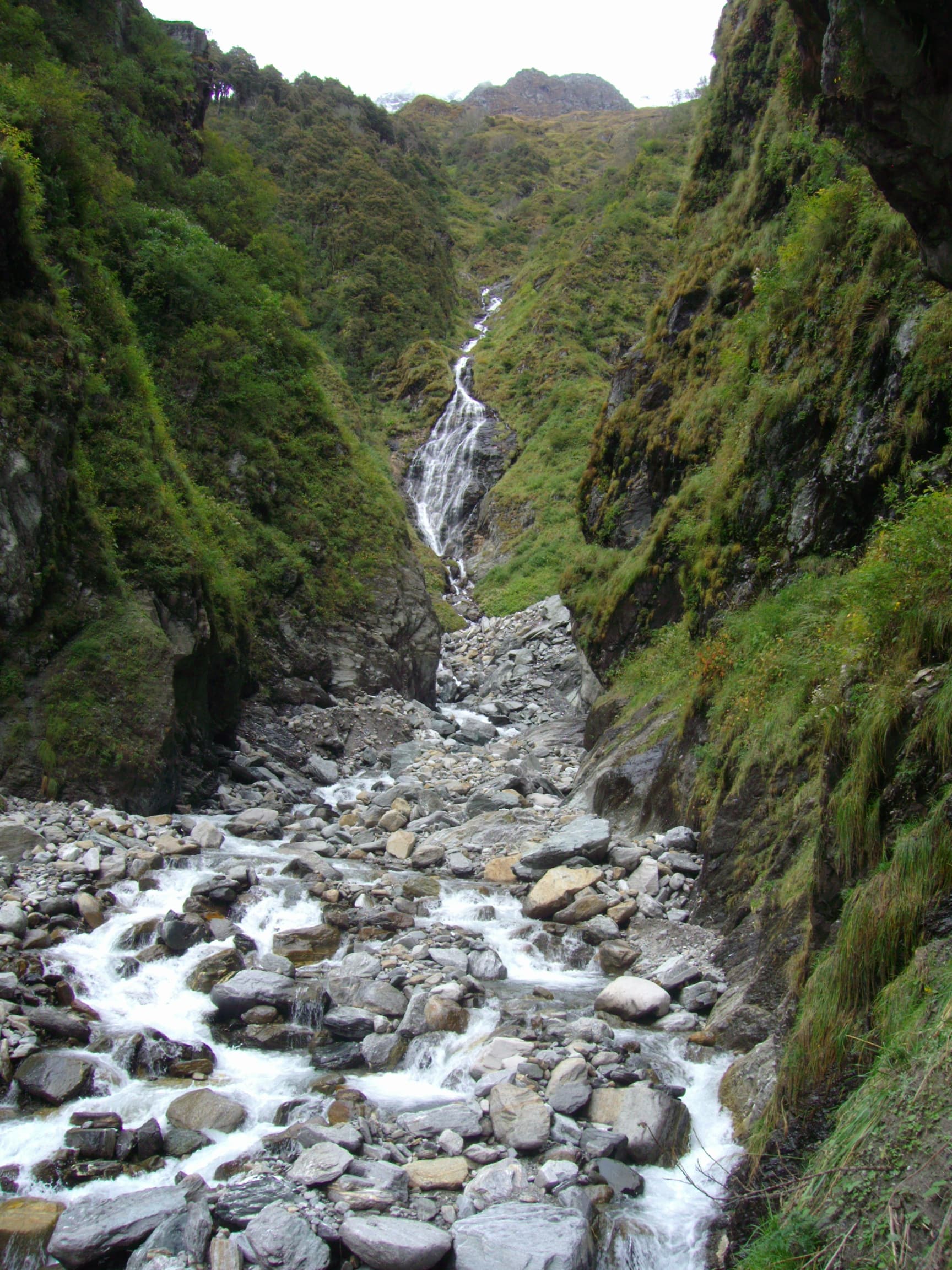
Yamuna River at Yamunotri, Uttarakhand, India. Image source · CC BY-SA 3.0
On this pilgrimage
Char Dham Yatra (Uttarakhand)Visit essentials
A quick read before you go
- Duration
- The 6-km trek from Janki Chatti takes roughly four to five hours on foot each way, with about…
- Access
- No vehicle road reaches the temple.
Overview
Yamunotri sits below Kalind Parvat in the Garhwal Himalayas, its temple set beside the geothermal Surya Kund and the cooler bathing pool of Gauri Kund. The goddess Yamuna, daughter of the sun god Surya and sister of Yama, is venerated here at the traditional source of her river, whose true glacial head lies higher still on the mountain, beyond most pilgrims' reach.
The site carries the memory of the sage Asit Muni, whose devotion is said to have drawn a miraculous stream to this spot. As one of the four Chota Char Dham shrines of Uttarakhand — a distinctly regional Himalayan circuit, not to be confused with the older pan-India Char Dham of Puri, Rameswaram, Dwarka, and Badrinath — Yamunotri is typically the first shrine pilgrims visit on the Uttarakhand yatra.
Why this place is sacred
What gathers at Yamunotri is not one register of sacredness but several held at once. There is the geological improbability of Surya Kund, water violent enough to cook rice within minutes, rising within feet of a river fed by glacial melt — heat and cold, fire and water, meeting at 3,293 metres.
There is the mythic weight carried by the goddess herself: Yamuna as daughter of the sun and sister of death, whose waters are said to spare bathers from Yama's fear. And there is the older, quieter thread of Asit Muni's hermitage, the sage whose age and devotion are remembered as having called a stream of the Ganga to his side when he could no longer travel to it.
The true source, high on Kalind Parvat at over 4,400 metres, remains unreached by nearly everyone who comes — which keeps the site's ultimate origin permanently just out of view, mediated only through the temple, the springs, and the trek.
A hermitage and bathing site associated with the sage Asit Muni, predating any built structure, oriented toward devotion to the river-goddess Yamuna at what was understood as her earthly seat.
From an ascetic's riverside retreat to a built shrine under royal patronage in 1839, repeatedly damaged by earthquake, snow, and flood and rebuilt, to its present role as an organized stop on the modern, tourism-supported Chota Char Dham circuit.
Experience and orientation
The approach begins well below the shrine, at Janki Chatti or the more distant Hanuman Chatti, where the road ends and the Himalaya takes over. The trail climbs roughly 700 metres over 6 kilometres, through pine and rhododendron, alongside waterfalls fed by snowmelt, the path narrowing at points to ledges and concrete ramps.
Most pilgrims walk it in four to five hours; those unable to manage the climb take a pony, a palki, or a dandi chair-carry, arranged through a government counter at Janki Chatti. Arrival brings the smell of sulphur and the sight of steam rising from Surya Kund beside the temple.
Many stop first to bathe in the milder waters of Gauri Kund, then tie rice and potatoes in cloth and lower them into Surya Kund, where the near-boiling water cooks the offering within minutes. Only then do pilgrims queue at the temple itself for darshan of Yamuna's black marble murti, the cooked prasad carried in and later taken home as a blessing.
Reach Janki Chatti by road via Rishikesh and Barkot; the final 6 km to the temple is on foot, pony, palki, or dandi only, as no vehicle road reaches the shrine. Online yatra registration with the Uttarakhand government is required in season, and pony/palanquin bookings are made at the prepaid counter in Janki Chatti.
Context and lineage
Tradition holds that the sage Asit Muni (also called Asita) kept a hermitage on the banks of the Yamuna, bathing daily in both the Ganga and the Yamuna as an act of devotion. As he grew too old and feeble to travel to the Ganga, a stream of that river is said to have appeared miraculously beside the Yamuna at this spot, allowing him to continue his practice — an event popularly linked to the presence of Surya Kund.
The goddess Yamuna's own birthplace is placed higher still, at the Champasar glacier on Kalind Parvat, the peak named for her father, the sun god Surya. A modest shrine at the site is remembered as predating any masonry temple; the present structure was built in 1839 by Sudarshan Shah, king of Tehri.
It was damaged by earthquake and later rebuilt in the 19th century — sources differ on whether this reconstruction, which installed the temple's black marble idol, is chiefly credited to Maharaja Pratap Shah of Tehri Garhwal or to Maharani Gularia Devi of Jaipur — and the temple suffered further damage, including in the 1923 earthquake, requiring repeated rebuilding since.
Worship at Yamunotri is conducted by the hereditary Uniyal family of priests. In winter, when the temple closes, worship of the goddess continues at Kharsali village across the valley, where the deity is traditionally moved.
Asit Muni (Asita)
Legendary founding sage
Sudarshan Shah
King of Tehri, temple founder
Maharaja Pratap Shah of Tehri Garhwal
Patron of reconstruction (per most sources)
Traditions and practice
Daily puja and aarti to the murti of Yamuna, conducted by priests of the Uniyal family; ritual bathing in the warm waters of Gauri Kund before entering the temple precinct; veneration of the Divya Shila rock; and the preparation of prasad by tying rice and potatoes in muslin cloth and lowering them into Surya Kund, where the near-boiling water cooks the offering for presentation to the goddess.
The same rituals continue each season, now organized around the temple's fixed opening on Akshaya Tritiya and closing on Bhai Dooj; when the shrine is shut for winter, the deity's worship is maintained at Kharsali village, and pilgrims increasingly combine the visit with the wider organized Char Dham Yatra of Uttarakhand, using government registration and pony/palanquin services.
Bathe in Gauri Kund before approaching the temple, prepare or purchase Surya Kund prasad to offer at darshan, and allow time to sit by the springs rather than treating the visit as a brief stop — the juxtaposition of the boiling spring and the glacial river is easiest to absorb slowly.
Hinduism (Shaktism / Sanatana Dharma)
ActiveYamunotri is the seat of the goddess Yamuna, daughter of the sun god Surya and sister of Yama, and is venerated as the source of the sacred Yamuna river. As one of the four Chota Char Dham sites of Uttarakhand, it anchors a major strand of Himalayan Shakta pilgrimage distinct from the older pan-India Char Dham.
Daily puja and aarti to the black marble murti of Yamuna; ritual bathing in Gauri Kund; preparation of rice-and-potato prasad cooked in the boiling Surya Kund and offered at darshan; veneration of the Divya Shila rock.
Perspectives and open questions
Yamunotri can be read through the theology of Yamuna as river-goddess and protector from untimely death, through the devotional memory of Asit Muni's hermitage, and through its comparatively recent institutional role within the 20th-century Chota Char Dham circuit — three lenses that sit together without needing to resolve into one.
Scholarly perspective
Scholarship treats the Chota Char Dham, including Yamunotri, as a modern touristic and pilgrimage-industry label that emerged in the second half of the 20th century, distinct from — and sharing only Badrinath with — the ancient pan-India Char Dham of Puri, Rameswaram, Dwarka, and Badrinath associated with Adi Shankara.
The present temple structure is dated to 1839, with no earlier masonry shrine documented; its repeated damage by earthquake and flood and subsequent rebuilding is well attested across regional histories, though the precise attribution of the major 19th-century reconstruction is inconsistently recorded.
Living and traditional perspectives
In Garhwali devotional tradition, Yamunotri is the living seat of the goddess Yamuna, daughter of Surya and sister of Yama, whose boon is remembered as sparing devotees who bathe in her waters from the fear of Yamaloka and from a painful death. The hereditary Uniyal priesthood and the seasonal movement of worship to Kharsali in winter reflect a ritual calendar shaped as much by Himalayan seasons as by scripture.
Alternative interpretations
Some devotional readings treat the pairing of the boiling Surya Kund and the glacial Yamuna as a deliberate symbolic union of solar and aquatic forces — Surya's heat meeting his daughter's cold, source waters — and regard the unreached glacial source on Kalind Parvat as the goddess's hidden, truer form, of which the temple murti offers only a mediated approach.
Open questions
The precise sequence of pre-1839 worship at the site is preserved only in legend, not in surviving records, and the individual chiefly responsible for the major 19th-century reconstruction — Maharaja Pratap Shah of Tehri Garhwal in most accounts, Maharani Gularia Devi of Jaipur in others — remains unresolved across the sources consulted.
Plan your visit
Access and arrival
No vehicle road reaches the temple. Travel by road to Janki Chatti (or the more distant Hanuman Chatti) via Rishikesh and Barkot, then proceed on foot, pony, palki, or dandi — the latter two booked through a government prepaid counter at Janki Chatti. Online yatra registration with the Uttarakhand government is required during the pilgrimage season.
Respectful visit
Modest dress covering shoulders and knees, as at other Hindu temples in the region; warm layered clothing is essential regardless of season, since the shrine sits above 3,200 metres and temperatures drop quickly even in summer. Footwear is removed before entering the temple.
Photographing the temple exterior, the springs, and the surrounding valley is generally accepted; photography inside the garbhagriha during active puja is discouraged, in keeping with practice at the other Chota Char Dham temples.
Rice and potatoes cooked in Surya Kund are the site's distinctive offering, alongside flowers and standard temple offerings made through official counters or the hundi. Cash should not be handed to unofficial individuals along the trail.
Direct contact with Surya Kund's near-boiling water should be avoided beyond the customary cloth-wrapped prasad. The temple and trek close completely for winter, from roughly mid-November to mid/late April, and can close temporarily in bad weather even within season.
Surya Kund's water is reported near 88°C (190°F); keep well clear of direct contact beyond the customary cloth-wrapped offering. The trail from Janki Chatti involves real elevation gain on uneven, sometimes narrow ground — acclimatize and pace accordingly, and expect the shrine and trek to be entirely closed from mid-November to mid/late April.
Location
Map loads as you approach this section.
Pilgrim reflections
A portrait of encounter, not a score
Pilgrims describe what they felt, how present they could become, and whether the place would shape a journey. There are no stars and no ranking of traditions.
No reviewed reflections yet
The first pilgrims can help describe the character of being here.
Share a reflection
Available after an account-backed “Been there.” Every reflection is reviewed before publication.
Nearby sacred places
Explore other sacred places in the region. Proximity does not establish access or travel time; check each place’s guidance.


References
Sources consulted for this page. Source categories describe the publication, not a guarantee that every claim is verified. Traditional accounts and outside interpretations may differ.
- 01Yamunotri — Wikipedia — Wikipedia contributorsacademicConfirms location, altitude, glacial source, Asita/Asit Muni legend, Sangya/Champasar glacier origin, Chota Char Dham grouping, and river course to Prayagraj.
- 02Yamunotri Temple — Wikipedia — Wikipedia contributorsacademicConfirms temple destruction/rebuilding history, Maharaja Pratap Shah reconstruction, black marble idol, Uniyal priestly family, Surya Kund and Gauri Kund, opening/closing dates.
- 03Chota Char Dham — Wikipedia — Wikipedia contributorsacademicConfirms Chota Char Dham as a mid-to-late 20th-century touristic label for the Uttarakhand circuit (Yamunotri, Gangotri, Kedarnath, Badrinath), representing Shakta, Shaiva, and Vaishnava traditions; clarifies it shares only Badrinath with the original pan-India Char Dham.
- 04Char Dham — Wikipedia — Wikipedia contributorsacademicConfirms the original pan-India Char Dham (Puri, Rameswaram, Dwarka, Badrinath) attributed to Adi Shankara, distinct from the regional Chota Char Dham of Uttarakhand.
- 05Yamunotri, Uttarakhand: Sacred Source of the Yamuna River — Uttarakhand Tourism Development BoardofficialState tourism board listing for Yamunotri as an official pilgrimage destination within Uttarakhand.
- 06Yamunotri Temple Uttarkashi - History, Architecture & Temple Guide — eUttaranchalSource contextCorroborates 1839 construction by Sudarshan Shah, later earthquake damage, and reconstruction; regional travel/heritage publisher with detailed local knowledge.
- 07Surya Kund Yamunotri - Surya Hot Water Spring In Uttarkashi — eUttaranchalSource contextDescribes Surya Kund temperature (up to ~88°C/190°F) and the rice/potato prasad-cooking ritual.
- 08Why You Should Visit Surya Kund Yamunotri Natural Hot Spring — Manchala MushafirSource contextDescribes the prasad-cooking ritual (rice and potatoes tied in muslin cloth, dipped into the spring) offered to Goddess Yamuna.
- 09Yamunotri Dham: History, Legends & Char Dham 2026 — ShikharSource contextRecounts Asit Muni legend, Yamuna as daughter of Surya and sister of Yama, and the boon protecting bathers from untimely death and fear of Yamaloka.
- 10Yamunotri History - Yamunotri Legends and Pilgrimate Stories — SacredYatraSource contextAdditional detail on Asit Muni's devotion and the Vedic-era association of the site prior to the 1839 temple construction.
- 11Yamunotri Dham Trek Guide & Route Map 2026 — ShikharSource contextConfirms 6 km trek from Janki Chatti (13 km from Hanuman Chatti), ~700 m elevation gain, moderate difficulty, and pony/palki/dandi services.
- 12Yamunotri Temple 2026: Opening Date, 6 km Trek from Janki Chatti & Travel Guide — PlanYourPackageSource contextConfirms 2026 opening date of 19 April (Akshaya Tritiya) and closing 11 November (Bhai Dooj).
Share a photo
Help visitors recognize Yamunotri, Uttarakhand. Every submission is reviewed before publication.