Gangotri Temple, Uttarakhand
Where the Ganges is said to descend to earth as a goddess
Understand sacred places, explore living traditions, and learn how to engage respectfully with Pilgrim Map.
Access has not been verified. Check current local guidance before planning a visit.
Gangotri, Uttarakhand, India
Read the sources
Visit essentials
A quick read before you go
- Duration
- Most pilgrims spend one to two days in Gangotri for temple darshan.
- Access
- By road from Rishikesh via Uttarkashi and Harsil, roughly 250 km and 9-11 hours' drive, usually…
Overview
At roughly 3,100 metres, the young Bhagirathi churns from the Gangotri Glacier through pine and deodar forest. The temple is dedicated to Ganga, worshipped here as the river in person: the water carrying ash and ritual across India begins its named, storied life at this bend, where pilgrims worshipped directly on the bank for centuries before any building.
Gangotri is one of two Shakti (goddess) sites in the Chota Char Dham—the Uttarakhand circuit of Yamunotri, Gangotri, Kedarnath, and Badrinath, a 20th-century religious-tourism label for a much older devotional geography. It is distinct from the pan-India Char Dham of Puri, Rameswaram, Dwarka, and Badrinath, credited to Adi Shankaracharya. Each winter the goddess's murti moves to Mukhba near Harsil and returns on Akshaya Tritiya in spring.
Why this place is sacred
Gangotri collapses distance between symbol and substance. Elsewhere in India, Ganga water is carried, bottled, and ritually invoked away from its source; here, the goddess and object of devotion are the same cold, fast water passing the temple steps. The Bhagirath Shila traditionally marks the exact riverbank spot where a king's penance brought that water from heaven, placing mythic and geographic origins within a few hundred metres.
Upstream lies Gaumukh, the glacier mouth from which the Bhagirathi physically emerges. Most pilgrims stop at the temple; fewer continue, and that graduated approach—from devotional stop to optional austerity—shapes how intensely different visitors encounter the place.
Long before any structure existed, Gangotri functioned as an open-air riverbank shrine: pilgrims performed worship directly at the water's edge, with no temple or idol mediating the encounter.
A built temple appeared only in the late 18th century, raised by the Gorkhali general Amar Singh Thapa during Nepalese control of Garhwal-Kumaon; it was rebuilt in 1807 after the 1803 earthquake and restored again in the early 20th century, traditionally credited to Maharaja Madho Singh II of Jaipur. The site's religious function — devotion to Ganga at her point of descent — has stayed constant even as its architecture and administration changed hands across two centuries.
Experience and orientation
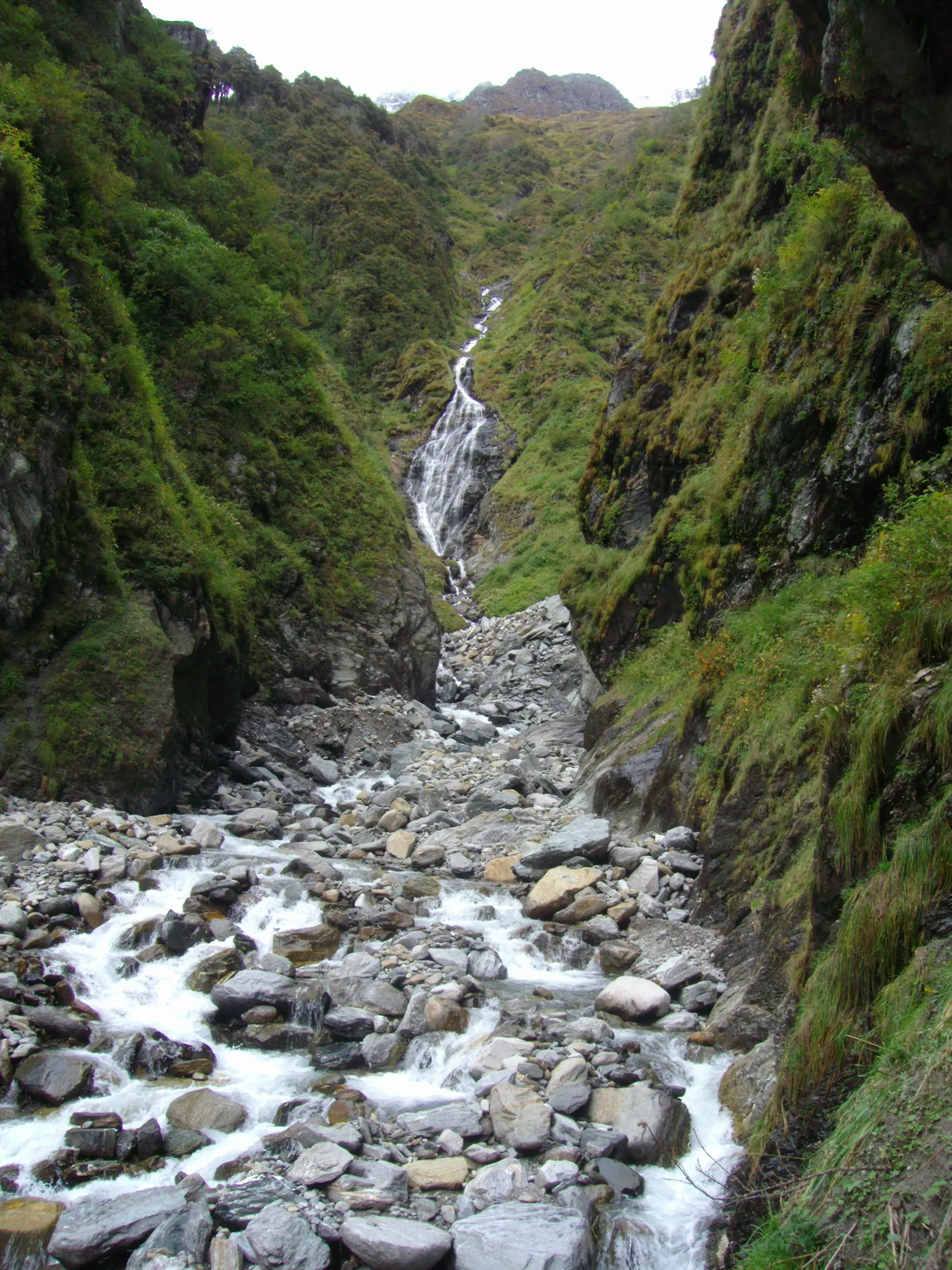
Because the road reaches Gangotri town, arrival has no long physical vigil; sacred attention often begins when the Bhagirathi first appears, glacial-green and audibly fast between conifer forest and granite walls.
In the temple courtyard, Mangal Aarti at dawn and Sandhya Aarti at dusk draw devotees afterward to a further riverside Ganga Aarti performed to the water itself. Many pilgrims collect Gangajal to carry home, while some take a brief ritual dip despite the glacier-fed cold. Continuing toward Gaumukh marks a transition from temple ritual toward a more austere stage of pilgrimage.
Gangotri is reached by road from Rishikesh via Uttarkashi and Harsil, roughly 250 km and 9-11 hours' drive, usually as the final stop on a Char Dham circuit. No trek is needed for the temple itself. Continuing to Gaumukh requires an Inner Line Permit (available in Uttarkashi or Gangotri) because the route runs close to the India-China border through Gangotri National Park.
Context and lineage
The dominant legend traces Gangotri to King Bhagiratha, descendant of King Sagara, whose 60,000 ancestors had been reduced to ash by the curse of the sage Kapila after they wrongly accused him of stealing a sacrificial horse. Only the water of the celestial Ganga could liberate their souls, so Bhagiratha performed years of penance to persuade first Brahma, then Shiva, to bring her to earth.
Ganga agreed, but her force threatened to shatter the ground on impact; Shiva caught her descent in his matted hair, releasing her gently to earth — the origin of his epithet Gangadhara, 'bearer of Ganga.' The Bhagirath Shila, a stone on the riverbank at Gangotri, is traditionally identified as the site of that penance. A secondary tradition holds that the Pandavas performed a Deva Yajna here to atone for kinsmen killed in the Mahabharata war.
Ritual care of the deity has long rested with the Semwal family of hereditary priests, who oversee the temple's daily worship and the murti's seasonal migration between Gangotri and its winter seat at Mukhba village near Harsil.
King Bhagiratha
Legendary founder of the site's sanctity
Amar Singh Thapa
Builder of the original temple
Madho Singh II of Jaipur
Restorer of the temple
Traditions and practice
Daily worship follows a set rhythm: Mangal Aarti at dawn, a Bhog offering of food to the goddess, and Sandhya Aarti at dusk, followed by a further Ganga Aarti performed directly at the riverbank. Special poojas mark Janmashtami, Vijayadashami, and Diwali.
The temple opens each year on Akshaya Tritiya, when the murti is ceremonially carried back from Mukhba amid festivity, and closes around Bhai Dooj shortly after Diwali, when she returns there for the winter. Ganga Dussehra, in the Hindu month of Jyeshtha (May-June), is the year's largest festival — ten days of aarti, kirtan, bhajans, and fairs marking Ganga's descent to earth.
Arrive in time for either the dawn or dusk aarti rather than mid-day darshan alone; the riverside Ganga Aarti that follows is, for many pilgrims, the more affecting of the two rituals. Those with the time and permits should weigh the two-day trek to Gaumukh as a further, more austere stage of the pilgrimage rather than a separate excursion.
Shaktism / Ganga worship (Hinduism)
ActiveGangotri is the principal temple to the goddess Ganga at the traditional point of her earthly descent, and one of the two Shakti (goddess) sites within the Chota Char Dham, alongside Yamunotri.
Mangal Aarti at dawn, Bhog offering, Sandhya Aarti at dusk, and a further Ganga Aarti at the riverbank; the ten-day Ganga Dussehra festival in Jyeshtha (May-June) marking the river's descent to earth.
Char Dham and Chota Char Dham pilgrimage (Hinduism)
ActiveGangotri is one of the four sites of the Chota Char Dham of Uttarakhand — Yamunotri, Gangotri, Kedarnath, and Badrinath — a regional Himalayan circuit representing Shakti (Yamunotri, Gangotri), Shaiva (Kedarnath), and Vaishnava (Badrinath) traditions. This is a distinct, later-coined circuit from the pan-India Char Dham of Badrinath, Puri, Dwarka, and Rameswaram, credited to the 8th-century philosopher Adi Shankaracharya and marking the four cardinal directions of the subcontinent; the two circuits share only Badrinath.
Multi-site pilgrimage typically undertaken in the sequence Yamunotri, Gangotri, Kedarnath, Badrinath during the May-October season, by road and helicopter package as well as on foot.
Perspectives and open questions
Gangotri is read through at least three lenses that rarely need to argue with one another: the historian's account of a comparatively young, Gorkhali-built temple over a much older riverside devotional practice; the devotee's account of a goddess who chose this exact bend of river to touch earth; and the pilgrim-planner's account of Gangotri as one stop in a four-site circuit whose very framing as a 'Char Dham' is itself a modern label laid over ancient geography.
Scholarly perspective
Historians treat the built temple as a late arrival — raised in the final years of the 18th century under Gorkhali authority, rebuilt after the 1803 earthquake, and restored again in the early 20th century — while noting that devotional practice at the site itself long predates any structure, having been conducted directly at the riverbank for centuries.
Scholars of Indian religious tourism further note that the 'Chota Char Dham' bundling of Yamunotri, Gangotri, Kedarnath, and Badrinath is a 20th-century tourism-industry label, distinct from the older, Adi Shankaracharya-linked all-India Char Dham of Puri, Rameswaram, Dwarka, and Badrinath — the two circuits share only Badrinath and should not be conflated.
Living and traditional perspectives
In Garhwali Hindu tradition, Gangotri is where Ganga Devi consented to touch earth after Bhagiratha's penance succeeded and Shiva agreed to break her fall; the Semwal priesthood has maintained continuous ritual care of the deity across generations, including her seasonal migration to and from Mukhba, treating the goddess as a resident who withdraws for winter rather than a fixed monument.
Alternative interpretations
Some devotional and yogic readings treat the Bhagirathi's descent from high glacier to plains as a symbol of grace entering embodied life, with Gangotri marking the threshold between the celestial and the terrestrial; pilgrims frequently describe the shock of the glacial water itself — its cold and clarity — as a distinct sensory register from any encounter with the river downstream.
Open questions
Sources disagree on the exact founding date of the first built temple — some describe a late-18th-century original construction, others specifically an 1807 rebuild after the 1803 earthquake — and this research does not resolve which is more accurate. The centuries of riverbank-only worship that preceded any structure are known only through oral and textual tradition, without direct archaeological confirmation.
Plan your visit
Access and arrival
By road from Rishikesh via Uttarkashi and Harsil, roughly 250 km and 9-11 hours' drive, usually as the final stage of a Char Dham circuit. The temple sits beside the road in Gangotri town — no trek is required, unlike at Kedarnath. Continuing on foot to Gaumukh requires an Inner Line Permit, obtainable in Uttarkashi or Gangotri, because the route runs near the India-China border through Gangotri National Park.
Gangotri town has GMVN guesthouses, ashrams, and private lodges catering to the pilgrim season; options thin out or close entirely once the temple shuts for winter.
Respectful visit
No dress code is formally enforced, but full-covering, modest clothing is expected, particularly for women; warm layers are essential year-round given the altitude, even in the height of summer.
Photography is generally permitted in the temple courtyard and surrounding area; visitors are expected to put phones and cameras away during aarti and to avoid photographing priests or rituals up close without asking first.
Flowers, Ganga water, and sweets are the customary offerings; many pilgrims carry Gangajal home in sealed containers as a blessing for household rites.
Footwear is removed before entering the inner shrine, as at any Hindu temple. There is no formal restriction beyond that, but visitors should treat the extreme cold of the river with caution rather than as a photo opportunity.
The Bhagirathi at Gangotri is glacier-fed and extremely cold; a ritual dip carries real risk of cold shock, and currents should be respected. The route to Gaumukh requires an Inner Line Permit, sits at altitude, and passes through a restricted border-proximate zone — this is not an casual add-on to the temple visit.
Location
Map loads as you approach this section.
Pilgrim reflections
A portrait of encounter, not a score
Pilgrims describe what they felt, how present they could become, and whether the place would shape a journey. There are no stars and no ranking of traditions.
No reviewed reflections yet
The first pilgrims can help describe the character of being here.
Share a reflection
Available after an account-backed “Been there.” Every reflection is reviewed before publication.
Nearby sacred places
Explore other sacred places in the region. Proximity does not establish access or travel time; check each place’s guidance.



References
Sources consulted for this page. Source categories describe the publication, not a guarantee that every claim is verified. Traditional accounts and outside interpretations may differ.
- 01Gangotri — Wikipedia — Wikipedia contributorsacademicCore facts on location, elevation, temple history, seasonal closure to Mukhba, priest lineage.
- 02Chota Char Dham — Wikipedia — Wikipedia contributorsacademicConfirms Chota Char Dham (Yamunotri, Gangotri, Kedarnath, Badrinath) as a 20th-century touristic/pilgrimage label distinct from the pan-India Char Dham (Badrinath, Puri, Dwarka, Rameswaram) credited to Adi Shankaracharya.
- 03Char Dham — Wikipedia — Wikipedia contributorsacademicDescribes the all-India Char Dham (Badrinath, Dwarka, Puri, Rameswaram) and its attribution to Adi Shankaracharya, contrasted with the regional Uttarakhand circuit.
- 04Gangotri — Uttarakhand Tourism (official government portal) — Uttarakhand Tourism Development BoardofficialOfficial state tourism body listing Gangotri as one of the sacred Char Dham (Chota Char Dham) temples.
- 05Amar Singh Thapa — Wikipedia — Wikipedia contributorsacademicBackground on the Gorkhali general credited with the temple's original construction.
- 06Nanda Devi and Valley of Flowers National Parks — UNESCO World Heritage Centre — UNESCOofficialConfirms the neighboring UNESCO-inscribed biosphere; Gangotri National Park itself is a separate, non-UNESCO protected area in the same Garhwal Himalaya region.
- 07Gangotri Temple Kapat Opening Date — Gangotri Dham Important Dates, Aarti Timings — eUttaranchalSource contextPractical detail on annual opening (Akshaya Tritiya) and closing (Bhai Dooj/around Diwali) dates and daily darshan timings.
- 08Gangotri Temple, Gangotri — Timings, Festivals, History, Darshan, Pooja Timings — Trawell.inSource contextDetail on Mangal Aarti, Bhog Offering, Sandhya Aarti, and Ganga Dussehra festival.
- 09History of Gangotri Temple, Uttarakhand — Char Dham Pilgrimage TourSource contextDetail on the 1803 earthquake, 1807 rebuilding, and Nagara/Katyuri architectural style.
- 10Gangotri Temple — Gangotri History, Mythology, Opening Closing Dates — Char Dham CentralSource contextCorroborates Bhagirath Shila legend, Pandava Deva Yajna alternative legend, and Semwal priest lineage.
Photo gallery
3 curated photos
Share a photo
Help visitors recognize Gangotri Temple, Uttarakhand. Every submission is reviewed before publication.