Worcester Cathedral
Where thirteen centuries of prayer have worn thin the boundary between earth and heaven
Understand sacred places, explore living traditions, and learn how to engage respectfully with Pilgrim Map.
Access has not been verified. Check current local guidance before planning a visit.
Worcester, England, United Kingdom
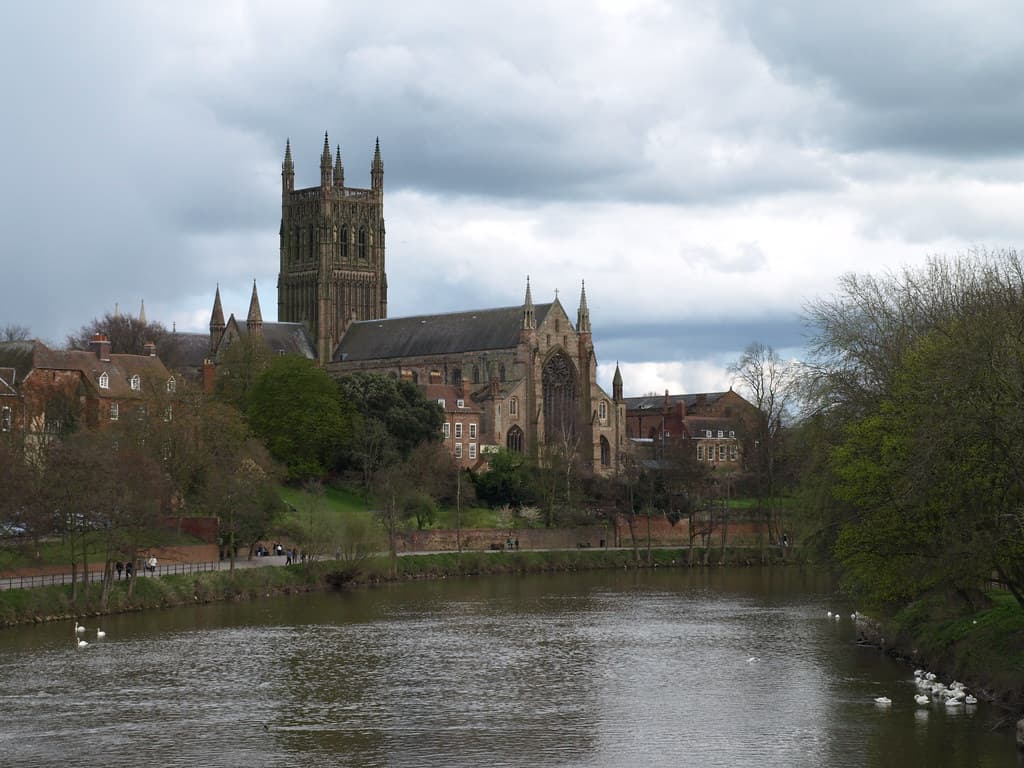
Image of Worcester Cathedral. Image source
Visit essentials
A quick read before you go
- Duration
- 2-3 hours to explore thoroughly, including the crypt, cloisters, and perhaps attending Evensong
- Etiquette
- Worcester Cathedral is an active place of worship that welcomes visitors warmly.
Overview
Some places accumulate sanctity the way old libraries accumulate silence. Worcester Cathedral is such a place. For over thirteen centuries, morning and evening prayers have risen from this ground above the Severn, each day adding another layer to what has become one of England's most continuously sacred sites.
The building tells its own story in stone. Descend into the Norman crypt and you stand in the oldest surviving structure in Worcester, laid by St Wulfstan himself in 1084. The bishop who built it was later canonized for miracles worked at his tomb. Together with St Oswald, whose relics were enshrined here a century earlier, Wulfstan made Worcester a pilgrimage destination that once rivaled Canterbury.
The shrines are gone now, dismantled at the Reformation. But what drew medieval pilgrims was never simply the relics. It was the quality of attention that had gathered here through centuries of daily office, the sense of a thin place where prayer came easier and the ordinary world grew transparent. That quality persists.
Today, the cathedral choir still sings evensong in the building Charles II watched the decisive battle of the Civil War from its tower. Visitors light candles where pilgrims once knelt at saints' tombs. King John lies between the spaces where Oswald and Wulfstan once rested, his ancient effigy gazing upward. The worship continues. The door remains open.
Why this place is sacred
The concept of thin places suggests locations where the boundary between ordinary experience and something larger grows permeable. Worcester Cathedral exemplifies this through multiple converging factors.
First, there is the sheer continuity. Since Bosel was consecrated as Worcester's first bishop in 680 AD, this ground has never ceased to be a place of Christian worship. The daily office, interrupted perhaps only briefly during the Civil War when Cromwell's forces used the nave as a prison, has continued for nearly fourteen hundred years. Each generation adds its prayers to what has been laid down before, creating a cumulative weight that newcomers often sense immediately upon entering.
Second, the presence of saints. St Oswald, bishop from 961 and later Archbishop of York, founded the Benedictine monastery here and was buried in the cathedral he built. His relics drew pilgrims from the time of his death. St Wulfstan, bishop from 1062 until his death in 1095, was the only Anglo-Saxon bishop to keep his post after the Norman Conquest.
According to tradition, when challenged to surrender his staff, he placed it upon the tomb of Edward the Confessor; when no one else could remove it, William himself confirmed Wulfstan in office. More significantly, Wulfstan campaigned successfully against the slave trade from Ireland, centuries before abolition movements. His canonization in 1203 transformed Worcester into a pilgrimage center that rivaled Canterbury.
Third, the crypt. Unlike shrines that can be dismantled, the crypt Wulfstan built in 1084 remains. To descend those steps is to enter a space the saint himself constructed, to stand under vaults he raised. The largest Norman crypt in England, it carries an atmosphere of antiquity and depth that visitors consistently describe as palpable.
Finally, the river. Worcester has been called the Cathedral of the Severn, and the connection runs deep. The building stones themselves were brought by water. The cathedral rises above the flood plain, visible for miles to those traveling the river. In a landscape where water has always been the carrier of goods, people, and meaning, the cathedral's position creates a liminal quality, standing at the threshold between the commerce of the river and the contemplation of the altar.
The site has served multiple but interwoven purposes across its long history. Initially, it was the seat of a new diocese carved from Lichfield in 680 AD. When St Oswald founded his Benedictine monastery in 983, it became a center of monastic learning and the reform movement that sought to deepen English Christianity. Under Wulfstan, the current building began as both episcopal church and pilgrimage destination.
The monks maintained the shrines, copied manuscripts, and kept the daily round of prayer that was understood not as separate from practical life but as its foundation.
The Reformation stripped the shrines. The monks were dispersed in 1540. Yet the building adapted. It became an Anglican cathedral, its worship reformed but continuous. The Three Choirs Festival, begun in the early 18th century and rotating between Worcester, Gloucester, and Hereford, established the cathedral as a center of sacred music. Victorian restoration under George Gilbert Scott addressed structural decay while adding new splendors, including the great west window depicting creation.
In 1986, the discovery of a medieval pilgrim's remains beneath the floor reminded the cathedral of its past as pilgrimage destination, prompting renewed attention to that heritage. Today, Worcester works with the British Pilgrimage Trust to offer routes that connect parish churches across the county to the mother church, reviving ancient patterns for contemporary seekers.
Experience and orientation
The experience of Worcester Cathedral unfolds gradually. The nave impresses with scale, the perpendicular Gothic arches drawing the eye upward toward the central tower. But the deeper encounters wait in quieter spaces.
The Norman crypt is the heart of the cathedral's thinness. Descending the worn steps, visitors enter what is effectively a church beneath the church, the low vaulted ceiling and massive columns creating an atmosphere of containment and depth. This is where Wulfstan himself worked. The stone has absorbed nearly a thousand years of candlelight and prayer. Contemporary pilgrims often sit here in silence, finding a stillness that the busier spaces above cannot match.
King John's tomb holds its own power. The king who sealed Magna Carta lies between the spaces where the two saints' shrines once stood, his request to be buried between them honored even after the shrines were destroyed. The Purbeck marble effigy from 1232 is the oldest royal effigy in England, designed as an actual likeness rather than an idealized type. Flanked by miniature carvings of Oswald and Wulfstan, John gazes upward in perpetual vigil.
Visitors sometimes report finding unexpected sympathy for the much-maligned monarch, his devotion to Wulfstan evident in this final resting place.
Choral evensong transforms the building entirely. When the Cathedral Choir fills the quire with the evening office, the architecture reveals its purpose. The stone seems designed to hold these voices, the light through the windows shifting as the service proceeds. Those who arrive skeptical about the value of liturgy often leave moved, the experience transcending doctrinal questions.
The medieval misericords offer a different kind of encounter. These carved choir stall supports, mostly from the 14th century, depict biblical scenes alongside mythology, folklore, and the Labours of the Months. Harpies and manticores share space with Adam and Eve. Here the medieval imagination reveals itself as far stranger and more capacious than modern categories suggest, blending the sacred and the fantastic without apparent contradiction.
The cloisters and Garth Garden provide contemplative space outside the building proper. The rhythm of the arches, the enclosed garden at the center, the sense of walking where monks once walked their daily round, all create conditions for reflection. Many visitors find their way here after the main building, seeking a quieter processing of what they have encountered.
Worcester Cathedral rewards those who arrive with time and without agenda. The building can be walked through in an hour, but its depths reveal themselves to those who stay.
Consider beginning in the nave, allowing the scale to settle, then moving toward the quire and beyond to the Lady Chapel. When ready, descend to the crypt. If possible, time your visit to include Evensong, usually sung at 5:30pm during term time. The service provides context for the architecture that mere walking cannot.
The tower climb, when available, offers a different perspective, the panoramic view connecting the cathedral to its landscape and the river that has shaped its identity. From this height, Charles II watched the Battle of Worcester in 1651, the decisive end of the Civil War. To stand where the king stood is to encounter the building's role not only in sacred but in national history.
Bring a question if you can. Not necessarily a religious question, but something genuinely unsettled. Places that have witnessed this much human seeking seem to respond to honest inquiry. The medieval pilgrims came with petitions. You need not believe in intercession to find value in arriving with intention.
Context and lineage
Worcester's sacred history begins when Theodore of Tarsus, the Greek monk who became Archbishop of Canterbury, divided the Diocese of Lichfield in 680 AD. Bosel was consecrated as the first Bishop of Worcester, establishing Christian presence on this ground above the Severn.
For three centuries, Worcester remained a relatively modest cathedral. The transformation came with Oswald. Appointed bishop in 961, he had been professed as a monk at Fleury in France and brought that reforming spirit to England. Around 983, he founded a Benedictine monastery dedicated to St Mary the Virgin, replacing the secular clergy with monks who would maintain the daily office. Oswald died in 992 and was buried in the cathedral he had rebuilt.
Within a decade, his relics were solemnly enshrined and pilgrims began to come.
Wulfstan completed the transformation. Bishop from 1062 until his death in 1095, he is one of English Christianity's most remarkable figures. The only Anglo-Saxon bishop to survive the Norman Conquest in office, he successfully defended his position through a combination of holiness and political acumen. More impressively, he campaigned against the slave trade that ran from Ireland through Bristol, preaching against it until the practice ended in the region, centuries before broader abolition movements.
In 1084, he began rebuilding the cathedral in the Norman style. The crypt he constructed remains the oldest part of the current building.
Wulfstan's canonization in 1203, following papal investigation of miracles at his tomb, transformed Worcester into a major pilgrimage center. The income from pilgrims funded the rebuilding of the east end in the new Gothic style. For three centuries, seekers came from across England and Ireland to venerate the two saintly bishops, until the Reformation ended the shrine cults.
The transition from Catholic monastery to Anglican cathedral came gradually. The dissolution of 1540 ended monastic life but preserved the building for cathedral worship. The dean and chapter replaced the prior and monks. The daily office continued in English rather than Latin. The shrines were dismantled, but the bodies of the saints were, according to tradition, encased in lead and buried anonymously near the high altar, where they remain.
The Civil War brought trauma. In 1651, after the Battle of Worcester, Parliamentary forces used the cathedral as a prison for Scottish soldiers. Damage was considerable. Yet the building survived and was restored under Charles II, who had watched the battle from its tower.
Victorian restoration under George Gilbert Scott addressed centuries of decay while adding new elements, most notably the great west window. The 20th century brought the first women's voices to the choral tradition when the Chamber Choir was founded in 1998. In 2021, girl choristers were given equal share in the choristership with boys, a historic change that continues the cathedral's evolution while maintaining its core identity as a place of continuous worship.
St Oswald of Worcester
founder/saint
Bishop of Worcester from 961 and later Archbishop of York, Oswald founded the Benedictine monastery in 983 that transformed Worcester into a major religious center. His relics were enshrined after his death in 992 and drew pilgrims until the Reformation.
St Wulfstan
builder/saint
Bishop from 1062 to 1095, the only Anglo-Saxon bishop to remain after the Norman Conquest. Built the crypt that survives today, campaigned against the slave trade, and was canonized in 1203 for miracles at his tomb. His legacy shapes the cathedral to this day.
King John
patron/burial
The king who sealed Magna Carta was a devoted pilgrim to St Wulfstan. He requested burial in Worcester Cathedral between the two saints' shrines, and his 1232 effigy remains the oldest royal tomb in England.
Prince Arthur Tudor
burial
Eldest son of Henry VII and first husband of Catherine of Aragon, Arthur died in 1502 at age 15. His ornate chantry chapel, completed in 1504, represents the final flowering of English Perpendicular Gothic and may have protected the cathedral from destruction during Henry VIII's Reformation.
Edward Elgar
composer
Born near Worcester, Elgar conducted the Three Choirs Festival and premiered his Enigma Variations at the cathedral in 1899. Unusually, this Anglican cathedral contains a memorial window to the Catholic composer, depicting his Dream of Gerontius.
Traditions and practice
The Benedictine monks who inhabited Worcester from 983 to 1540 maintained the full round of the Divine Office: Matins before dawn, Lauds at first light, Prime, Terce, Sext, None, Vespers, and Compline marking the hours of the day. This continuous cycle of psalmody and prayer was understood as the monks' primary work, their contribution to the spiritual economy that sustained both church and society.
Medieval pilgrims came seeking the intercession of St Oswald and St Wulfstan. They would approach the shrines, possibly touching the reliquaries, purchasing ampullae containing holy water or wearing pilgrim badges as souvenirs. Healing miracles were reported and recorded; it was these documented miracles that led to Wulfstan's canonization in 1203.
The cathedral maintains daily Morning Prayer and Evensong, with sung Evensong during choir term providing the most immersive experience of the building's liturgical purpose. Sunday worship includes Sung Eucharist at 10:30am, when the full Cathedral Choir participates. Book of Common Prayer communion is offered several times weekly for those who value the traditional language.
Prayer candles can be lit at stations throughout the building, with prayer request books available for written intentions. The cathedral actively promotes pilgrimage through partnership with the British Pilgrimage Trust, offering day-routes from parish churches across Worcestershire that converge on the mother church. An Anglo-Saxon Spirituality trail, available through the cathedral app, guides visitors through the building with attention to its early medieval heritage.
The Three Choirs Festival, one of the world's oldest classical music festivals, comes to Worcester every third year. For one week, the cathedral becomes a concert hall for sacred music, offering an experience that connects contemporary performance to centuries of musical tradition.
If seeking spiritual engagement rather than architectural tourism, begin by attending a service. Evensong, typically at 5:30pm during term time, offers forty-five minutes of psalmody, scripture, and prayer sung by one of England's finest cathedral choirs. No participation is required; you may simply sit and receive.
After or instead of a service, descend to the crypt. Find a place to sit in the chapel of St Thomas Becket at the east end. Allow the silence to settle. This is where Wulfstan worked. The stone around you was placed by a man later recognized as a saint. Let that recognition do whatever it will.
Before leaving, light a candle at one of the prayer stations. Bring an intention, whether you frame it as prayer or simple hope. The medieval pilgrims came with petitions. This continuity of asking, of reaching toward something beyond the self, is part of what has made this place what it is.
Christianity - Anglican (Church of England)
ActiveWorcester Cathedral is the mother church of the Diocese of Worcester and seat of the Bishop of Worcester. It has maintained continuous Christian worship for over 1,300 years since the diocese was founded in 680 AD. The cathedral maintains the Anglican tradition of choral worship, with daily services sung by its renowned Cathedral Choir continuing a practice that links contemporary worshippers to medieval monasticism.
Daily Morning Prayer and Evensong structure the cathedral's rhythm. Sung Eucharist on Sundays at 10:30am provides full liturgical celebration. Holy Communion using the Book of Common Prayer is offered multiple times weekly. The Three Choirs Festival, rotating among Worcester, Gloucester, and Hereford, has brought sacred music to the cathedral for over 300 years. Prayer candles can be lit at stations throughout the building, and pilgrimage routes connecting parish churches to the cathedral are actively promoted.
Christianity - Benedictine monasticism
HistoricalFrom St Oswald's foundation in 983 until the Dissolution in 1540, Worcester was a major Benedictine priory. The monks maintained the shrines of St Oswald and St Wulfstan, making Worcester a significant medieval pilgrimage destination. The monastic community was a major landowner and economic force in the region, while the library they maintained became one of England's most important manuscript collections.
The Benedictine monks sang the Divine Office throughout the day, from Matins before dawn through Compline at nightfall. They maintained the pilgrimage infrastructure, including the shrines where miracles were reported and recorded. Pilgrim souvenirs including badges and ampullae were sold. The monks engaged in scholarship and manuscript production, creating the library that partially survives today.
Perspectives and open questions
Worcester Cathedral invites understanding from multiple angles. Historians see one of England's most important medieval ecclesiastical centers. Tradition holds a place of continuous prayer and saintly presence. Seekers find a thin place where centuries of devotion have worn the boundary between ordinary and sacred thin enough to feel.
Scholarly perspective
Historians recognize Worcester Cathedral as a site of exceptional continuity and architectural significance. The Norman crypt of 1084 is the largest in England and among the best preserved. The circular chapter house, completed around 1120, may be the first of its type in the world, establishing a pattern that influenced cathedral architecture across England.
The cathedral's library, with nearly 300 medieval manuscripts, is second only to Durham among English cathedrals and provides crucial evidence for medieval monastic scholarship. The fragments of early polyphonic music preserved here suggest Worcester as an important center for the development of Western musical notation.
The medieval pilgrimage cult has been the subject of academic attention, particularly the phenomenon of Irish pilgrims traveling to Wulfstan's shrine. After his canonization in 1203, Worcester appears to have rivaled Canterbury in pilgrimage popularity, though specific pilgrim numbers are not documented. The discovery in 1986 of a 15th-century pilgrim's remains, complete with boots, staff, and Santiago de Compostela emblem, provided rare physical evidence of medieval pilgrimage culture.
Living and traditional perspectives
From the Christian perspective, Worcester Cathedral represents over thirteen centuries of faithful witness. The saints Oswald and Wulfstan exemplify Anglo-Saxon Christianity at its finest, combining scholarship, pastoral care, and social justice. Wulfstan's campaign against the slave trade makes him a figure of particular relevance for contemporary faith.
The cathedral's dedication to Christ and the Blessed Virgin Mary reflects its identity as a place set apart for divine worship. The Anglican tradition maintains that the Holy Spirit dwells in sacred places where the Eucharist is regularly celebrated and the Word faithfully preached. Worcester's continuity of daily prayer creates a spiritual reality that transcends historical change.
King John's burial between the saints' shrines demonstrates medieval understanding of the communion of saints and the hope of resurrection. That a king would seek to spend eternity flanked by holy bishops speaks to a worldview in which proximity to sanctity carried salvific significance.
Alternative interpretations
No prominent alternative or esoteric interpretations are specifically associated with Worcester Cathedral. Its significance is understood primarily through the Christian tradition. However, some visitors approaching from broader spiritual perspectives describe the crypt as possessing an 'energy' or 'presence' they find compelling independent of Christian frameworks. Such reports align with patterns seen at other continuously-used sacred sites and may reflect accumulated human intention rather than anything specific to Christian teaching.
Open questions
Genuine mysteries remain. The exact location of St Oswald's and St Wulfstan's relics after the 1538 Reformation dismantling is unknown. The cathedral believes they were encased in lead and buried anonymously near the high altar, but this has not been archaeologically confirmed.
The identity of the medieval pilgrim discovered in 1986, presumed to be Robert Sutton based on circumstantial evidence, has not been definitively established. The original appearance of the medieval shrines before their destruction is known only from fragments and descriptions. The specific miracles that made Worcester rival Canterbury in pilgrimage popularity are documented in medieval sources but remain matters of faith rather than historical verification.
Plan your visit
Access and arrival
Worcester offers accommodation at all price points, from budget hotels to historic inns. Those seeking extended engagement might consider the wider county, with the Malvern Hills offering retreat-like settings within easy reach of the cathedral.
Respectful visit
No formal dress code is published. Modest, respectful attire is generally expected as in any place of worship. For the tower climb, comfortable shoes with good grip are essential.
Personal photography with handheld devices is permitted throughout most of the building. Tripod use requires permission from the welcome desk. No photography is allowed during services or concerts. Photographing the Cathedral Choir or individual children requires parental consent and is generally discouraged. Commercial photography requires advance permission and payment. Drone photography is not normally permitted.
Entry is free but donations are welcomed. Candles for prayer lighting are available. There is no expectation of monetary offering during services, though collection plates are passed during Sunday Eucharist.
Some areas close during services. The library is accessible by appointment only. The tower climb requires payment, has age restrictions, and is currently closed until Spring 2026. Photography restrictions apply during services. Large bags are not permitted; storage is available.
During communion services, visitors who are not receiving should remain seated rather than approach the altar for a blessing, though practices vary. The tower climb is strenuous: 235 steps with no lift, and children under 8 are not permitted. Visitors with mobility limitations should note that the crypt, tower, and library are not wheelchair accessible, though the main nave is.
Current practical details
Address
College Yard, Worcester WR1 2LA, UK
Phone
Hours
Hours, fees, and access can change — verify on the official source before you travel. Practical details last checked Jun 2026.
Location
Map loads as you approach this section.
Pilgrim reflections
A portrait of encounter, not a score
Pilgrims describe what they felt, how present they could become, and whether the place would shape a journey. There are no stars and no ranking of traditions.
No reviewed reflections yet
The first pilgrims can help describe the character of being here.
Share a reflection
Available after an account-backed “Been there.” Every reflection is reviewed before publication.
Nearby sacred places
Explore other sacred places in the region. Proximity does not establish access or travel time; check each place’s guidance.

Photo gallery
3 curated photos
Share a photo
Help visitors recognize Worcester Cathedral. Every submission is reviewed before publication.